DECEMBER 2026 / JUSTICE
Scammers Pretending to Be Grandchildren Are Robbing the Elderly
A made-up family emergency. A desperate call. And a fraud designed to make you believe every word
BY RACHEL BROWNE
ILLUSTRATION BY MICHAEL BYERS
Published 5:45, SEPTEMBER 24, 2026
On March 2, 2023, Charles Gillen boarded a flight from St. John’s to Montreal, carrying an absurd amount of cash: around $3,600 in his wallet, plus $11,600 in an envelope and $16,050 in a sock packed in his carry-on. Earlier, the twenty-three-year-old had shipped two UPS packages filled with more than $36,000 in cash to an address in Montreal.
All of the money had been voluntarily handed to him by sixteen people between the ages of seventy and eighty-eight who were led to believe it was to bail their grandchild out of jail. “Todays booming,” someone texted Gillen the day before, along with the details of his flight that they had arranged for him. Over three days in Newfoundland and Labrador and two weeks in Nova Scotia, Gillen had collected $138,200 from the victims.
After settling into his plane seat, Gillen spotted police officers headed down the aisle toward him. He pulled out his phone and, according to court documents, texted three quick words to an unknown recipient: “I got caught.”
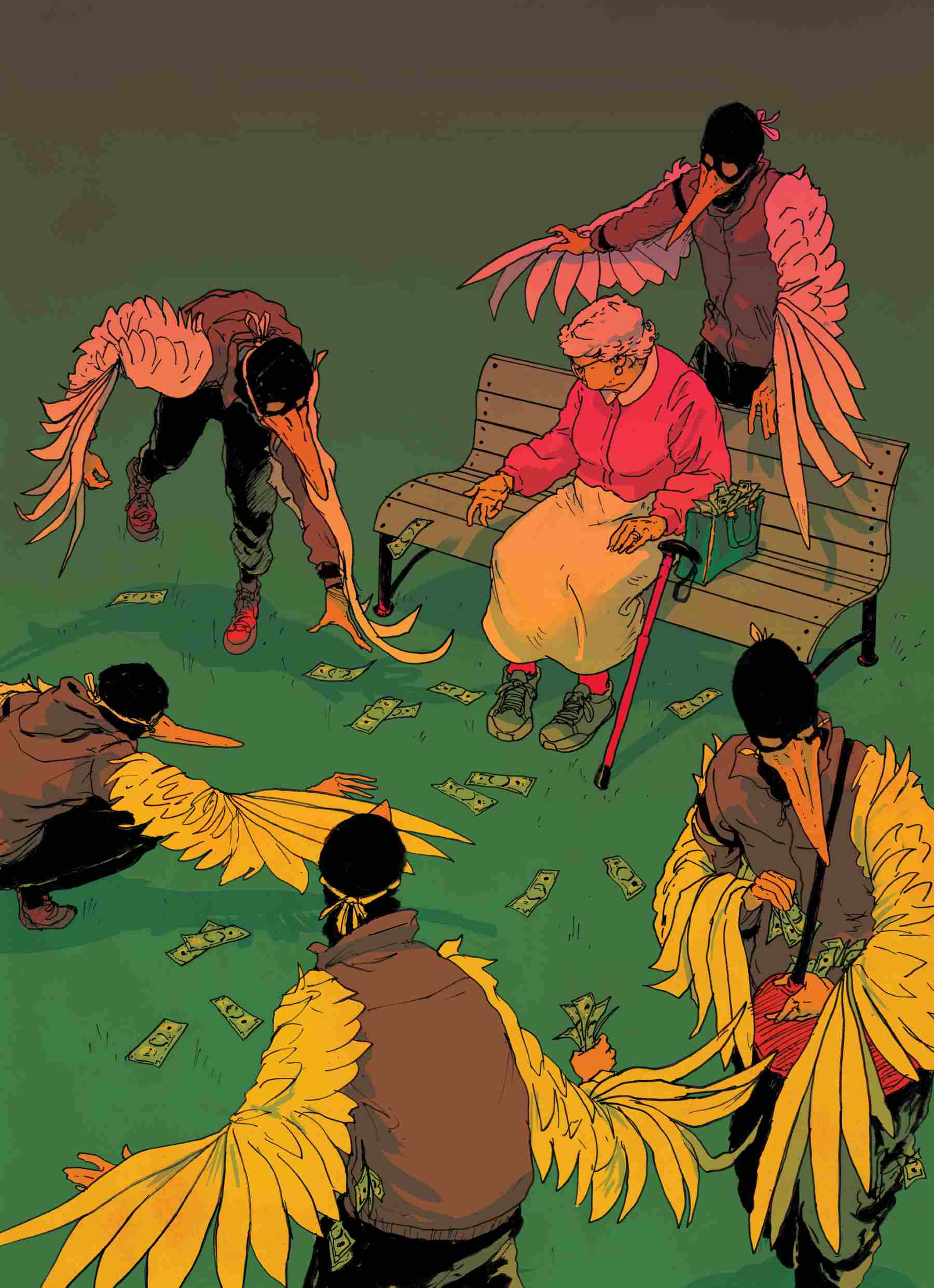
What Gillen had been caught doing is known as a “grandparent scam,” sometimes referred to as an emergency scam—a fraud in which elderly people are manipulated into believing their grandchild is hurt, arrested, or in serious trouble and must pay for the child’s safety.
According to the Canadian Anti-Fraud Centre, approximately 28 percent of the total amount of money stolen each year through scams in Canada is from seniors—adding up to more than $644 million, an increase of nearly 300 percent since 2020. In the United States, the Federal Trade Commission said in August 2025 that some of the fastest-growing fraud schemes are targeting older adults and use fear and urgency to override good judgment.
Financial consequences are one thing. Emotional tolls are another. When Gillen eventually went to court, three of his victims, whose identities are protected by a publication ban, wrote statements that were read out. One victim, who was falsely told by the scammers that her granddaughter was in trouble, wrote that she experienced trauma and fear of living alone and had to sleep at a relative’s home. She wrote that there are not enough remaining years in her life to forget what happened to her.
“I could never imagine that I would have to endure such an emotional upheaval in my elderly years,” she wrote. “I shall never forget the sound of this man posing as a lawyer, the voice of this young girl impersonating my granddaughter. . . . I relive it daily and will remember it until the day I die.” (Gillen declined to speak to The Walrus for this story.)
Gillen may have walked up the front steps of his victim’s homes, looked them in the eye, and collected thousands of dollars they believed were helping out their grandchild, but he was just one cog in a much larger assembly line of deception.
Grandparent scams likely evolved out of mass emails that linked to fraudulent websites or contained computer viruses that could steal a password. Those were a trawling net cast wide in the hope of catching anything. Grandparent scams are a harpoon: direct, personal, targeted.
The US Federal Bureau of Investigation’s Internet Crime Complaint Center has been receiving reports about grandparent scams since at least 2008, but in the past few years, the scale and scope of these kinds of cons have expanded at an alarming rate across North America. “A lot of the threats have become social engineering threats,” says Macaulee Cassaday, co-founder and program director of the Canadian nonprofit Cyber-Seniors, which provides free tech support and training for seniors. These are threats that exploit psychology rather than computer software. Whereas previous scams used to be more easily identified through bad grammar in an email or other visual cues, grandparent scams are deeply elaborate in their creation and manipulation. “You have to look for the tactics the scammers are using,” Cassaday says, “rather than these outright signs.”
The most common grandparent scam follows a pattern: a scammer phones an elderly person pretending to be their grandchild. The scammer says they have been arrested and are in desperate need of cash for bail. Sometimes the story is the grandchild has been in a car crash or that police found drugs in their vehicle. Sometimes a second scammer will come on the line, pretending to be the grandchild’s lawyer or a law enforcement official, deepening the scam. The victim is urged to keep everything a secret, either to protect the grandchild from embarrassment or because the scammers say a court has issued a gag order over the case. The grandparent is then told that a courier or bail bondsperson will come to their home to pick up the needed cash.
Grandparent scams require advance planning and data mining to gather names, phone numbers, and personal details—from where grandchildren live and go to school to terms of endearment used between relatives. While some of these operations are halted at banks, where a teller becomes suspicious of a sudden large withdrawal of cash or a family member intervenes just in time, many of them slip through the cracks.
Last November, the Royal Canadian Mounted Police in Richmond, British Columbia, received an influx of reports about elderly residents being targeted by scammers claiming to be representatives from a foreign embassy abroad and saying that their loved one was in custody and needed bail money quickly.
“These days, it’s so out of hand,” says Richmond RCMP corporal Frank Bryson. He says he gets phishing calls himself, multiple times a day, on his work and personal cellphones. Some offer jobs or romance, while others pretend to be the Canada Revenue Agency. “I couldn’t believe how good it was and how professional it looked,” he says. Bryson regularly gives presentations on these scams at retirement homes and other community centres in an attempt to raise awareness. Whenever seniors ask him what to do, he just tells them to hang up. “If you have a number calling you and it’s not in your contact list, don’t even answer it. Let it go to voicemail.”
For Cassaday, however, many older people are just wired to pick up the phone. “It’s not compatible with how they’ve lived their life and want to live their life,” Cassaday says. “It can be really difficult.”
News stories and alerts about grandparent scams pop up regularly. Last spring alone, the RCMP in Chilliwack, BC, announced a man in Surrey had been charged with fraud over $5,000 for allegedly targeting an eighty-eight-year-old woman in a grandparent scam; a woman in her nineties in North Bay, Ontario, told a local news outlet she narrowly avoided losing $6,000 to scammers—someone pretending to be her granddaughter in distress—thanks to a wary bank teller who became suspicious of the transaction requested and intervened; Hamilton police issued an alert asking for help identifying a man believed to be a “grandparent scam courier” who picks up money from victims’ homes; the RCMP in Saskatchewan issued a similar news release asking for any information involving an alleged perpetrator after a grandparent scam spree in the Battleford area resulted in victims being urged to take cash for “bail” to a crypto ATM; in Calgary, a man who disguised himself as an Edmonton police detective was located after allegedly defrauding a woman out of nearly $5,000 that she believed was to help her grandchild.
The nature and efficacy of these scams continue to evolve in tandem with rapid technological advances, including artificial intelligence. Thanks to AI voice cloning and deepfake video tools, scammers can fabricate the voice of a loved one by scraping audio found online—such as from videos a grandchild has posted to social media—or from a recording on an answering machine or voicemail.
While many of these scams involve elaborate impersonations to gaslight and manipulate, others are launched through social media ads to lure people into financial scams with promises of massive returns. The target is the same. Last year, a senior in Acton, Ontario, was watching craft videos online and came across a deepfake ad of Prime Minister Mark Carney pitching an investment opportunity. She was initially swindled out of $13,000, then was contacted by someone almost every day for months who convinced her to send more money. In total, she lost $83,000.
An eighty-six-year-old woman in Sault Ste. Marie, Ontario, saw a similar deepfake video on Facebook of Carney advertising cryptocurrency investments that would be backed by the Bank of Canada. She made a modest investment at first, before refinancing her mortgage to invest further after she was told her money had tripled. She ended up losing more than $900,000.
Earlier this year, I tried to track down one of Charles Gillen’s victims, to see if they wanted to speak on the record. I started searching on Facebook. Instead of finding one of his victims, I discovered countless others who had been targeted in near identical ways. Among the first was a viral post by a woman in Newfoundland who said her mother had lost thousands.
In August 2025, Shirley Smith, then eighty-seven, picked up the phone and heard a young man crying hysterically on the other end. He said he was in trouble with the police and needed money for bail. “Who is this?” Smith asked. “It’s your grandson,” the man replied through tears. From that point on, the scammers had Smith hooked—she would do anything to help her grandson, who at the time was twenty-one. The man on the phone said he needed $5,000 in cash in order to get out of police custody and that she wasn’t allowed to tell anyone.
Smith’s husband had passed away a few years earlier, and she was finally starting to feel good about her finances. For the first time in her life, she had saved up an emergency fund. In a panic, Smith got a ride to the bank and took out the cash. Then someone came to her apartment complex and picked up the money.
Sometime after the handover, Smith called her grandson to make sure he was all right. He was fine, he told her, relaxing on the couch after a long day at work. Smith realized she’d been conned. “She said she felt stupid afterwards,” Smith’s daughter Tammy told me. “She always prided herself on not being scammed.” Tammy used to poke fun at her mother for not wanting to give out her credit card number over the phone to book hotels.
Tammy called the scammer’s number—a BC area code. She says a man on the other end answered and she tried, in vain, to get him to return the money. Tammy then called the RCMP. She also took to Facebook: “My 87-year-old mother just got scammed out of $5,000 today,” she wrote. She described how her mother was “scarred from the trauma thinking her grandchild was in serious trouble, needed help, and being told she couldn’t tell anyone, to fear monger her into submission.” She continued: “To say I am livid, is an understatement. There has to be something we can do to protect against these ruthless, conniving, criminals.”
The post exploded with comments, many by people who had something similar happen, or almost happen, to a parent or someone else they know. There is an account of one woman almost falling for a $3,000 gift card scam; another says her boyfriend’s eighty-five-year-old grandmother lost $80,000 to a scam. “Every penny she had saved . . . just gone.”
But the comment section also morphed into a hotbed of what appears to be other scams, with many comments posted by companies and people offering help. “Send me a DM i can recover back your lost funds,” read one, which appears to be what is known as a recovery scam, typically involving an offer to help a victim recover funds they’ve lost in a previous scam. The virality of Tammy’s post had drawn the attention of not only other victims but also other scammers. “Which is wild to me,” Tammy says. “So they must have these algorithms or something, searching all the time.”
The ordeal has turned the family deeply suspicious. When I first reached out to Tammy to talk about her mother’s experience, she couldn’t help but doubt who I said I was—a journalist hoping to interview her. She thought I might be a scammer myself. “I didn’t answer you [at first],” Tammy told me. There’s been no arrest in the case, and Smith is still out $5,000.
After Gillen was arrested at the Newfoundland airport, he was taken into custody. He had to call someone to explain he was in trouble, that he’d been arrested and needed money for bail. He called the people who raised him: his grandparents.
According to court records, Gillen arrived in Canada in the early 2000s with his aunt and grandparents after fleeing Sierra Leone’s civil war. His parents are believed to have died in the conflict. There are some photos of him as a baby with his mother, but he’s never seen a picture of his father. Gillen doesn’t know much about what happened to them because, his lawyer later told the court, his grandparents find it too painful to speak about the experience.
Gillen excelled at school and in sports, particularly football. After high school, he attended the University of Waterloo, in Ontario, on a football scholarship. But his grandparents didn’t want him to leave Manitoba and didn’t support him financially. He worked part time to cover living expenses, on top of having to maintain a high enough grade point average while playing football at an elite level.
By the fall of 2022, he was sleeping in his car at times and visiting the food bank, sometimes living off of a pizza for days. He eventually hit a breaking point, with only $12 to his name. A friend suggested a new way to earn extra money. All he’d have to do, she said, was pick up cash. It was only later, Gillen’s lawyer told the court, that he learned there was more danger and risk involved.
Posing as a bail bondsman or a courier, Gillen was dispatched by his handlers to various addresses where he would collect money from victims convinced they were paying legal fees and securing a loved one’s release. He travelled by taxi from house to house, around various cities, often using the alias Greg Deluch. Sometimes victims were instructed to hand over envelopes of cash to unsuspecting taxi drivers—real ones—who then delivered the money to Gillen, including, on one occasion, at the departures entrance of the St. John’s airport.
In March, Gillen, now twenty-six, pleaded guilty to sixteen fraud offences at the Supreme Court of Newfoundland and Labrador. The judge noted that Gillen had never committed a crime before but in this case became “motivated by greed and the promise of easy money.” Gillen was “a part of a sophisticated fraud targeting a perceived vulnerable group,” the judge wrote, adding that he did not play “a minimal role in the fraud scheme.”
Several people wrote victim impact statements that were read out in court. One woman said that, prior to the scam, she was getting used to living alone after the death of her husband and was also adjusting to living off of one income. She described feeling embarrassed and vulnerable afterward, knowing that she had been taken advantage of. Another victim wrote: “I realized after, my grandson was fine, and I was out my money which made me feel so stupid and gullible for falling for a scam.” And another wrote that the experience changed her, leaving her paranoid. She has nightmares, has trouble sleeping, and fears that her personal information had been given to the perpetrators by someone in her community, given how specific it was. “I feel that because I fell for a scam I cannot tell my friends,” she wrote. “I have lost confidence in myself and feel very vulnerable.”
During his sentencing hearing, Gillen appeared to recognize the consequences. “Hurting them, the people who raised me, opened my eyes to the pain that I caused other seniors and their families,” he said. Gillen described how his grandparents were hard-working, “old-school” people who taught him the values of honesty, education, and contributing to one’s community. But when he encountered financial distress, “I made a terrible decision to solve my problems the wrong way.” Gillen continued: “I put my grandparents in a situation where they had to get me out on bail. I know how hard it was for them to see me in this position and to have to promise to pay if I ever made a mistake, so I know exactly what that’s like now.”
Gillen described how he has reconnected with his grandparents since living with them as part of his release conditions. “Seeing their disappointment has made me understand the true harm I caused,” Gillen told the court. “I just want the court to know that I should have been better. I was raised to be better, and I failed to live up to that.” He explained how he had been working to rebuild his life, trying to establish himself as a musician and continuing his university studies.
In March, Chief Justice Raymond Whalen handed Gillen a four-year sentence for his role in the con but granted him more than two years’ credit for time spent in custody leading up to the trial and on bail. Instead of returning to prison, Gillen was ordered to serve the remainder of his sentence on probation, living with his grandparents in Winnipeg and observing a curfew from 10 p.m. to 6 a.m. He must also repay the victims: around $70,000 within four years. “You have some road ahead of you. A long road ahead of you,” the judge told Gillen at his sentencing decision. “You’re still a young man. You can get past this, or you can chase the easy money and we’ll see you again.”
The judge noted that Gillen, despite the severity of his actions, was a “pawn in the scheme”: he was not involved in the phone calls made to the victims, nor did he coordinate the larger fraud. “While Mr. Gillen has not been charged nor convicted of acting on behalf of a criminal organization,” the judge wrote, “the facts make clear that he was a member of a larger organized enterprise,” whose goal “was to get as much money as quickly as possible and move on.”
During Gillen’s trial, the court heard how the area codes used to contact the victims appeared to be linked to burner phones with Montreal area codes. While there’s no indication that the scheme Gillen was part of was connected to a wider criminal enterprise, in early 2025—two years after he was arrested—Canadian and US law enforcement busted a massive multi-million-dollar cross-border grandparent scam ring operating out of call centres in and around Montreal. Twenty-three Canadians were arrested, accused of defrauding elderly people across dozens of US states out of more than $21 million (US). The scam followed the now-familiar script.
This May, one Canadian man involved in this scheme was sentenced in a US federal court to fifteen and a half years in prison. Stefano Zanetti hired others to pose as bail bondsmen to collect money from elderly victims; ten of these “bondsmen” were arrested over the years, while Zanetti spent his victims’ money living a lavish life at a beachfront property in Panama. The investigation revealed the international reach of these scams. And while this network saw its leaders taken down, countless more continue to operate and evolve as law enforcement scrambles to keep up.
Enter a popular American YouTuber known as Pierogi, who documents takedowns of scammers—many targeting the elderly. His channel, Scammer Payback, has nearly 10 million subscribers. “My goal every day is: How do I protect people? How do I save people? Not just how I go after scammers but how do I save people? How do I make sure my next-door neighbour who’s by herself and ninety years old doesn’t get scammed? That stuff, that’s really, really important to me,” he said in a podcast interview.
Pierogi frequently turns the scammers’ own tactics against them, even going so far as to infiltrate their computer systems, delete files, and shut them down. He has also used voice-modifying software to make himself sound like an elderly person. In 2020 and 2021, Pierogi baited scammers at a call centre in India, confronted them on camera, and posted the videos to YouTube. The videos then helped American law enforcement indict several people involved in a multinational ring accused of stealing $65 million (US) from seniors across the US.
Pierogi’s own grandmother was once targeted by fraudsters who called her and said he was in jail and needed money for legal fees. Luckily, his grandmother didn’t lose any money, but it was a close enough call that he launched his anti-scamming mission. “I’ve heard so many stories, and it . . . continues to give me purpose as to why I do this,” he said in one video. “I get probably hundreds of stories from $2,000 to $200,000—it really doesn’t matter. There’s a lot of pain—not just financial pain but emotional distress—that people go through that continues to fuel me every single day.”
As a daughter and a granddaughter, I worry about someone taking advantage of the loved ones in my life. These scams are everywhere and, as my Google alerts tell me almost every day, countless people fall prey to them, including those who pride themselves on being skeptical and savvy. While the rise in cases has also brought about a rise in warnings from banks and government agencies, it’s still easy to see how a call from a family member in desperate need of help could prompt someone to send an e-transfer or race to the ATM.
In June, I joined a seminar hosted by Macaulee Cassaday at Cyber-Seniors. Every month, the organization hosts free online seminars on a range of topics related to technological literacy. That month, the seminar was about grandparent scams: how to spot them, how to protect yourself from them. At the start of the session, Cassaday had participants answer a poll about whether they had ever been targeted by a grandparent scam. Around a third said yes. “No, but know several people who have,” one participant wrote in the Zoom chat. “Not yet,” wrote another.
Cassaday acknowledged that while voice cloning and deepfake videos had vastly increased the potency of these scams, the most effective form of prevention is understanding the storytelling that underpins them. “If we know what kind of stories are being pushed, then we’re going to be quicker to understand what might be a scam,” Cassaday said. The details may change but the narrative never does: create a sense of urgency and fear that pressures someone into acting quickly.
Cassaday encouraged the members of the seminar to slow down, to verify what they are being told before acting, and to remember that even familiar voices may not be what they seem. “We have to trust our gut,” Cassaday said, “and we have to trust real people in our life.”


Michael Byers (michaelcbyers.com) is an award-winning artist based in Hamilton. His clients include Sports Illustrated, the New York Times, Wired, Variety, and the Wall Street Journal.