
This text originally began as a personal investment thesis. I recently spent considerable time analyzing Adobe, the giant that has defined digital creativity for decades. I was considering opening a position, but it was impossible to ignore the omnipresent market noise.
The narrative goes like this: AI is coming to change everything, including the creativity process. Adobe’s stock swings on waves of sentiment as the market fears AI will cannibalize their business.
However, when viewing the market through a macroeconomic lens, cracks begin to appear in the logic of many investors. On one side stand established players like Adobe, companies with massive user bases and functional products, implementing AI as another powerful tool in their arsenal. On the other side, we see a group of new startups tagged simply as “AI companies” in the eyes of venture capital.
The problem with these new players is often that without the “AI” label, they have nothing. They lack a user base built on trust, they lack a functional “non-AI” product, and often they lack a clear business model too. They are essentially just entertainment apps, tech demos looking for a problem to solve.
Viewing this from the investment perspective, we must stop asking “Who has the better AI?” and start asking “Who has the better product?” It is precisely at this intersection, between a tool for professionals and a toy for the masses, that the key lies to understanding who will economically survive this technological revolution.
To expand on this concept, I must briefly leave the world of financial charts and take you into the world I know best. As a musician through and through, I won’t mince words. Let’s look at the case of Suno.
This company entered the market in a completely unethical manner. Operating in a legal gray area and banking on the sluggishness of the legal system, they scraped millions of copyrighted tracks. Without consent, without compensation. They plundered the intellectual property of real artists to train a model they then offered to the masses. They created a generator which, at the peak of its hype (around May 2024), reportedly attracted up to 10 million users.
Suno functioned as a toy: come for the magic, play for a moment, and then walk away.
But what happened? Exactly what happens with every toy. These 10 million non-musicians got bored. The dopamine hit of clicking a button and getting a song eventually generates you to death. Users realized they were churning out hundreds of tracks they had no emotional connection to. The novelty wears off. And most importantly, they stop paying.
Suno realized a brutal truth, their viral user base is worthless because it is unpredictable. Sustainable business lies where it always has, with professionals. And this is where the most repulsive moment of the entire story unfolds.
A company built on the theft of musicians’ work is now desperately trying to re-frame its business model and posture as a tool for real artists.
My feed is now flooded with ads where paid influencers and sell-out creators sit in recording studios, claiming with a straight face how Suno upgraded their creative process. Allegedly, you just need to mumble a melody to get a guitar solo. It’s an insult. First they robbed us, and now that their amateur users are fleeing, they are trying to sell their product back to us professionals under the false flag of helping creativity.
If you think I’m exaggerating, take a look at their latest marketing stunt. Suno recently released an ad with the grandiose title “The first-ever generative audio workstation” (link here). And this is where the comedy unfortunately descends into tragedy.
In the video, you see real musicians. They are holding real guitars, sitting behind real drums. They look cool, they look like creators. And underneath runs a caption about a generative workstation. Can you feel the cognitive dissonance? It is utterly absurd. Why would a person who actually knows how to play the guitar (as the video implies) need AI to generate that guitar for them?
They are attempting to hijack professional terminology. The word “Workstation” (DAW) is sacred in music; it designates tools like Logic or Pro Tools, where music is created through work.
Suno is now trying to pretend that writing prompts is equivalent to studio engineering. It is as if McDonald’s started calling their burgers “Generative Michelin Gastronomy” and hired Gordon Ramsay to just stand there and smile in the commercial. It is fake, it is desperate, and it speaks volumes about the current state of these entertainment AI startups that seem to have completely lost track of who they are actually targeting.
When we apply this behavioral pattern from music to visual art and the stock market, we arrive at the core of the issue. All those popular AI image generators and apps that skyrocketed from zero to hundreds of thousands of users in the last year share one fatal fundamental flaw. Their user base is not comprised of actual creators, but of what I call “AI Tourists.”
These are regular people for whom generating images is entertainment, not a profession. It is a game. And here lies a massive investment risk.
I would compare the entire situation to the Clubhouse effect. Remember? It was that trendy app that everyone had to have for a moment. Everyone was there, everyone was talking, it was fun. But just as quickly as Clubhouse’s star rose, it burned out. Why? Because the app lacked a deep economic moat and relied on novelty and entertainment, rather than being indispensable to a workflow.
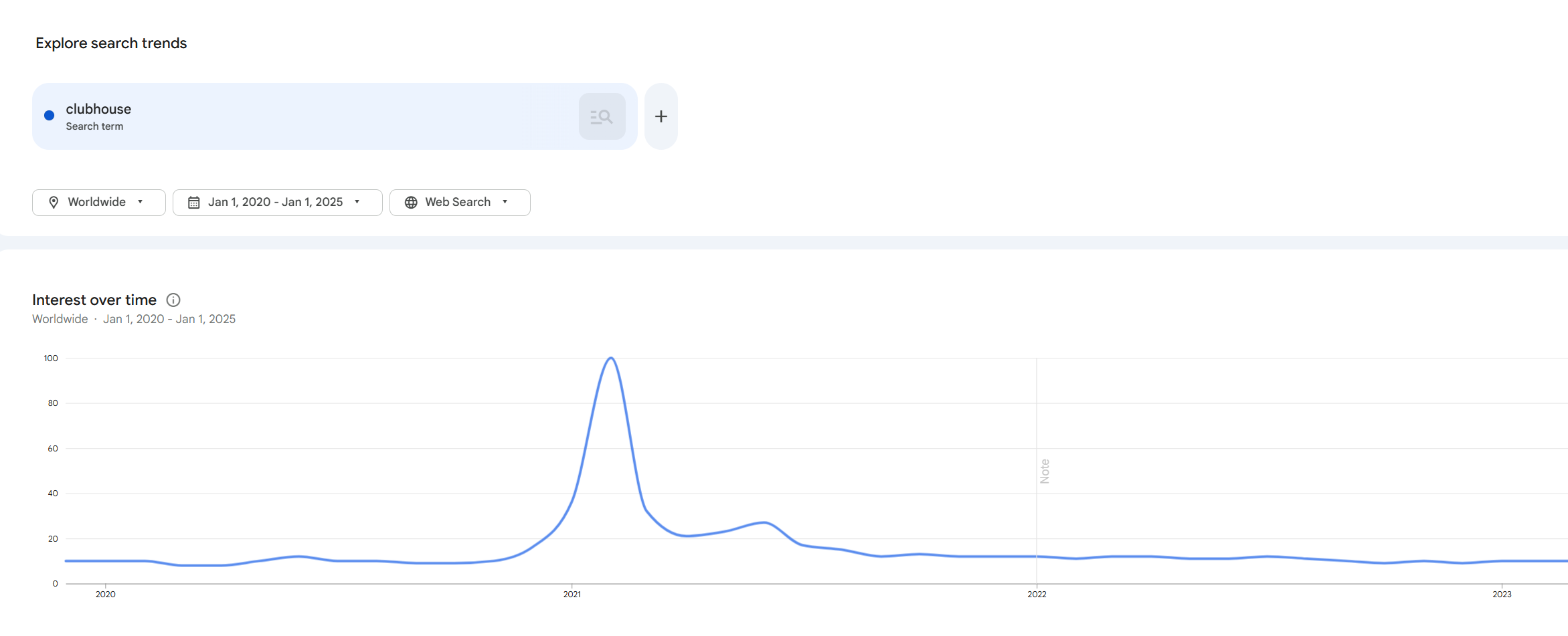
The same fate awaits most pure-play AI companies targeting the B2C segment. An AI tourist arrives, generates fifty images of a cat in a spacesuit, and gets their dopamine hit. But that dopamine reaction eventually generates them to death. After a week, they realize the hundredth image brings no joy. The result holds no value because there is no effort or story behind it. And what does a user do when an app stops being fun? They cancel the subscription.
From an investor’s perspective, we are looking at companies with an extreme churn rate. These firms must constantly burn cash on marketing to replace the tourists who leave as soon as the initial excitement fades. In stark contrast stands the professional. They are not looking for fun. They are looking for a tool that pays the bills. And this is the moment we circle back to Adobe.
When applying this framework to Adobe, the conclusion is clear: Adobe will not lose its current users. At least, not the ones who are serious about their craft. A professional doesn’t just need to generate an image. They need to mask it, adjust curves, prepare it for print, and insert it into a layout.
This is the key differentiator. By integrating AI directly into Photoshop (as Adobe is doing with Firefly), AI becomes a feature, an efficient shortcut within an already established workflow. For a graphic designer, it is infinitely more valuable to generate a missing background piece directly within a PSD layer than to context-switch to a browser, prompt in a third-party app, and then clumsily import a result that is often unusable anyway.
This principle of integration winning over novelty, is starkly evident in the current battle of the giants; Google vs. OpenAI. The tables have turned dramatically. While Google had its crisis moment two years ago, today the code red is flashing at OpenAI.
OpenAI had the first-mover advantage and delivered a revolution, but they have hit the ceiling of their product definition. A chat is simply just a chat. It is an isolated island in a browser tab. You have to go there, solve a task, copy it, and leave. That represents friction, something users do not forgive in the long run.
Google, on the other hand, has been quietly arming itself. With the release of models like Gemini 3.0, it is now demonstrating where the real power lies. Not in the chat, but in the ecosystem. Google holds our emails, docs, spreadsheets, calendars, YouTube, and Drive. The moment Gemini interconnects this ecosystem, the game changes.
An AI that finds an invoice in Gmail, logs it into a spreadsheet in Sheets, and sets a payment reminder in Calendar is orders of magnitude more useful than even the fastest chatbot in a blank window. Google is streamlining a process we already do, while OpenAI is trying to impose a new one.
What does all this mean for my portfolio? AI is undoubtedly here to stay and will be integrated into everything we use. However, the market is now undergoing a drastic cleansing. We are at the tail end of the wow effect phase, and the sobering reality is setting in.
As an investor, I am now avoiding companies that bet on AI tourists, users seeking dopamine and entertainment. The story of Suno in the music industry or Clubhouse in social media serves as a warning finger. These companies, lacking a moat and built on a single replicable technology, face a struggle for survival and a drastic exodus of users.
I believe the boring incumbent players will fare the best. Companies that are already established, possess a strong brand, and most importantly, a massive user base that is locked into their ecosystem by their work. For Adobe or Google, AI is not the product, but just another feature that makes their existing product indispensable.
It may sound like a paradox, but in the era of the greatest technological revolution of our lives, the biggest investment opportunity seems to be a bet on the old, reliable, established firms that are merely innovating smartly, rather than betting on wild cards that promise a revolution but deliver only a disposable toy.
4.12.2025 ~ The Silent Value Philosopher