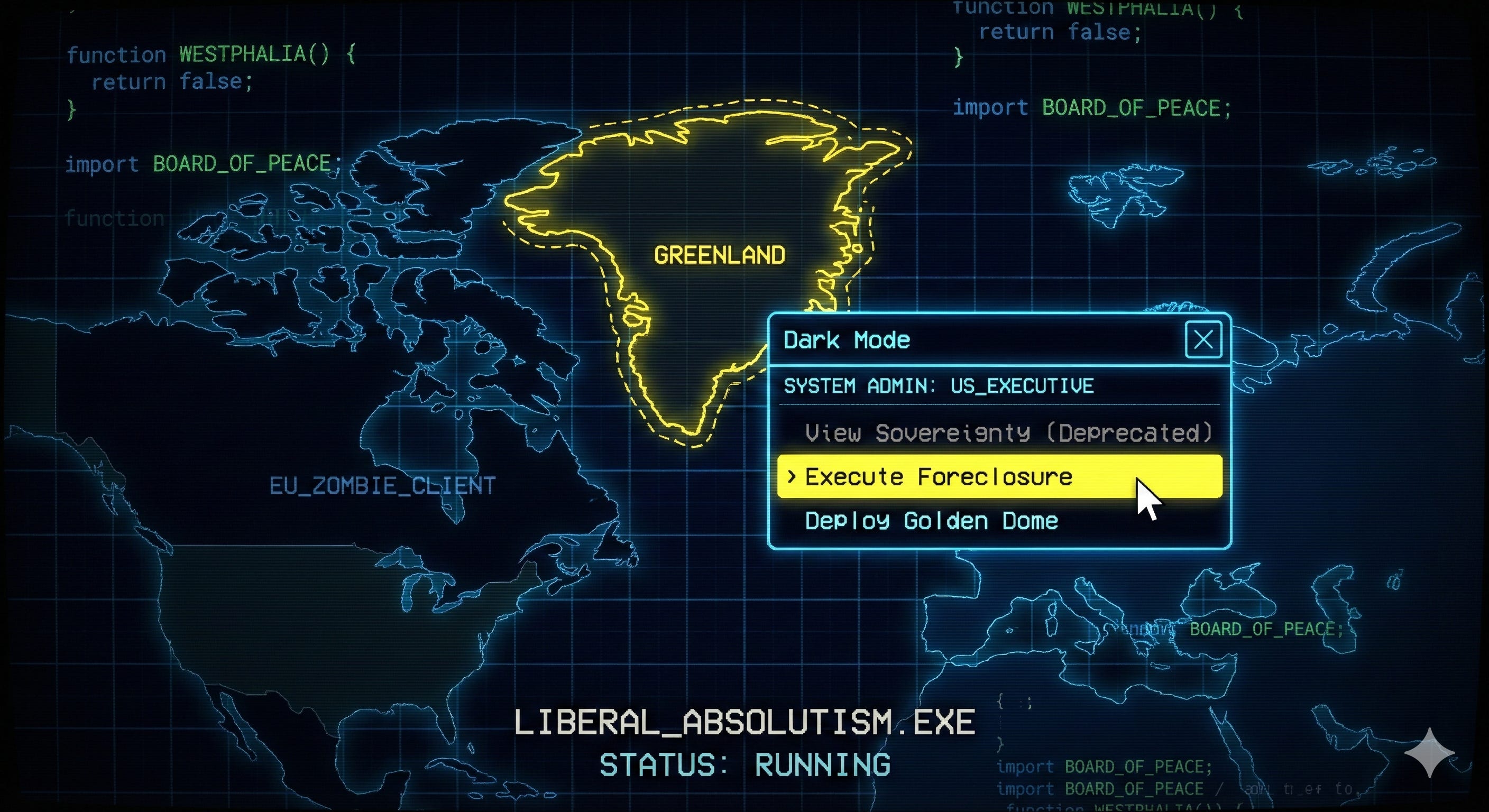
The collective scream rising from the chancelleries of Europe this last couple of weeks is not just fear; it is ontological shock.
When Donald Trump demands the annexation of Greenland, establishes a pay-to-play ‘Board of Peace’ to replace the UN, and imposes punitive tariffs on his ‘Allies’, the European political class reacts as if the laws of physics have been violated. They wave treaties. They cite the UN Charter. They point to the eighty-year history of the ‘Transatlantic Partnership’ and cry that this cannot be happening because it is against the rules.
What they fail to realise is that they have spent their entire lives interacting with the User Interface (UI) of the American Empire, while Trump is the first President to simply talk about the Back-End.
The ‘Rules-Based International Order’ was never a structural reality. It was a graphic user interface designed to make American hegemony palatable to the European electorate. It allowed vassal states to feel like partners. It allowed the conquered to feel sovereign. But as any programmer knows, the UI is not the machine. And now that the machine is running low on energy, the management has decided that the expensive, polite graphics are a luxury they can no longer afford.
To understand why the current crisis is being experienced as a psychological collapse, we must strip away the mythology of the post-war era and look at the Material Reality (MM) of 1945.
The standard narrative holds that the United States ‘helped Europe recover’ and ‘restored its democracies’. This is a category error. Europe did not recover; the entity known as ‘European Civilisation’ ceased to exist as an independent thermodynamic unit in May 1945. The continent was a rubble heap with no currency, no standing army, and crucially, no independent energy source.
The United States did not restore European sovereignty; it constructed a Synthetic Westphalia. Using its massive Net Exergy Surplus (Exnet)—the cheap oil and industrial capacity that allowed it to generate half of global GDP—the US built a ‘Habitat’ in which European nations could play-act at being Great Powers without bearing the thermodynamic costs of power.
The Marshall Plan was not an act of charity, nor was it primarily about humanitarian aid. It was the massive Capital Expenditure (Capex) required to build a subsidiary market for American surplus production. But a subsidiary market requires corporate security, and this is where the true function of NATO becomes clear.
NATO was never an alliance of equals. It was the Maintenance Contract attached to the Marshall Plan. The deal was implicit but absolute: the United States would cover the Maintenance Power (Pmaint) costs of European defence—providing the nuclear umbrella, the intelligence backbone, and the freedom of the seas. In exchange, Europe would align its internal markets, its foreign policy, and its energy infrastructure with Washington.
For eighty years, this arrangement functioned perfectly because it was low-friction. By allowing France, the UK, and Germany to maintain the aesthetic of sovereignty—allowing them to have parliaments, flags, and even minor foreign adventures—the US reduced the Friction (Fdrag) of occupation. It was infinitely cheaper to let the vassals believe they were partners than to force them to comply at gunpoint. The European elite convinced themselves that they were protected by a ‘Shield of Values’, when in reality they were simply living in a gated community where the landlord paid the security guards.
The expert class views Trump as a vandal destroying the liberal tradition. Russian ideologues like Aleksandr Dugin hail him as an ‘Anti-Liberal’ saviour. Both are wrong. Trump is a Liberal Absolutist. He is merely stripping the ideology down to its source code.
The confusion arises because, for the last seventy years, ‘Liberalism’ was bundled with a specific set of high-maintenance Features: Democracy, Human Rights, Free Speech, and Parliamentary Procedure. But these were just the Premium Plugins that the system could afford when energy was cheap.
The Definition of Liberalism is much colder. At its core, it is the belief that Everything is a Contract. It is the universal solvent that dissolves ‘Tradition’, ‘Sacredness’, and ‘Community’ into Market Value. It holds that there is no higher authority than the Deal.
The ‘Universalism’ preached by the UN and Human Rights Watch is just one of these features—a moral overlay that claims Western values are the default setting for humanity. This has long rankled non-Western powers who see it not as a truth, but as a compliance mechanism. When Trump discards this Universalism, Dugin thinks he is rejecting Liberalism. In reality, Trump is intensifying it. He is applying the market logic to sovereignty itself.
European leaders like Keir Starmer and Chancellor Friedrich Merz make the fatal mistake of thinking that Liberalism is the ‘Nice Stuff’ (The Features). Trump knows that Liberalism is the ‘Market Stuff’ (The Definition). When he uninstalls the ‘Human Rights’ plugin to make the ‘Contract’ kernel run faster, he is not betraying the ideology; he is optimising it.
This framework also explains the role of Vladimir Putin. The West views him as an anti-liberal monster. But at his core, Putin is a Transactional Realist—a secret liberal. He hates the Social Plugins (LGBTQ rights, Protest), but he loves the Kernel (Financialisation, Oligarchy, Resource Monetisation). He speaks the language of Price.
This convergence of Liberal Absolutism (Trump) and Transactional Realism (Putin) has birthed the new operating system of the planet: The Board of Peace.
This institution, designed to replace the ‘inefficient’ United Nations, is the Marketization of Geopolitics. It strips away the pretense of sovereign equality. Permanent membership is not a right; it is a subscription service costing $1 billion (or resource equivalents). There are no lectures on human rights, nor vetoes based on moral standing. There are only shareholders and dividends.
The Al Jazeera opinion pages scream that this board is a “club of rights abusers” and that it de-emphasises human rights, citing reports that Russia and China have long sought to do exactly that. They miss the point. The Board is not ‘Pro-Abuse’; it is ‘Anti-Friction’. Human Rights are a friction on the transaction. The Board removes the friction.
This explains why Russia is considering joining. To an Ideologue, joining a US-led board is treason. To a Transactional Realist like Putin, it is simply a merger. It allows him to preserve his domestic monopoly while buying shares in the global cartel.
The Domestic Fracture:
However, this merger carries a lethal risk for the Kremlin. For two decades, Putin has legitimised his rule not on ‘Efficiency’, but on Civilisational Resistance—posing as the Katechon (the Shield) against Western decadence. If he signs the Board of Peace charter, he reveals that this resistance was merely a negotiating tactic.
The ‘United Russia’ establishment—the bureaucrats and oligarchs who miss their villas in Como—will welcome the dividends. But the patriotic base and the true believers will see it as a spiritual surrender. They will realise that the ‘Third Rome’ has just become a franchise of the ‘First Rome’. Putin is betting his survival on the cynical calculation that he can suppress the Ideologues with the same efficiency he suppresses the Liberals.
Of course, every contract needs an enforcer. The US is not relying solely on the ‘invisible hand’; it is using the Iron Fist.
The Merey 16 Blockade: The US interception of Venezuelan heavy crude bound for China is a precision strike on Beijing’s entropy budget. China’s independent ‘Teapot’ refineries in Shandong are chemically calibrated for this specific, bitumen-rich crude. Switching feedstocks requires massive capital expenditure (Capex) and downtime—a thermodynamic bottleneck the US is exploiting. By cutting this flow, Washington is starving China of the bitumen needed for infrastructure maintenance (Pmaint) exactly as the winter frost breaks and construction season begins.
The Golden Dome: The annexation of Greenland is the prerequisite for the ‘Golden Dome’ missile defence system. This gives the US a First Strike Capability that neutralises the Russian and Chinese nuclear deterrents. This architecture destroys the logic of Mutually Assured Destruction (MAD). By deploying a comprehensive interceptor layer, the US is not building a shield; it is building a Sword.
This places Russia in an existential “Use it or Lose it” dilemma. They cannot wait for the Dome to come online. They must either preemptively strike the Greenland assets now to preserve their deterrent, or reach a deal immediately.
This is where the Board of Peace functions as the exit ramp. Trump is offering Putin a way out of the nuclear dilemma. The price of the ticket is simple: Betray China. By signing the charter, Putin effectively joins the containment ring, “snitching” on his Eurasian partner just as Beijing faces the bitumen crisis. It is a pincer movement of biophysical starvation and nuclear coercion, designed to isolate China by buying off its only ally.
The ultimatum to Moscow is simple: Join the Board (become a junior partner) or face the Dome (become a target). It is Geopolitical Extortion industrialised.
As of 24 January, the mask has fully slipped. A deal has been reached in Davos granting the US de facto control over Greenland’s minerals and expanded military access.
While framed as a “framework agreement” to defuse tensions, reports from Deutsche Welle reveal the reality of the foreclosure. The US side describes it as a “permanent safeguard for American interests“—diplomatic code for annexation—while NATO Secretary-General Mark Rutte retreats to the user-interface language of “security cooperation”.
The deal explicitly integrates the island into the ‘Golden Dome’ architecture and paves the way for a return to the Cold War footprint, expanding US presence far beyond the current limits of Pituffik Space Base.
Crucially, this was finalised entirely over the heads of the local residents. As Nuuk activist Najannguaq Christensen observed with bitter clarity: “We do not want to be colonised twice.” But under the new OS of Liberal Absolutism, the democratic will of the inhabitants is a legacy feature that is no longer supported. The ‘relief’ expressed by some residents—relief that the Marines are not landing on the beaches today—is the specific relief of the foreclosed homeowner who is allowed to stay in the house as a renter. They have avoided the war, but they have lost the title deed.
This confirms the thesis: European sovereignty was a licensed product. The licence has expired. The owner has reclaimed the hardware. And the European elite are left holding a user manual for a machine that no longer exists.