A trip to a conference in Detroit back in 2016 changed the trajectory of my life. I was a sophomore in college, broke, and incredibly “green.” My first boss, Peter, saw something in me amongst a sea of established professionals and took a chance on me.
I remember landing at that massive, modern airport (DTW) and realizing I’d need two buses and over 90 minutes to reach Downtown*, a trip that takes 25 minutes by car. It was my one of my first “welcome to the reality of American transit” moment.
But it didn’t have to be this way. There was a time when the Detroit metro was on the verge of greatness. In 1974, they had a plan so massive the federal government killed it for being “too ambitious” that called for a train every 3 to 6 minutes and would take 21 minutes to reach General Motor’s Renaissance Center in Downtown.
The vision started in 1972 as a joint effort between the Southeastern Michigan Transportation Authority (SEMTA) and the Southeast Michigan Council of Governments (SEMCOG). At the time, the region was bracing for a massive boom. Projections showed the seven-county population hitting nearly 6 million people by 1990, with the number of private cars expected to more than double. (It’s 4.4 million people today)
Planners knew then what we are still fighting for today: a viable public transit system was “paramount” to address socio-economic disparities and the complete inhalation of the region by car dependency.
The 1974 SEMTA plan was a product of the Great Society era. To put it in perspective: BART had just opened two years prior, and MARTA and WMATA were slated to open within five. Detroit wanted to be next with a 74.7 mile rapid transit system made up of:
39.2 miles of tunnels
18.6 miles of aerial structures.
44.7 miles of cut-grade or embankments.
The price tag? $2.05 Billion in 1973 dollars. Even if we adjust for the typical cost overruns seen in DC or Atlanta, we’re looking at roughly $23 Billion today.
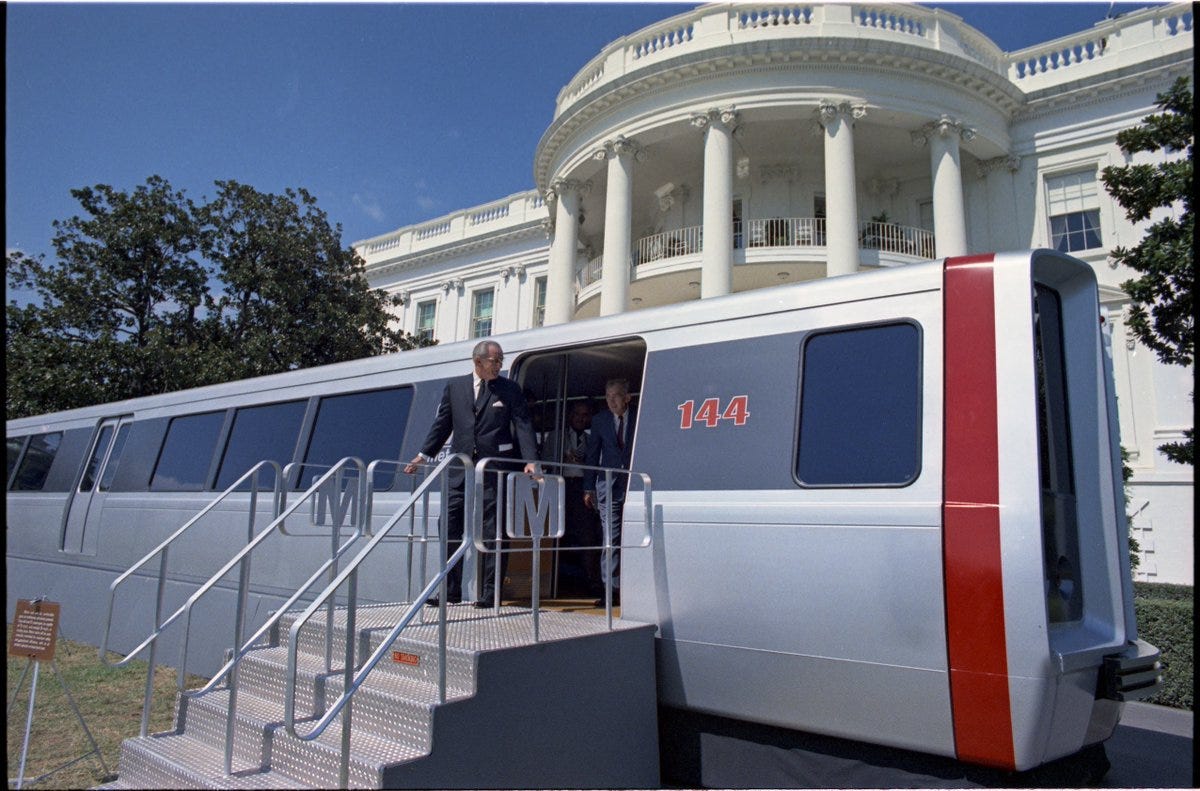
For that investment, Detroiters would have seen:
63 rapid transit stations.
A 40-minute average time savings at every station location to Downtown compared to existing transit.
A trip from Downtown Pontiac to Downtown Detroit would take just 35 minutes (compared to the 90-minute slog it is today).
To understand the efficiency of this plan, look at the impact on the Downtown core. Planners projected that 60% of all rush-hour trips into and out of the Detroit Central Business District (CBD) would be made by transit.
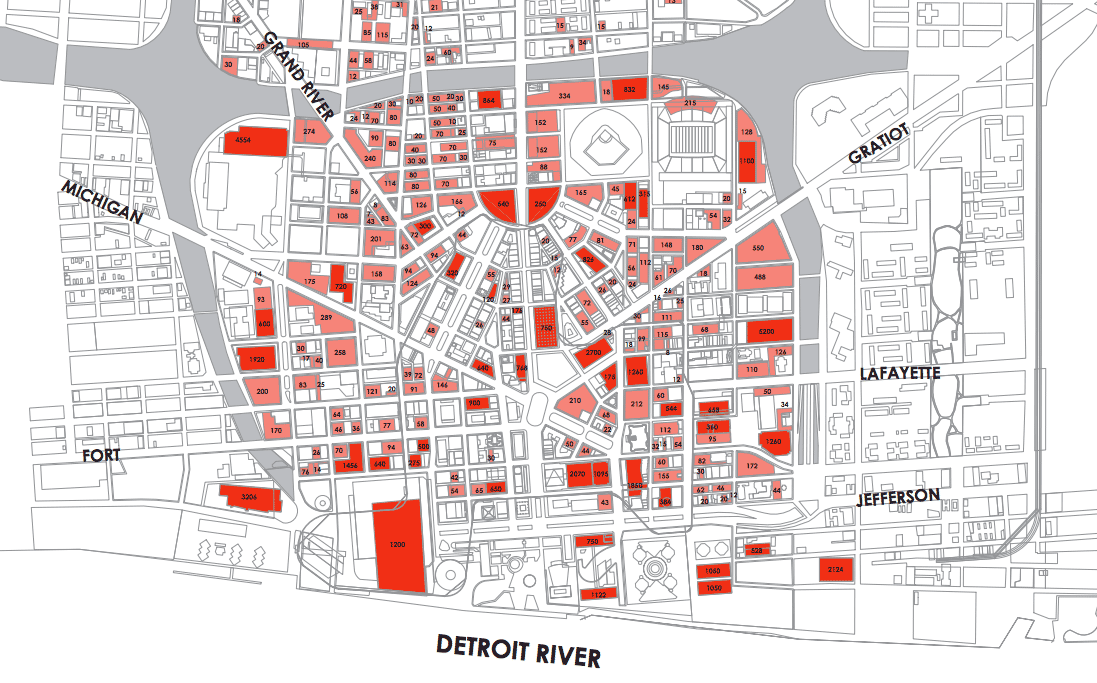
It brings up the question: would Downtown Detroit have far less surface parking if it had reliable and frequent rapid transit throughout the region?
The genius of this plan was through-running. Much like BART or WMATA, the trains wouldn’t just “dead-end” downtown. They would continue onward, creating a “one-seat ride” from one end of the metro to the other.
This connectivity is where the time savings become life-changing:
Downtown Pontiac to Downtown Detroit: 35 minutes (90 minutes today).
Downtown Pontiac to DTW Airport: 53 minutes. That is faster than driving and 100 minutes faster than current transit options.
100 minutes faster. Read that again.
To understand the sheer magnitude of what we walked away from, you have to look at the numbers. By 1990, this system was projected to carry 600,000 daily riders (5th largest agency by ridership today)
Author’s Note: The alignment and ROW are not fully accurate, as I pieced together scanned documents to understand where the proposed alignments were located. While not exact, this representation is very close.
To move that many people, you need a massive fleet. The plan called for 520 rapid transit cars and 830 buses. This wasn’t just a handful of trains; it was a full-scale rail system. But the rail was only half the story.
The SEMTA plan also proposed 179 miles of bus routes running on exclusive right-of-way, dedicated guideways, or receiving “preferential treatment” on existing roads. This was designed to be the ultimate feeder service.
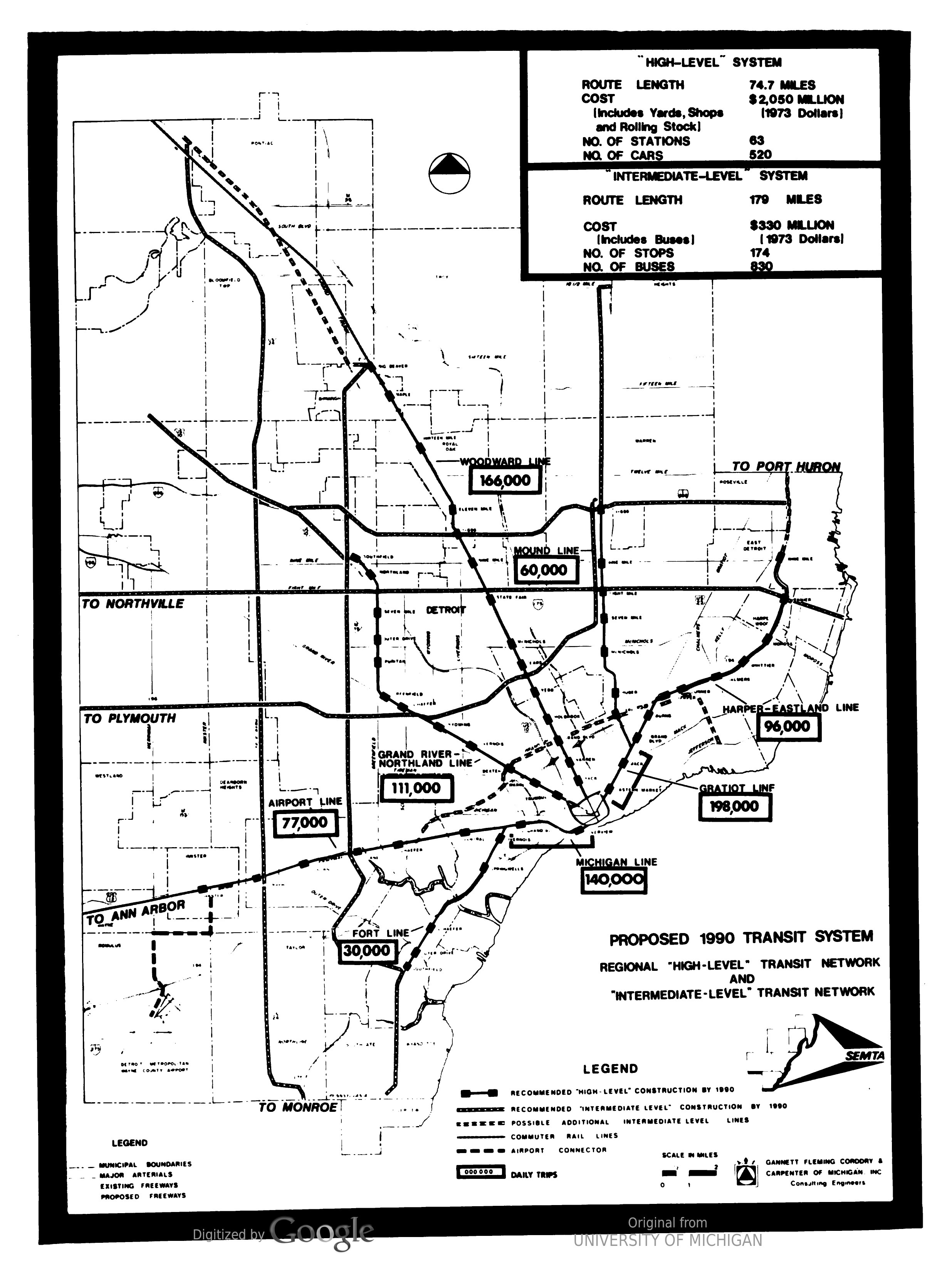
The service levels were elite: headways of 3 to 12 minutes depending on the time of day.
If this had been built as a modern BRT, it would be the biggest BRT system in the world.
Detroit wouldn’t have just had a robust rail spine; it would have had a world-leading bus network acting as its connective tissue. The price tag for this bus component was roughly $330 million in 1973 dollars, or $2.51 billion today.
In the world of infrastructure spending, $2.51 billion for the world’s largest BRT is the bargain of the century.
If you want to see the physical regression of Detroit’s transit, look at Woodward Avenue, the city’s principal arterial and heartbeat. The decline is staggering:
Pre-WWII (Historical): A streetcar arrived every 90 seconds.
The 1974 Plan: A train every 3 minutes at peak (6 minutes off-peak).
Today (2026): A bus every 15 minutes at peak (20 minutes off-peak).
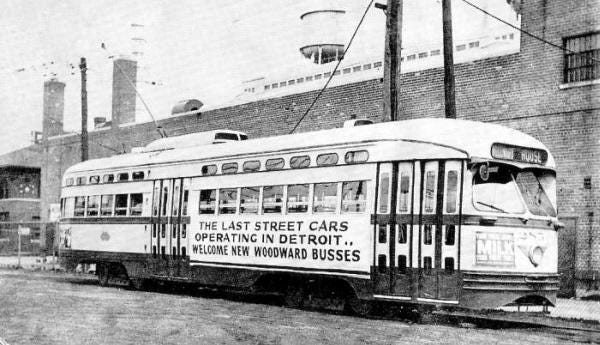
We went from world-class frequency to a service level that makes a car practically mandatory.
When you combine every single agency we have today: SMART (the suburban network), DDOT (local city transit), the QLine streetcar, and the Detroit People Mover, the total ridership is only 12.7% of what the 1974 SEMTA system alone would have projected to have carried.
We are currently operating at barely a tenth of the potential we had fifty years ago. That isn’t just a missed opportunity; it’s a policy failure that has hampered the economic mobility of generations of Detroiters.
The most frustrating part of this entire history is that the ROW is still there.
I’ve combed through the maps, and I cannot find a single portion of the original 1974 proposed route that is blocked by modern development. In fact, the rapid depopulation of Detroit since the proposal was first drafted has ironically made the plan more feasible in some ways. We have more vacant real estate today than we did fifty years ago. This means a modern version of this system could rely far less on expensive tunneling and more on cut-and-grade or embankments, though tunnels remain the gold standard for urban vibrancy.
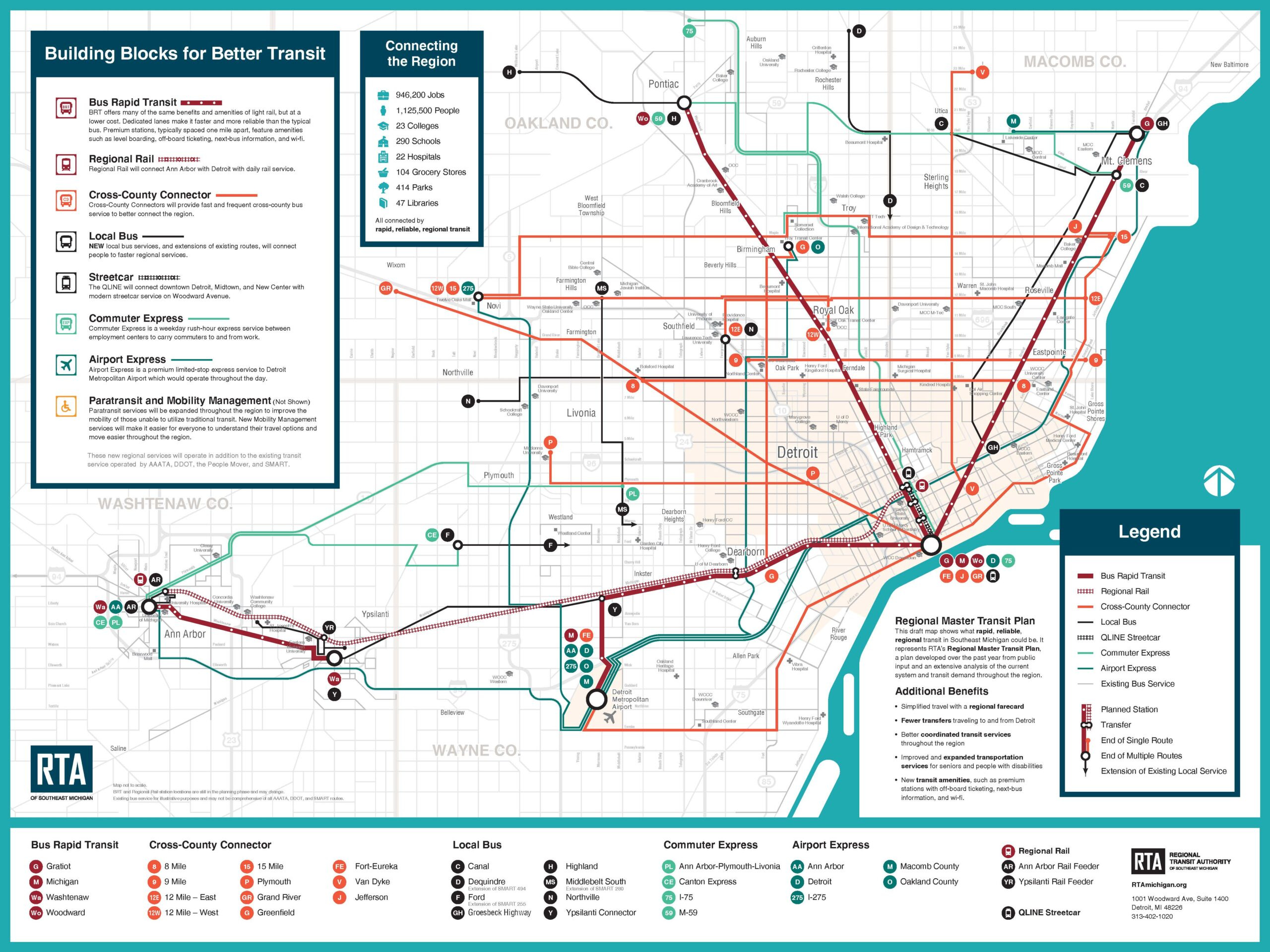
Detroit’s history is littered with missed opportunities. Most recently, in 2018, metro voters rejected a property tax increase intended to fund a $4.6 billion transit plan that would have added bus rapid transit, regional rail to Ann Arbor, and beefed-up bus service.
In total, there have been six major proposals for a subway-like rail system in Detroit since the original idea was floated in 1918. We are currently stuck in a 110-year cycle of “what if.”
If we committed to a 14-year build-out of the SEMTA plan today, the math looks like this:
Annual Capital Cost: $1.75 billion per year until opening.
This represents roughly 20% of the Michigan DOT’s total operating budget.
It is a steep price for a city and a metro area that is only just beginning to reverse decades of economic hardship and population loss. However, building even the initial phases of this system, combined with smart, transit-oriented development, to bring tax revenues and energy back into a city with such a rich cultural history is a no-brainer.
Six subway proposals over 110 years tell us one thing: the demand hasn’t gone anywhere. As much as we try to double down on the suburban sprawl and car dependency in the city that Ford helped build, we deserve more. We deserve a Detroit with a strong, mobile, and vibrant future. It’s time for an infrastructure investment that proves we are serious as a country about becoming that “shiny city on a hill”.
![r/TransitDiagrams - Proposed subway system for Detroit, 1918. This proposal failed by one vote at the city council. [oc]](https://substackcdn.com/image/fetch/$s_!KyA3!,f_auto,q_auto:good,fl_progressive:steep/https%3A%2F%2Fsubstack-post-media.s3.amazonaws.com%2Fpublic%2Fimages%2F4ee40dd8-2848-4b1b-8dbb-574b8ff9bd25_2000x1540.png "r/TransitDiagrams - Proposed subway system for Detroit, 1918. This proposal failed by one vote at the city council. [oc]")
Maybe, like that naive student arriving at DTW some years ago, I’m still a bit too idealistic about how the world works. Perhaps a proposal to run the largest BRT system in the world, connected to a rapid transit network with 3-minute peak headways, was “insanely ambitious” for 1970s Detroit. But if we collectively decide we don’t deserve a better future, then we might as well dwell eternally in what could have been.
Source of research comes from University of Michigan: A Preliminary Proposal for High and intermediate Level Transit in the Detroit Metropolitan Area, March 1974
*Since 2016, there is not a bus DAX, which directly serves the airport