Food has no passport. Passports are modern inventions; food moved long before modern border regimes, and it moved through routes that states never fully controlled: markets, bakeries, ports, caravans, monasteries, court kitchens, military camps, religious calendars, household labor, migration, and ordinary multilingual speech.
The mistake begins when food history is forced to behave like genealogy. It asks for a first ancestor, a clean route, and an owner. A dish came from here; a word came from there; one culture invented it, another borrowed it, and a third one modified it. That kind of story is easy to repeat because it gives culture the shape of a family tree. It is also too clean for the evidence. Food and food words do move, but they do not always move together. They do not preserve the same kind of history.
Food and words are both cultural artifacts. A word preserves traces of speech, borrowing, prestige, translation, sound change, and memory. A food preserves traces of ingredients, tools, labor, technique, ecology, taste, ritual, and social use. They overlap, but they are not the same artifact. A borrowed word can attach itself to a local dish. A local word can translate a foreign practice. A recipe can survive under a new name. A name can survive while the ingredients, texture, preparation, and social meaning change almost completely.
That mismatch is not noise. It is where the history becomes visible.
The root of a word is not the root of a food, and the root of a food is not necessarily the root of its name. Etymology can show how a name travelled. It cannot, by itself, prove how the dish originated. Food history can show how a technique, ingredient, or ritual travelled. It cannot, by itself, prove the origin of the word. Similar names do not prove identical foods. Similar foods do not require identical names. Correlation is evidence to investigate, not causation to assume.
This is not an etymology article pretending to be history, and it is not a recipe article decorated with language. It is a historical essay about traces. Etymology helps follow language contact. Recipe differences show how food practices diverge after contact. Material history explains what could be cooked repeatedly. Anthropology helps interpret why some words gain prestige, why some foods become ritualized, why some forms become heritage, and why daily life often matters more than formal political borders.
The useful frame is not always the modern nation-state. That frame often arrives too late. Many of these movements belong to older contact zones — settings of encounter, exchange, and unequal power that precede and outlast the political borders later drawn around them. The zones relevant here include the Abbasid and post-Abbasid Arabic culinary worlds; Persianate courtly and administrative cultures; Byzantine and eastern Mediterranean bakery systems; Ottoman urban, Balkan, and eastern European contact zones; Indo-Persian and Mughal food environments; Italian and wider Mediterranean bread economies; and later national, industrial, and diaspora layers. Modern labels such as Turkish, Greek, Persian, Arabic, Italian, Balkan, and South Asian are still useful for clarity. They identify words and current uses. They should not be mistaken for the whole historical structure.
A food name should be read through several histories at once.
The first is the history of the word. Where is the term attested? What did it mean? Which language transmitted it? Was it borrowed, translated, shortened, reanalysed, or semantically shifted? A word such as lokma can preserve Arabic-to-Turkish borrowing. Paneer can preserve a Persian lexical layer in South Asian usage. Peinirli can show how a phrase fragment becomes a new noun in another language.
The second is the history of the food practice. What was actually made? Was it fried dough, syruped sweet, milk-solid confection, flatbread, filled pastry, wrapped leaf, pounded meat mixture, clotted cream, fermented milk, or acid-set cheese? Were the ingredients the same? Was the preparation the same? Did the texture, shape, and serving context remain stable? A name may survive even when these features change.
The third is the history of material conditions. Food requires matter and infrastructure: grain, milk, sugar, honey, rose water, fat, fuel, ovens, pans, storage, trade, labor, climate, and price. A syruped sweet is not only a sweet idea. It depends on sweeteners, fuel, and access. A bread is not only a word. It depends on flour, ovens, urban markets, and daily habits. A dairy food is not only a name. It depends on milk animals, fat content, fermentation, straining, preservation, and household routines.
The fourth is the history of social meaning. What did the food do? Was it eaten daily, served at weddings, distributed in mourning, used in fasting periods, associated with religious calendars, sold in bakeries, refined in courts, or later claimed by national cuisine? A food may survive not because its recipe remained pure, but because its use became durable.
Reading these histories together does not remove uncertainty. It makes the uncertainty more precise. Some traces survive as words, some as recipes, some as ritual uses, and some only as later regional variants. Written attestation remains the easiest evidence to cite, but it is only one strand. The archive tells us what became visible, not everything that happened.
This distinction sets the evidentiary standard. A dictionary may support a claim about a word. A manuscript recipe may support a claim about a dish. A trade history may support a claim about sugar, spice, or wheat. An anthropological account may support a claim about ritual meaning. A political history may explain why one language had naming authority in a given region. None of these sources can do the work of all the others.
A written recipe, a dictionary entry, or an early attestation tells us that a word or dish was visible to a particular literate world by a certain date. It does not prove that the food began there. The first written attestation of a dish is not its birth certificate. It is only the earliest surviving record we can currently point to.
Court cookbooks, dictionaries, and travel accounts matter because they preserve evidence. They also distort the picture because they privilege people and institutions that wrote things down. Court cuisine is more visible than village food. Literate elites leave archives. Household practice often leaves indirect traces: names, tools, ritual uses, regional variants, and later memories.
The archive is a record of visibility, not a complete record of life.
Food history is full of correlations: similar names, similar shapes, similar techniques, similar ingredients, similar rituals. These correlations matter. They are often the first sign that something should be investigated. They are not causation.
A similar name may indicate language contact, borrowing, or a shared root, but it does not prove the same recipe or the same origin. A similar shape may reflect imitation, convention, or practical constraint, but not necessarily direct descent. A similar technique may point to contact, but it may also come from common technologies: frying dough, stuffing vegetables, curdling milk, or baking flatbread are not rare human inventions. A similar ingredient may point to trade, ecology, or availability, but not ownership. Even an early written attestation only proves that the word or dish was visible by that date. It does not prove invention.
The evidence becomes stronger only when several traces align: chronology, textual record, recipe continuity, ingredient movement, trade route, migration, or a documented contact setting. Similarity opens the question. It does not close it.
Every case therefore has to be split in two before it can be compared. The word has one history: meaning, borrowing, sound, prestige, and route. The food has another: ingredients, technique, texture, use, and variation. Without that second layer, etymology becomes misleading. Yoğurt and industrial fruit yogurt are not the same social object. Peynir and paneer are not the same cheese category. Focaccia, poğaça, pogača, and bougatsa may preserve related bakery vocabulary, but they are not the same food. Dolma, sarma, gemista, and mahshi overlap in technique, but they classify the action differently.
The variations are not side notes. They are evidence that words and foods travel unevenly.
The point is not to replace nationalist origin stories with another formula. Food history does not follow a single mechanism. A prestige language may supply a name in one setting. In another, a market phrase may be reanalysed. In another, a household technique may continue under a translated term. In another, similar foods may emerge because people faced similar material problems.
Artifacts and traces are heterogeneous. They do not produce the same pattern everywhere. Variety is not deviance from an original form. Variety is the normal condition of living food traditions.
This matters because theory can become as rigid as the stories it tries to correct. Hegemony, trade, empire, migration, ritual, class, and economy all matter. They do not matter in the same way in every case. Theory should follow the artifact, not dominate it. A food word is a trace, not a verdict.
Cultural hierarchy still matters. Some languages become more borrowable because they are associated with courts, administration, religion, scholarship, commerce, urban refinement, or elite dining. Persianate vocabulary in parts of South Asia, Ottoman Turkish food words in Greek and Balkan usage, French culinary vocabulary in English elite dining, and English in modern global food marketing all show versions of this mechanism. But naming authority is not recipe origin. A community can already have the food practice and still borrow the prestige name.
Daily life decides whether the word survives. Markets repeat it. Households adapt it. Religious calendars stabilize it. Migrants carry it. Restaurants standardize it. Later, national cuisine may convert a multilingual and messy exchange into a clean heritage object. The food becomes “ours” not because its earlier routes vanish, but because repeated use creates local meaning.
Arabic luqma means a morsel, bite, or mouthful. Medieval Arabic cookery gives us luqmat al-qāḍī, “the judge’s morsel,” a fried dough sweet; al-Baghdadi’s version is soaked in dense sugar syrup, while honey belongs to the broader fried-dough tradition.1 Turkish lokma preserves the morsel sense and names the familiar syrup-soaked fried dough sweet. Greek loukoumades is commonly explained through this Arabic–Turkish route, with Greek morphology adapting the borrowed form.
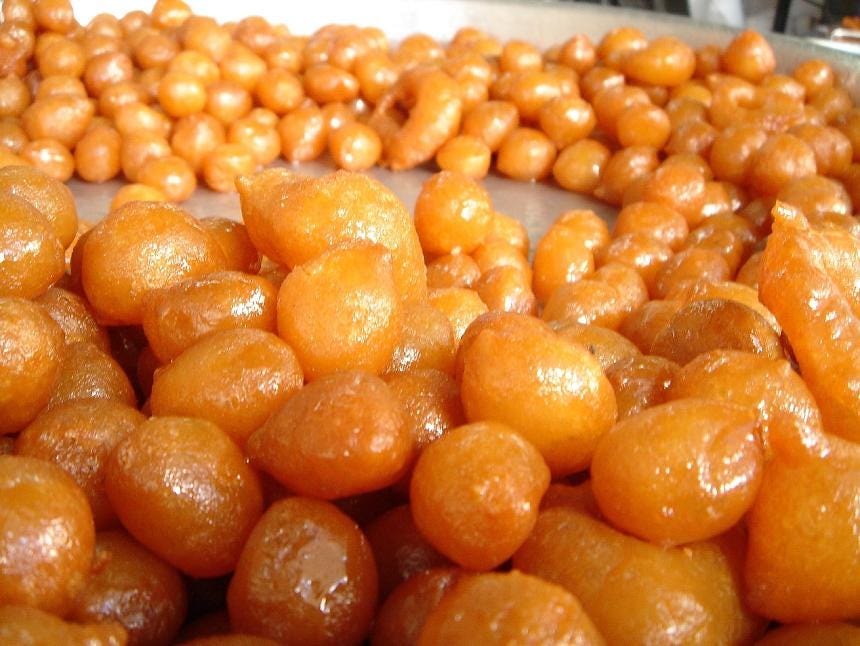
For readers unfamiliar with the dish, lokma and loukoumades are small pieces or balls of fried dough, usually served with syrup or honey. That practical description is more useful than an origin claim at this stage. It tells us what kind of food object we are discussing before we attach history to it.
The word route is useful, but it should not be converted into a total food-origin claim. Greek-speaking communities also had older honey-fried dough traditions, often discussed through ancient or Byzantine terms such as enkrides. That does not cancel the Arabic–Turkish route of the modern name. It means name history and food-practice history must be separated.
The recipe layer sharpens the distinction. Turkish lokma is strongly associated with şerbet, a sugar-water syrup, often lemon-scented, which soaks into the fried pieces. Greek loukoumades are commonly associated with honey and cinnamon, often with walnuts or modern toppings. The boundary is not absolute; syrup and honey overlap across the wider food family. But the common sensory profiles differ enough to matter. One presentation emphasizes sugar-syrup saturation. Another often emphasizes honey, cinnamon, and topping.
Chronology alone cannot explain why the same fried dough can be dessert, street food, memorial offering, or public charity. The name gives one route. The social use gives another. Publicly distributed lokma is not merely consumed. It can create memory, obligation, charity, piety, or belonging. The same fried dough ball can be dessert in one setting and a social act in another.
Gulab jamun is a South Asian sweet usually made from milk solids, often khoya, shaped into balls, fried, and soaked in syrup. The syrup is often scented with rose water, cardamom, saffron, or related aromatics. The first part of the name, gulab, comes from Persian gul-āb, “rose water.” The second part, jamun, refers to a South Asian fruit, usually invoked as a comparison for the sweet’s shape or color.
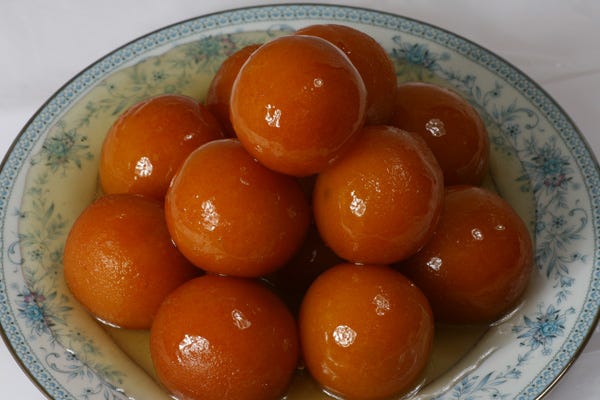
This looks like it could become a simple descent story: fried balls, syrup, Persianate name, Islamic and Persianate sweet repertoires. But the material base interrupts the clean line. A flour-based fried dough in syrup and a milk-solid sweet in syrup are not the same food. 2Visual resemblance is not recipe identity.
The better reading is convergence. The fried-and-syruped logic belongs to a wider Islamic and Persianate sweet repertoire. The rose-water vocabulary is Persianate. The milk-solid base belongs to South Asian dairy practice. The social life of the sweet, including weddings, festivals, restaurants, and diaspora food culture, developed in South Asian contexts.
Recipe variations reinforce this. Traditional khoya gulab jamun differs from modern milk-powder versions. Kala jamun is darker and more deeply fried. Bengali pantua and related syruped sweets form a regional neighborhood rather than a single identical dish. Similarity to syruped fritters may show a shared sweet logic, but the ingredient system matters.
The word gulab explains one layer of the dish: aroma, prestige, and syrup. It does not explain the whole food. The milk solids, frying, syrup, festival use, and later restaurant standardization are separate traces.
Sweetness also has material history. Sugar, syrup, rose water, milk, fuel, and frying fat depend on labor, trade, price, class, and access. A sweet may begin as courtly or expensive and later become ordinary. That transition is not merely culinary. It is economic and social.
Turkish kurabiye means cookie or biscuit. Greek kourabies, plural kourabiedes, refers to a rich shortbread-like cookie, often associated with Greek Christmas and covered in powdered sugar. The Greek form is best treated as a borrowing from Turkish kurabiye, and that proximate link is not seriously disputed.
The deeper etymology of the Turkish form is not settled. Arabic-side explanations connect the family with ghraybeh, ghurayba, or related shortbread-like forms; Nişanyan’s later position instead points toward a Persian gulābiya line connected with rose water.3 Other explanations have also been proposed, but none has enough primary lexical or food-historical support to carry the argument alone. The uncertainty is genuine and should remain visible rather than be papered over with a plausible-sounding chain.
The food variation matters as much as the word. Turkish kurabiye is a broad cookie category. Greek kourabiedes are a specific festive form, tied to powdered sugar, butter-rich texture, and holiday use. Arabic ghraybeh and related forms often belong to a shortbread-like family, but they are not identical to Greek Christmas kourabiedes. Balkan biscuit forms add another layer.
The value of this case is precisely that it refuses to become a clean origin story. One link may be strong while the deeper route remains uncertain. That is not a weakness in the method. It is the method doing its job.
A festive cookie is also not just a recipe. It can signal domestic competence, hospitality, religious calendar, and family memory. Once a food becomes part of a holiday, its borrowed history may fade behind its local social role. Correcting the etymology may be historically valid, but it does not erase the belonging created by repeated use.
Dairy terms are useful because they make material conditions hard to ignore. Milk must be preserved, thickened, fermented, skimmed, strained, curdled, dried, or cooked. These actions depend on animals, climate, containers, microbes, fat content, fuel, and household labor.
Persian panīr means cheese. Turkish peynir derives from this Persian form and is the generic Turkish word for cheese. South Asian paneer is usually treated as part of the same Persian lexical family, but in modern culinary usage it names a much narrower food category: a fresh, acid-set, non-melting cheese.4
That difference is not minor. Turkish peynir is a broad category. It can cover white brined cheese, kaşar, tulum, lor, and many other cheeses. South Asian paneer, in practice, means a fresh cheese made by curdling milk with acid and pressing or draining the curds. Eastern South Asian chhena/chhana adds another fresh-curd category, especially important in sweets.
The lexical relationship is strong. The food categories are different. The Persian origin of the word does not settle the origin of the South Asian cheese practice. South Asia had older dairy traditions; Indo-Persian influence shaped elite and regional food cultures; some historians discuss Portuguese-contact hypotheses for acid-set cheeses in certain regions. The word history is clearer than the food history.
The same caution becomes even sharper with yogurt. The international word comes through Turkish yoğurt, but fermented milk as a practice is older and wider than that word. Milk ferments wherever dairy animals, warmth, microbes, containers, and preservation needs meet. The Turkish word travelled globally; fermented milk did not begin with the English spelling yogurt.
In Turkish food culture, plain yoğurt is usually tart, unsweetened, and strongly tied to savory meals. It is served with rice, meat, vegetables, soups, mantı, stuffed dishes, and many everyday foods. When diluted with water and salt, it becomes ayran, a cold savory drink. Similar savory yogurt-drink logics appear elsewhere under names such as doogh.
Greek strained yogurt should not be described as inherently sweet. Traditional strained yogurt is plain and tangy and has important savory uses, especially in preparations such as tzatziki. What is often sweet is the modern global commercial yogurt category: fruit cups, sweetened breakfast products, smoothies, dessert yogurts, and high-protein branded “Greek-style” yogurts.
Other dairy forms show further branching. Labneh moves strained yogurt toward a spreadable cheese-like form. Kefir is fermented milk with a different microbial culture and word history. Qatiq, suzma, kurut/qurut, and related products show thickened, strained, or dried fermented dairy systems. Tarhana/trahana takes fermented dairy into a dried grain-and-yogurt soup base. These are not just flavor variations. They are preservation technologies and household economies.
Kaymak adds another dairy layer. It is a fat-rich milk product, often compared to clotted cream, made from the cream layer of milk. The word is Turkic and spreads widely across Turkic and Ottoman contact zones: Turkish kaymak, South Slavic kajmak, Greek kaimaki, Romanian caimac, and Central Asian forms such as qaymaq/qaymoq.
But the food is not identical everywhere. Turkish kaymak may appear at breakfast, with honey, or with desserts. Regional forms carry animal and fat-content histories. Balkan kajmak may be fresh or matured and eaten with bread or meat. Greek kaimaki can refer to cream or extend into ice cream contexts. Romanian caimac can refer to the cream layer.
The dairy word travels; the milk economy localizes it.
Köfte adds a different mechanism. The word family is widely traced in food-historical and etymological literature to Persian kufta/kofta, from a verb root associated with the action of pounding or beating — a connection that fits a food made from minced, pounded, or ground material. Arabic kufta/kafta, Turkish köfte, Greek keftedes, Balkan forms such as chiftele, ćufte, or kyufte, and South Asian kofta belong to a broad contact field.
But the food category is not one stable meatball. Turkish köfte can be grilled, fried, baked, raw-style, bulgur-based, lentil-based, or regional. Çiğ köfte today is often meatless, built from bulgur, spices, and kneading. Mercimek köftesi is lentil-based. Greek keftedes may be meatballs, but vegetable fritter forms such as tomato or courgette keftedes show the category extending beyond meat. South Asian kofta may be meat, vegetable, paneer, or other balls served in sauce or curry. Balkan forms may be patties or meatballs shaped by local meat, spice, and cooking traditions.
The word remembers pounding, mincing, and shaping. The food remembers meat economies, religious rules, spice systems, frying, grilling, legumes, bulgur, sauces, and household practice.
Greek peinirli is a small example, but it carries a large lesson. In Turkish, peynirli pide means “cheese pide.” Peynir means cheese. The suffix -li means “with” or “containing.” Peynirli is therefore an adjective: “with cheese.” Pide is the head noun, the bread or baked dish.
Greek peinirli appears to preserve the adjective peynirli and turn it into the dish name. The Turkish head noun disappears.
Calling this a mistake is too crude. It is reanalysis. Borrowing often happens in bakeries, markets, and menus, not in philological classrooms. Speakers hear a phrase, keep the part that becomes useful, and make it work in their own language. Once repeated, the reanalysed form becomes correct locally.
No formal imperial policy is needed to explain it. Bakery contact, oral exchange, migration, and ordinary bilingualism are enough.
Bread is where resemblance becomes especially dangerous. Grain, flour, heat, and ovens produce similar forms across large regions. Some word histories may be related; some food histories may be parallel; some connections may be material rather than lexical. The evidence has to slow the argument down.
The resemblance between pide, pita, and pizza is a good warning. Pide and pita have a more plausible shared eastern Mediterranean lexical history, with Byzantine Greek and possible Aramaic layers in the background.5 Pizza is different: the word is securely attested in Gaeta in 997 CE, but its derivation remains contested — Latin pinsere, Lombardic bizzo, and a Byzantine Greek or Aramaic connection have all been proposed, and the OED returns a verdict of uncertain origin.6 That combination is exactly the point. A firm attestation can prove that a word was visible by a certain date without proving where the word, or the food, began.
Turkish pide can refer to plain bread, Ramadan bread, or elongated topped or filled baked dishes. Greek pita has a wide semantic range: bread, pie, pastry, flatbread, or filled/layered food depending on context. Italian pizza is attested from 997 CE in southern Italy, but modern Neapolitan pizza, especially tomato-based pizza, is much later and belongs to a separate urban food history.
The food variations make the point. Ramazan pidesi is tied to a religious calendar and communal bread practice. İçli pide or cheese/meat pide belongs to a bakery-meal category. Greek pita includes pie-like and pastry-like forms, not only flatbread. Medieval piza/pizza is not the same as modern tomato-based pizza. Neapolitan pizza is an urban food history of its own, and global pizza is another later industrial and commercial layer.
Pide, pita, and pizza are exactly the kind of resemblance that should slow the argument down, not speed it up.
The focaccia / poğaça / pogača / bougatsa group gives the bread argument a different shape. Italian focaccia is tied to Latin panis focacius, hearth bread, from focus, the hearth or fireplace.7 Related forms moved through Byzantine Greek and into South Slavic, Ottoman Turkish, and modern Greek usage, though the precise dating and path of each transfer still deserve caution. Here the deeper lexical layer is stronger than in the pizza case — the Latin hearth-bread root is well-evidenced, and the broad direction of travel is not seriously disputed — but the modern foods still diverge sharply.
The modern foods are sharply different. Italian focaccia is usually an oven-baked flatbread, often with olive oil and regional toppings. Turkish poğaça is often a small bun or pastry, frequently filled with cheese, olives, potato, or meat. South Slavic pogača may function as bread, sometimes with ritual or ceremonial significance. Greek bougatsa today is usually a phyllo-based pastry with custard, cheese, or meat.
The older lexical layer points back to the hearth. The modern foods point elsewhere as well: to local ovens, fillings, rituals, bakery systems, and eating habits.
A brief South Asian comparison makes the same point. Roti belongs to an Indic lexical and food world. Naan comes through Persian nān, meaning bread, and became associated in South Asia with particular breads, ovens, courtly or restaurant contexts, and later global Indian cuisine. The point is not that one replaced the other. South Asia did not need Persian vocabulary in order to have bread. The borrowed term entered a region with older bread practices and became attached to particular categories. A borrowed term may specialize rather than replace.
Stuffed foods show how languages classify the same culinary action differently.
Turkish dolma comes from the idea of filling or being filled. Turkish sarma comes from the idea of wrapping or rolling. Greek dolmades preserves a borrowed form related to dolma, while Greek gemista means stuffed or filled. Arabic mahshi also means stuffed.
The food world includes filled peppers, tomatoes, eggplants, vine leaves, cabbage leaves, and similar carriers. The cooking action may be related, but the language classifies it differently. One term foregrounds filling. Another foregrounds wrapping. Another preserves a borrowed sound. Another translates the meaning.
Recipe variation matters here as well. Vine leaves, cabbage leaves, peppers, tomatoes, and eggplants create different food objects. Rice-herb-olive-oil fillings differ from meat-rice fillings. Lenten or fasting forms differ from festive meat forms. A dish may be warm, cold, oily, sour, herb-heavy, meat-rich, or vegetarian depending on region, class, season, and religious calendar.
The absence of a loanword does not mean absence of contact. Sometimes exchange is visible through borrowed sound. Sometimes it is visible through translated meaning. Sometimes it is visible only through parallel categorization and shared practice.
The familiar English contrast between pig and pork, cow and beef, sheep and mutton is often used to explain prestige borrowing. It is useful, but it should be handled carefully. After the Norman Conquest, English absorbed large amounts of French vocabulary, including terms associated with law, courtly life, status, and cuisine. The general point about prestige borrowing is valid, but the neat class division is often repeated in a cleaner form than the history warrants.
The better lesson is narrower. Prestige languages can reshape food vocabulary without proving that the food itself is new. Persianate vocabulary in South Asia, Ottoman Turkish vocabulary in Greek and Balkan settings, and French vocabulary in elite modern dining each show different versions of this mechanism. A culture can already have the food practice and still borrow the prestige name.
That is naming authority, not necessarily culinary invention.
At some point, messy contact often becomes cleaner heritage. A multilingual bakery item becomes a national staple. A courtly sweet becomes a domestic holiday expectation. A borrowed word stops feeling borrowed. Cookbooks, restaurants, tourism, school culture, media, diaspora memory, and state heritage programs stabilize one version of the story.
They do not invent the food out of nothing. They make one version legible.
The political economy of that legibility is worth pressing. Heritage programs, protected geographical indications, tourism board marketing, and diaspora cultural institutions do not simply celebrate food; they adjudicate it. A protected designation forecloses competing claims. A national cuisine narrative selects which version of a dish becomes canonical and which regional or minority variant gets reclassified as peripheral or derivative. When a food becomes the subject of trade rules, protected designations, diplomatic branding, or ownership disputes, the clean origin story is not a historical curiosity. It is an economic and political instrument. What gets suppressed in that process is the record of entanglement: the shared technique, the borrowed name, the parallel practice that no single state invented or owns.
That suppression is not accidental. Clean origin stories are useful precisely because they are clean. They can be trademarked, promoted, and defended. A contact zone, by definition, belongs to no one exclusively, which makes it commercially inconvenient and politically awkward. The transformation of exchange into heritage is therefore not only a cultural process. It is also a process of enclosure.
Historical complexity and social belonging do not line up neatly, and recognizing the enclosure does not require delegitimizing the belonging. A food can be historically entangled and still be experienced locally as fully one’s own. A Greek Christmas cookie does not become less Greek because the word has a Turkish route. A Turkish poğaça does not become less Turkish because the deeper bakery vocabulary is older and more entangled. A South Asian paneer dish does not become less local because the word has a Persian origin.
The history of contact does not cancel the history of belonging. It explains how belonging was made — and at what cost to the complexity it replaced.
The family-tree model remains tempting because it is easy to draw and easy to defend in public arguments. It is also often misleading. Food history is usually better understood as a network in which words, techniques, ingredients, and meanings move through different paths and at different speeds.
The relevant contact zones and their culinary outputs form a web rather than a line of descent. The Abbasid and post-Abbasid Arabic culinary world contributed sweet vocabularies and fried-dough forms that moved into Ottoman Turkish and from there into Greek and Balkan usage. The Persianate sphere contributed cheese, bread, rose water, and the pounding-and-shaping logic of kufta, distributing these across South Asian, Ottoman, and Central Asian food cultures. Byzantine and eastern Mediterranean bakery worlds fed into Balkan and Ottoman systems, while older hearth-bread vocabulary survived unevenly across the region. The Ottoman urban contact zone acted as a major relay, transmitting and transforming forms outward into Greek-speaking, Balkan, and eastern European household cuisines. South Asian food worlds absorbed Persianate vocabulary while maintaining and developing their own dairy, bread, and sweet traditions. Italian and Mediterranean bread economies preserved Latin hearth-vocabulary that intersected — imperfectly and partially — with eastern Mediterranean forms. Later national, industrial, and diaspora layers then restabilized these inherited materials into the food identities visible today.
This is not a claim that everything is connected equally. Some links are lexical. Some are culinary. Some are material. Some are social. Some are strong. Some are plausible. Some remain unverified and should stay that way until better evidence appears.
The foods discussed here do not share one origin. They share histories of contact, and those contacts moved at different speeds along different paths. Some left lexical traces. Some left culinary traces. Some left only a preparation logic beneath different names. What recurs is not a single pattern of descent, but the failure of single-pattern descent to explain the evidence.
Food history is not a search for the pure form behind all variations. It is the study of how variation becomes normal. Food words and food practices are both traces — through them, we can follow hierarchy, trade, migration, daily life, economy, ritual, and memory, but only when we resist the urge to turn a trace into a verdict. The changed recipe, the borrowed word, the translated category, the reanalysed phrase, the ritualized sweet, the industrial yogurt cup, and the household version are not deviations from history.
They are history.