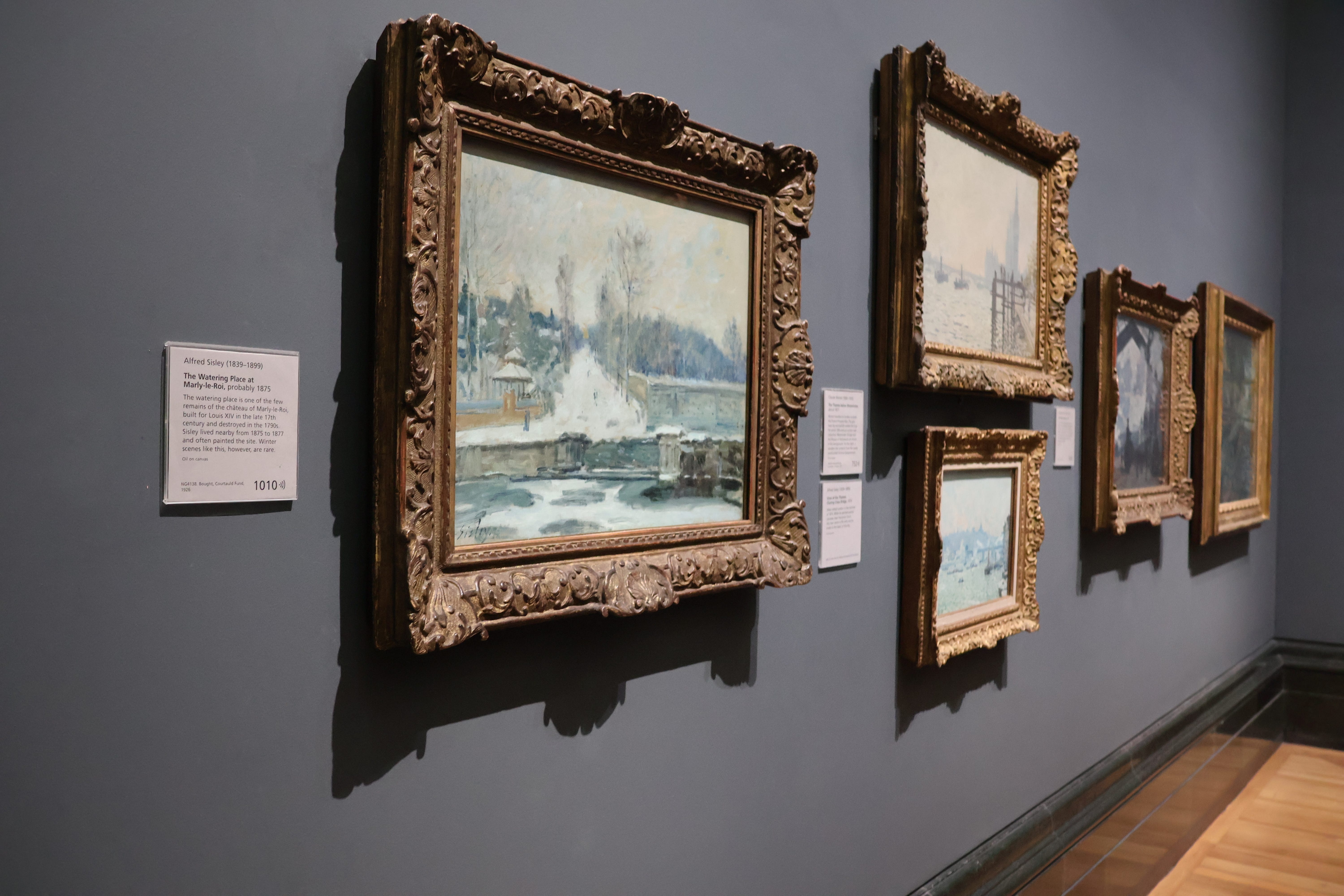
National Gallery interior, London, December 2023. (Via Wikimedia Commons)
I have walked the National Gallery’s route often enough to stop noticing it. Late medieval and Renaissance Italy, then the Netherlands, Spain, France, Britain, ending somewhere around French Impressionism. Different languages, patrons, churches, wars and political systems, hung so that moving between them feels like moving forward rather than sideways.
The Gallery describes what it holds as the Western European tradition, and the description is accurate about the arrangement. It is not accurate about the painters. The earliest panels in the building were made around 1300. The collective political idea of the West emerged from the 1820s and was given systematic form in the 1840s. Somewhere in the middle of the route, the category arrives. The painters in the first rooms could not have used the phrase under which their work is now filed. The painters in the last rooms could: Turner died in 1851, Monet and Degas worked decades after Comte.
The route does not mark the join. A visitor walks from a world in which the category did not exist into a world in which it did, and nothing on the wall registers the crossing. That absence is the subject of this essay.
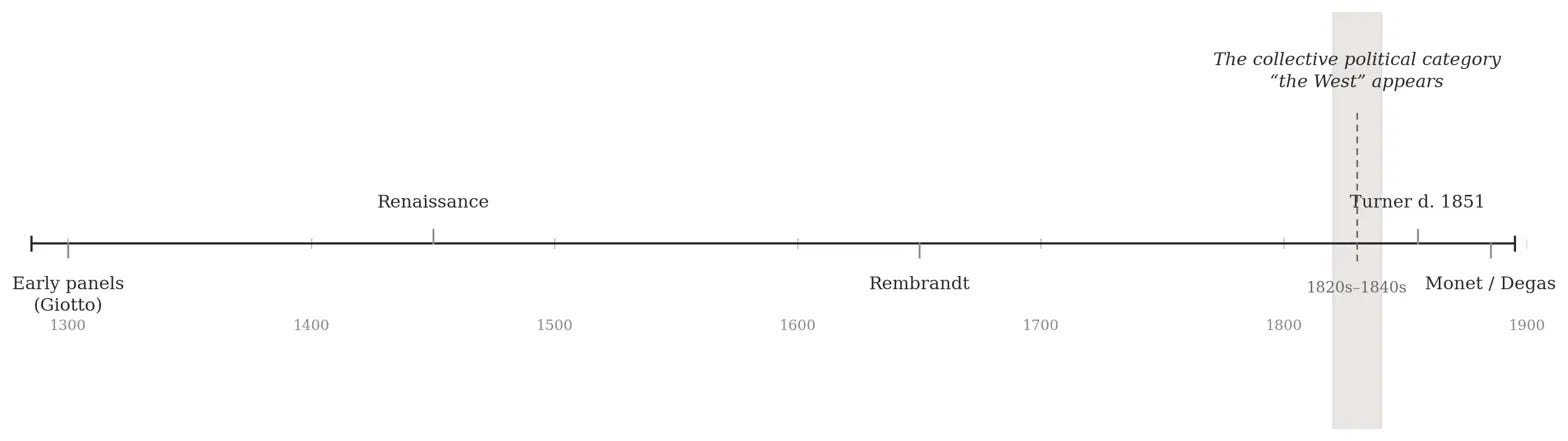
The paintings do not acquire the category at the same time. The route simply continues across the point at which “the West” becomes available as a collective political name.
The British Museum was founded in 1753 to cover all fields of human knowledge, and it now says, in its own Enlightenment Gallery, that the systems through which eighteenth-century British collectors understood the world were predominantly European and developed alongside colonial expansion and the transatlantic slave trade. The institution has become capable of describing its own classification as a historical artifact. It has not stopped classifying, because it cannot: a collection has to be arranged somehow, and the arrangement will always assert relationships that the objects themselves do not. Take the assertion seriously and the definition begins to come apart in the building.
The Rosetta Stone is a decree issued by Egyptian priests for a Macedonian-descended king, inscribed in hieroglyphic, Demotic and Greek. Its Western significance is that Champollion and Young read it. Its origin belongs to none of the categories that significance requires. The Parthenon sculptures were made for a temple in a city that had no concept of a West to belong to. They were removed from Ottoman Athens under an authority the British Museum has long described as an imperial permit - though no original document has ever surfaced in the Ottoman archives, and researchers able to read Ottoman Turkish have found no record of a Sultan’s decree, only an unsigned, unsealed Italian translation. The institution’s account of its own authority is itself a piece of retrospective classification, asserted with more confidence than the record supports - which is the mechanism this essay is about, caught in the act.
The Gallery works the same way at a smaller scale. Its Netherlandish panels were painted in ultramarine ground from lapis lazuli carried west along Mediterranean trade routes, in a market city where the Medici bank’s Bruges branch financed and connected the merchants who commissioned them - Tommaso Portinari, the branch’s manager, commissioned Hugo van der Goes to paint an altarpiece that then travelled to Florence and shaped Italian painting in return. The connections are documented. Every one of them crosses the boundary the room asserts.
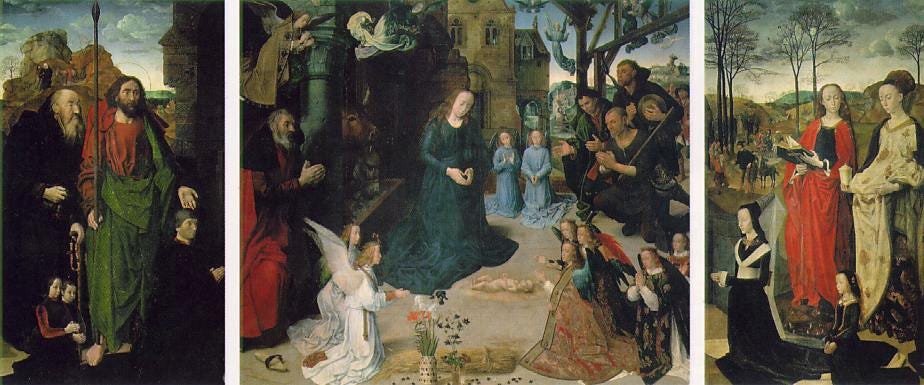
Hugo van der Goes, Portinari Triptych, 1473–78 (Uffizi; public domain, via Wikimedia Commons).

Commissioned in Bruges by Tommaso Portinari, manager of the Medici bank’s branch there; the triptych travelled to Florence in 1483. The connection between Flanders and Italy is documented. Calling both stages episodes of one Western civilisation is a different claim.
Definitions fail one after another. Geography breaks on Japan and Australia. Religion breaks on secularism, and on the fact that Christianity’s institutional continuity runs strongest through the Orthodox east. Race breaks on the passport index. Values break on the question of which values, and when, and whether the eighteenth century qualifies. Democracy and capitalism break on chronology, since both are younger than most of what they are said to characterise.
The interesting fact is not that the definitions fail. It is that the failures change nothing. The word survives every one of them, the rooms stay arranged, the syllabus keeps its order, and the objects keep meaning what the arrangement says they mean. Something is surviving that is not a definition.
What survives is not a property shared by the objects. It is a relation asserted about them: that they belong to a single continuous us.
The title poses this as a question: was the West there? That phrasing is a trap. The Rosetta Stone exists, or it doesn’t. A treaty exists, or it doesn’t. Whether a name attached to them afterwards is the same kind of thing - a bounded object with a yes-or-no existence - is a different question. A discourse does not hold or lack existence the way an artifact does. The better question is not whether the category exists, but how it operates, and for whom.
That relation is what the arrangement produces. Walk the route and the paintings stop being separate objects with separate histories and become episodes. Read the syllabus and Plato stops being an ancient writer whose texts survived through a complicated and largely non-European route, and becomes chapter one. In both cases the sequence is the argument, and no one has to state it, which is why it is difficult to disagree with.
This is where the substitution happens. That a classification works - that it is legible, repeated, absorbed without reconstruction - proves something real. It proves an organising decision was made, that it can be dated, that the people who made it can usually be named, and that it has been performed often enough to become infrastructure. When a visitor walks the Gallery without noticing the route, the unnoticing is evidence. It is evidence about the institution.
It is not evidence about the tradition. The relationships inside the rooms may be entirely real - Titian was copied, techniques travelled, patrons moved, markets connected - but those relationships are established by contracts, pigments, letters and account books, not by the wall the paintings hang on. The wall proves a decision about a wall. Legibility is evidence that a classification is working. It is not evidence that the thing classified exists as a continuous object.
A category naming a continuous social object should leave more behind than repeated classification. There should be a traceable chain through which later participants inherit something from earlier ones while the transmission is happening: offices, rules, obligations, archives, jurisdiction, membership, property, recognised authority, or an explicit claim of succession that contemporaries act upon. Contents may change. Borders may move. Governments may fall. Continuity does not require sameness. It requires a bridge that existed for the people crossing it, rather than one supplied afterwards by curators.
France clears that bar for the periods in which one government inherits treaties, debts, archives and jurisdiction from another and is treated by its own officials and by other states as the continuing French state. International law preserves exactly this kind of identity across constitutional rupture. It does not follow that France is continuous with Gaul; that larger ancestry would need demonstrating separately, and usually is not.
The criterion has to survive its hardest case, which is Latin Christendom. Canon law had jurisdiction. The papacy had recognised authority across polities. The Republic of Letters had archives and membership. Translatio imperii was an explicit succession claim that emperors and jurists acted upon for centuries.
Christendom clears the succession test and fails a different one. Its succession claim ran to Rome, and it was imperial and Christian rather than civilisational. Medieval Christendom did not remember fifth-century Athens as its own childhood: Petrarch owned Greek manuscripts of Plato and Homer that he could not read, and systematic Greek instruction did not reach the Latin West until Manuel Chrysoloras began teaching in Florence in 1397, decades after Petrarch’s death. A chain existed. The memory did not. The two are separable, and separating them is the work of this essay.
Georgios Varouxakis has written the first comprehensive history of the idea, and its central finding is chronological. The term was not used by Plato, Cicero, Locke or Mill. It was not first wielded by empire-builders. It emerged gradually from the 1820s and was decisively promoted in the 1840s by Auguste Comte.
The detail that matters most is the least convenient one. The category was not built to separate Europeans from the colonised. It was built to separate western Europeans from other Europeans, principally the Russian Empire, which after 1815 was too powerful and too entangled in European politics to be placed outside Europe, and which was Christian, so the older religious boundary would not do the work. Europe included Russia. The West did not, and it left room for the Americas. Comte, who promoted the term hardest, was passionately anti-imperialist.
By the 1840s the Renaissance, the Reformation, the Enlightenment and the American and French Revolutions had already happened. The British Museum had been open for nearly a century. The protagonist appears late in its own biography, and everything before its appearance was enrolled retrospectively.
The obvious objection is that the ancestry predates the name. It does. Winckelmann’s history of ancient art appeared in 1764. German Hellenism, the Greek Revival and the philhellenic enthusiasm of the 1820s all run ahead of Comte. If Europeans were already treating Greece as their childhood two generations before the West existed as a self-designation, the memory did not follow the category. The objection holds and then reverses, because of who else was making the claim.
Philhellenism was not a western European sentiment. It was an international movement expressing appreciation for the classical and Byzantine heritage, with philhellenes in the West and in Russia alike. Russian sympathy rested on shared Orthodoxy and on bonds traced to the Eastern Roman Empire. The entanglement was institutional, not atmospheric: Ioannis Kapodistrias, a Greek from Corfu, served as joint foreign minister to Tsar Alexander I from 1816, and the Filiki Eteria twice tried to recruit him as its leader, trading on the fact that most Greeks regarded the Orthodox Russians as their likeliest liberators. The society’s original objective was not a national state but the revival of the Byzantine Empire with Constantinople as its capital.
So the Greek ancestry was available before the category, and it was available to the rival. Any genealogy running through Greek continuity — language, liturgy, imperial succession, the physical survival of the Roman state — hands the inheritance to Petersburg and Constantinople rather than to Paris and London.
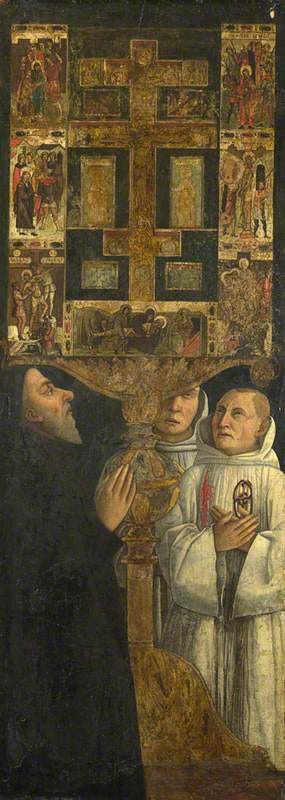
Gentile Bellini, Cardinal Bessarion with the Bessarion Reliquary, c.1472–73 (National Gallery, London; public domain, via Wikimedia Commons). Bessarion, a Greek churchman, settled in Venice after the fall of Constantinople in 1453 and donated this reliquary hoping it would move western Christians to help the Greek Christians he had left behind. It didn’t. The painting the National Gallery itself now shows as an early landmark of “Western” collecting is a record of the West declining to answer the plea of the party it would later claim as its ancestor.
_-_Cardinal_Bessarion_and_Two_Members_of_the_Scuola_della_Carit%C3%A0_in_prayer_with_the_Bessarion_Reliquary_-_NG6590_-_National_Gallery.jpg)
That constraint is visible in the finished product. The received sequence runs Greece to Rome to Latin Christendom to the Renaissance, and passes over Byzantium, which is the actual continuous survival of the Roman state - its inhabitants called themselves Romaioi, Romans, for the entire thousand-year span - and the actual continuous transmitter of the Greek texts. The thousand-year hole in the middle of the story is not an oversight of periodisation. It is where the competing claimant stood. The West did not invent an ancestry. It inherited a contested one and made it exclusive, by selecting the route that disinherited the rival.
Benedict Anderson described most of this mechanism for nations. In the chapters added to the 1991 edition, Anderson argued that the census, the map and the museum allow a state to imagine population, territory and ancestry, and that these institutions do not merely describe the reality they name - they help produce it. Archaeological objects become national heritage although their makers had no concept of the nation now claiming them. In “Memory and Forgetting” he pushed further: national history behaves like biography, constructing continuity through documents for a childhood no one can remember, and nationalism therefore produces ancient nations rather than discovering them. The West runs the same operation with most of the equipment missing.
Anderson’s nation is imagined as limited and as sovereign. It has borders it enforces, a census that counts its members, a map that renders it as a bounded object, schools that reproduce it and a state that can compel. The West has none of these. There is no Western census, no Western passport, no Western territory whose edge is patrolled as such, and no authority that can compel anyone to be Western. What it has is the museum and the syllabus: the machinery for producing historical depth, running without the machinery for producing membership. That asymmetry predicts something specific: the category should persist wherever classification is soft and dissolve wherever classification is hard.
Eric Hobsbawm’s correction applies here too. Nationalism does not build from empty space; it selects and reorganises materials that already exist — languages, laws, texts, attachments. Those materials are why the Western genealogy feels solid. Roman law, Latin literacy, canon law and the manuscript tradition are all real. Reorganisation into a lineage is a separate operation performed on real material, which is what makes it hard to see.
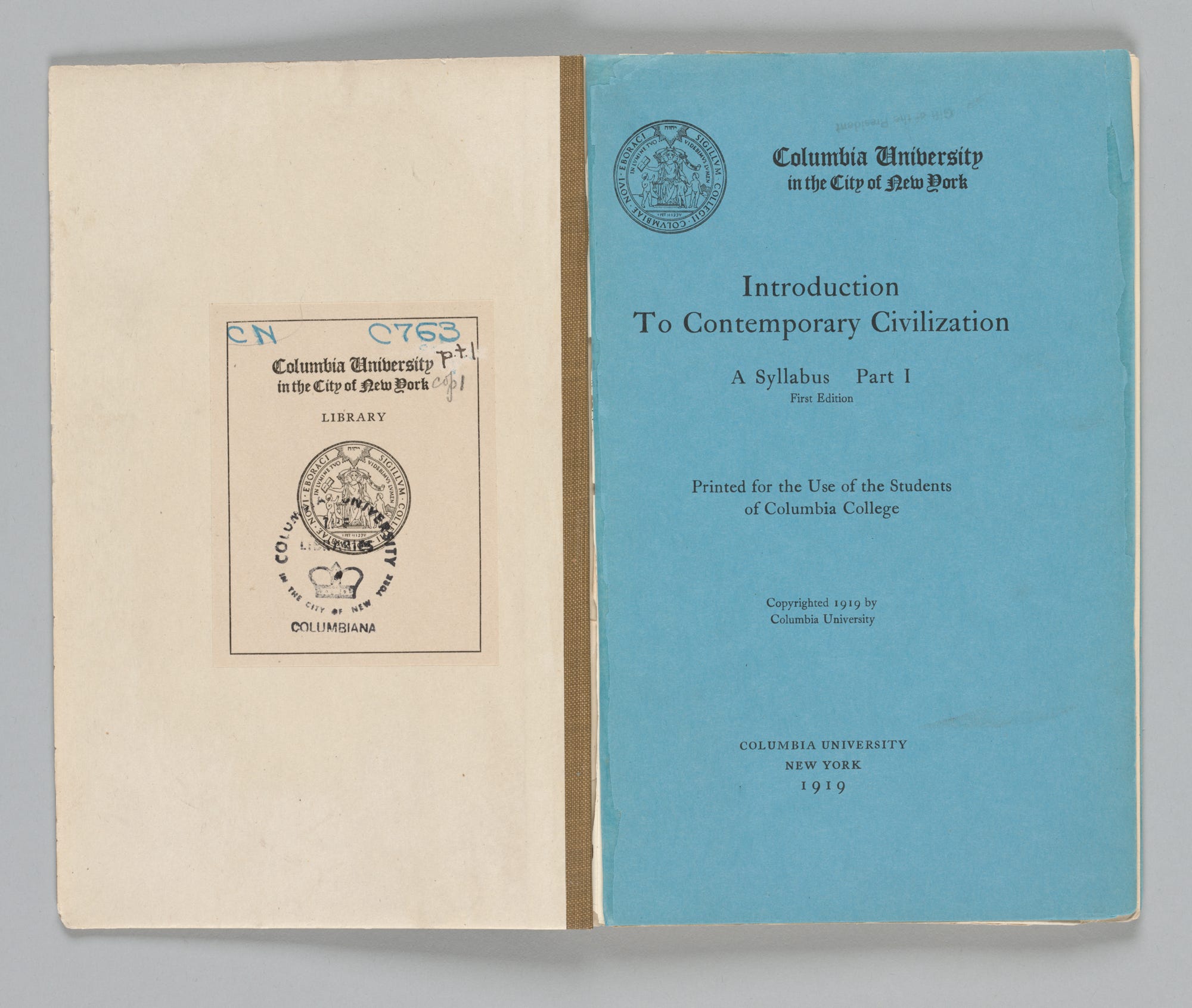
Cover of an edition of Introduction to Contemporary Civilization, via the Columbia University Libraries (public domain).
Columbia’s Contemporary Civilization course is the cleanest institutional case, and the date of its titling is genuinely unsettled. The course began in 1919 as a civics response to the war. Its official title is Introduction to Contemporary Civilization in the West. Columbia’s centennial materials imply the phrase was there from the start; the January 1919 faculty resolution records only “Contemporary Civilization”; the 1928 syllabus is catalogued both ways; and a historian currently teaching the course dates the retitling to 1946.
The candidates are not interchangeable. A 1919 title makes the civilisational framing a product of the Armistice. A 1946 title makes it a product of the Cold War. The question cannot be settled from published sources and requires the syllabus editions themselves. What is not in doubt is the order the course teaches: classical thought, Christian and Jewish thought, medieval society, Renaissance, Reformation, modern science, state formation, constitutionalism, Enlightenment.
David Gress named the simplified version “Plato to NATO,” and he is the most useful witness available precisely because he is a hostile one. Gress attacks the Grand Narrative in order to replace it with a better-founded West: he holds that the West is real, that it did not begin in Greece, and that it emerged from a synthesis of classical, Christian and Germanic culture between the fifth and eighth centuries. His account of the narrative’s assembly is nonetheless the most specific on offer. He dates it to early twentieth-century American educators and argues that after the Second World War it served propaganda as much as pedagogy. A defender of the category and a critic of it agree on when the story was built. That agreement is worth more than either testimony alone.
Josephine Quinn is arguing against something else and should not be enlisted here. Her target is civilisational thinking as such - Huntington’s premise that civilisations arise separately and that contact between them is intermittent - and she shows that the contents were globally sourced: Babylonian law codes, Assyrian irrigation, Phoenician sail, Indian literature, Arabic scholarship, steppe metalwork. That the ingredients travelled is established. When the container was built is a different question, and running the two together is how the argument usually goes wrong.
The category persists without anyone owning it, and explanations that look for an owner keep failing. Varouxakis makes the imperial account historically fragile, since the term was coined for an intra-European boundary by an anti-imperialist. Any account naming a single beneficiary also has to explain why the category’s opponents keep it alive.
A better mechanism is coordination value under increasing returns. Once a classification solves recurring problems, actors with incompatible purposes have reasons to reuse it. Universities need boundaries for courses. Museums need taxonomies for collections. Diplomats and governments need a shorthand for alliance and threat. Political movements need a larger us, and their opponents need a name for the thing they oppose. None of these has to agree on what the West ultimately is. Each needs only that the category stay legible enough for the others to understand what is being invoked.
The returns compound: each repetition of the classification lowers the cost of the next. Replacing the category would mean not proposing a better definition but rebuilding the network of references that already assumes it.
Gress’s Grand Narrative is the concrete instance. Once Greece-to-modernity became a standard educational sequence, later teachers did not have to construct the lineage again. They inherited a course.
Samuel Huntington’s Clash of Civilizations draws the same line for a different purpose, a century and a half after Comte and just as long after the Filiki Eteria was negotiating it with Kapodistrias. His 1996 map separates a Western civilisation from an Orthodox one centred on Russia, and his own justification for the boundary reaches past Comte entirely - he traces it to the fourth-century division of the Roman Empire and the tenth-century Holy Roman Empire. A Harvard political scientist working in international relations, with no stake in this essay’s argument, reconstructed the identical boundary and treated it as self-evident enough to build a foreign-policy framework on.
The same dynamic works without ideological agreement. A liberal invokes Western democracy, a far-right movement Western civilisation, an anti-colonial movement Western imperialism. The meanings conflict and every use preserves the category as an available unit of thought. No one captures the return, which is the coordination value of a classification other people already recognise.
The far right does not need to build an archive. It is already built, indexed and taught. What changes is a pronoun: Greek philosophy becomes our achievement, Rome our law, the Renaissance our rebirth.
Ashton Kingdon’s study of far-right appropriation of antiquity traces how Sparta, Athens and imperial Rome are recruited into racialised and Islamophobic narratives, with the whiteness of surviving sculpture treated as evidence of racial continuity. Rogers Brubaker’s account of civilisationism describes the party-level move: a European us against a Muslim them, with Christianity emptied of religious content and kept as an identity marker.
Neither operation invents its materials. Both require that a transhistorical archive already be intelligible enough to be claimed. The museum assembles. The movement asserts ownership. Ownership claims are only available over things already assembled, and the assembly was done by institutions with entirely different intentions.
This is also where the argument turns on itself. If treating the West as a coherent historical actor reproduces it, then an essay arguing that the West was constructed reproduces it too, by giving the category a biography and a birth date. The objection is correct and cannot be answered by disclaiming it. It can only be limited: an argument about how a classification was assembled leaves the assembly visible, which is a different outcome from an argument that assumes it. Visible is not the same as dissolved.
The strongest argument against everything above is Roman law. A jurist’s formulation enters the Corpus Juris Civilis under Justinian, is recovered and glossed at Bologna from the eleventh century, is taught across European universities for six hundred years, is absorbed into the Napoleonic Code, and is legible today in the civil law systems of France, Germany, Italy, Spain, Latin America, Japan and Turkey. Every link has texts, named people and dates. Nothing in the chain is retrospective; the documents were produced by the transmitters themselves rather than by later curators.
This is not the Gallery’s wall. The wall asserts a relationship. The law reports one, in instruments that had force at the time and can be checked against each other.
By the criterion set out above, Roman law clears the bar. It is a continuous legal tradition with a documented chain of succession, and the essay should concede it without qualification.
What it does not establish is that Roman jurisprudence, Netherlandish painting and the North Atlantic alliance are successive states of one social object. The chain is institutional rather than civilisational: it runs through specific universities, codes and courts, and it terminates in Japan and Turkey, which the same discourse places outside the West. Justinian codified in Greek-speaking Constantinople, which the received sequence omits. And transmission is not membership - a Roman jurist and a Turkish civil lawyer stand in a real documentary relationship without belonging to a community either would have recognised.
The concession costs the essay its largest version and improves what remains. There are demonstrable transmission chains inside what later gets called the West. Evidence for those chains is not evidence for continuity of the container.
The border is the most operationally binding classification regime that exists, and it does not reproduce the civilisational one. In July 2026 the Henley index placed Singapore first with visa-free or visa-on-arrival access to 192 destinations. The United Arab Emirates climbed three places since January to join Japan and South Korea in second at 188, having added 153 destinations in twenty years. Sweden holds third at 187. The United Kingdom is sixth. The United States is tenth at 180.
One hundred and fifty-three destinations in twenty years. That figure describes a state acquiring mobility for its citizens faster than any civilisational account would predict, through diplomatic reciprocity, documentary infrastructure and perceived overstay risk. The UAE does not become Western because Emirati passports open more borders than British ones.
At a border the hierarchies meet in one person and can conflict. The body is read before the document is opened. A Black American may be racialised as Black while holding a passport associated with extensive mobility. A white citizen of a state with a weak passport occupies the inverse position. Nationality is also an ordinary legal basis for differential treatment: a rule sorting travellers by race would be indefensible across most of the states involved, while a rule sorting them by citizenship is routine. Radhika Mongia’s work on Indian migration under empire and John Torpey’s account of states monopolising the legitimate means of movement show these systems have connected histories. Connected is not identical, and a ranking cannot settle how much of the older hierarchy was translated rather than abolished.
The prediction made earlier holds. Where classification is hard - enforced, documented, consequential at the point of contact - the category produced is not the West.
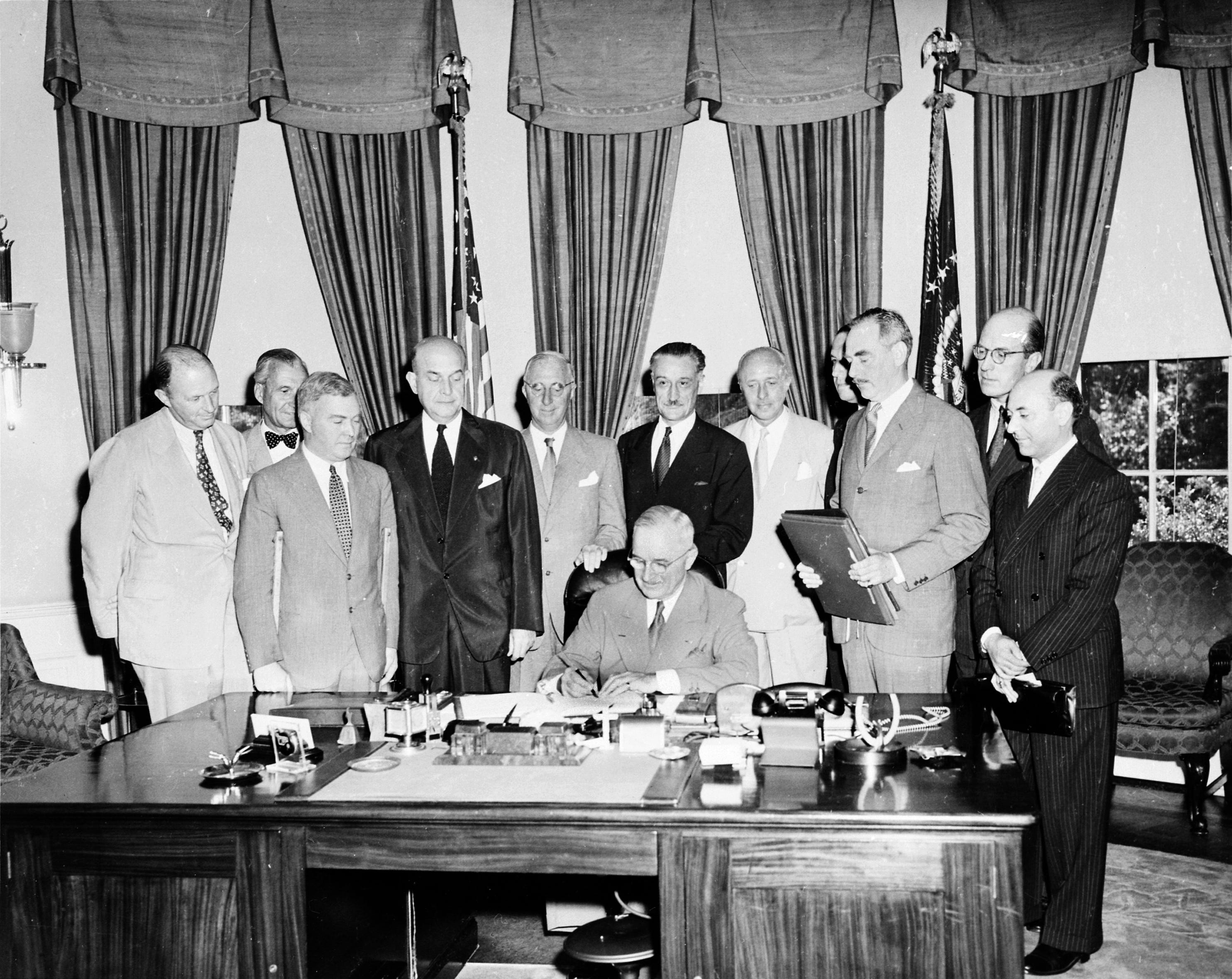
*President Truman signing the document implementing the North Atlantic Treaty, 1949 (US National Archives; public domain, via Wikimedia Commons). The cultural category eventually acquired an institution with actual members, procedures and obligations. NATO made one version of the West operational - but its membership still does not coincide with the broader political category.*

NATO is the exception, and it is sharper than it looks. The 2022 Strategic Concept commits to protecting one billion citizens, states that the transatlantic bond is indispensable and that the Allies are bound by individual liberty, human rights, democracy and the rule of law, and identifies Russia as the most significant and direct threat to Allied security and to peace and stability in the Euro-Atlantic area. It states an accession criterion: the door remains open to European democracies that share the Alliance’s values and can assume the obligations of membership.
That is a membership list with a procedure and a stated boundary, and the boundary is European. It excludes Japan and South Korea, which every other instrument in this essay places inside the political West. The institutional West and the discursive West are not the same object and do not share members. One has an accession protocol and a founding date in 1949. The other has a wall label and a birth date in the 1830s.
Two centuries after Comte, the sharpest institutional definition of the West still turns on the boundary it was coined to draw. The paperwork has changed. The line has not moved much.
The ambiguity is not a defect in the category. It is the condition of its usefulness. A term with a fixed definition can be checked against cases and found wanting. A term that operates simultaneously as a cultural inheritance and a political bloc can move between the two whenever either is challenged. Question the political membership and the answer is civilisational: Japan belongs to a tradition. Question the civilisational continuity and the answer is institutional: NATO has a treaty and a date. Neither register is available for falsification while the other is in use, and each lends the other a legitimacy it has not separately earned. The alliance borrows the depth of the museum. The museum borrows the reality of the alliance. That is the pivot, and it is where the two halves of this essay meet.
Most of the people placed near the start of that genealogy did not know a community existed to be placed at the start of. The name arrived after them. Its geography, membership, religion, politics and boundaries have all changed since, and the objects have not moved. The classification is what moves.
I called this piece I Met the West, Which Wasn’t There. I want to know if the title survives what came before it.
By one measure it does. The West has no census, no border it patrols, no authority that can compel anyone to be Western - Byzantium held the stronger claim to the ancestry and lost it anyway. Measured against a nation, it fails every test.
By another measure it doesn’t survive at all. NATO has a founding date and a treaty still in force. The Gallery has a route, walked daily, unremarked. Roman law travelled from Justinian’s Constantinople to a courtroom in Ankara, documented at every step. None of that is imagined in the sense of false. It is imagined the way Anderson meant the word: built, and real regardless.
The man on the stair is half right, then. He is there and he is not, and which one depends on what is being asked.
I know one thing no catalogue records. I have crossed the join. I have walked from rooms containing painters who could not have called themselves Western into rooms containing painters who could. I have done it more than once. I did not notice when it happened.
There is no threshold. No label announces that the category has now entered history. No change in the route tells the visitor that the painters on one side lived before “the West” became available as a collective political name, while those on the other side lived after it. The paintings continue. The chronology continues. The classification remains continuous even where the thing being classified changes status.
That is not evidence about what Titian or Turner believed. It is evidence about the arrangement I actually encounter.
I can stand in front of Turner - and I usually linger, especially when The Fighting Temeraire is involved - knowing that he lived long enough to inhabit the period in which the term had begun to circulate. I can then walk backwards towards painters separated from that vocabulary by centuries. Nothing in the Gallery asks me to change categories on the way.
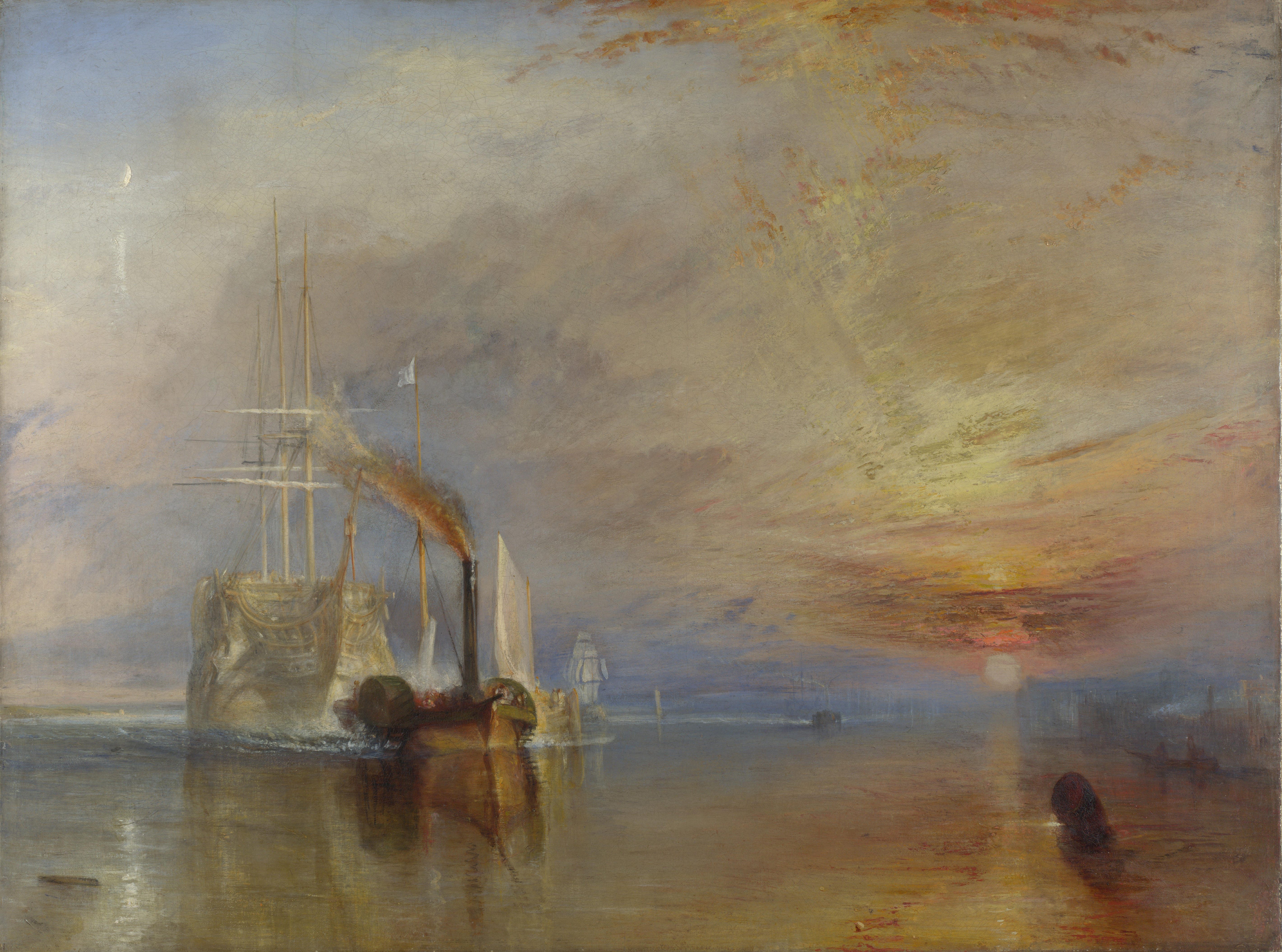
J. M. W. Turner, The Fighting Temeraire, 1839 (National Gallery, London; public domain, via Wikimedia Commons). Painted while the modern political language of “the West” was itself coming into use. It is also the painting before which I become conscious of having crossed the join.

The same name covers both sides. That continuity exists in the route even where it did not exist in the language of the people whose work supplies the route.
The sources can date the category. They can date the paintings. They can reconstruct transmission, patronage and institutions. What they do not record is the ordinary experience of crossing from one historical condition into the other without being told that a crossing occurred. The join remains unmarked.
Further reading.
Benedict Anderson, Imagined Communities: Reflections on the Origin and Spread of Nationalism (Verso, 1983; revised 1991), especially the chapters “Census, Map, Museum” and “Memory and Forgetting.”
Eric Hobsbawm, Nations and Nationalism since 1780 (Cambridge University Press, 1990).
Radhika Mongia, Indian Migration and Empire: A Colonial Genealogy of the Modern State (Duke University Press, 2018).
John Torpey, The Invention of the Passport: Surveillance, Citizenship and the State (Cambridge University Press, 2000).