I haven’t talked much about the state of social media and the internet this year, at least not compared to other people who can’t seem to leave the topic alone. We’ll talk about them later.
People saying followers don’t matter and social media is not about your friends anymore isn’t new, but it gets more true by the day and has led to much more than the usual “no one watches my videos anymore” reactions at family gatherings.
Over the past few years, I’ve seen people go from posting about their neighbourhoods to making reactionary videos about whatever topic is trending. Their engagement went up. While they didn’t reach their friends and family, they reached someone. And soon they started catering to that audience.
That gave rise to a fair chunk of creators who cater to audiences and topics that don’t hold much debate in the real world. Jubilee and the people you see on that channel wouldn’t exist without the dynamic of algorithms treating people as topics or keywords and pushing them toward other keywords, not toward people who actually care about them.
Those creators, and many others who didn’t grow their audience by accident, are now also facing the harsh reality of feeling like “followers don’t matter,” and they are jumping from one roof to another. It will take them too long to realise they left their own self behind.
We are already seeing this dynamic play out in the political world. People don’t matter. Their views do. It is a by-product of social media treating everyone as another piece of content and a list of keywords.
All of this is going to turn the marketing and creator world into a game of attention that only lasts seconds.
If Reddit changing its key metric from “members” to “visitors” isn’t a hint, what is? It is the path forward. As marketers, we shouldn’t be that concerned about the “death of followers,” because it is a fairly new concept if we zoom out from the Internet.
As regular people, we should be concerned. Some think attention is only craved by the narcissists or the greedy, but that is not true at all. Attention is a survival tactic for many. It is a call for help. You can’t use ignorance to solve this problem. Social media needs to change for the better.
AI chatbots are visiting websites, scraping information, and serving it to everyone on a minimalist plate. As a user, you feel the joy of not seeing pop-ups. As a publisher, you are enraged. As a writer, you feel unaddressed and fear the next set of layoffs might take you out.
What will happen is a question I can’t answer, and I don’t allow myself to make many judgement calls.
I’m only aware of what’s happening, and that is: the user interface of the Internet, news publishers, and apps like DoorDash is consistently under threat from scraping and is being abused by bots. Their decisions to partner with AI companies might mislead you into thinking they are okay with this change, but in reality most of these decisions can be considered risk control measures.
AI Overviews, Perplexity, and ChatGPT aren’t threatening the medium of the Internet or information as much as they are threatening the purpose of both.
Just like brainrot isn’t threatening literature itself; it threatens the way we as humans communicate and what we consider acceptable in daily life.
The Internet is asking itself questions about the purpose of making a website, designing a blog, curating information, archiving work, and so on. Wikipedia and the Internet Archive aren’t threatened by AI as a technological innovation; they are worried about their purpose within the constructs of the Internet.
Most people writing blogs and sharing their expertise aren’t publishers trying to monetise their work. Most of the focus right now remains on “What will the publishers do? Will they allow AI companies to use their content?” and many are already bending the knee.
Just like they bent the knee for Facebook, TikTok, and every other platform. Even if they don’t, the information flows. The question about information and copyright is the wrong question.
It’s about purpose. The Internet is not going to die the day every publisher signs the licensing deals and some people stop designing websites for humans and keep information onboard for AI bots. It will die the day we, the people, decide the structure, the aesthetics, and the culture of the Internet no longer matter.
Whenever I hear discussions about AI-generated content becoming the norm on social media, non-marketing people, including tech founders, say, “People will continue watching real people. It will just be the advertising industry using these tools.” And they are right to a certain extent.
That’s not the sentiment I hear from marketers. Yes, the anti-AI crowd is still the majority in our industry, but they are also in full panic mode. The marketing leaders on my feed are training AI and decoding its behaviour like a therapist, but they still believe in human creativity.
Strategists are running every bit of research through AI and treating it like a spelling double-check before you submit the essay.
The big agencies launching audience reaction simulators for creative testing doesn’t seem like a bad idea when you were already doing the same thing at your job level.
I’m not against AI tools, and even if I was, who gives a f**k about my take on AI? All I’m saying is there are an awful amount of people in our industry, including companies like WPP, that are basically in bed with AI and consoling others the way they would console their wives if she found out about the Tinder profile.
Here’s a more reasonable rant/post on the marketing and AI topic that I wrote earlier this week:
Since the ’90s, marketers have been trying to describe the indescribable, human behavior.
The never-ending loop is: we turn people into data, then data into presentations; presentations turn into conversations, conversations turn into ideas, and those ideas turn into messages that reach people.
Everyone in marketing hates one or two sections of this loop, and the story goes…
What if we automate or get rid of XYZ from this loop? Martech.
Just like every other industry, marketing is also obsessed with productivity, which means people are trying to automate everything in the name of “that’s the future, dawg.”
Hence, MarTech. Platforms like HubSpot, Salesforce, and The Trade Desk have been more influential than any agency or campaign in determining how marketing works.
But every year, we are reminded how useless some marketing tools are, and even platforms like HubSpot and Salesforce haunt us with their new updates that no one will ever use It’s 2025. McKinsey says, “AI can help with that.”
Can anyone articulate the value of their martech stack? According to new research by McKinsey, no, they can’t.
None of the 50-plus senior marketing leaders McKinsey interviewed could clearly articulate the ROI of their martech investments. Instead of tying outcomes to revenue, customer lifetime value, or business growth, most track operational metrics—email sends, open rates, impressions, and reach.
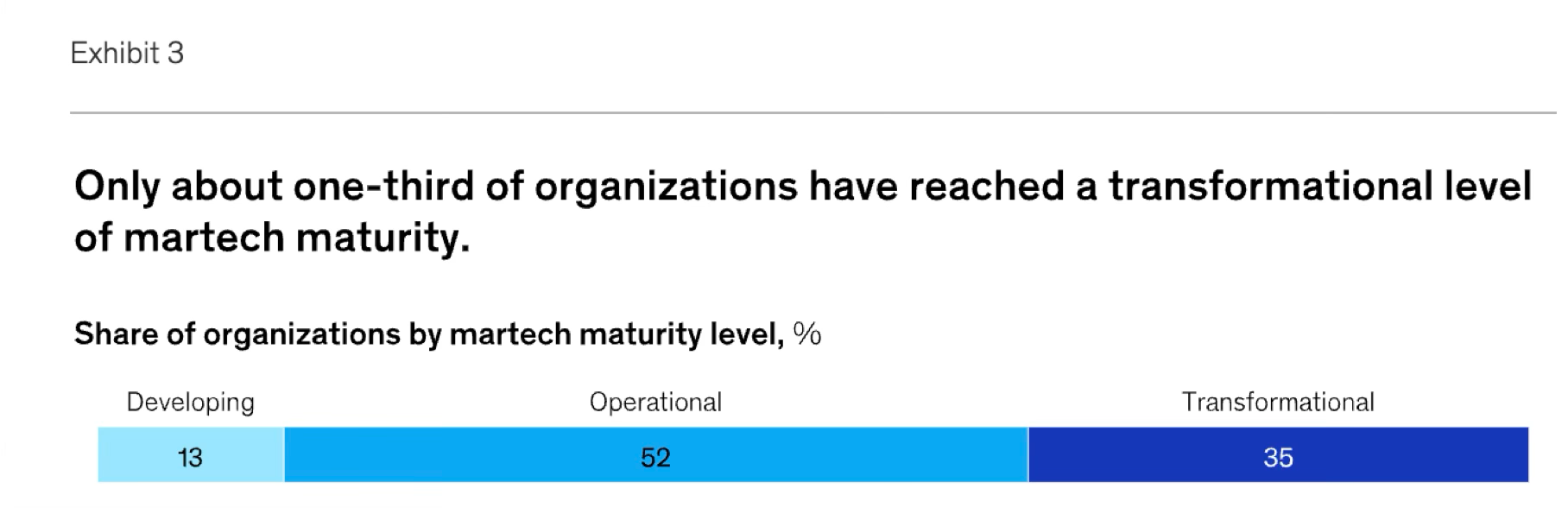
I want to point out that every piece of research mentioned in this post came out within the last two or three weeks. Timing matters, it shows us where we are headed.
MarTech primarily supports how the media business works, and it’s also f**ked, says the WFA. Fifty-six of the world’s biggest companies, representing $52 billion in annual media spend, reveal that just 25% of marketers believe they have the right level of resources and capabilities, and a similar proportion (26%) feel they have the right technological infrastructure in place.
When it comes to AI, an even lower proportion (19%) feel they are in a position to effectively scale its use across their media investments.
Probably because most people handling media no longer understand the landscape. Why? Media is becoming a butcher shop, and Amazon is accelerating everything. Understanding media is no longer about knowing the audience, category, city, or even the strategy.
Most marketers in media are just doing ad management work, and the few roles that do involve actual media planning are transitioning into comms and strategy roles.
On top of that, Amazon is doing to media what it did to shopping. The process of buying media is going to be smoother than ever, good news for brands, in one way or another. But it’s not going to eliminate all the problems we already face. Media planning has become about distribution, and concerns about brand safety and intent are forgotten.
How do I justify my job and the marketing budget? Annoy & Deploy.
Bureaucracy and management culture poison marketing. For a very long time, we’ve known that filling the market with too many messages about your brand is the worst mistake you can make.
Shutterstock’s 2025 Creative Impact Report finds that consumer/viewer believability drops after just three campaign messages. Multi-format campaigns built around a single, clear idea deliver 40% more ROI than single-format efforts.
That’s the new number. Multiple studies from Kantar, IPSOS, and others have shown similar results. But we don’t listen to these stupid stats, every quarter needs a new campaign, and it has to amaze the executive marketer who has nothing in common with the brand’s audience. They want new campaigns to justify their own roles.
Good or bad, marketers in general face more scrutiny than other corporate departments because the end product of marketing isn’t immediate, no matter what the dashboards show. All that matters to the C-suite is business growth.
While new data from PwC and the ANA show that marketers continue to deliver growth, trust in the industry and in CMOs is lower than ever.
Over the past five years, leading marketers delivered an annualized total shareholder return of 23.3%, outpacing the S&P 500 by 8.8 percentage points.
We truly have a communication problem as marketers and creatives stuck in the corporate sh*thole, and the data doesn’t lie. CMOs are being asked to do more with less, only 27% leaders feel their organizations are well-equipped to handle the broadening remit.
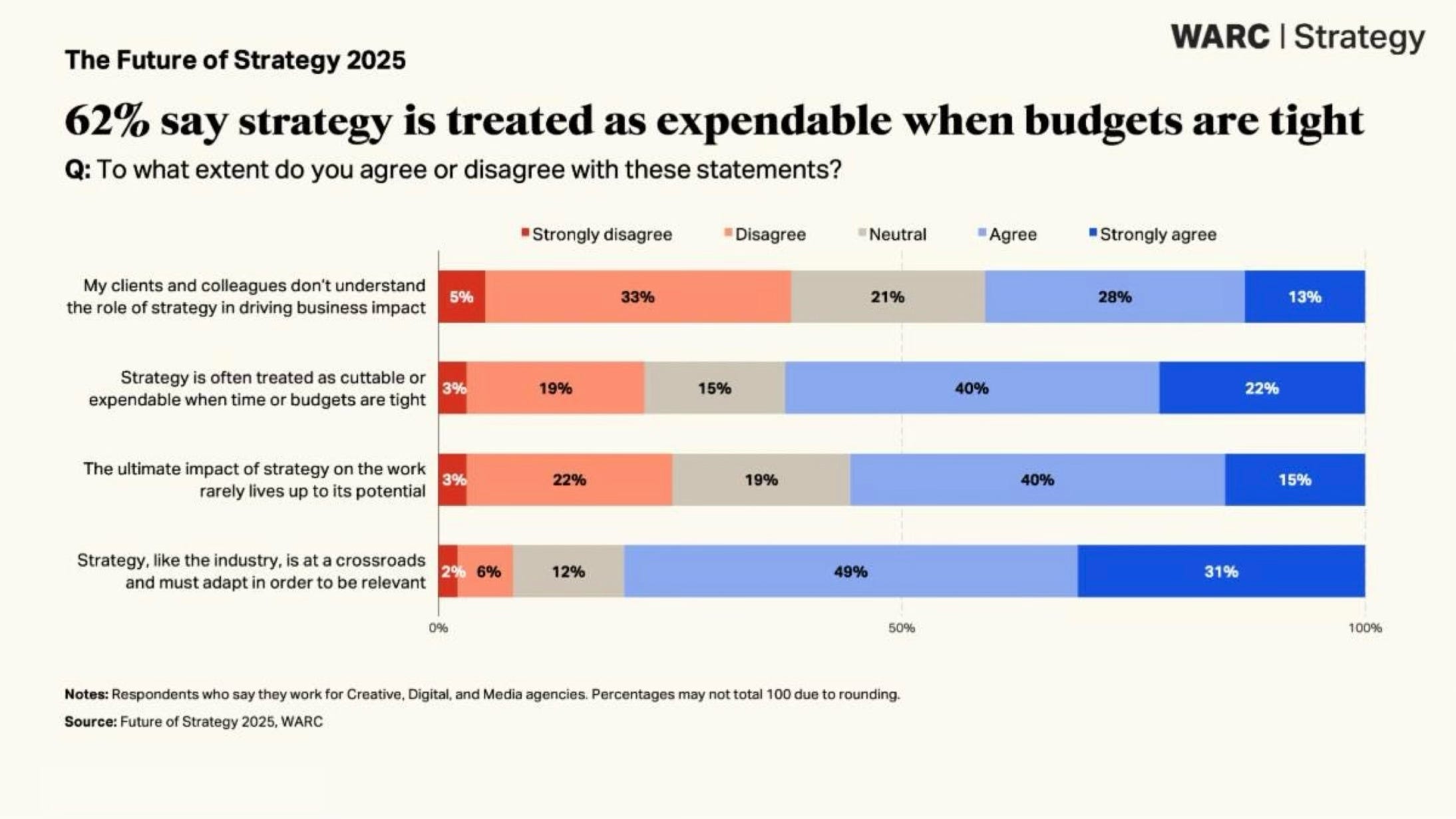
I can fill more pages with problems and data showing that marketers are already in trouble, but the question I’m here to answer is, “Can AI unf**k all of these problems?”
If it’s not obvious by now, the answer is “no.” But agencies and holding companies are so out of touch that they are now launching tools that simulate audience reactions to future campaigns and generate synthetic data to save money on research. The same agencies scream about authenticity at Cannes.
In 2025, brands are struggling to escape all the political and non-political chaos. Their content, meant to evoke positive emotions, is surrounded by negativity, ragebait, and sadness.
The answer for most brands on social media has been either to evade the comments or clickbait audiences through other niche communities. What I mean by that is: reactionary coverage has become the only safe or contextual space that allows brands and audiences to take in the full context.
Brands are paying creators, Instagram accounts, reposting content from employees, and manufacturing PR articles that turn their first-person marketing efforts into second- and third-person efforts.
It all sounds very typical, but the catch is that everyone is posing as a third party to make it sound authentic. You have to manufacture a reaction before you push out the campaign, because when there is nothing surrounding your campaign, there is nothing protecting your brand from other content that steals the attention.
Dear brands, you can do much more than posting memes as quotes and using AAVE to impress online audiences.
TikTok comments now allow images, and guess what? You could actually do something funny by creating a set of images ready for audience reactions and dropping them into other viral videos. It would be more creative than what most of you are doing now. A lot of regular people are already posting their own images in hopes they turn into memes.
The same goes for Instagram. A ton of creators and brands have already uploaded their images to Giphy, and you’ll see that if you search any random keyword.
Those will do more for your brand than whatever dumb comment you made last week just to hit your engagement quota.
And yes, I’ve done a fair share of them in the past, and there are reasons I never explain them. One, they are always up for interpretation. Two, they get engagement if you shut your mouth.
Now, I’m not saying aesthetics, trends, and social media aren’t that deep. Every single object surrounding us has a huge lore behind it. But there are a lot of bad cases when it comes to people creating diagrams about where culture is headed.
One, people are trying to rebrand their personal consumption as a form of critique. They’re abandoning existing context to push their work forward as a new discovery.
Take me as an example: a lot of people might consider “algorithmic nihilism” a pretty useful term to explain what we’re experiencing now. But chances are, a better term already exists and I just didn’t take the time to find it.
And that’s the problem. A huge chunk of people aren’t citing the work or acknowledging what already exists.
Two, the news cycle today is filled with stuff that makes you feel like everything is changing, but nothing really does. So it becomes extremely important to ask yourself: has anything changed in my life to prove what I’m writing?
We have access to an unlimited amount of data and images. You can prove anything if you don’t care about “correlation does not imply causation” or have no integrity.
Three, it’s all about personal branding. Our obsession with taxonomies and trends is a direct response to the job market. People feel the need to personalise their work and knowledge to come across as the ideal person to do XYZ job.
Another layer of classification has been added to the topic of trends, generations, and human behaviour, and it’s to sell marketing and ideas to each other, not to solve the problem.
Because cultural norms don’t change as fast as we think they do, and nothing is new under the sun. The search for “new” still looks down on us, and we ought to have the courage to cite the past and not treat it as an anomaly for personal gain and marketing.
The context collapses within minutes.
Nostalgia & IP, people recognise the attempt from miles away.
Reddit is getting bombarded with promotional bots, and r/SubredditDrama has become the biggest spectacle on the platform, showing how we no longer care about having control over our beliefs.
Instagram is struggling so badly with content moderation that not a single marketer talks about how young adults and teens often refer to the platform as “my racist app.”
For years, people have complained that Meta’s advertising targeting is more accurate than their algorithmic recommendation system.
The pace of content consumption on TikTok and Instagram Reels leaves no room for creators to change the interpretation after you post. Most people skip the caption. You have to remind them to check again!
X and Threads are filled with ragebait and content that is either the most mainstream news ever or something only that specific audience cares about.
Brands are ignoring everything and interacting with each other when they actually have the opportunity to focus on 1:1 interactions instead of engagement bait. Or they could focus on hyper-active users who still tweet a gazillion times within a few days or hours. They understand the platform. You should focus on that audience.
Just look into the Museum of Twitter and you’ll learn how even tweets with 100 likes turn into cultural codes for audiences on and off the platform.
Distribution is the new game. Every news publisher has their own version of Flash News, sports media is posting highlights by the hour, meme pages have other meme pages to post about new trends.
Simply put: if your brand has only one handle, it needs another to boast about everything it sells.
Substack is now filled with people who only joined recently to get distribution, and the platform pushes content more relevant to BookTok audiences than to the users on the app.
The writers and journalists who moved to this post-algorithm world struggle after a few months of joy, because they don’t engage with romanticism or post images that get all the engagement.
People are consuming slop content and hiding their real thoughts. People may find AI visuals disgusting, but they’re still watching AI summarise a whole movie with B-roll in the background.
The clipping farms are now removing the number one answer from their “Top 5 XYZ Moments” clips, and some are even ranking dialogues instead of scenes in these compilations made to farm engagement and money.
Social media trends are also downgrading the amount of context needed to hit the slop standard. “Humans saw this and created XYZ” turns into “Girl/Dude, whatever,” and soon it will be just one word.
“Less is more” now applies to people valuing Instagram Story likes more than comments or post likes.
Pinterest is pushing a platform of positivity, but the complaints about AI slop and ads are haunting the platform. While Pinterest promises change with new updates, the real problem is advertisers treating the platform’s ad strategy as secondary. Very few brands create native content to actually engage with audiences.
Reddit has a similar problem, with advertisers pushing the same old creative as “new” Reddit ads. Some brands are making an effort to change that, and Reddit is beginning to integrate native formats and guidelines into the platform. Pinterest has something to learn from Reddit.
If we leave the ad business aside, it’s still good news that unlike Meta and OpenAI, Pinterest isn’t trying to become the next slop platform. If it did try, it would probably be better at it than Vibes or Sora, because Pinterest’s systems of curation and personalisation are stronger and give users more control.
I don’t have much to say about YouTube as a platform. The improvements and problems YouTube faces now have more to do with its TV business and the lobbying it does to stay part of the kids’ brainrot loop.
It went through a spree of “anti social media” and “death of media literacy” video essays over the last few years. What you were seeing on TikTok in 2024 and early 2025 was just the end product of YouTube finally being done with that phase.
What I’ve come to dislike about social media is how it feels as if everyone is waiting for someone else to say the thing, and only then will they take action or support something. We are being robbed of our personal thoughts, not by anyone else, but by ourselves. It’s the age of self-censoring.
We censor ourselves for different reasons. I won’t decide what to watch until I read what Letterboxd has to say.
I won’t advocate for XYZ cause unless it benefits or harms me in some way. Even if you keep politics aside, LinkedIn as a platform embodies what self-censoring looks like in the current job market. People don’t share their personal beliefs. They would rather use someone else’s beliefs or identity to make a point because it benefits their career more that way.
Gen-Z, and most people on social media, would rather show their beliefs through reposts and reactions than fight for XYZ themselves. It’s not AI. We are already de-platforming ourselves because of fear, convenience, and greed.
None of this matters to the majority of brands. The playbook of escapism, nostalgia, IP, and collaborations continues to thrive, but it’s all getting too expensive and played out.
Brands think the answer is to create a moment of socialisation within the content. They are running social media strategies like PR nightmares: someone goes viral and the collaboration goes live the very next day.
It all works out in the end, as long as you ignore the fact that most top comments are from fellow marketing people and the campaign never integrates with other brand initiatives. Most importantly, the margins are getting thinner than ever.
Am I being too pessimistic? Yes, but marketers need to care about the overall business and the customer just as much as they care about “good marketing.”
As we always say to our kids, “what is good for one person may not be good for another,” and that is exactly how business works. We’ve cooked up this imaginary marketing playbook to win on every channel, but there is no playbook for winning people over with the same old lies and still keeping the business open.
I’m neither the best person to lecture you about any of these topics, nor am I the most articulate person to convince you. The purpose of this post is simply to expose you to certain arguments and ideas that also exist in the space of social media.
The typical playbooks and B2B content are relics of the past. The marketing industry is suffering, and we need to get past the things that hold us back and make consumers live through boring marketing.
Back to the usual…
Self-Awareness: A cool brand understands its position in the market and in the mind of the consumer. It tries to keep itself away from “How Do You Do, Fellow Kids?” Energy.
Zeitgeist: A cool brand’s marketing either tries to embody what the zeitgeist is feeling or fights against it with its own merit and purpose.
GAP vs. American Eagle and PrettyLittleThing Rebrand vs. Ben and Jerry’s are examples of marketing efforts influenced by zeitgeist.
Aesthetics: A brand that looks cool is also a “cool brand.” You can influence people with aesthetics and branding. You can either do that by following the ongoing design trend among the trendy brands or by using a palette that’s universally considered “cool” in one way or another.
Volume: A cool brand doesn’t engage too loudly with its audience. It has to keep its messaging calm and limited. Most brands do this by limiting their distribution and retargeting channels to different audience segments and specific periods of the year.
Collaborations: A brand maintains its cool by collaborating with people who support its long-term growth and identity. Collaborations allow a brand to create an exchange between multiple audiences, brand identities and, categories. You diversify your coolness through collabs.
Brand Connection: For most brands, being considered cool is temporary, and their cultural perception changes as time passes. The anomalies are brands that provide their customers with an experience, product and message worth passing on. It sounds simple, but these products have to be universal and personal at the same time.
Back on Sunday. Until then…