
Reality drift often appears as the gradual expansion of procedure around ordinary life. The original task remains simple. You want to check an account or return an item. Yet each task becomes surrounded by verification steps, interfaces, and prompts.
These layers usually begin as attempts to improve the process by increasing security, reducing risk, or making outcomes easier to measure. But the system can only optimize what it can represent. The person becomes an account, and the problem becomes a category. Success is gradually redefined as the completion of a step rather than the resolution of the original problem.
As those representations take over, the original constraints weaken. The system no longer has to solve the problem directly. It only has to record or process it correctly. On the surface, nothing is obviously broken. The system continues to function while the distance between intention and outcome keeps growing.
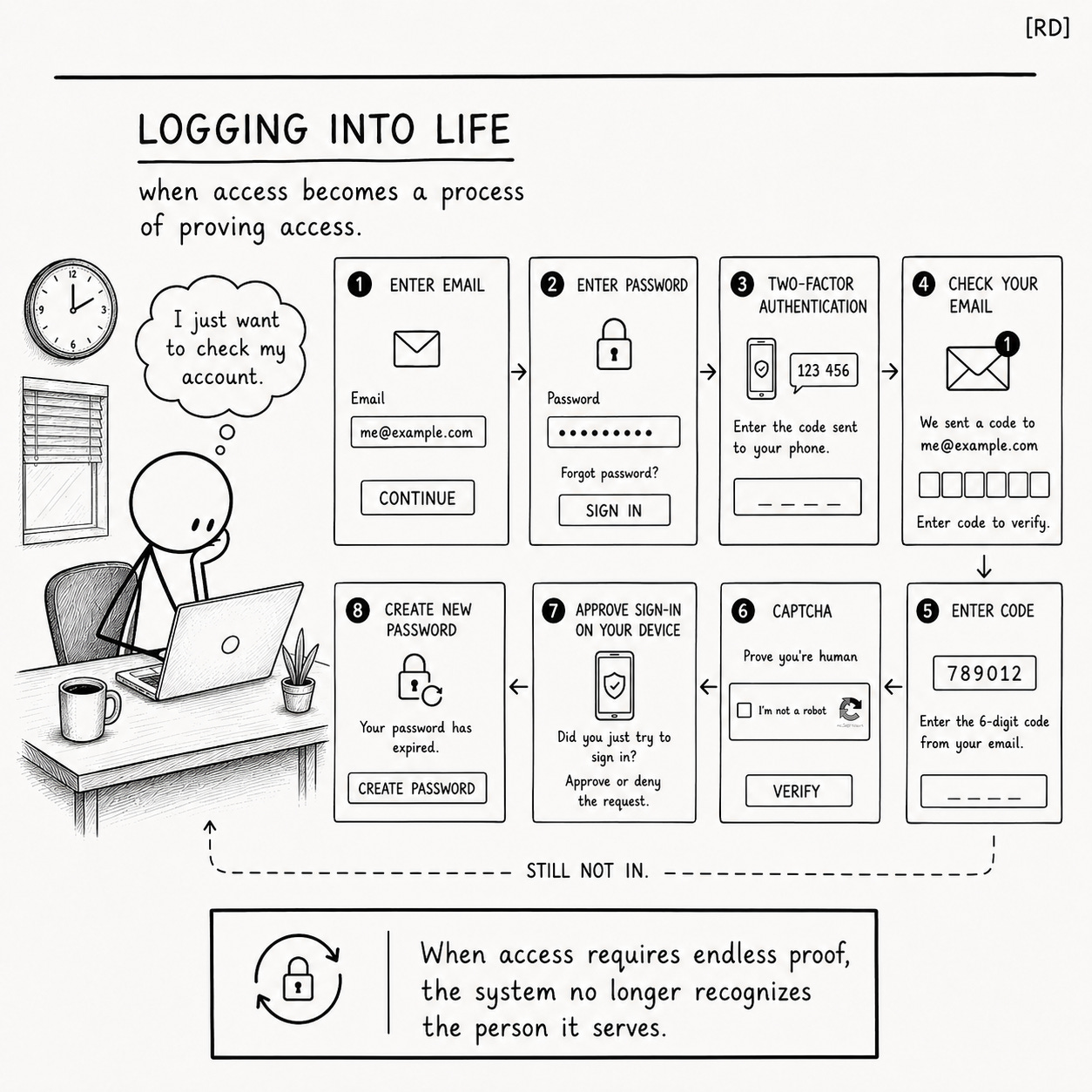
Access once meant possessing the correct ticket or password. It now often requires proving access repeatedly across several connected systems. A person enters an email address and password, retrieves a code from another device, completes a CAPTCHA, approves the attempt, and may still have to create a new password before reaching the account. Each step can be justified in isolation, but together they transform access into a ritual of authentication. Reality drift appears in the growing separation between the person’s legitimate intention and the system’s ability to recognize it.
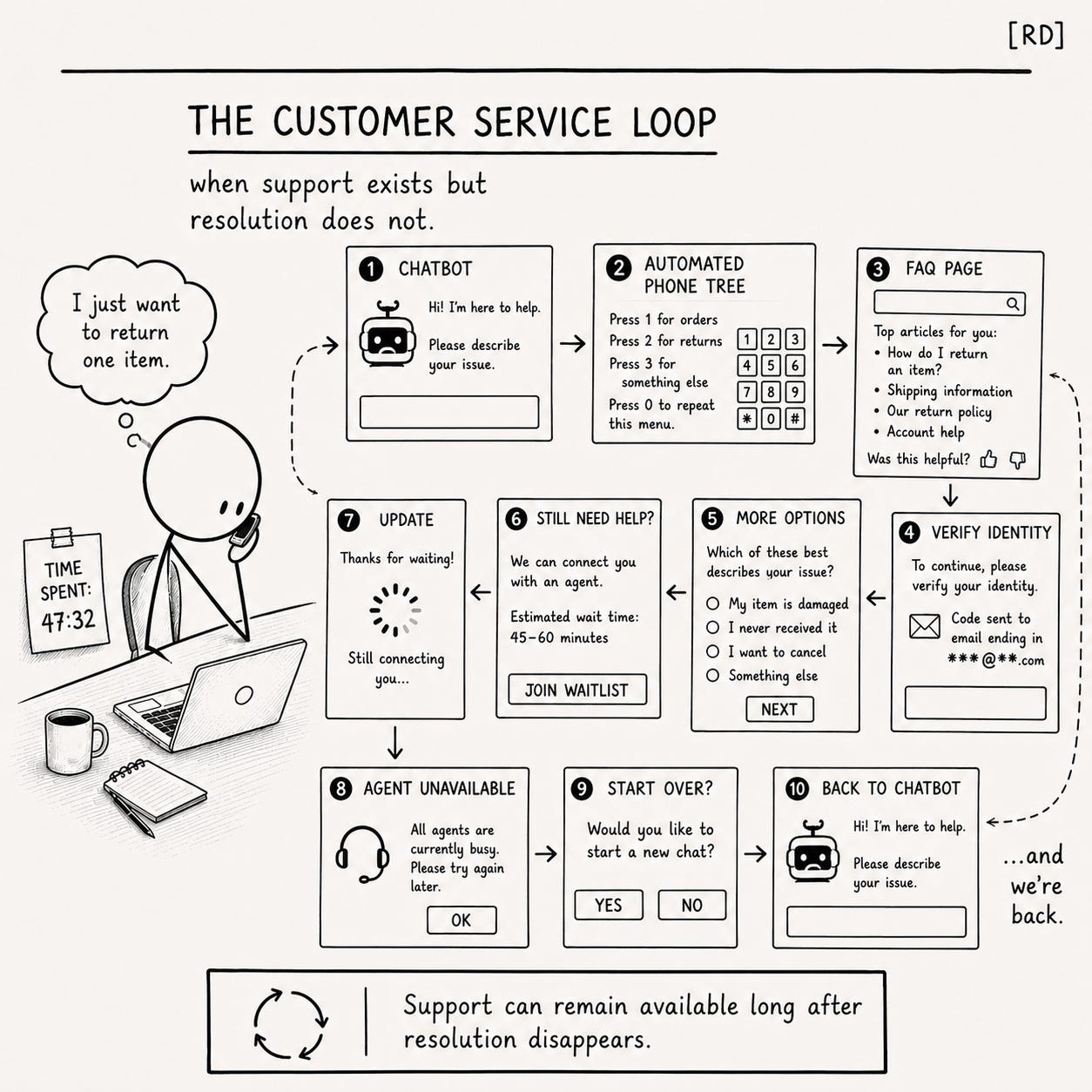
Customer support can remain fully operational while becoming increasingly detached from resolution. The customer may pass from a chatbot to a phone tree, then through FAQs and identity verification, with each system performing its assigned function. Yet the original problem remains untouched. The user moves through a sequence of systems that represent help without necessarily providing it. This is a clear form of reality drift. Procedural activity becomes evidence that support exists, even when the outcome the customer needs is never reached.
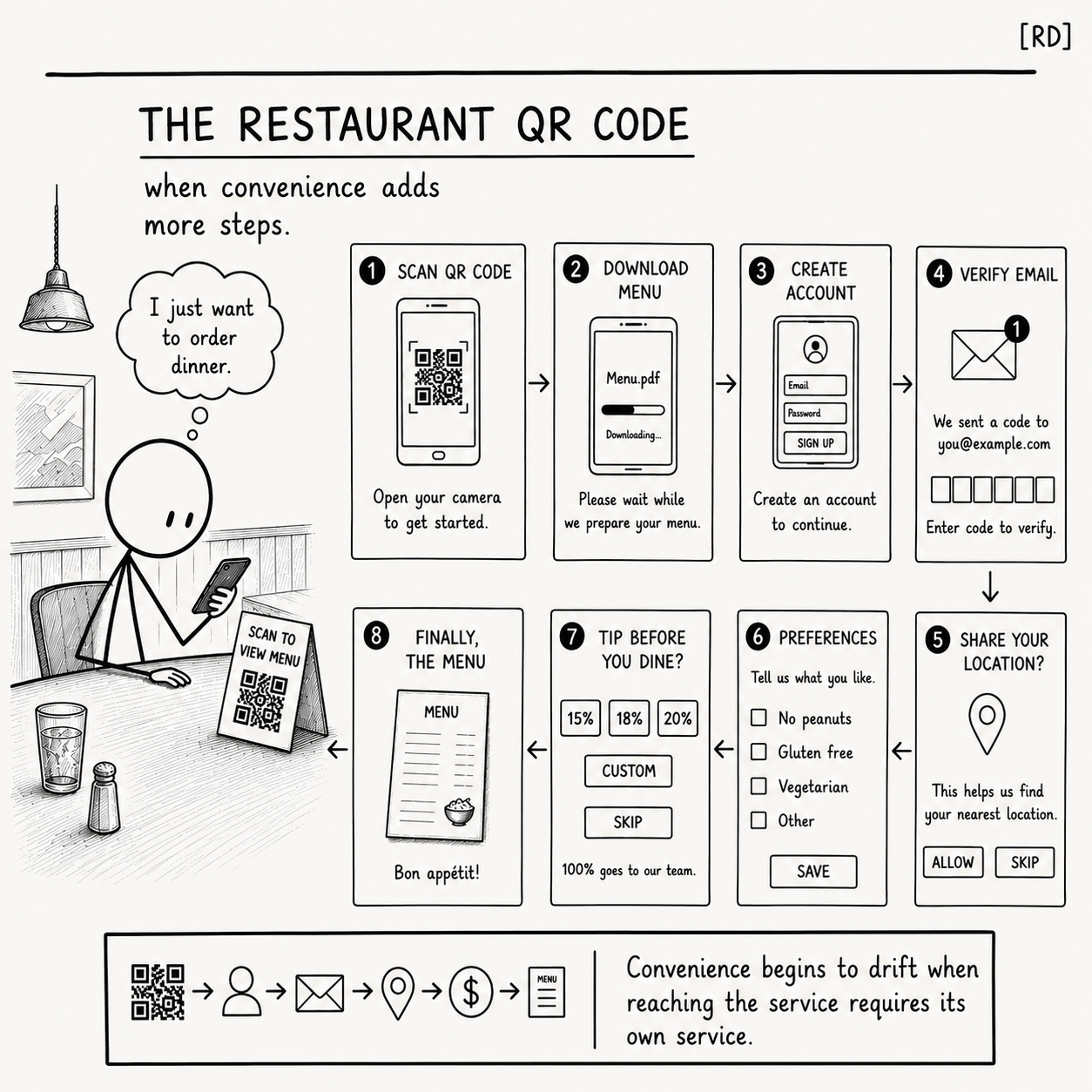
The restaurant QR code shows how convenience can add layers between a person and a simple action. Ordering dinner may now mean scanning a code, waiting for a webpage or menu to load, and moving through cookies, location requests, account creation, and other prompts before the menu becomes usable. The restaurant has not stopped serving food, and the digital system may technically work as intended. But the interface increasingly serves its own informational and commercial objectives alongside the diner’s objective. The task survives, while its surrounding structure becomes larger than the task itself.
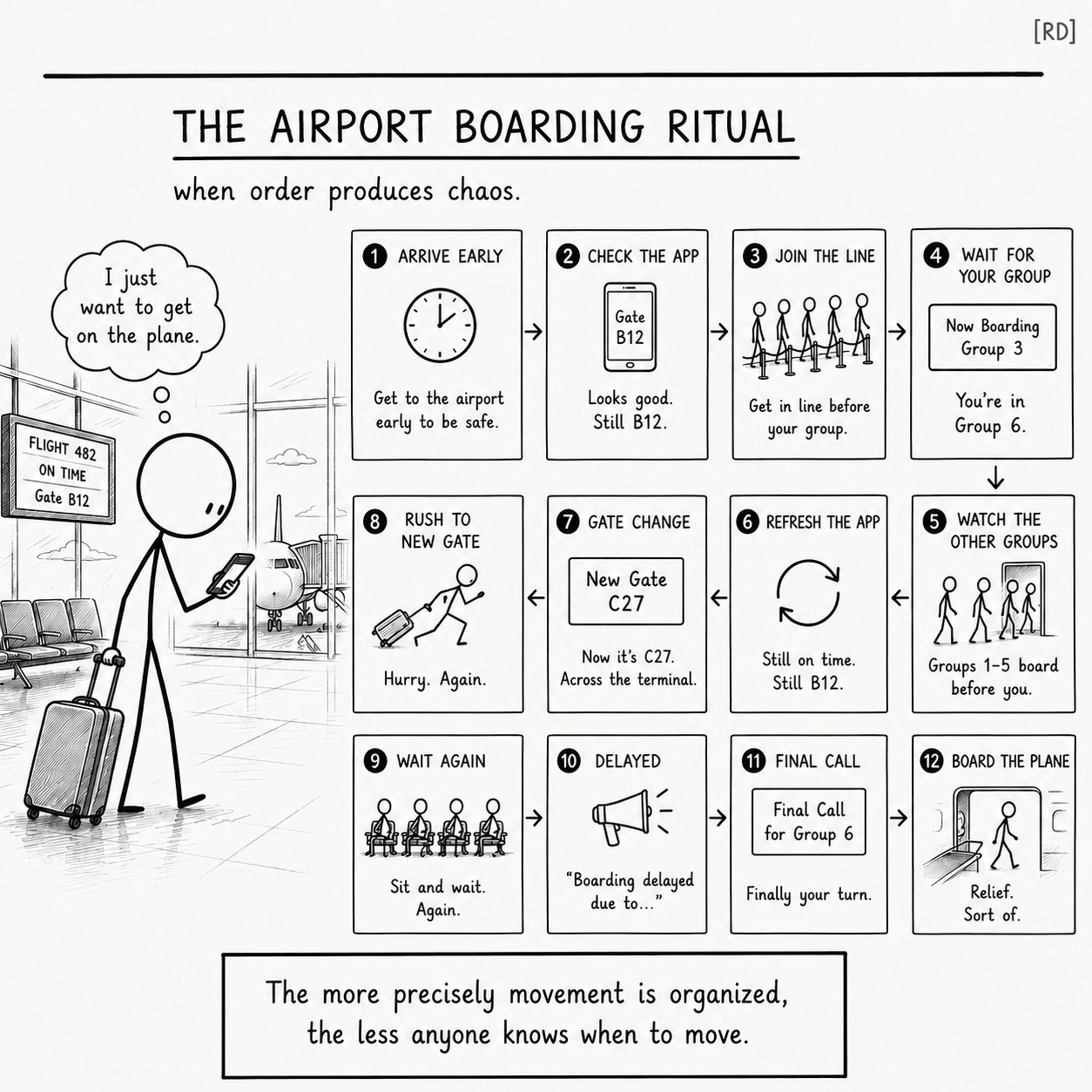
Airport boarding is organized through overlapping systems of grouping, priority, gate information, and live instruction. These systems exist to coordinate movement, yet they often produce repeated checking and sudden confusion. Passengers who simply want to board must monitor a shifting procedural environment in which following the rules can still leave them rushing across the terminal or waiting in the wrong place. Order has multiplied until the experience begins to resemble disorder.
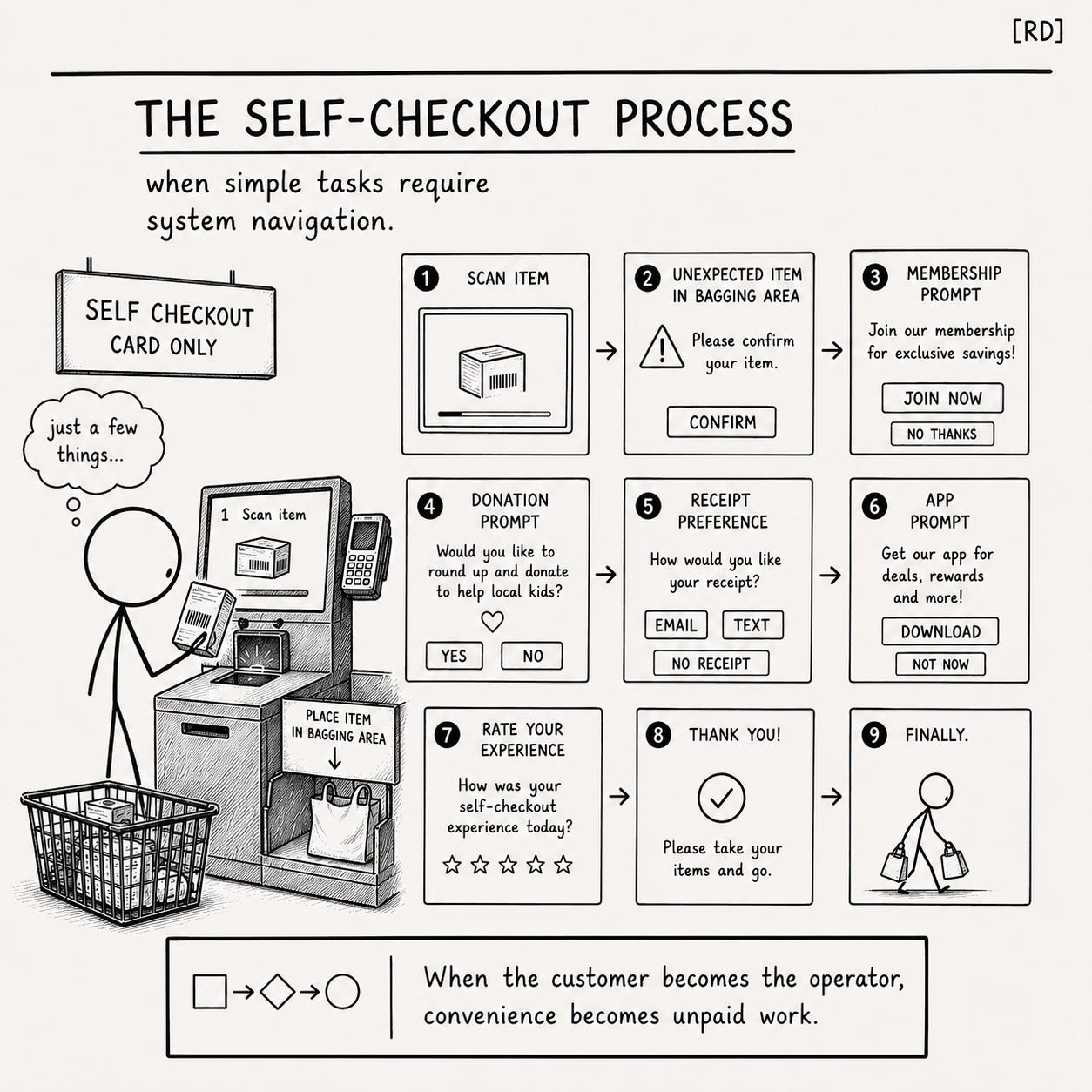
Self-checkout transfers a routine transaction into a small system-management exercise. The customer scans and bags the items, works through payment and membership prompts, and may still need an employee to override the machine. The system appears efficient because fewer workers are directly involved in the transaction, but part of the work has simply moved onto the customer. Reality drift emerges when the metric of efficiency improves while the lived task becomes more demanding or more fragile.
These examples are not just complaints about inconvenient systems. They show the same mechanism already visible at a macro level in modern institutions. An activity gets translated into something the system can represent. That representation becomes the target of optimization. Over time, the constraints that once kept the process tied to its purpose begin to weaken.
The system becomes better at processing the representation while becoming less reliable at producing the outcome. A patient can move cleanly through the billing system without getting better, just as a student can leave with a score that says little about what was learned. What the system can measure begins to stand in for what it was supposed to accomplish. The absence of failure is not proof of alignment.
What Is Reality Drift? (PDF)
A short introduction to the core framework and how drift emerges across modern systems.Reality Drift Overview and FAQ (PDF)
A broader orientation to the framework, its core concepts, and how they fit together.Reality Drift Glossary (PDF)
Definitions of the core vocabulary and related concepts used throughout the framework.Semantic Fidelity (PDF)
A companion concept focused on how meaning degrades across AI systems, language, and recursive transformation.