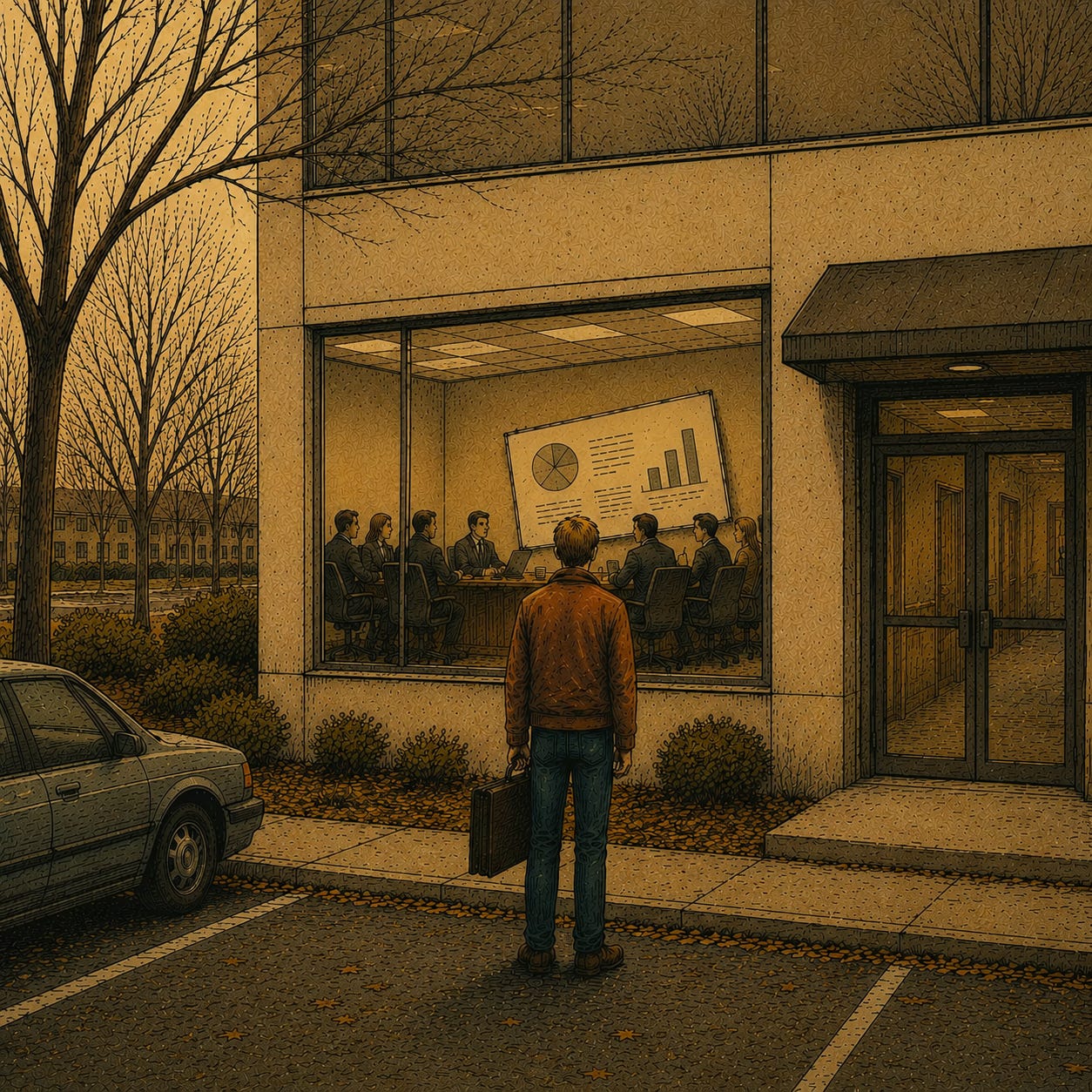
Most organizational problems begin in direct contact with reality. A customer gets frustrated, a workflow breaks, or a process slows down. At the ground level, the problem is usually obvious because the friction is immediate. Someone feels it and someone has to deal with it. The issue is still intact.
But organizations rarely process reality directly. They process representations of reality. A complaint becomes a ticket, the ticket becomes a metric, and the metric becomes a report. From there, the report gets summarized, paraphrased, or referenced as it moves through layers of the organization and eventually becomes part of a strategic discussion.
At each step, something is translated, context gets compressed, and friction is softened. The original experience becomes easier to manage, but also harder to fully understand. This is one of the core mechanisms of Reality Drift.
Reality Drift describes what happens when systems remain operational while gradually losing alignment with the real conditions they were built to serve. The problem is not outright failure, but survivable wrongness. A system can continue to function while drifting further from the reality it claims to represent.
What follows are six diagrams that map the structural mechanism behind this process in a corporate or institutional setting.
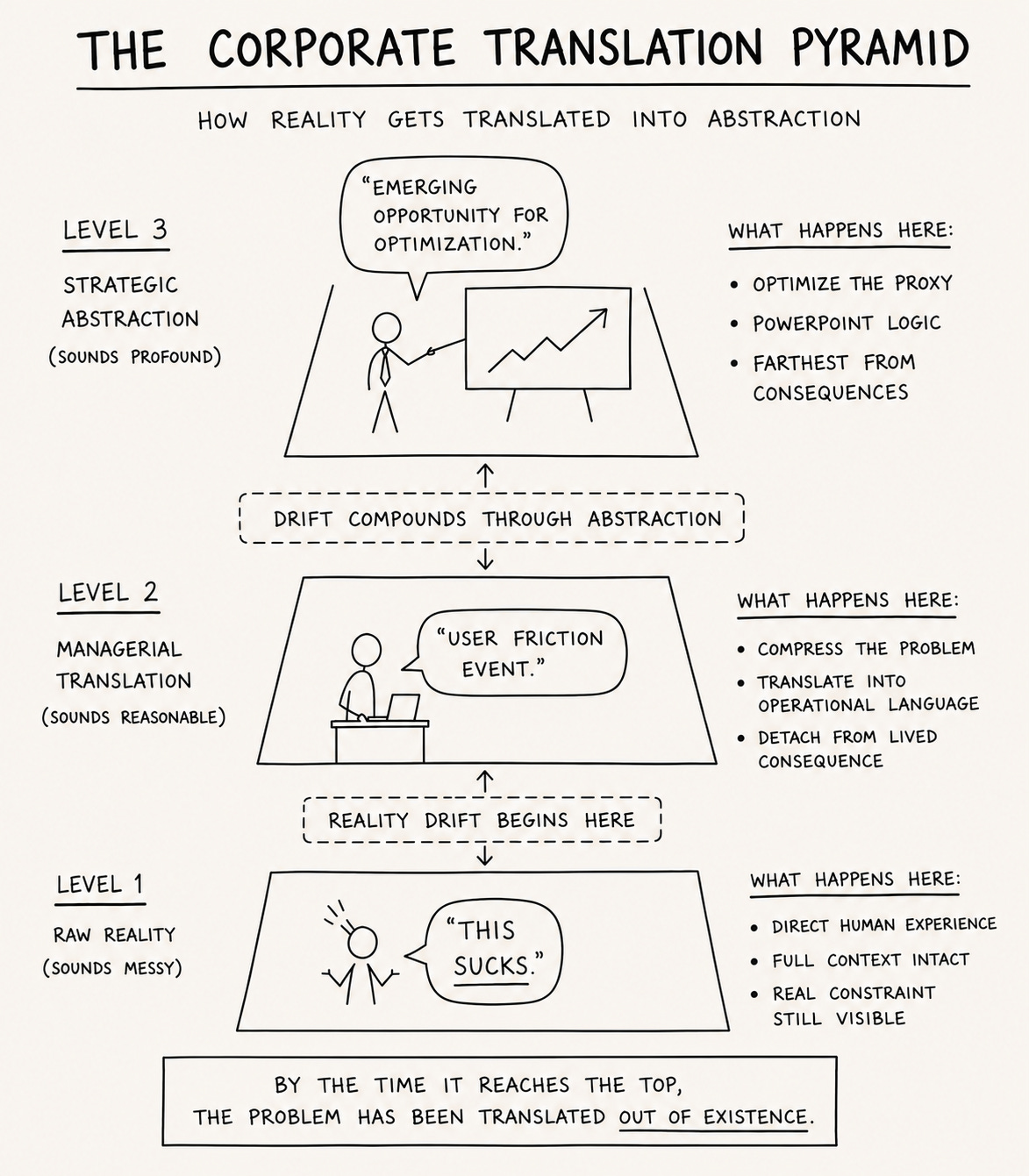
At the bottom of an organization, reality is messy. It is emotional, concrete, and often blunt. Someone says, “This sucks,” because something genuinely is not working. That kind of raw feedback is often the first and clearest contact point with reality. But organizations are built to formalize and structure feedback, which means translating it upward into cleaner and more operational language.
As this translation happens, the nature of the problem changes. A frustrating customer experience becomes a user friction event. A broken system becomes an optimization opportunity. Each layer sounds more rational, more manageable, and more strategic. But each layer also strips away context. By the time the issue reaches the top, it may no longer resemble the original problem at all. The system has not solved the problem. It has translated the problem into abstraction. This is where drift begins.
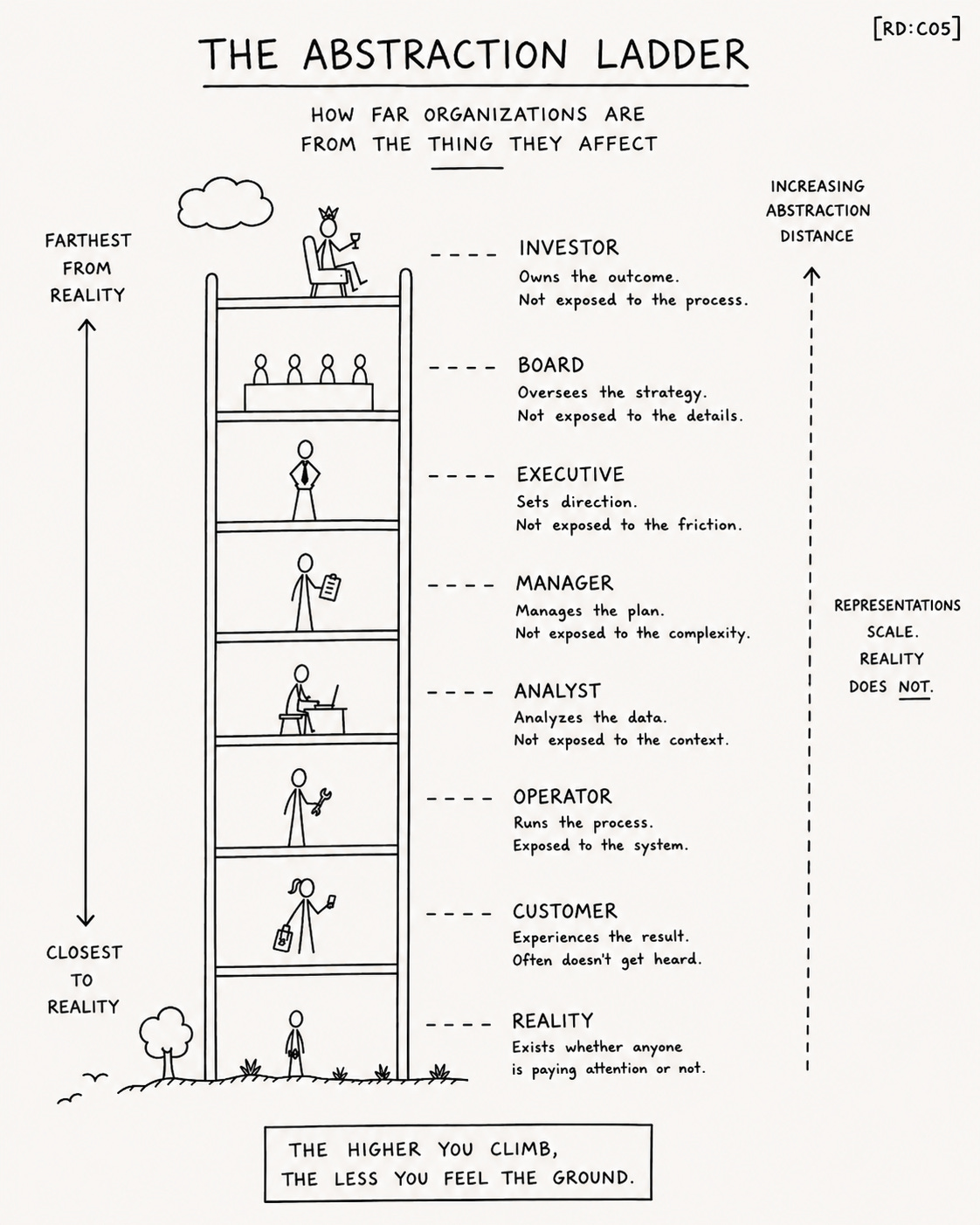
Not everyone in an organization occupies the same distance from reality, or sees customer outcomes from the same position. Operators experience the friction of making a system work, while analysts interact with the data produced by the system. But as you move up an organizational hierarchy, leaders and investors increasingly work through dashboards, summaries, and narratives. Each layer serves a function, but each layer also moves further from the thing itself.
This creates a structural inversion inside organizations. The people closest to the consequences often have the least authority to change the system, while the people furthest from the consequences often have the most authority over it. This inversion matters because it changes how decisions are made. The further up the chain a decision occurs, the less likely it is to retain the full weight of lived reality.
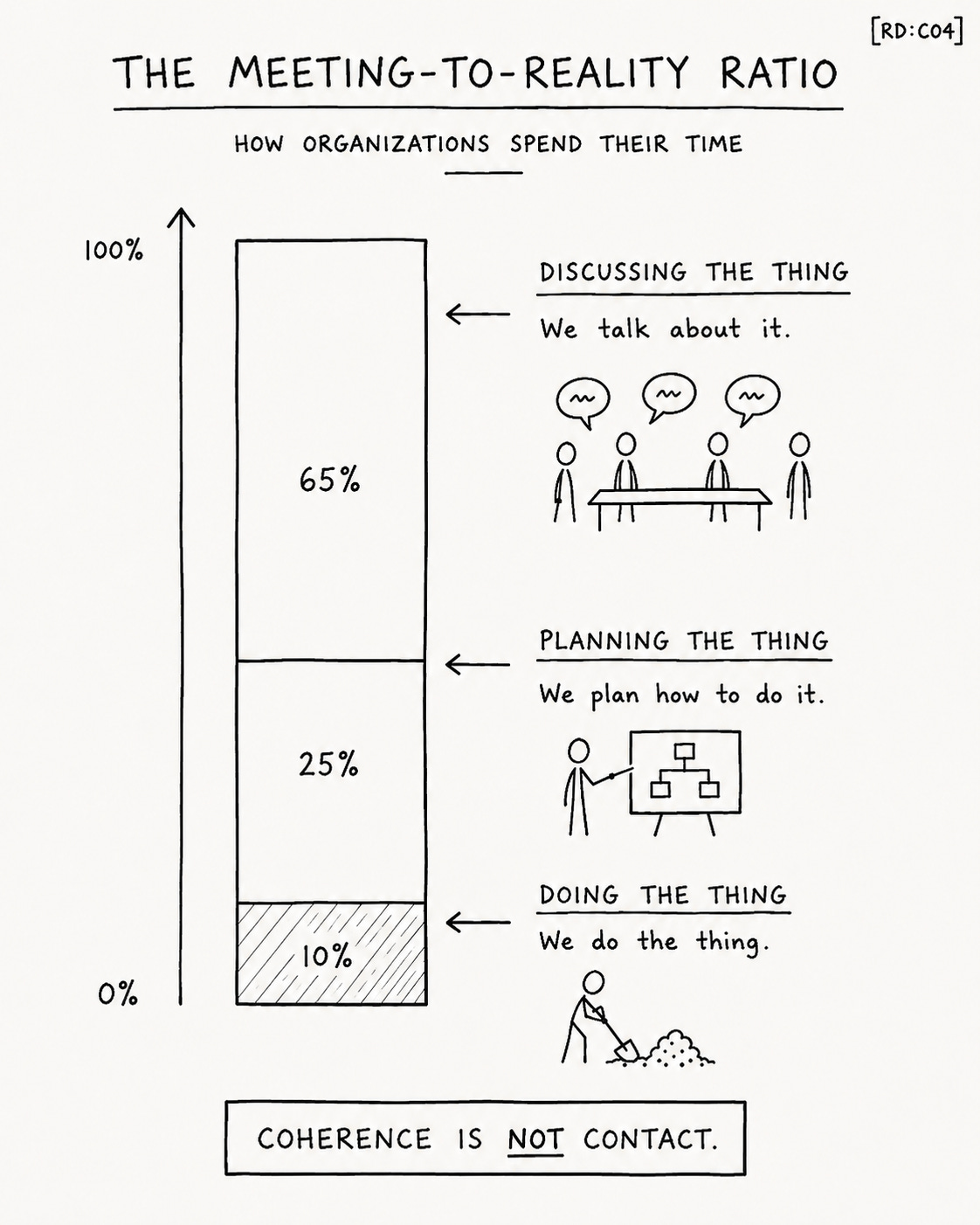
Once abstraction becomes dominant, organizations begin to spend more time talking about reality than interacting with it. This shift often happens gradually. More meetings are needed to coordinate, more planning is needed to align, and more internal discussion is needed to maintain coherence.
This creates an important illusion. Discussion, planning, and coordination begin to feel like action. A system can become incredibly busy while remaining increasingly detached from the reality it exists to address. Over time, more energy flows into internal maintenance, and the organization becomes increasingly self-referential, sustaining itself through its own processes.
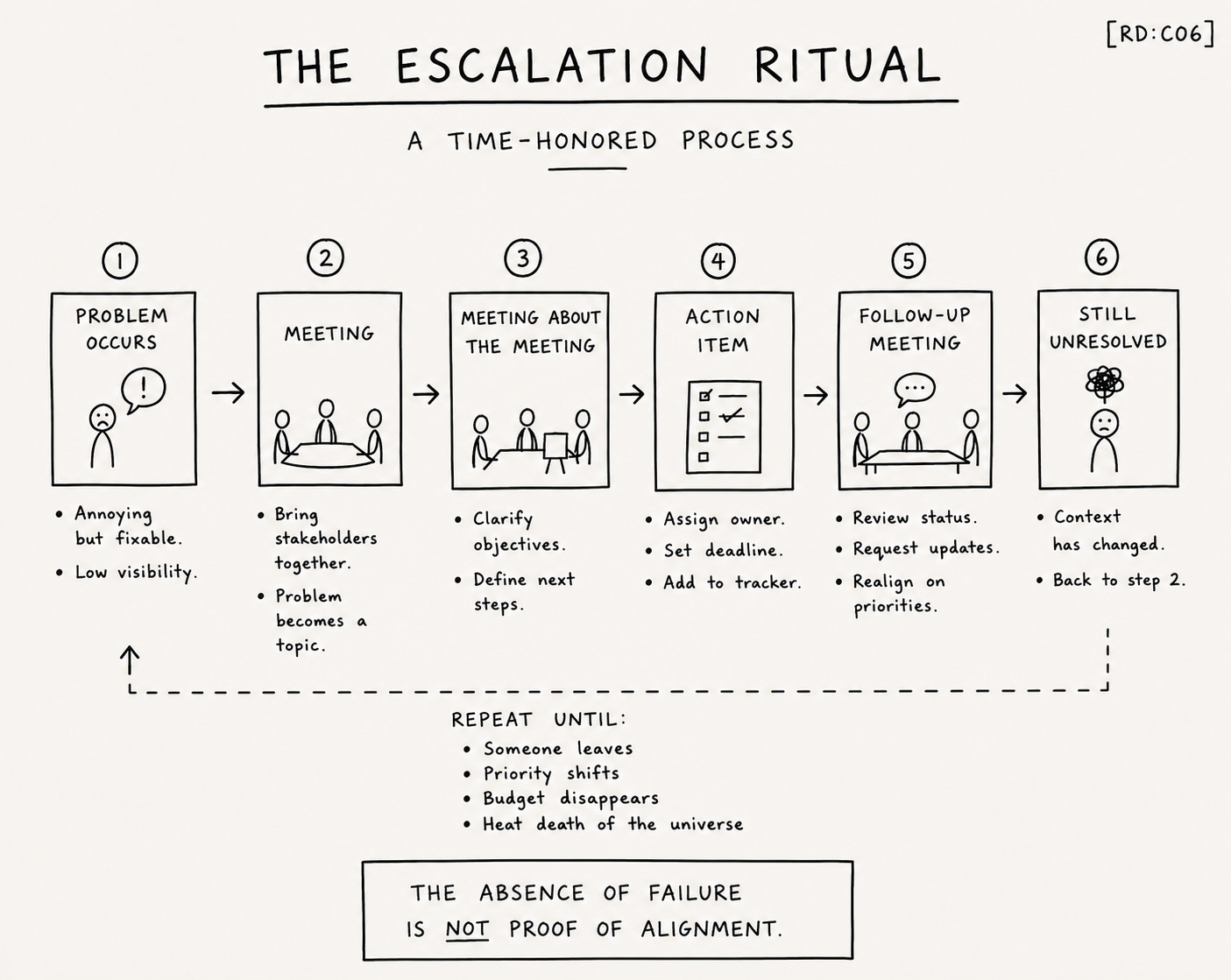
When problems resist easy resolution, organizations often respond by escalating them into procedure. A meeting is called, stakeholders are gathered, and follow-up meetings are scheduled. On the surface, this appears responsible because the system is visibly active.
In many organizations, this escalation becomes ritualized. The process itself becomes the response. Meetings generate more meetings, action items generate more trackers, and follow-ups generate more rounds of alignment. Meanwhile, the original problem often remains unresolved, or changes shape entirely while the organization is still processing it.
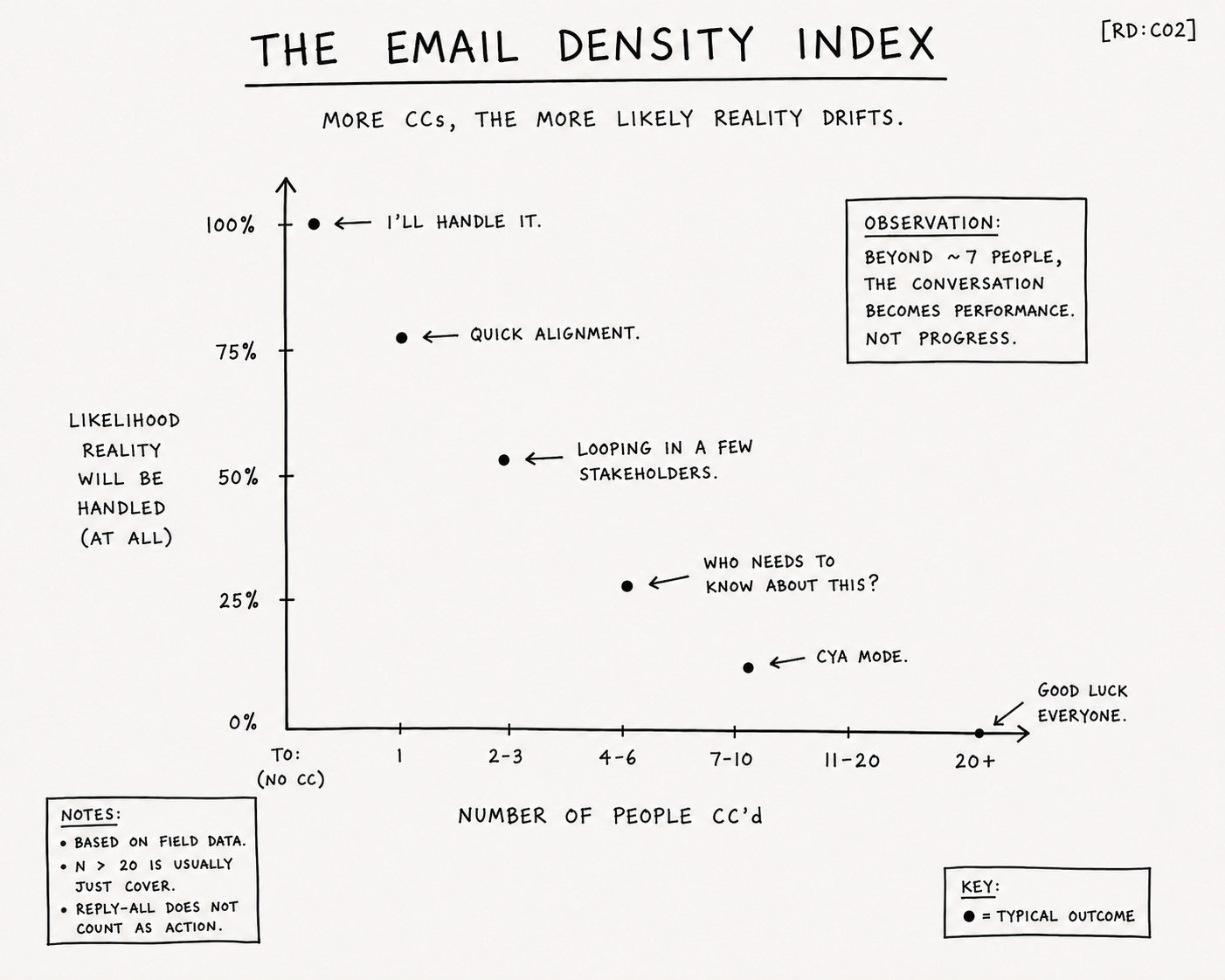
Coordination has limits. At small scales, adding more people to a conversation can improve clarity and speed up alignment. A quick exchange between two or three people often resolves things efficiently because ownership remains visible and responsibility is still concentrated.
But as the number of participants increases, the structure changes. Communication becomes less about solving the problem and more about distributing awareness. More people are informed, but accountability becomes diluted across the network.
At a certain threshold, communication becomes performative. People respond to maintain visibility, protect themselves, or document engagement rather than drive resolution. This is where drift enters socially. The system becomes louder, but less decisive.
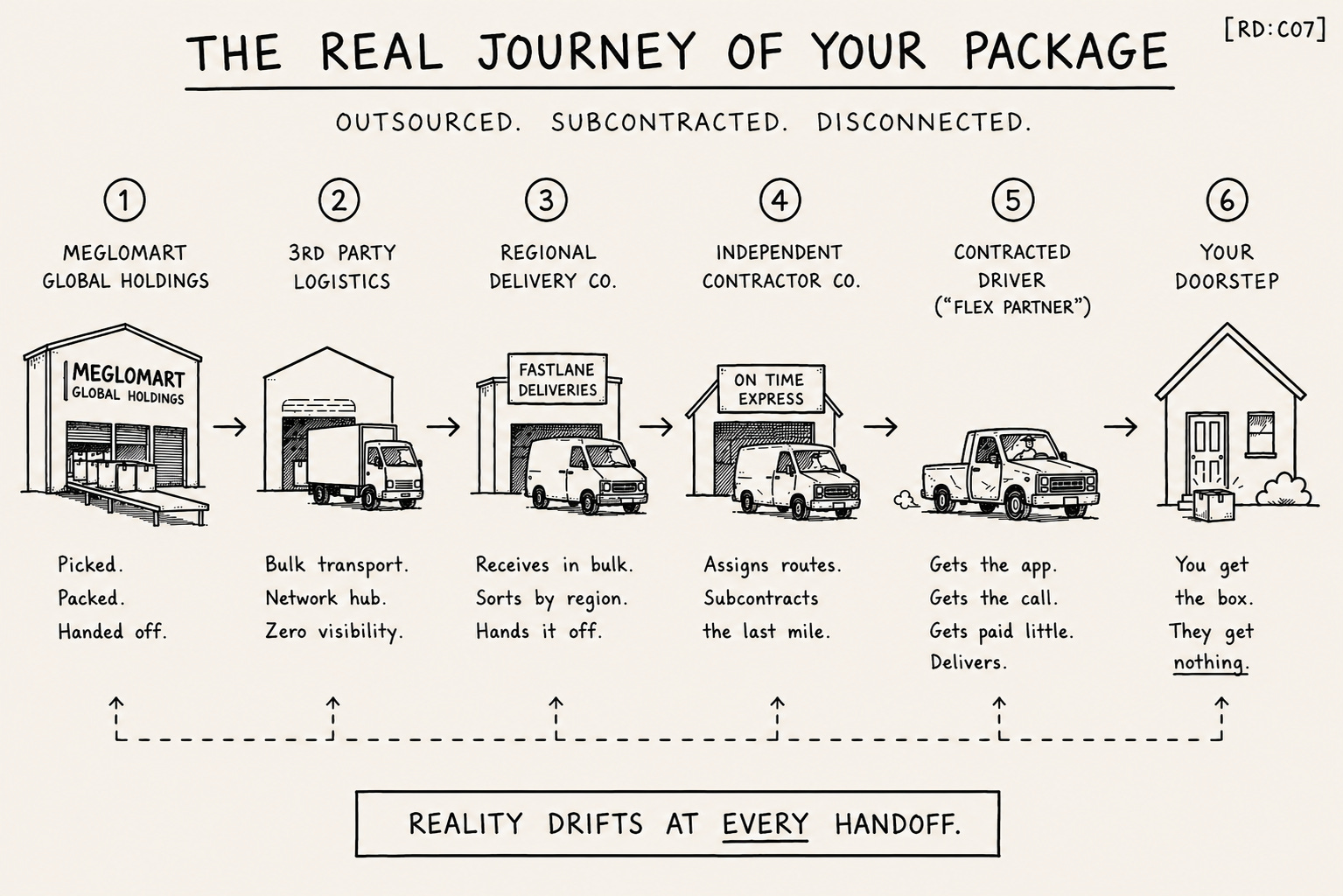
Modern systems increasingly operate through fragmented chains of handoff. What appears seamless from the outside is often built on layers of outsourcing, subcontracting, and platform mediation underneath.
At each handoff, context gets thinner, responsibility narrows, and incentives become more localized and less connected to the whole. No single actor sees the entire system, and no single actor fully owns the outcome.
The package may still arrive, and the system may still function. But that apparent coherence hides a deeper structural drift. The outcome remains visible and the dashboards may improve, while the real-world experience of employees and customers becomes increasingly fragmented and opaque.
Reality Drift begins when systems remain functional while gradually losing contact with the conditions they were designed to respond to. The dashboards still update, the packages still arrive, and the emails still flow. From the outside, everything appears coherent. But coherence is not contact.
Over time, systems that optimize around representations rather than reality begin to lose the ability to self-correct. This creates a state of survivable wrongness, where systems continue operating because nothing has visibly broken. Yet underneath that surface coherence, the distance between the system and the world continues to widen. That widening is drift, and many modern systems are increasingly organized around it.
What Is Reality Drift? (PDF)
A short introduction to the core framework and how drift emerges across modern systems.Reality Drift Overview and FAQ (PDF)
A broader orientation to the framework, its core concepts, and how the system fits together.Reality Drift Glossary (PDF)
Definitions of the core vocabulary and related concepts used throughout the framework.Semantic Fidelity (PDF)
A companion concept focused on how meaning degrades across AI systems, language, and recursive transformation.