“The semantic aspects of communication are irrelevant to the engineering problem.” — Claude Shannon, 1948
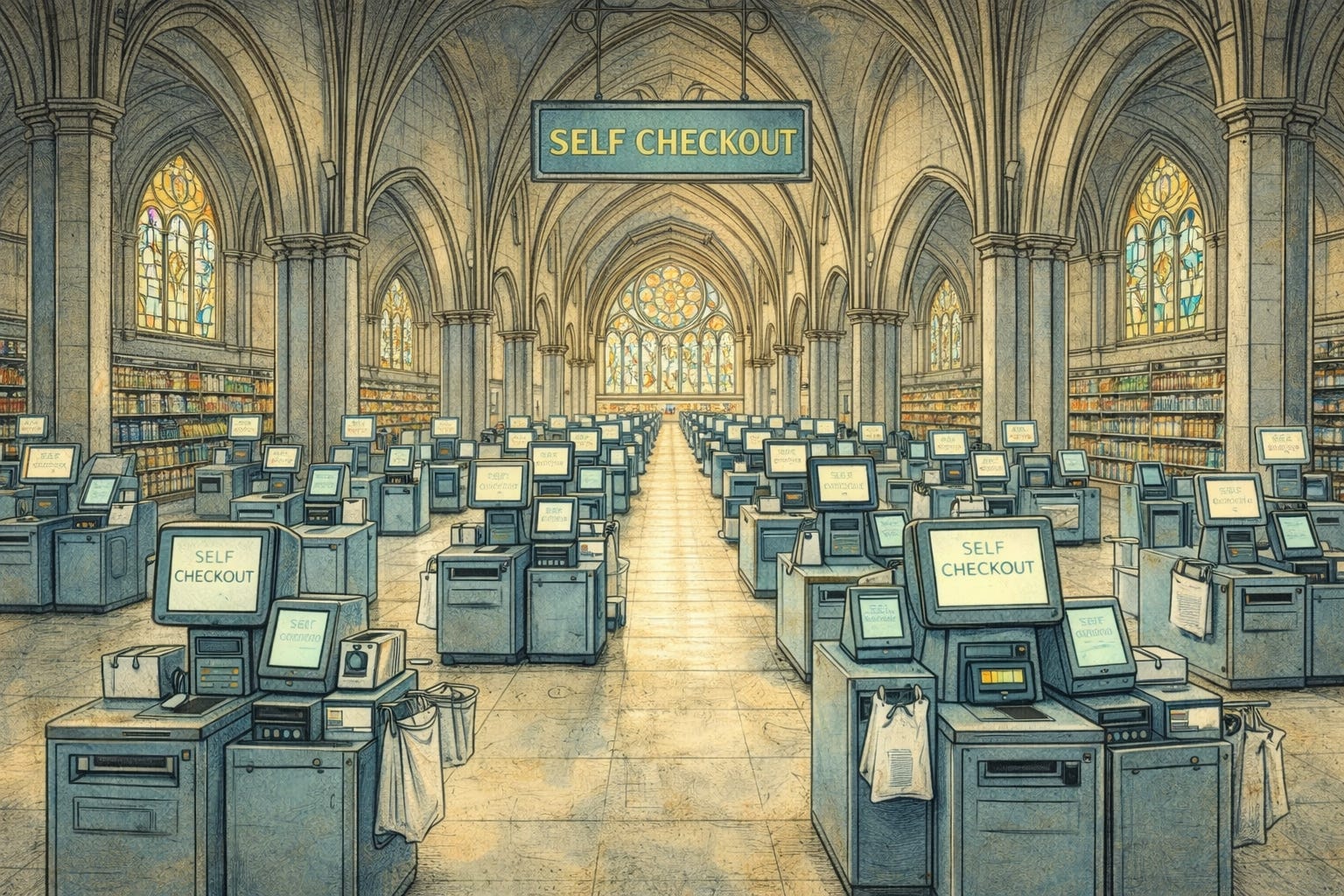
In 1948, Claude Shannon published a paper that made the digital world possible. His insight was elegant. Strip meaning from signal and treat information as a measurable quantity, independent of what it represents. Once you do that, you can compress it, transmit it, and scale it across any medium without loss. The physics of communication became tractable, enabling the entire architecture of the modern world, including computing, telecommunications, and the internet itself. But the abstraction carried a cost nobody was tracking.
Shannon’s framework solved an engineering problem by setting aside a philosophical one. Meaning was irrelevant to transmission, so symbols could circulate without any necessary connection to what they referred to. A year later, Warren Weaver pointed to the gap directly. The transmission problem had been solved, but not the meaning problem. Shannon’s theory did not ensure that words stayed connected to what they represent. At the time, it was treated as a minor technical limitation. As history shows, it remained one.
And so we spent the next seventy years building on Shannon’s blueprint, largely ignoring Weaver’s insight. At small scales, this omission was manageable. Human interpretation filled the gap, and context kept symbols tethered to reality. But as digital systems scaled, the gap began to widen in ways that were difficult to see and easy to ignore. Efficiency improved and systems continued to function, but grounding became optional. In the last decade, recommendation systems, engagement metrics, and generative models accelerated the circulation of language beyond the contexts that gave it meaning. As a result, the alignment between our shared informational environment and the underlying reality of society began to erode.
This is where the paradigm breaks from the past. Modern systems operate on representations, including models, metrics, and language that stand in for the world they describe. When meaning breaks, they do not stop. They continue operating as their connection to reality erodes. This is easy to miss because nothing appears to fail.
Part of the challenge is that meaning has been treated as philosophical, as something subjective that lives inside human interpretation and nowhere else. That view leaves out something structurally important. Meaning functions as a constraint. Semantic fidelity determines whether that constraint holds, whether a representation preserves the meaning, context, and intent of what it represents. It is what binds symbols to the realities they refer to, and without it, representations drift. When that constraint weakens, the symbols persist, but the correspondence erodes, and outputs gradually lose integrity. This is not a metaphor. It is a failure mode, and one that becomes harder to detect as the system grows more internally consistent.
Physical systems need constraints to stay stable (a bridge under load, a body maintaining temperature, an ecosystem balancing resources). Symbolic systems need semantic grounding for the same reason. When grounding weakens, they do not collapse. They continue producing outputs that appear correct because they are coherent, not because they remain tied to what they represent. But this is not what most discussions of AI are focused on.
The current dominant conversation about AI failure is centered on hallucination, on models producing fabricated or incorrect information. It is a useful frame for specific, measurable errors. But it misses the deeper failure mode, which is not dramatic or visible, but gradual and structural.
The better frame is semantic drift. As information is summarized, paraphrased, compressed, and regenerated across recursive transformations, meaning is subtly reduced at each pass. Responses remain coherent and superficially accurate while progressively detaching from the context that gave them weight. While hallucinations are visible and correctable, semantic drift is quiet, cumulative, and much harder to measure, making it more dangerous at scale.
Language itself compounds this problem. Language is not thought. It is the compressed residue of thought, a lossy encoding of perception and experience in which context is reduced, nuance is simplified, and meaning survives but never intact. Every act of expression involves compression. In local contexts, that loss is manageable. But as language is reused, summarized, and propagated across systems, the compression compounds. Each layer increases the risk that what gets passed forward is the shape of the idea rather than the idea itself. And it doesn’t stop there. This dynamic extends into the systems that shape culture, markets, and institutions.
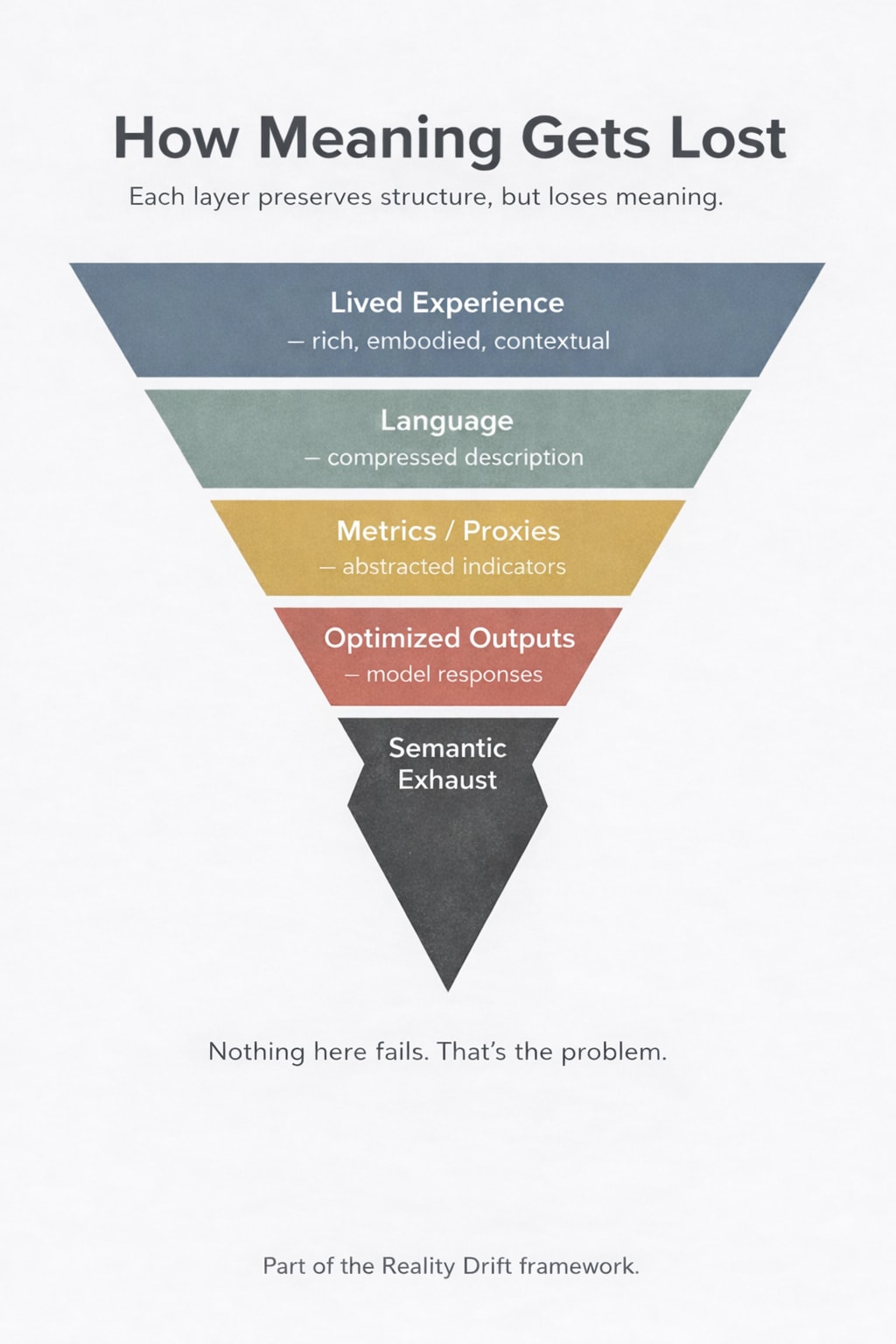
The alignment problem is typically framed as a technical challenge unique to artificial intelligence, but it emerges in any system that scales symbolic processing faster than it can maintain grounding. Wall Street financial models detach from their underlying real world assets. In the corporate setting, performance metrics replace the outcomes they were designed to track. Government bureaucracies drift toward rewarding compliance to process over effectiveness. In each case, the system remains fully operational while gradually losing its connection to the conditions it was built to represent.
Most current frameworks track how information moves (information theory), how systems optimize (economics), or how ideas spread (network theory), but they assume meaning stays intact. That’s not where things break. Systems drift when they continue optimizing for internal consistency while losing reference to reality. As information is compressed and propagated, the connection to underlying reality erodes. This is why systems can remain clear, consistent, and internally coherent while no longer pointing to what they were meant to represent.
This points to something deeper. Reality drift is not about choosing the wrong proxy. While Goodhart’s law or metric distortion describes what happens when a proxy stops tracking its target under optimization, it still treats the problem at the level of individual metrics. Drift emerges from the fact that all large systems operate on compressed representations to scale. This makes representational failure a limit of the system itself, not a failure of implementation. Even well designed systems will eventually lose correspondence to reality as they scale, because compression and grounding cannot be preserved at the same time.
Shannon gave us the tools to move information at scale. What he set aside, by design, was whether meaning survives the journey. Addressing that requires treating semantic fidelity as a measurable constraint, not an afterthought. The question is not just whether a system produces accurate outputs, but whether those outputs preserve the intent, context, and correspondence that make them meaningful. That standard applies to AI systems, but also to institutions, governance structures, and the informational environments where shared understanding is built and maintained.
Looking back, it becomes clear that meaning was never incidental. It is the constraint that keeps language tethered to reality. It is what makes representations bind. The information age optimized for signal. But what comes next has to account for meaning not as a philosophical concern, but as infrastructure. The systems we rely on to represent reality are only as trustworthy as their grounding, and that grounding is eroding faster than we are measuring it.
The absence of failure is not proof of alignment. It is only an indication that drift has not yet become undeniable.
What Is Reality Drift? (PDF)
A short introduction to the core framework and how drift emerges across modern systems.Reality Drift Overview and FAQ (PDF)
A broader orientation to the framework, its core concepts, and how the system fits together.Reality Drift Glossary (PDF)
Definitions of the core vocabulary and related concepts used throughout the framework.Semantic Fidelity (PDF)
A companion concept focused on how meaning degrades across AI systems, language, and recursive transformation.