There is a particular kind of political failure that recurs across history, and that storytellers, from Tolstoy to George R.R. Martin, seem to understand better than the institutions themselves. Game of Thrones is perhaps the most vivid recent example. In it, the existential threat is not the political intrigue consuming the Seven Kingdoms, it is the army of the dead advancing from the north, ignored by rulers too absorbed in their own rivalries to coordinate against it. The warning has been issued. The threat is real. The window to prepare is closing. And yet the institutions that should be responding are locked in their separate agendas, each defending their own domain, none of them owning the problem that falls between. That problem, in our case, is not white walkers. It is the humble air conditioners and cold chains keeping our food and medicines from getting spoiled, and their effects the climate.
The threats of unregulated refrigeration on global warming is not unacknowledged. First, Hydrofluorocarbons (HFCs), the synthetic refrigerants at the heart of most cooling systems, are widely considered as the most potent greenhouse gases known (High GWP). Second, cooling systems themselves are known for being highly energy-intensive. International treaties administering the refrigerant transition away from HFCs, and the energy-efficient regulations do exist. Yet, the mechanism coordinating the response to both pieces of the threat is cruelly missing. The environment ministry holds the refrigerant mandate. The energy ministry holds the efficiency standards. The finance ministry holds the procurement rules. And the window, this rare and ephemeral moment during which reformulating the global product range of cooling equipment could be done at minimal incremental cost, is closing while they govern in parallel.
Winter, in the show, does eventually come. The question Game of Thrones never quite answered, and that this piece tries to, is whether the warning arrives in time to matter. The answer turns out to be less about political will than about institutional architecture.
The hotter it gets, the more we cool. The more we cool, the hotter it gets.
The world is starting to suffocate. In the summer of 2024, Dubai, Doha, and Riyadh were ranked among the cities with the most dangerous heat on the planet. Temperatures across the Gulf regularly exceeded 45°C (113°F). In 2025 in the UAE, August peaks reached 51.8°C (125°F), a full degree higher than the previous year's record. Projections suggest Gulf summer temperatures could exceed 55°C (131°F) by the end of the century under a business-as-usual scenario. In India too, 2024 was the hottest year since records began in 1901. At least 37 cities recorded temperatures above 45°C (113°F), with heat stress projected to cost India 4.5% of GDP and 35 million jobs by 2030 if current trends continue. Across both regions, the response to heat is the same: more cooling, using more refrigerants, driving higher temperatures, requiring even more cooling. A response that creates a self-reinforcing feedback loop between cooling and global warming.
To break the loop, governments are focused on the refrigerant transition.
Scientists had identified this cooling feedback loop dynamic back in the early 1990s. Negotiations to address HFC emissions began in earnest in the late 2000s, and in 2016 197 countries quietly signed one of the most effective international climate agreements ever negotiated: the Kigali Amendment to the Montreal Protocol. The amendment tackles cooling’s direct emissions and commits governments to phasing down HFCs by 80% to 85% by mid-century. If the Kigali Amendment is fully implemented, it is estimated to avoid up to 0.5°C of warming by 2100, making it one of the largest contributors toward keeping the 1.5°C target alive.
But the refrigerant transition is only a fraction of the journey to sustainable cooling.
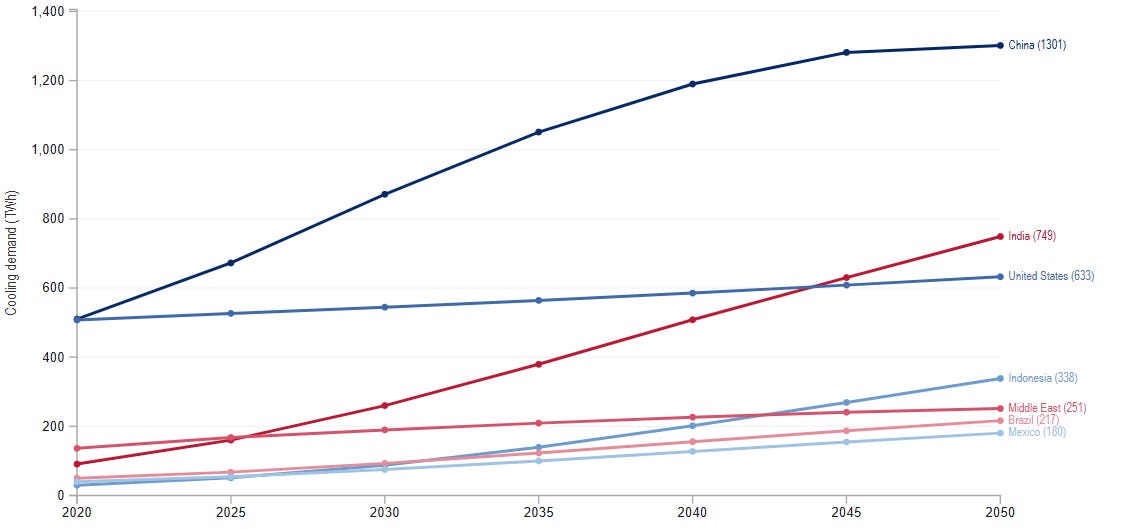
While reducing HFCs is essential, it addresses only one dimension of cooling’s climate impact. The other is energy. Cooling is already the single largest electricity end-use in buildings globally, representing a significant 10% of global electricity demand. This share is expected to nearly triple by mid-century. Notably, this growth is concentrated in countries where grids are the most carbon-intensive. As cooling demand grows in these markets, the electricity required to meet that demand will produce substantial indirect emissions.
So much so that this growth risks offsetting a significant share of the savings in direct emissions from phasing-down HFCs. Even in a scenario where all countries were to decarbonise their grids in line with their Paris Agreement pledges, an estimated 30% or more of the cumulative Kigali climate benefit would be lost between now and 2050. Managing indirect emissions is therefore key to limiting the overall impact of cooling on the climate. A transition that successfully phases down direct HFC emissions while ignoring indirect electricity emissions risks substituting one climate problem for another.
Cooling electricity demand by country/region
The Kigali phase-downs are already coming into effect, the window to align them with an efficiency transition is open now, and it will not stay open long.
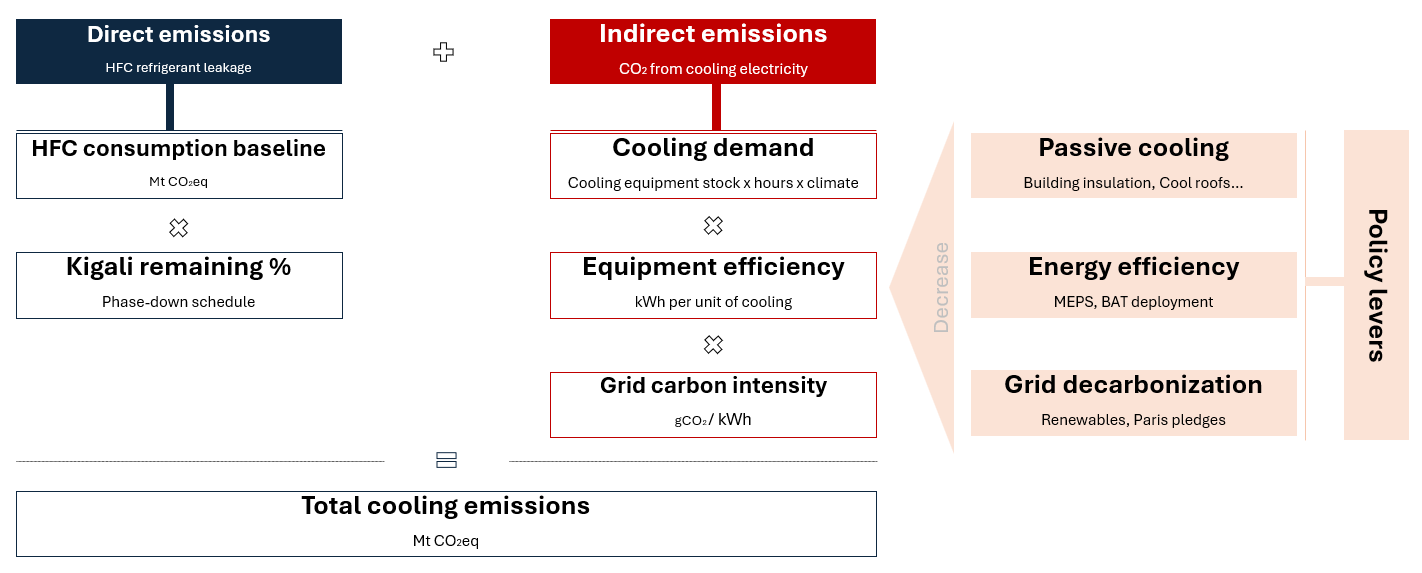
Decreasing indirect emissions from cooling means lowering the carbon intensity of the grid faster than cooling electricity demand grows. In practice, as the following analysis shows, rapid growth in electricity consumption actively jeopardises the ability to decarbonise the grid at pace.
Cooling carbon emissions key determinants
When overall electricity demand surges, fossil fuels are quicker to deploy than renewables
Grid decarbonisation is slow for structural reasons that no amount of political ambition fully overrides. Power plants are built to run for 25 to 40 years, and retiring them early carries stranded asset costs that are fiscally and politically prohibitive in capital-scarce developing economies. Replacing them requires utility-scale renewable projects that take five to ten years to plan, permit, and build. It is far longer than the 18 to 24 months needed to commission a gas peaker or deploy diesel, which is therefore the default response when demand surges faster than the renewable pipeline can deliver.
Throughout, the financing costs for renewable projects in emerging markets run two to three times higher than in advanced economies, slowing the pace at which clean capacity can displace fossil generation on commercial terms. These are not policy failures but structural features of energy systems that take decades to change. A surge in electricity demand is therefore often met primarily by a surge in fossil fuels.
When electricity demand peaks outside renewable generation window, fossil fuels become even more indispensable
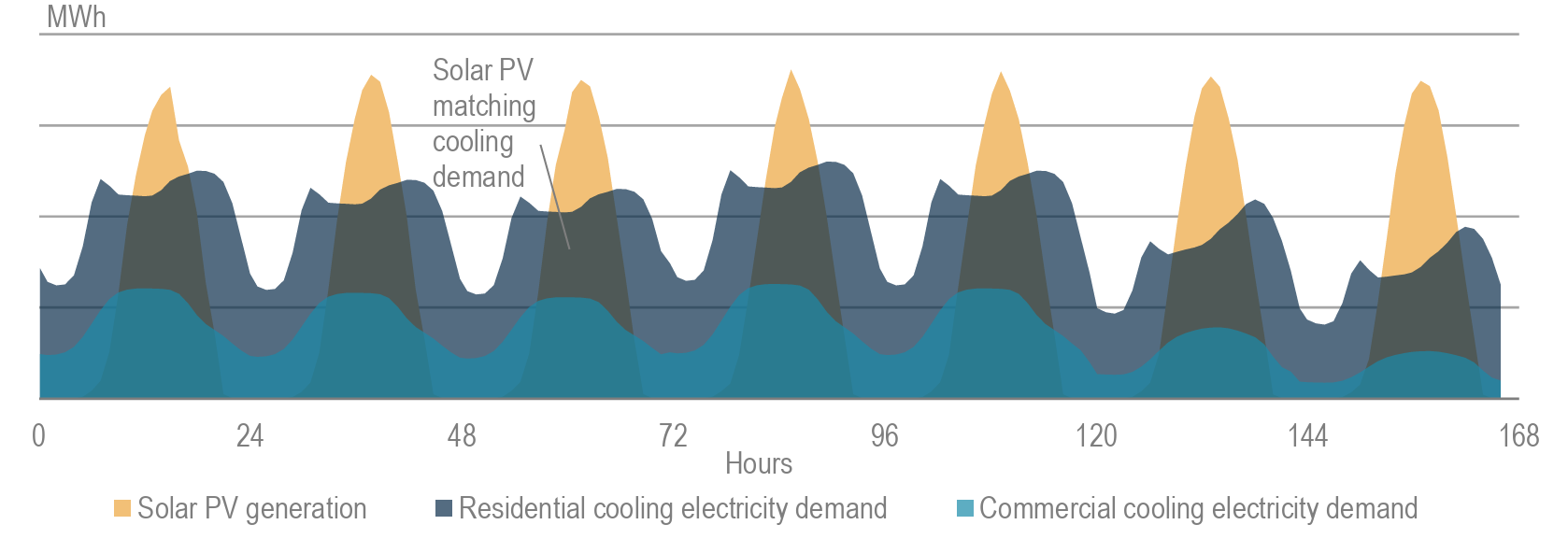
The surge in cooling demand increases not only electricity overall but also peak load both throughout the day and in the evening. When temperatures rise, cooling demand does not peak only at midday alongside solar generation. In the hottest countries, residential cooling demand specifically peaks in the late evening and at night, when people return home, when accumulated heat makes indoor temperatures unbearable, and when solar panels produce nothing.
Illustrative daily profile of electricity generation and demand
In India, where less than 20% of households currently own an air conditioner, cooling already contributes 60 GW to peak electricity load. The IEA expects this figure to reach 140 GW by 2030. Each additional degree of outdoor temperature added more than 7 GW to India’s peak demand in 2024, twice the sensitivity observed five years earlier.
Cooling electricity projected share in peak load
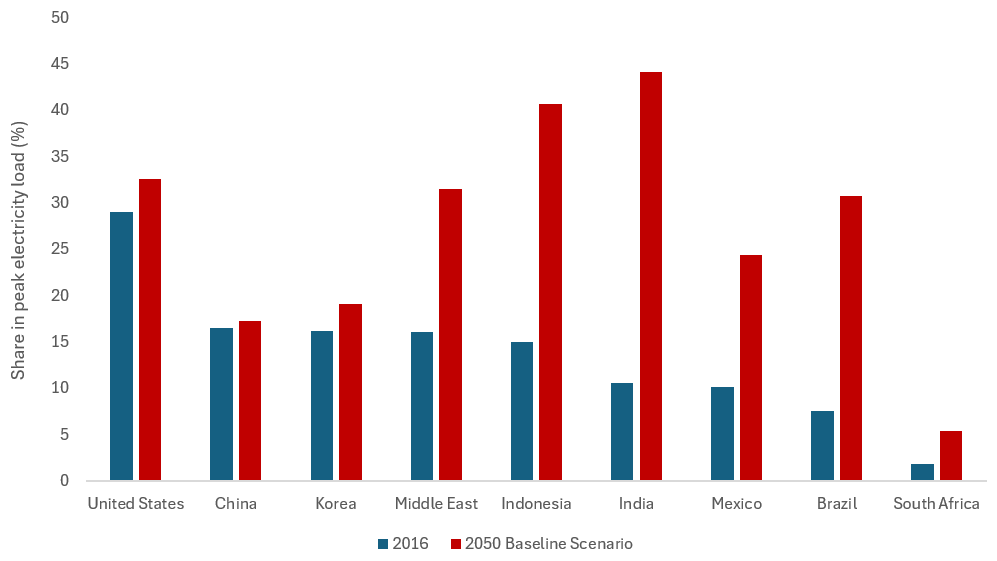
While there is important overlap between cooling electricity demand and solar generation, cooling demand does not stop when solar generation does. Meeting the evening and overnight peak requires either expensive storage or investment in cheaper dispatchable generation capacity - power plants that can be switched on when the sun goes down. In most developing countries, that means gas or coal.
Renewables can decarbonise the average electricity mix progressively, but they cannot replace the dispatchable capacity that an evening cooling peak requires without very large battery storage investment. Even a grid that is predominantly renewable cannot retire its dispatchable fossil backup until storage or demand flexibility can cover evening peaks, a condition most developing-country grids cannot yet meet.
The Kigali transition itself compounds the electricity problem
The Kigali transition creates an additional complication that is rarely acknowledged in policy discussions: Substitute gases perform less efficiently than the HFCs they replace, and this performance gap widens significantly at high ambient temperatures. Above 45–50°C, temperatures increasingly common in countries like India, Pakistan, and the Gulf states, the cooling output of substitute refrigerants degrades faster than that of the HFCs they displace.
To deliver equivalent cooling, a device must either run longer, consuming more electricity on grids, or be engineered to compensate through better compressors, larger heat exchangers, and tighter refrigerant management. The first option increases emissions and slows down decarbonisation of the grid as seen earlier. The second increases upfront cost in precisely the markets where buyers are most price-sensitive and credit constraints most binding. In other words, the refrigerant transition does not simply leave the electricity problem unchanged, in the hottest and fastest-growing markets it actively intensifies it.
The Kigali paradox: how a partial fix can amplify the problem
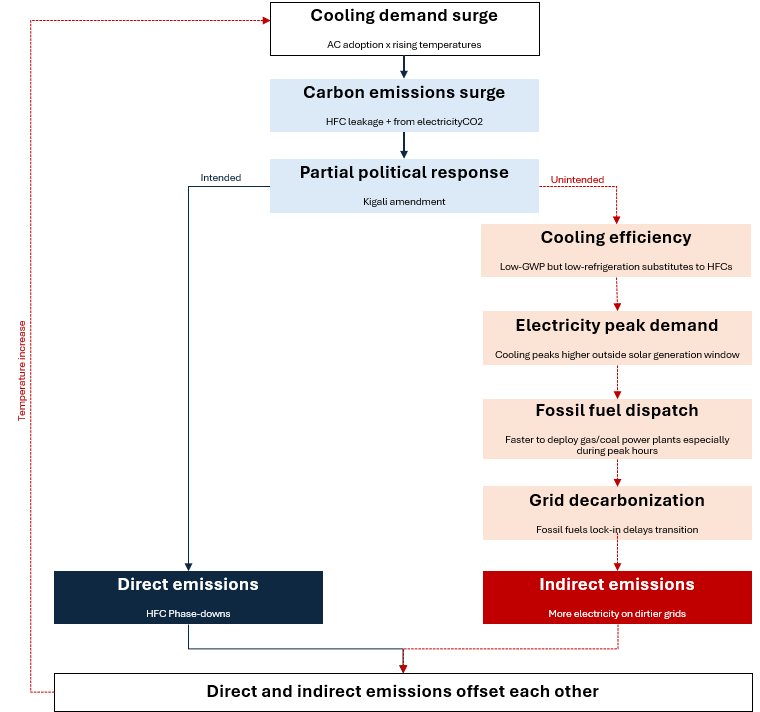
Keeping electricity demand stable over time is key for the green transition of the grid, making it not a complement to sustainable cooling, but a precondition for it.
Energy efficiency is a critical lever in the short run.
Energy efficiency is the most powerful lever available in the short run. The updated numbers make the case starkly. According to UNEP's Global Cooling Watch 2025, electricity use for cooling is expected to rise from 5,000 TWh in 2022 to 18,000 TWh by 2050 under business as usual. Applying the IEA's 2018 Efficient Cooling Scenario, which shows that effective policies can double average AC efficiency and reduce cooling electricity demand by 45%, energy efficiency therefore could save up to 8,000 TWh annually by 2050. To put that figure in context, 8,000 TWh is roughly equivalent to China's entire current annual electricity consumption, saved every year, not through restricting access to cooling, but simply through deploying equipment that delivers the same thermal comfort with half the electricity.
But rebound effects jeopardise energy efficiency gains in the long run.
Energy efficiency gains have only temporary impacts on demand. More efficient ACs make cooling cheaper to run, which encourages households to eventually cool larger spaces, set lower thermostat temperatures, run units for longer periods, or purchase additional units. In developing countries, where cooling has historically been rationed by prohibitive running costs, efficiency gains may unlock demand that was previously suppressed. As a result, the total electricity consumed could therefore rise even as the electricity consumed per unit of cooling output falls. This is what the literature has called the Jevons paradox, which describes the rebound effect of technological gains on demand.
Energy efficiency gains buy us time and can therefore create the space for grids to decarbonise before the rebound effect takes place. But if the rebound is strong enough, and if grid decarbonisation does not advance fast enough in the window that efficiency creates, the long-run trajectory returns to unconstrained demand growth on a grid that may be cleaner but not yet clean. Efficiency wins battles: it compresses the peak, slows the feedback loop, reduces the fossil investment forced by surging cooling demand, but it does not on its own win the war.
Countering the rebound effect requires a holistic approach to cooling
If efficiency alone is insufficient in the long run, then the case for treating it as a standalone solution is wrong. The case for the full package of coordinated interventions becomes stronger. Of these structural changes, building-level measures are the most immediate and the most under-deployed. A building that is well-designed does not need to cool as much air in the first place, and the gains could be substantial. Cool roofs and reflective surfaces, which redirect solar radiation rather than absorbing them, can reduce indoor temperatures by 1 to 3°C without any energy input. Insulation and low-emissivity windows reduce heat gain through the building envelope, cutting the cooling load before the AC switches on. External shading addresses the same problem at the facade level. Together, passive design measures of this kind can reduce a building's cooling load by up to 80%, according to IEA estimates. At the urban scale, the logic extends further: green spaces, tree canopy, and permeable surfaces reduce the urban heat island effect that can push city temperatures up to 10°C above surrounding rural areas, compounding cooling demand in precisely the dense, rapidly urbanising environments where it is growing fastest.
UNEP explicitly calls for passive cooling, better urban design, and nature-based solutions alongside stronger energy efficiency standards and the Kigali HFC phase-down, arguing these measures together could protect 3 billion people from extreme heat by 2050. Hence, UNEP's Global Cooling Watch 2025 report promotes a "passive-first pathway"combining passive design, low-energy and hybrid options, rapid uptake of high-efficiency equipment, and an accelerated HFC phase-down, with about two-thirds of the mitigation coming from passive and low-energy cooling.
Coordinated governance is the key barrier to policy implementation
The reason energy efficiency dominates in practice is institutional rather than analytical. UNEP's Kigali-related programmes, including OzonAction and United for Efficiency, are funded through the Multilateral Fund and designed around the treaty's compliance architecture, which is appliance and refrigerant-focused. District cooling and passive building design require different implementing partners, different financing instruments, and crucially different government counterparts, including urban planners, building regulators, municipal authorities who sit entirely outside the Montreal Protocol governance structure. Achieving near-zero emissions by mid-century requires integrated policies focused on climate-friendly refrigerants, high energy efficiency, and passive cooling. But the policy toolkit for doing so spans the entire cooling value chain.
This is actually a precise illustration of the institutional fragmentation issue at the heart of cooling: UNEP knows the full solution set, but its operational mandate under Kigali only reaches part of it.
Similar institutional fragmentation jeopardises energy efficiency adoption
According to the IEA, the average AC sold today operates at less than half the efficiency of models already on the shelves. Efficient equipment does exist, but a series of structural failures ensure it does not reach the people who need it most. High upfront costs, information failures, thin distribution chains and service infrastructure, no certification requirements, all are known barriers to energy efficiency widespread adoption, and each has a known remedy: Labelling corrects information failures, financing instruments address cost constraints, regional MEPS harmonisation shifts manufacturer behaviour, technician certification creates the market signal that justifies investment in service infrastructure… None are technically complex. None are fiscally prohibitive. And yet in most Kigali jurisdictions they remain absent, partial, or advancing entirely out of step with one another, not because governments lack the knowledge, but because no single institution holds the mandate to act across the full set of failures simultaneously.
In most jurisdictions, Kigali implementation sits with environment ministries, while energy performance standards and labelling sit with energy or industry ministries. These tracks run in parallel, on separate timelines, with no mechanism for joint planning. Neither ministry is failing in its own terms. The environment ministry is implementing refrigerant phase-downs on schedule. The energy ministry is updating efficiency standards on its own cycle. And yet the outcome of two institutions each doing their job is a refrigerant transition that advances without the efficiency upgrade that would make it climate-effective, because the upgrade belongs to no one’s mandate specifically enough to be anyone’s priority urgently enough. Refrigerant phase-down schedules advance without simultaneous revisions to efficiency benchmarks, markets shift toward lower-GWP refrigerants without meeting higher performance requirements, and the letter of Kigali is satisfied while its climate purpose is quietly forfeited, one individually defensible institutional decision at a time.
The window to act is open now, and it is closing
Regarding energy efficiency measures, there is a narrow window to correct this and the Kigali framework itself is what creates it. The phase-downs force manufacturers to reformulate entire product lines to accommodate the specific thermodynamic properties of new substitute gases (Low GWP) to HFCs. This in turn creates a rare and externally mandated window during which the cost of simultaneously upgrading energy-efficiency is minimal. Miss it, and newly installed low-GWP but energy-inefficient equipment locks in a higher emissions baseline for the next fifteen to twenty years, the typical lifespan of cooling infrastructure.
Similarly for passive cooling, the critical observation is that these measures are cheapest when buildings are first constructed, retrofitting them onto existing stock is significantly more expensive and disruptive. In cities where the majority of the 2050 building stock has yet to be built, the window to embed passive design from the outset is open now, and it is closing for the same reason the Kigali window is closing: not because the opportunity will disappear, but because every year of new construction without mandatory building codes sets a baseline that will stand for decades.
The cooling transition presents three interlocking paradoxes: Warming drives demand for the very cooling systems that deepen warming, the refrigerant transition risks offsetting its own climate benefits by substituting one climate problem for another, and energy efficiency gains — which make cooling cheaper to run — risk being absorbed by expanding demand.
Game of Thrones understood this and is full of similar paradoxes. The Starks’ had the necessary honour but not the political acumen , the Lannisters’ had the much needed resources but a blinding obsession with power, and the Dragon Queen held the firepower but eventually betrayed her own liberating principles. In the show, the army of the dead is eventually defeated. In the real world though, there is no Arya arriving at just the right moment. There is only the coordinating mechanisms that either get built in time, or don’t.
This need for coordination is not unique to cooling. The feedback between a problem and its drivers, the risk of trading one climate liability for another, and the rebound effect that absorbs efficiency gains are at the heart of almost every long-term climate and energy challenge. Electric vehicle batteries depend on carbon-intensive mining, hydrogen's net climate value depends on how it is produced, fuel economy standards increase total miles travelled by making driving cheaper. In each case, the question is the same: Who owns the coordination between the policy responses resolving these paradoxes? This Substack is an attempt to lay out that framework and to apply it systematically to the commitments we are told will save us.
This piece is based on a policy brief: “The Kigali Window: Integrating Refrigerant and Efficiency Policy Before the Opportunity Closes”, covering the market barriers, governance gaps, and detailed recommendations for national governments, climate finance institutions, and international bodies. Available upon request.