It’s common to think that something has gone wrong when you’ve got a demanding child. A toddler who refuses to be weaned. A 3-year-old who insists on being carried. A child who keeps asking for more even after the parent said enough. Those children get labeled selfish and undisciplined. And many parents worry that they may have done something wrong to end up with such an egotistical child.
Yet demanding children are not unique to the Western world. You can easily find a baby refusing to be weaned in Brazil. You can easily find a toddler demanding that his parent play hide-and-seek one more time in Japan. We even have ethnographic records of forager children insisting on being carried.
After age five [Ache children] are weaned from the back and encouraged or made to walk on forest trips, a crisis in their lives as it was for the !Kung.
Children scream, cry, hit their parents, and try everything they can think of to get adults to continue carrying them.
— Hunter-Gatherer Childhoods p. 53
In fact, in evolutionary biology, children wanting more parental care than their parents are selected to provide is considered an expected part of a normal parent-child relationship. Not a sign that something has gone wrong. Here’s why.
Genetically, a parent and child have highly aligned interests. A parent shares, on average, half of their genes with each child, so what benefits one often benefits the other.
But their interests are not perfectly aligned. A parent is selected to allocate resources across all of their offspring, who are each equally related to them. A child, however, is 100% related to themselves but only about 50% related to a full sibling. Because of this asymmetry, natural selection is expected to favor children who seek somewhat more parental investment than is optimal for the parent.
The full math behind this gets a little more involved, but the basic idea looks something like this:
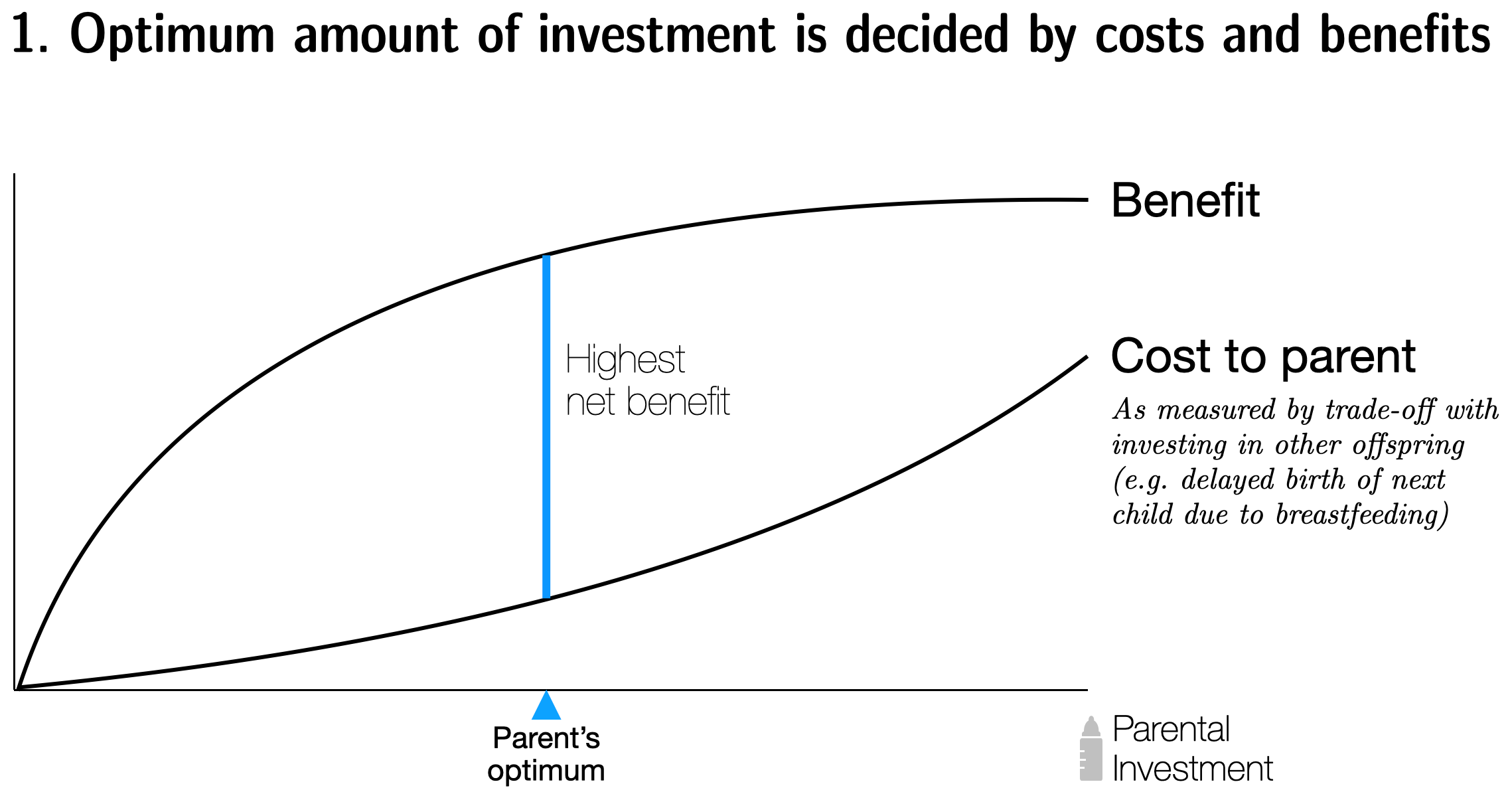
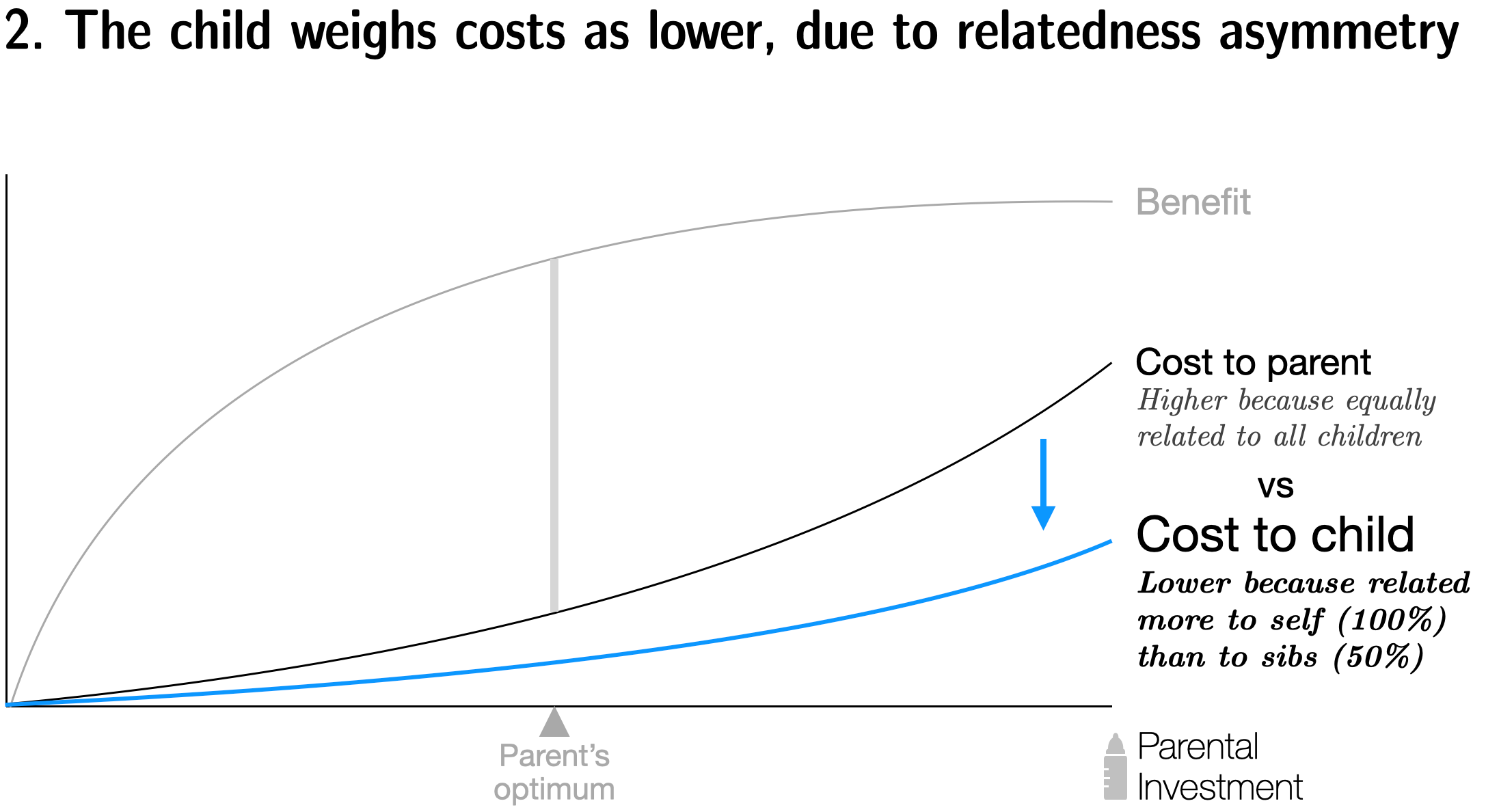
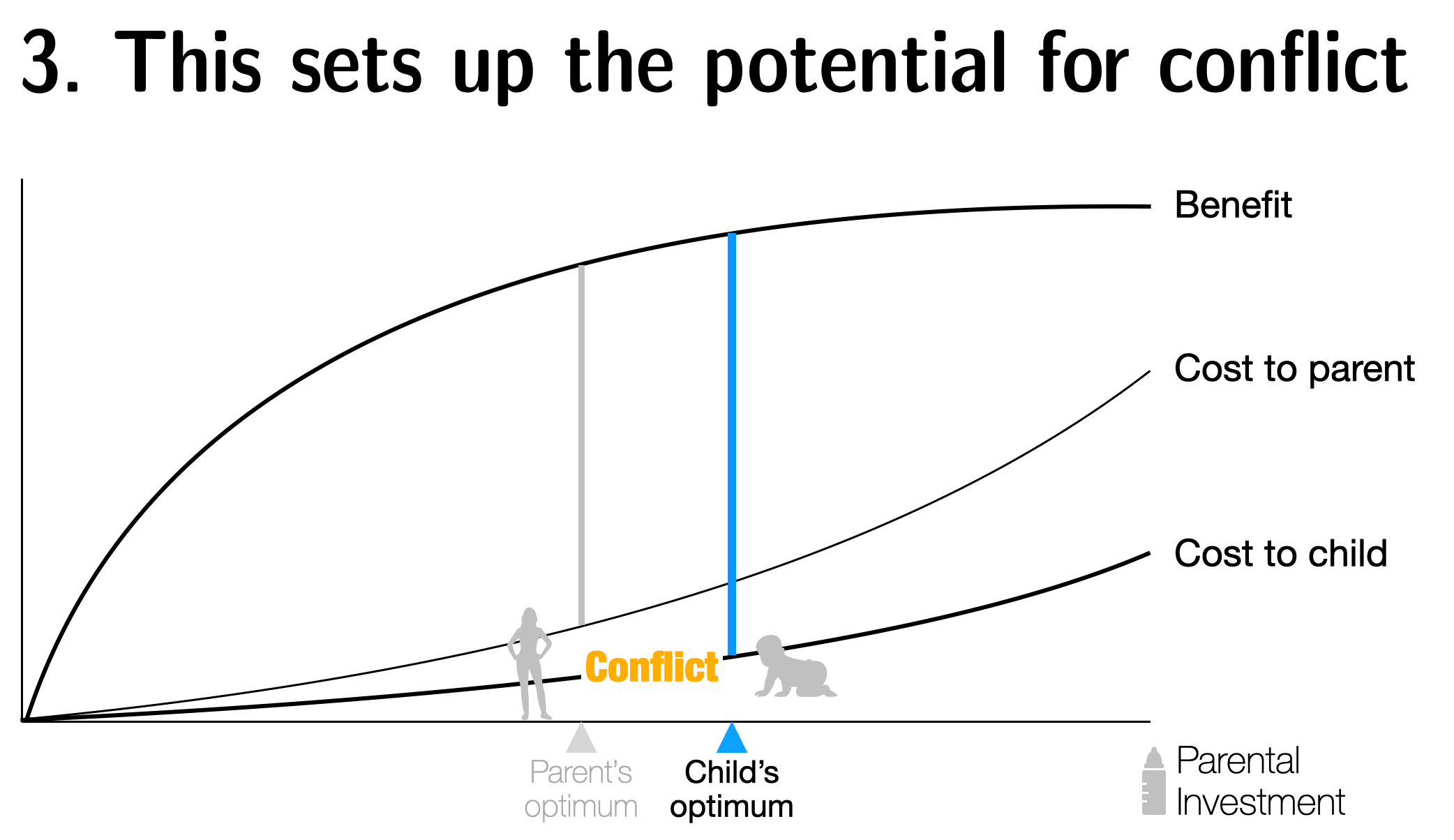
One of the best-known examples of this conflict is weaning. Weaning conflict is common among mammals and has been observed in a variety of species, including baboons, langurs, cats, dogs, and rats. The following description by Robert Trivers, who originally proposed the theory of Parent-Offspring Conflict, follows the same pattern illustrated in the diagrams above.
Consider a newborn calf nursing from his mother. The benefit to him of nursing is large, the cost to his mother presumably small. As time goes on[…] the benefit to him of nursing decreases while the cost to his mother may increase. At some point the cost to the mother will exceed the benefit to her young[…]
The baby is not expected, so to speak, to view this situation as does his mother, for the baby is completely related to himself but only partially related to his future siblings[...] This period where nursing is beneficial to the offspring but not the mother is one of expected conflict between mother and offspring[.]
And parent-offspring conflict is thought to extend well beyond weaning. Conflict over carrying, bedtime, and how children use their time and energy have all been proposed as areas where the same evolutionary dynamics may play a role. At a more biological level, traits such as gestation length, inter-birth interval, and genomic imprinting are also thought to be influenced by the same underlying evolutionary principle.
Many of these have been interpreted as reflecting the overarching pattern of parents and offspring disagreeing over how long parental investment should last and how much should be given, with the child generally wanting more than the parent is selected to provide.
We don’t know exactly how this evolutionary conflict translates into everyday behavior, but scientists have some educated guesses. Here, let’s start from the child’s point of view.
A child, especially in toddlerhood, is at a disadvantage when it comes to getting his parents to do things. A baby cannot just make his mother breastfeed him at will. A child is smaller and less experienced than his parent, and his parent controls the resources at issue. Given these disadvantages, it is thought that natural selection may have favored developmental tendencies and behaviors that increase a child’s ability to induce more investment from his parent through psychological rather than physical means.
Because parents cannot directly observe exactly how much care a child needs, they must rely on cues from the child. This creates a communication problem where children generally have better information about their own immediate needs, while parents must decide how much investment to provide based on imperfect information.
Given this, scientists have proposed that some metabolically costly behaviors, such as intense crying, persistent protesting, and perhaps some tantrums, may have been selected in part to function as signals of need. And by amplifying those signals (e.g. making more noise), children may sometimes convince parents that additional investment is warranted. At least up to a point.
In turn, parents’ ability to read the child’s true needs is thought to improve with experience, making parent-offspring interactions increasingly biased in favor of the parent over time.
Moreover, avoidance behavior and aggression sometimes shown by mothers during the weaning period can also be interpreted as examples of traits that help parents navigate through this conflict. This, in turn, suggests that irritability and frustration experienced by parents may also have some adaptive value in the context of parent-offspring conflict.
But this conflict isn’t expected to be equally intense for every parent or in every situation.
Generally speaking, the more future reproductive opportunity a parent has, the higher the cost of parental care. And thus the more intense parent-offspring conflict is predicted to be.
The most obvious example of this is the difference between a young female and an old female. All else being equal, an older mother’s marginal cost of parental care is lower, because her expected number of future offspring is lower. So parent-offspring conflict is predicted to be more intense for younger mothers and less so for older mothers, on average.
The same logic also applies within the same mother. All else equal, conflict is predicted to be more intense with an early-born child than with a later-born child.
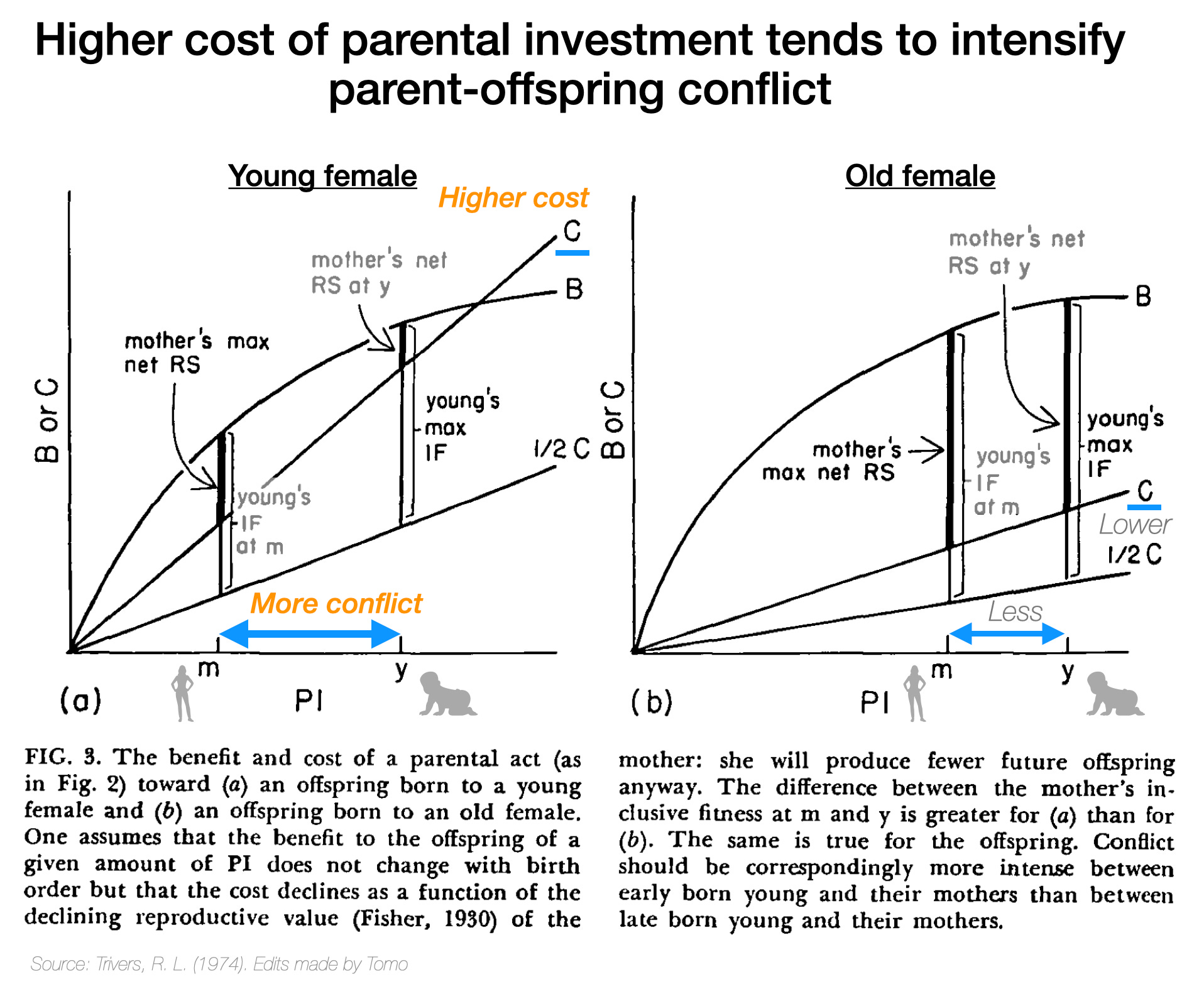
What this suggests is that although the underlying principle of parent-offspring conflict applies universally, the parents’ experience of providing care at various points in the investment period may differ. More specifically, it hints at the possibility that what feels great to one parent can be a genuinely difficult experience psychologically for another parent even when two parents are providing the exact same amount of care. All because of differences in the relative cost of parental care.
Although it is common to see a demanding child as a sign of parenting gone wrong, from a biological perspective, children wanting more parental care than parents are willing to provide is actually what is expected. So too are occasional disagreements between parents and children. Thus, at least according to evolutionary biology, parent-offspring conflict is very much an expected feature of a normal relationship between a child and a parent.
In terms of practical implications, this theory does not necessarily tell us what we ought to do. But I think it hints at a few things.
If emotions such as frustration and irritability are indeed mechanisms that help us calibrate our behavior, it probably makes sense to treat them as useful information rather than trying to overcome them. For example, if you read, say, 6–7 books before bedtime and keep getting burned out toward the end, it’s probably good and healthy for you to experiment by setting the limit at 2–3 books instead. What parent-offspring conflict suggests to me is that we can get frustrated when we overdo things even if that thing is something that we truly believe is good for our children, like breastfeeding or reading aloud.
Very strict parenting advice tends to emphasize consistency and strong discipline, especially for very young children. To me, parent-offspring conflict framing hints at another possibility of a negotiated middle ground. Where it is okay for parents to occasionally step outside their comfort zone and meet in the middle. And similarly for the child to also experience a bit of frustration occasionally by getting less than what he wants.
Not necessarily because the advice is wrong, but simply because you’re in different circumstances from the people giving you the advice.
Happy Parenting,
Tomo