The Noösphere is an entirely reader-supported publication that applies recent social science research to the cultural, political, and technological issues shaping our world today. If you read it every week and value the labour that goes into it, consider supporting it by liking or sharing this essay, becoming a paid subscriber or buying me a coffee! Thank you!
First, it was the kettle that broke. Then the fridge started to malfunction. Then the vacuum cleaner. And finally, the grass trimmer.
A couple of months ago, my partner and I found ourselves in the midst of an electronic appliances apocalypse of sorts.
Perhaps you might just assume we got unlucky; the appliances stopped working all at once, after years of reliable service. Except that three of them — the kettle, fridge, and grass trimmer — had been bought just a year earlier. All three were also from reputable brands, not the cheapest options, and vetted before purchase. Luckily, the fridge and grass trimmer were repairable. The vacuum cleaner, which, to be fair, was the oldest of the bunch, wasn’t. But the practically brand-new kettle was also declared beyond repair after spending a month awaiting its fate at the repair shop.
Sometimes I think to myself, unironically, that I should’ve started buying home appliances and furniture and clothing and other (supposedly) durable consumer goods when I was a teenager. I still own a few items from those days, which, at this point, I suspect I may even take to my grave. The ones I bought more recently? I doubt it.
Everything’s supposed to be more convenient, more efficient, better now. Yet everything also seems worse. And there are a few reasons for that.
Incandescent light bulbs were initially designed to last as long as possible. The Centennial Light, first switched on in 1901 at a fire station in Livermore, California, still glows even today.
The business model was different back then, though. Customers, mostly wealthy individuals, purchased entire electrical systems, which were installed and maintained by their supplier. So, if a bulb burnt out, the cost of replacing it fell on the supplier.
But as electrification spread and the market for light bulbs expanded, companies started selling them individually. Then, in December 1924, several major manufacturers, including Osram, General Electric, and Philips, colluded to artificially reduce the lifespan of their light bulbs from around 2,500 hours to 1,000 hours.1 This plan, hatched by the international cartel also known as the Phoebus Cartel, is one of the earliest major cases of an industrial strategy that would later be dubbed ‘planned obsolescence’ by the real-estate broker Bernard London. And its objective was, most likely, rather straightforward: sell more light bulbs.
As media historian Markus Krajewski, who researched the Osram corporate archives in Berlin alongside journalist Helmut Höge, notes:
Of course, given the collective ingenuity of the cartel’s engineers and scientists, it should have been possible to design a lightbulb that was both bright and long-lived. But such a product would have interfered with members’ desire to sell more bulbs. And sell more bulbs they did, at least initially. In fiscal year 1926–27, for instance, the cartel sold 335.7 million lightbulbs worldwide; four years later, sales had climbed to 420.8 million.
In various forms, both subtle and overt, this strategy is still in use today. Apart from products being intentionally engineered to wear out faster (also referred to as contrived durability), other examples of product obsolescence include repairs being made difficult, uneconomic, or outright impossible (like batteries being literally glued into devices or replacement parts being hard to find), software updates gradually rendering the product obsolete or slow (systemic obsolescence or performance throttling), and intentional marketing of new products as superior and more desireable than previous ones (perceived obsolescence). These psychological tricks, artificial limitations, and declining durability—whether deliberate or the result of cheap, mass manufacturing and poor design—then keep us buying, replacing, upgrading, and throwing away far more than we probably should. And more than we used to.
Studies and consumer reports suggest that, too. According to a 2015 study commissioned by Germany’s main environmental protection agency, the Umweltbundesamt, the proportion of appliances purchased specifically to replace defective ones more than doubled, rising from 3.5% in 2004 to 8.3% in 2012. During the same period, the share of large household appliances replaced within their first 5 years of use also increased nearly twofold, from 7% to 13% of all replacements. A more recent 2022 study by the Consumer Technology Association found a drop in the expected lifespan of consumer tech products as well— for TV, for example, it fell from 9 years in 2011 to just 6.5 years in 2022.
Unsurprisingly, global e-waste — the waste generated by discarded electrical and electronic equipment — has become one of the world’s fastest-growing waste streams. And it’s rising five times faster than documented recycling.
But it’s not just electronics and household appliances that are replaced or discarded sooner than they once were — it’s also clothing items, accessories, furniture, children’s toys, and even textbooks. And it’s not just physical products that are getting worse and worse, either.
More than a decade ago, in an article for The New Yorker, legal scholar Tim Wu described a strategy increasingly employed by airlines that he called ‘calculated misery:’
Basic service, without fees, must be sufficiently degraded in order to make people want to pay to escape it. And that’s where the suffering begins.
For many low-cost airlines, travelling with anything bigger than a small backpack or purse now costs extra, with fees that fluctuate constantly and can soar to five times the lowest advertised price. Then there’s also the fee for choosing seats in advance and sitting next to the person you’re travelling with, getting a window seat, or enjoying extra legroom. Ryanair, Europe’s largest airline, has even been accused of imposing a ‘family seat fee’ that parents must pay to ensure their child sits beside them.
At the same time, aeroplane seats and legroom have shrunk, service quality has plunged, prices have remained the same or increased (although now also because of the US and Israel’s war in Iran), while airlines have enjoyed record profits in recent years, with billions of additional revenue coming from baggage fees, seat-selection charges, etc.
More recently, journalist Cory Doctorow identified a strikingly similar pattern on digital platforms and coined the term ‘enshittification’ to describe it. As he writes:
First, they [the platforms] are good to their users; then they abuse their users to make things better for their business customers; finally, they abuse those business customers to claw back all the value for themselves.
We’ve seen this happen with platforms like YouTube, which began largely ad-free and now serves viewers a parade of 6 to 20-something ads, many of them unskippable. We’ve seen it with Google Search, increasingly crowded with sponsored links and other junk, much of which is now also AI-generated. We’ve seen it with Meta’s platforms, Facebook and Instagram, which introduced a ‘pay-or-consent’ model that asks some users to pay to maintain their privacy rights, and have recently rolled out new premium subscriptions promising users a boost in algorithmic reach. We’ve also seen it with Amazon, Netflix, Spotify, Uber, and many others.
But similar dynamics are increasingly visible in physical products as well. Some printer manufacturers now offer subscription plans that cap the number of pages you can print each month. And if you exceed the limit, the printer may refuse to work until you upgrade. Some smart fridges, smart TVs, and cars also started displaying advertisements on their screens. Once products become connected and software-controlled, manufacturers gain new ways to access, control, monetise and enshittify them.
Perhaps the next kettle I buy will come with a screen and unskippable ads, too. Or a pay-per-boil subscription model. Perhaps vacuums will, one day, spit dust back in our faces if we don’t upgrade them to the Deluxe Ultra Comfort Tier. Perhaps enshittification will also come for our thoughts and dreams, flooding our heads with inescapable ads we don’t even realise are ads.2
At what point does it all stop? Doctorow has suggested that the enshittified platforms eventually die. But what if they don’t?
If you want to buy anything of quality these days, you essentially need to conduct a literature review first. But thanks to the near-all-encompassing enshittification of our information space, even that isn’t easy.
Amazon product reviews are frequently fake. Product pictures are increasingly AI-generated. We have access to more information than at any point in history, and yet it’s increasingly difficult to trust what we’re shown — or even to find what we’re looking for, beneath layers of adverts, sponsored content, and AI slop.
And if you don’t have time to sift through all of that, and/or the money to buy the better option, you end up buying whatever is cheapest and most convenient. And then you have to keep buying and buying and buying. But even spending more is no guarantee of escape from this cycle.
Consumers often bear much of the blame for the enormous waste and the resulting environmental degradation caused by modern consumption. To an extent, it’s a fair criticism. There are many people, especially in high-income countries, who buy things they don’t need, never use them, and throw away perfectly functional products just to replace them with the latest versions. There are also many ways we can make better, more sustainable choices as individuals. I buy from second-hand and charity stores3, attend swaps — events where people trade items with others — and have even picked a few things from a bin disposal or the side of the road.4 I also try not to buy anything I don’t really need. And I research before buying. And yet I still struggle to find appliances that don’t break prematurely or cotton t-shirts that don’t develop holes after just a few uses.
You can tell people to buy less, buy responsibly, buy locally, participate in the circular economy, learn how to mend things, repurpose old items, and so on, but there comes a point where individual choices run headlong into systemic constraints.
The Phoebus Cartel wasn’t so much a failure of capitalism as it was a predictable outcome of its incentives. The prioritisation of short-term financial returns and shareholder value still drives corporations to maximise profits by whatever means they deem necessary (and haven’t yet been prohibited from using), whether through deliberate design decisions, perpetual upgrade cycles, aggressive marketing, cost-cutting, or lobbying against right-to-repair laws, all of which can, and often do, contribute to the erosion of quality and longevity of various products and services. The throwaway, move-on-to-the-next-shiny-thing culture we live in today is both created and stoked by corporations, too. Would your current product feel outdated or undesirable if nobody kept telling you that it was?
Still, we’re not powerless. The EU, for example, has recently passed some regulations aimed at pushing back against the enshittification of it all, including a new battery rule requiring tech manufacturers to include user-replaceable batteries in their products, and another granting air passengers the right to bring one free personal item and a small wheeled cabin bag, reducing the need to pay some additional fees.
Meaningful change is possible. But it requires turning the spotlight back onto manufacturers and the economic incentives that shape their behaviour.
Of course, not everything is objectively worse today. Many products are safer and more energy-efficient, while technologies once available only to the wealthy (like light bulbs) are now commonplace. But we are also technologically sophisticated enough to make things that can be repaired, updated, and made to last longer than many of them currently do.
If a light bulb switched 125 years ago can still be glowing today, surely we can manage a kettle that survives for more than a year or two, can’t we?
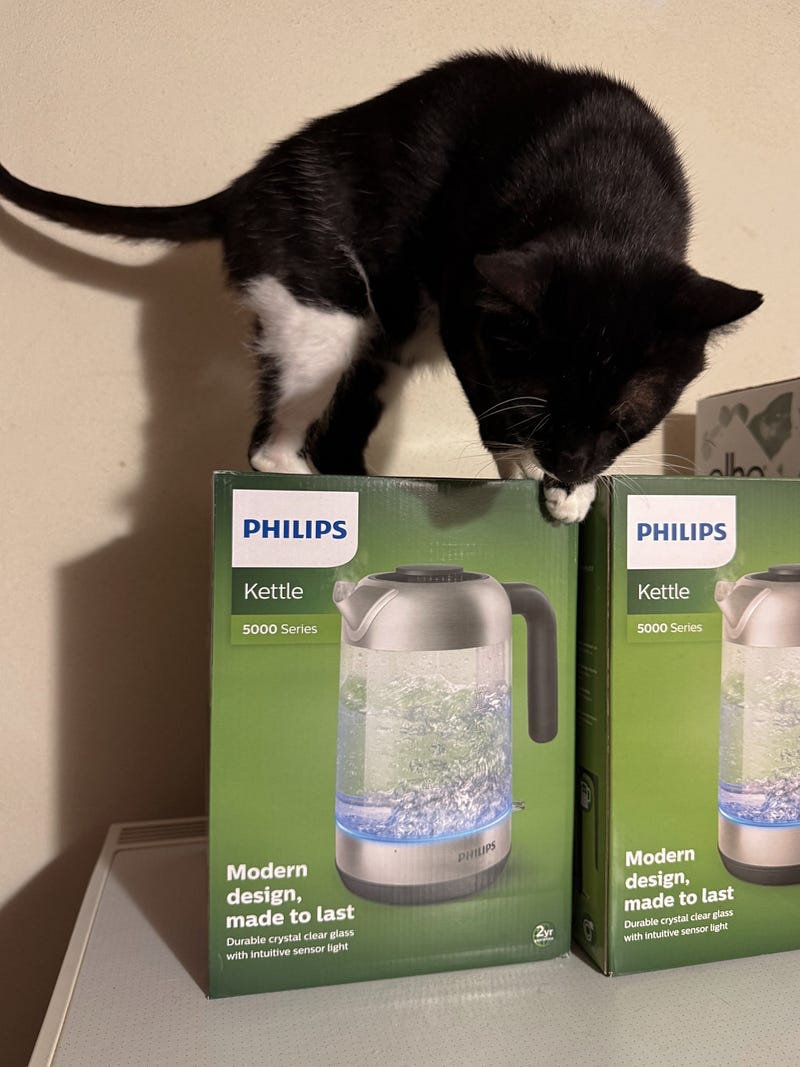
Once ours was pronounced dead, we were told that we’d receive the same model as a replacement. Guess what the slogan printed on its box read? ‘Modern design, made to last.’