I was at a dinner recently, the kind of meal where you’re half-listening, half-assessing whether these are “your people.” Somewhere between tapas, the conversation turned to GLP-1s.
But not in the way I expected.
These weren’t people whispering about weight loss.
They were swapping notes on something stranger: the woman who noticed she’d stopped doom-scrolling Zillow for houses she’d never buy.
A guy mentioned he’d deleted his sports betting app, not out of guilt, but because the urge had just... evaporated.
Someone else said the strangest part was walking past a wine bar and feeling nothing. No pull. No negotiation with herself. Just neutral.
They kept using the same word: quieter.

I left that dinner thinking about the noise. Not the weight loss or the drug itself, but that hum, the background static of WANT that most of us have just accepted as the baseline of being human. The pull toward the phone, the drink, the cart, the scroll, the snack. We’ve built entire industries around managing it: wellness, self-help, productivity, addiction treatment.
We’ve moralized it, monetized it, blamed ourselves for it.
But what if the noise was never a character flaw? What if it was a signal?
Here’s what fascinates me: GLP-1s weren’t designed to quiet your urge to doom-scroll or online shop. They were designed to regulate hunger hormones.
But people are reporting that when the “food noise” goes quiet, so does... a lot of other noise. The betting. The drinking. The scrolling. The wanting.
Scientists describe what’s happening as “turning down the gain on the reward circuitry in the brain.” Which suggests something that should stop us in our tracks: What if all of these compulsions, the ones we’ve treated as separate weaknesses, separate failures, separate industries, were always connected?
What if we’ve been short-circuited this whole time, and we just didn’t have the language for it?
I'm not here to tell anyone what to do with their body. But I am endlessly curious about what happens when millions of people suddenly get quieter brains and what that teaches us about the noise we'd all accepted as normal.
So I dug into the data. And the who is almost as interesting as the what.
The Generational Story
GLP-1 adoption isn’t evenly distributed.
The generation leading the charge might surprise you:
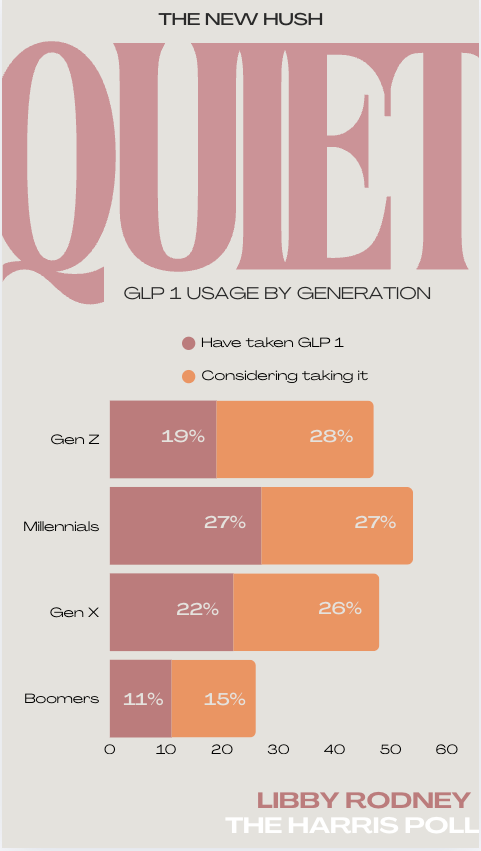
When you look at the numbers are see the possibilities, you will notice, 54% of Millennials have either taken or are considering taking a GLP 1. This is followed by Gen X ( 48% either taken or are considering), Gen Z (47% either taken or are considering) and finally Boomers (26% either taken or are considering).
Millennials are leading this adaption curve. This is the generation that came of age during the wellness boom, shells out $300 for boutique gym memberships, and earnestly debates whether red light therapy actually works.
They've tried everything; the cleanses, the trackers, the 5 AM routines, the cold plunges. And now they're discovering that the thing that actually helps... is medicine that quiets the noise they'd been white-knuckling against for years.
But here’s the real headline:
64% of parents with children under 18 have either taken GLP-1s or are considering it.
Parents. The people I’ve called “Crispy Parents” for years—overwhelmed, burnt out, running on fumes. The ones who spent a decade putting themselves last, stress-eating through bedtime routines, pouring a glass of wine to take the edge off, scrolling to numb out after the kids finally sleep. They’re not pursuing vanity. They’re pursuing quiet.
The self-reported effects from GLP-1 users go far beyond the scale:
Decreased “food noise” or obsessive thoughts about eating: 43%
Eating less low-quality processed food: 50%
Eating more high-quality natural food: 44%
But here's where it gets interesting.
Millennials are reporting effects that have nothing to do with food:
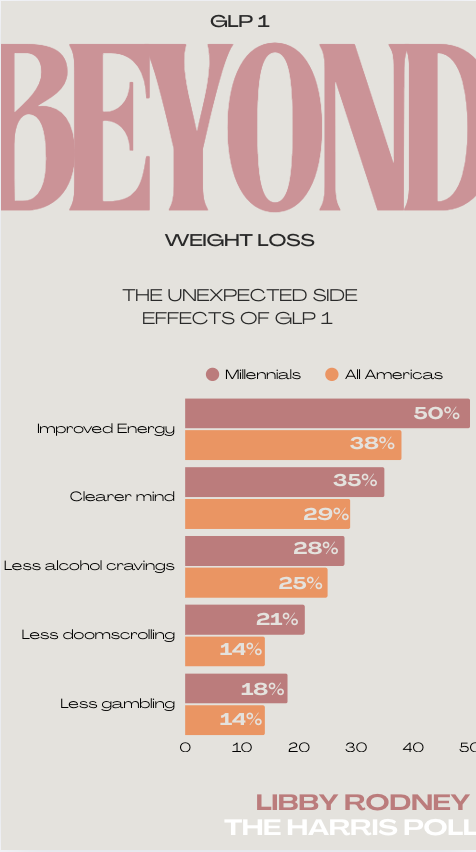
Doomscrolling. Gambling (for Gen Z this hits 31%). Alcohol. These aren’t weight-related behaviors. But they might share the same wiring.
52% of Millennials say they would take a GLP-1 if they were confident it could help with an addiction outside of weight loss—gambling, gaming, social media (vs. 48% of Gen Z, 38% of all Americans).
We’ve spent decades treating these compulsions as separate problems requiring separate solutions. Overeating? Diet industry. Can’t stop scrolling? Digital detox. Drinking too much? Each one framed as its own moral failure, its own billion-dollar industry.
But what if they were always the same noise, just pointed at different targets?
And here's what's telling: 84% of people taking GLP-1s say they're willing to tell anyone they're on the medication. No shame. No whispers.
Glenn Doyle has this phrase her family uses—MYOB. Mind Your Own Body. What someone else does to find their quiet is none of my business. And what I do to find mine is none of theirs. It might be the most radical wellness advice I've heard.
The shift is already reshaping markets, not because industries are panicking, but because consumer needs are evolving in real time.
Restaurants are rethinking portions and prioritizing protein density. Olive garden, Chipotle and Blaze Pizza others are developing options designed for people who eat less but need more nutrition per bite. This aligns with updated dietary guidelines recommending Americans consume significantly more protein than previously suggested and it makes sense for GLP-1 users trying to avoid muscle loss.
The food and beverage industry has seen a 42% growth in launches with gut or digestive health claims, responding to GLP-1 users who need fiber-rich, nutrient-dense foods to manage side effects.
The ripple effects go beyond food. Airlines are quietly factoring weight changes into fuel calculations. A Jefferies study found the four major U.S. carriers could save a combined $580 million annually as passenger weights shift.
Weight Watchers has reimagined its entire model to meet this moment, integrating GLP-1 support into a more holistic approach to wellness.
The pipeline is staggering, with new GLP 3s, Retatrutide, CagriSema, and MariTide each promising to quiet the noise even further. And the access barriers are falling fast: the Wegovy pill launched in January 2026 at $149/month for lower doses.
48% of Americans say they'd try a GLP-1 if it was available in pill form. It now is.
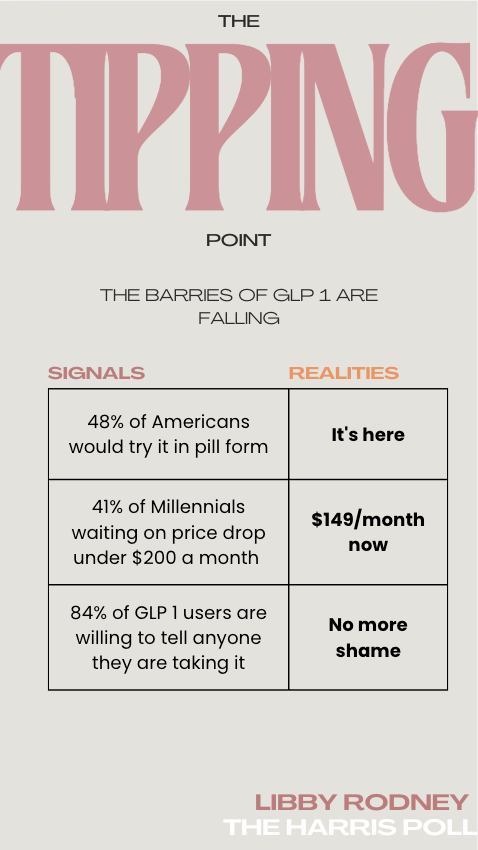
This is the quiet revolution, led by Millennials, embraced by exhausted parents, and about to go mainstream as pills hit the market and prices drop.
41% of Millennials say price alone is the barrier—”if the price drops to $200 a month, I’d take it.” With pills now on the market and insurance mandates expanding coverage, that barrier is dissolving. The cohort waiting on the sidelines is about to move.
Here’s what to sit with:
The “Try Harder” Era is Ending. Consumers are increasingly skeptical of messaging that frames struggle as moral failure. They’ve seen the data. They know biology plays a role. Brands built on shame will feel increasingly out of step.
Parents Are the Unexpected Power Users. 64% adoption/consideration among parents of kids under 18. They’re not chasing aesthetics, they’re chasing functionality and quiet. Marketing that speaks to exhausted caregivers finally addressing their own needs will resonate.
Normalization Is Already Here. 84% of people taking GLP 1 say “yes, I'm willing to tell anyone that I am taking the medication for weight loss”. The stigma is dissolving faster than most brands realize. Companies that treat pharmaceutical support as just another tool in the wellness kit (e.g., therapy, fitness, and sleep optimization) will build trust with this growing cohort.
Maybe the most interesting thing about that dinner conversation wasn’t what people said about GLP-1s. It was how they said it.
No shame. No whispers. No justification.
Just people marveling at what it felt like to finally have a quieter brain. To walk past the thing that used to pull at them and feel... nothing. To discover that the voice they’d been fighting their whole life wasn’t a character flaw.
It was just noise.
And noise, it turns out, can be turned down.
_________________________________________________________________________
Shout out to Jacklyn Cooney for leading this research with me, we’ve been tracking this trend for two years now.
_________________________________________________________________________
Curiosity is contagious; if you like this newsletter, please share it!!
Penned by Libby Rodney and Abbey Lunney, founders of the Thought Leadership + Futures Group at The Harris Poll. Thanks for reading The Next Big Think! Subscribe for free to receive new posts and support my work.