I’ve not blogged in a while. In my defence, I’ve been very busy. And still am. As well as launching an anniversary edition of my first book while trying to finish my next one, I’ve taken on multiple other duties as well, what with ‘cost of living increase’ being a thing, and children needing to eat, like, every day. What’s that about? I blame wokeness.
In any case, it mean’s I’ve had to cut back on the random articles by roughly 100%.
However, I was recently approached by a reporter asking me to comment on the latest story involving Elon Musk’s ‘Neuralink’, the world’s richest man’s attempt to give ‘brain chip’ (brain-computer interface) technology to the masses.
I’ve espoused on this many times before, like here, and here, and here, and here. Far too often, in some people’s view. But it’s still been a while, and due to being asked to comment on the current news story, about seven ‘GB-PRIME’ subjects taking place in the latest Neuralink trial1 in London, I ended up writing a thorough overview of the main concerns, which was 90% an article already, so why not put it up as one? And here we are.
So, what’s my beef with the latest Neuralink efforts? And how do they show that the widespread rollout of brain chips to the masses, that Musk seemed so confident about not too long ago, is actually further away than ever?
Helping patients with paralysis and movement disorders regain functioning is obviously good.
First and foremost, if paralyzed and immobilised people get some degree of function and independence restored, which is what the new trial reportedly hopes to achieve, that’s always a positive to be celebrated.
However, a cynical person could point out that this does mean Neuralink’s efforts automatically get a healthy level of positive, favourable coverage and goodwill, regardless of the overall intent or motivation. And I never said I wasn’t a cynical person.
Perhaps that’s unfair. Perhaps Elon Musk’s ultimate goal here is indeed to help better the lives of a small population of very vulnerable people. I can’t rule this out. But I can say that, going by the vast amount of data we have about his past actions and behaviours, this would be wildly out of character.
Again, it’s good that vulnerable, incapacitated people would get a degree of autonomy and independence back. But, as we’ve seen, the Neuralink technology can have a limited shelf life. And if these new chips prove to be similarly short-term, what happens to the subjects then? Can they expect to be supported long-term, by a ruthlessly capitalist organisation? You’d hope so. But I wouldn’t bet on it.
Point is, helping vulnerable people is good. Exploiting vulnerable people’s plight as a quick route to favourable media coverage before discarding them, is bad. Both should be getting the same degree of attention, to provide an accurate overall picture. But that hardly ever happens.
‘Brain Chip’ technology is not new
Seriously, ‘Brain chip’ technology, the act of planting a computer chip or similar directly into someone’s brain, allowing direct interaction between technological and neurological activity, and thus immediate communication between the brain and a device, is not new. It’s been around for decades.
Indeed, neuroprosthetics, the use of technology to restore neuronal functioning, are about 60 years old, and hundreds of thousands of people have cochlear implants alone. Point is, this isn’t something that first happened within the last 5 years. It’s definitely not something Elon Musk (or, his employees) invented.
What Musk has done is turned the mainstream media spotlight onto it, via his profile and influence. This is, in and of itself, an achievement. And I suspect it’s the main reason so many now think Musk is some sort of pioneer in this area. Because until now, it’s been the reserve of dedicated, but little known, expert scientists and technicians, working behind the scenes to help people with movement disorders and paralysis, i.e. a low-profile population working, on an issue that affects a niche subgroup of patients.
Of course, this has resulted in a narrative that goes against the actual facts.
For instance, if you Google ‘Who was the first person to have a chip in their brain?’, here’s the answer you get.
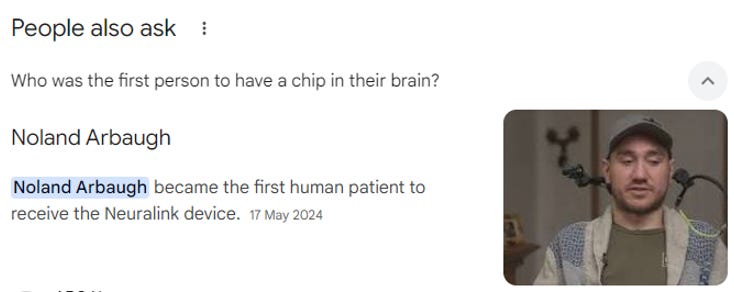
No disrespect to Noland Arbaugh, but he was the first person to receive a Neuralink chip in his brain. In 2024. Many decades after the first patients to receive what could genuinely be described as a ‘brain-computer’ interface chip in their cortex.
But of course, the widespread media coverage posted online skewed the algorithms and AI search summaries, and now the go-to information, the ‘most common’ answer, regarding chips in the brain defaults to Neuralink.
This is obviously another problem with relying on AI, which is a whole other discussion. But it still ultimately sets people up to believe that brain-chip technology is a whole new world that Musk has opened up. Sort of like the European explores who would plant a flag in the countries they ‘discovered’ and promptly name it after themselves, while the many natives looked on, confused and, eventually, scared.
And this is an issue, because those who defer to the Neuralink narrative rather than the facts, will make decisions accordingly. And when those decisions involve ‘voluntarily submitting to brain surgery’, that’s not ideal.

Chips in the brain are a very bad commercial prospect (at least at present)
Until Musk’s involvement, brain-computer interface tech hadn’t really been considered commercial venture that everyone could partake in. And for good reason.
Think of what is required to actually inert a computer chip into someone’s brain and have it actually function as a technological interface. Locating the ‘thoughts’ it needs to reed would be hard enough. Every brain is structurally unique, so you’d need to map exactly where the thoughts and processes you’re after actually take place in an individual’s cortex.
Then there’s the whole “surgical insertion of an object into the skull, without causing any damage or long-term harm” aspect. Even a tattoo, something literally surface level, is a long and elaborate process involving highly trained professionals (and rightly so). Having your brain physically mapped and tampered with would be considerably more involved. And the goal is to offer this to the average person in the street, like with smartphones?
Basically, for brain-chip technology to be commercially viable, it would require many millions of people to volunteer for actual brain surgery, and an army of neurosurgeons and accompanying professionals, to provide it, and the before and after care required, and all the resources this would need.
And all this medical care would logically have to cost less than the price of a brain chip itself, which would have to be cheap enough to appeal to the average user, for it to be commercially viable. It’s a tricky sell otherwise.
“Would you like to have your skull surgically opened and a mass-produced chip inserted directly into your brain, by people who are likely hastily trained, underpaid, and overworked?2”
“How much is it?”
“Only a few hundred thousand dollars, for the basic package”
I honestly can’t see many takers for this offer.
But even if there were, what would you get with a chip in your brain? What, exactly would it offer you? All the claims involve things like being able to use a computer or smartphone, or play video games, just by thinking about it.
But… we all already do that. All the time. It’s just those ‘thoughts’ get relayed via our arms and hands, or our voices in some cases, and we use those to interact with our devices. Having a chip in our brain meaning we can do it with thoughts alone might require less effort, but… how much less effort really?
You usually still need to hold your smartphone or laptop, or at least position it, in order to use it. A brain-chip can’t do that for you. Unless your home setup also includes an array of versatile mechanical arms, or a fleet of small and very precise drones. That’ll make everything more expensive.
It’s also overlooked that these brain chips are largely one-way. Your brain can control a device, but unless Neuralink have made multiple breakthroughs they haven’t thought to mention, the device cannot control, insert information into, or otherwise enhance your brain. I’ve had people say that a brain chip could mean you have ‘the whole of Google inside your head’. But, it won’t. No known technology accelerates the comparatively plodding pace with which the human brain absorbs information. That’s just not how it works.
So, if you’re a typical person with full physical mobility, how does a brain chip improve your life? You can move a cursor, or type, or steer a virtual car, with your mind, not your hands. But… then what? It doesn’t make you better at those things, just slightly faster. Does this benefit you in the long term? To an extent that warrants the inevitable cost and invasive, dangerous surgery? That seems unlikely.
All of these factors combined suggest to me that brain chip technology is not, in its present state, an appealing commercial prospect. And I’d argue this realisation is slowly sinking in for the Neuralink project. The story previously linked to, about the GB-PRIME trial, specifically states:
“Neuralink’s brain-computer interface (BCI) technology, which aims to improve independence for people who are paralysed…”
Phrasing it this way suggests that treating such patients was/is the entire point, when it never was before. It was more like ‘brain chips will give quasi superpowers to millions!’, and restoring some function to paralysis patients was the first step on the way to that.
This change suggests a scaling back of ambitions, in the face of logic and reality.
But it would be so much better if people could just be honest about this, rather than let billionaire technocrats adjust reality in real time.