Dear Merchants,
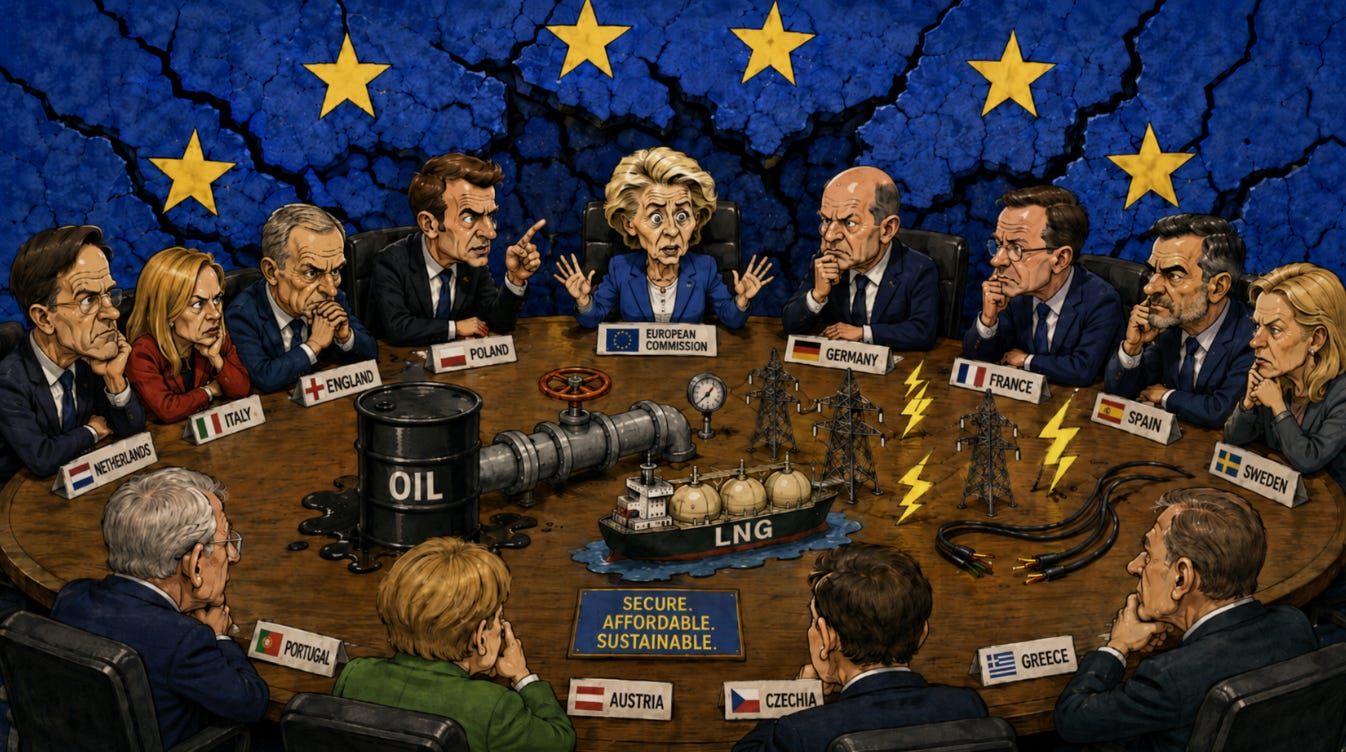
Europe is running its energy system on a war footing. Gas storage sits at 31% of capacity, the lowest start to an injection season since 2018. TTF trades near 45 €/MWh with a war premium attached to every cargo that passes within missile range of Hormuz. IEEFA expects the USA to supply 66% of Europe’s LNG this year, the deepest supplier concentration the continent has ever run. This is the middle of a crisis, not the aftermath of one, and it is not hitting every country at the same depth. Some are waking up.
Others are sinking.
5 charts show the divide.
Every Country Replaced Russia Differently
Let’s start with the gas, because that is where the split began.
In 2020, Russian pipeline gas covered roughly 40% of European demand, and every country drank from the same pipe at roughly the same price. When that pipe closed, each country solved the problem alone, and the solutions were not equal. ACER reports that 58.4% of EU LNG came from the USA in 2025. IEEFA measured 63% in Q1 2026 and now has Europe on track for 66% across the full year, because the Iran war has made every Qatari cargo through Hormuz conditional. That average hides the real story, which is the spread between countries.
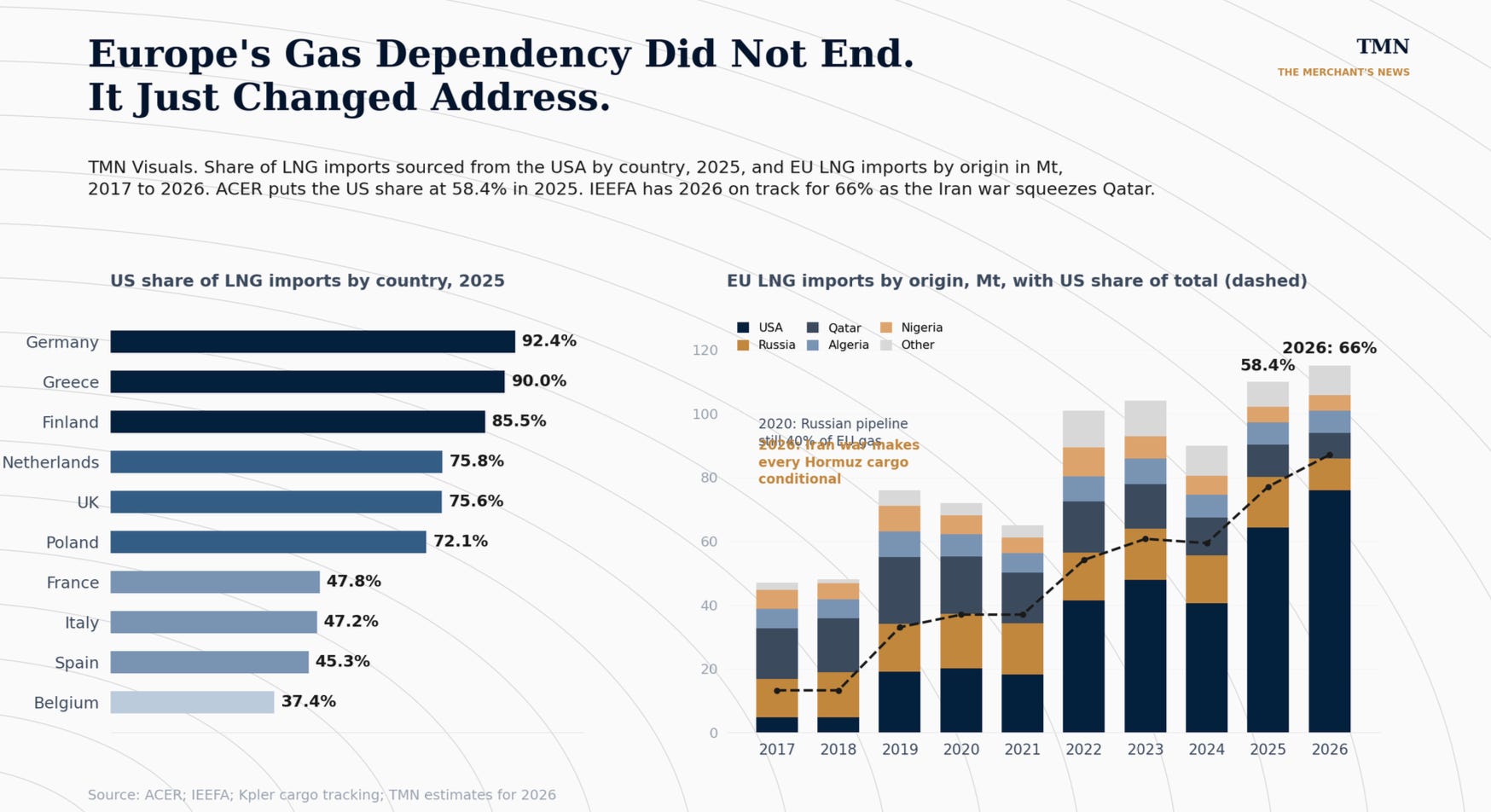
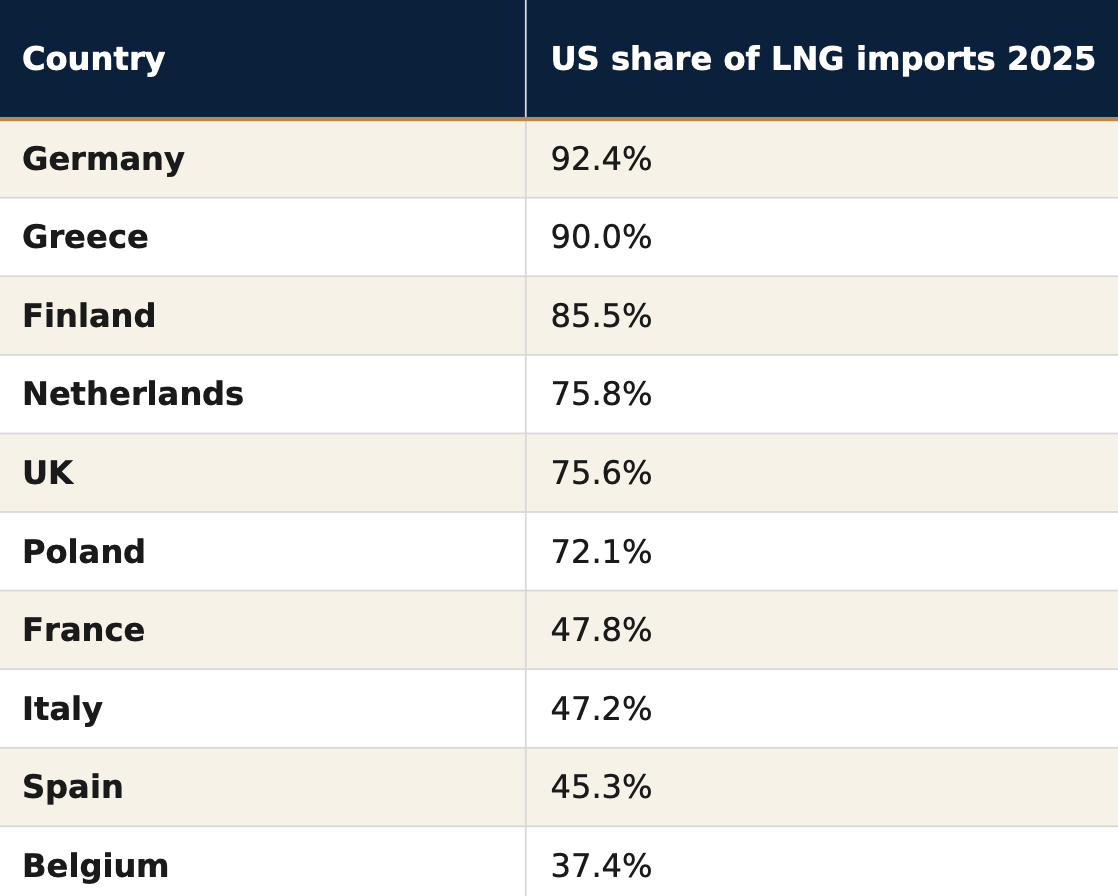
Germany sourced 92.4% of its LNG from the USA in 2025.
Greece took 90.0%, Finland 85.5%, the Netherlands 75.8%, the UK 75.6%, Poland 72.1%. At the other end of the table sit the countries with older, wider import networks: France at 47.8%, Italy at 47.2%, Spain at 45.3%, Belgium at 37.4%.
And Russia never fully left. I
EEFA counts Russian molecules at 13% to 16% of EU LNG in H1 2025, arriving quietly through Zeebrugge and Montoir.
Add Norway, whose pipelines now carry about 30% of EU gas, up from roughly 24% in 2020, and the arithmetic becomes uncomfortable. 2 suppliers, the USA and Norway, now cover about 55% of European gas. That is more supplier concentration than Europe ran before 2022, when the politicians called dependency a strategic emergency.
Europe did not diversify, it swapped 1 dominant supplier for 2 friendlier ones and declared victory.
The market has already rehearsed what this concentration costs. In June 2022, the explosion at Freeport removed a single US liquefaction plant, about 2 Bcf/d, and TTF repriced violently within hours because Europe had nowhere else to turn. That was 1 facility. Today the exposure is a whole export coast, plus 1 Norwegian pipeline system whose maintenance schedule European traders now read the way they once read Gazprom nominations.
Diversification was the stated policy goal of 2022. Concentration is what actually got built and the buffer is gone. Europe entered the 2026 injection season with storage at 31% of capacity, the lowest level since 2018, after ending the winter below 30% and filling to less than 80% in 2025. Brussels quietly cut the storage target from 90% to 80%, which changes the regulation but not the physics. Europe has to buy more LNG than last year, into a market pricing an active war around Hormuz, with TTF near 45 €/MWh, roughly 35% above any level a European industrial buyer calls comfortable.
The countries most exposed to US LNG are also the countries paying the highest industrial energy bill. That is not a coincidence.
The Industrial Bill and Who Pays It
Cefic, the European chemical industry council, publishes the number that defines the emergency, and the number has not moved into 2026: European chemical companies pay roughly 3x US energy costs and roughly 2x Chinese ones. A chemical plant is mostly an energy bill with pipes attached, so that gap is not a margin problem. It is an existence problem.
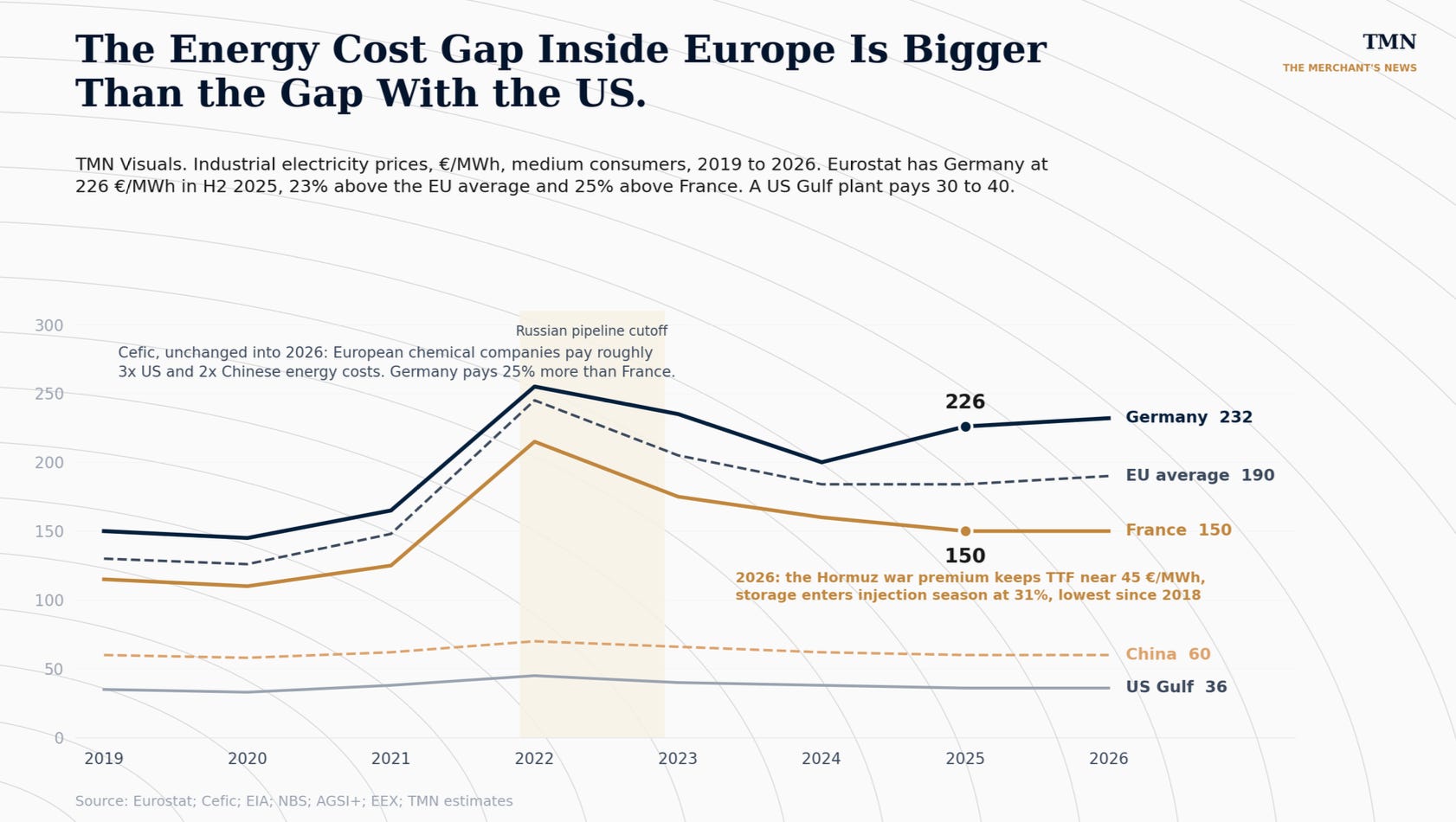
Inside the European average, the split from the first chart reappears with precision. Eurostat’s December 2024 data puts industrial electricity for medium consumers at 0.20 €/kWh in Germany, 0.16 €/kWh in France, 0.15 €/kWh in Italy.
By H2 2025 Germany paid above 0.22 €/kWh against an EU average of 0.18, which is 23% above the average of the club Germany is supposed to lead.
Germany pays 25% more than France for industrial electricity, and the gap is widening, not closing. This is not a residue of the 2022 shock. It is the cost baseline sitting inside every plant level investment decision being taken in Europe in 2026. Meanwhile a US Gulf Coast plant buys power at 30 to 40 $/MWh, a Chinese competitor at 50 to 70 $/MWh, and the TTF to Henry Hub gas spread sits stubbornly at 3x to 4x.
The gap with the US is not a market anomaly that arbitrage will close. It is the physics of LNG.
Liquefaction consumes roughly 10% of the gas, the liquefaction fee adds 2 to 3 $/MMBtu, shipping and regasification add more, and by the time a Henry Hub molecule lands in Rotterdam it costs a multiple of what it cost in Louisiana. A gas system built on imported LNG carries that stack permanently. Which means the only variable each European country actually controls is how much of its power price depends on gas at all.
For 25 years, cheap Russian pipeline gas hid a structural European disadvantage. Countries that built alternative baseload, nuclear in France, coal to nuclear transitions in Poland and the Czech Republic, hydro and nuclear in Sweden, absorbed the shock and moved on.
Countries that never built it are absorbing the entire gap, every hour, on every meter.
You cannot pay 3x your competitor’s energy bill indefinitely and still make chemicals, steel, or aluminium. Someone stops trying. The countries where that is already happening are exactly the ones from the previous chart.
The Silent Migration Concentrated in the Sinking Countries
Cefic’s (the European Chemical Industry Council) Closures Radar counts 37 Mt of European chemical capacity closed between 2022 and 2025, and the radar is still adding entries in 2026. That is 9% of the entire European chemical base, gone in 4 years, at 6x the historical closure rate. This is not history, it is the current run rate, and I keep it taped above my desk because it is the single best measure of what the energy crisis is actually doing.
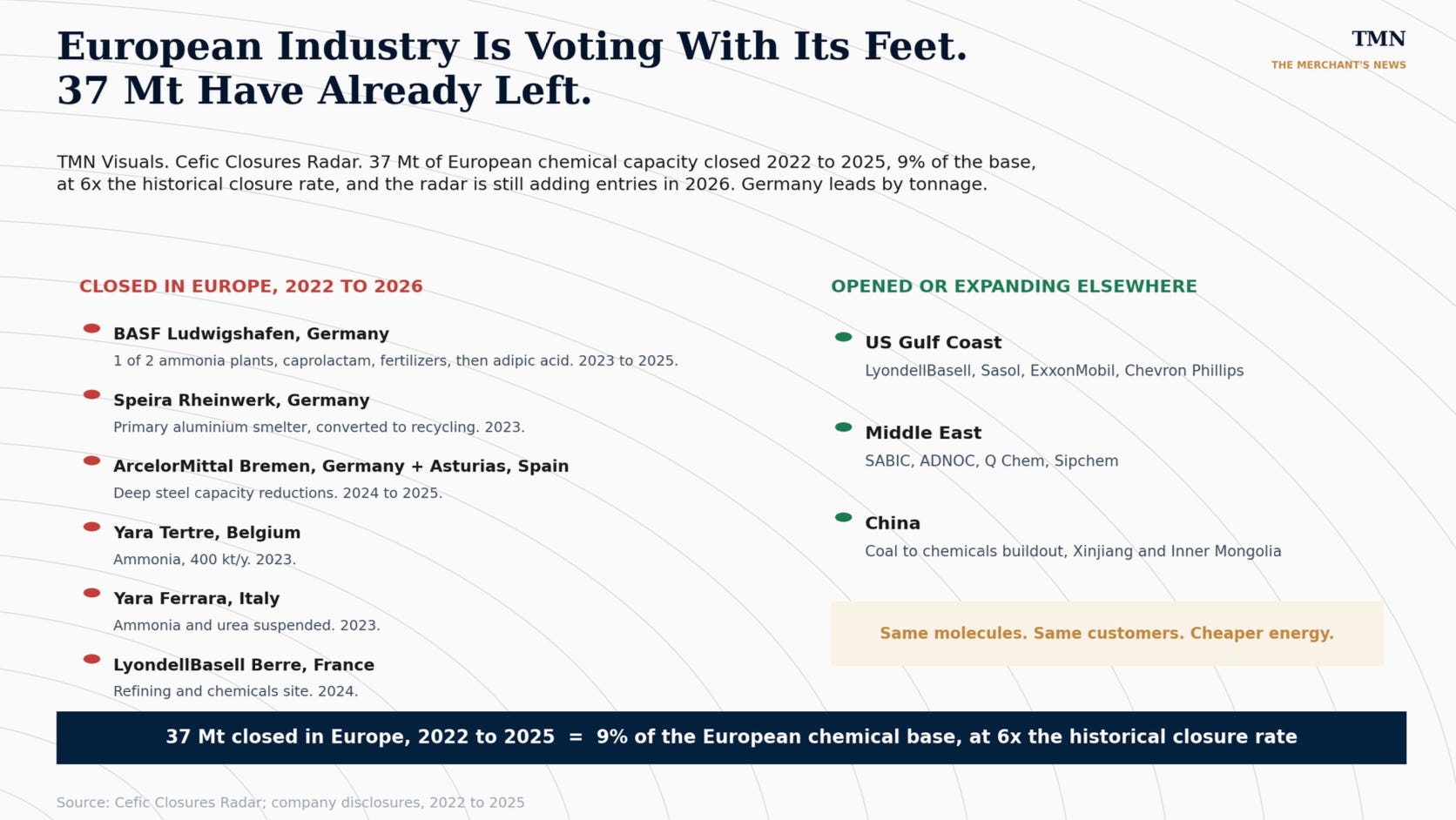
The names make the map. BASF Ludwigshafen closed 1 of its 2 ammonia plants plus caprolactam and fertilizer units, announced February 2023, implemented through 2024, with a second wave on adipic acid through 2025. Yara shut 400 kt/y of ammonia at Tertre in Belgium and suspended ammonia and urea at Ferrara in Italy. Speira shut the Rheinwerk primary aluminium smelter in Germany and converted it to recycling. LyondellBasell closed Berre in France. ArcelorMittal cut deep at Bremen and Asturias. Germany accounts for the largest share of closed tonnage, which is exactly what the price data predicts.
The capacity did not disappear…. It moved.
LyondellBasell, Sasol, ExxonMobil, and Chevron Phillips are building on the US Gulf. SABIC, ADNOC, Q Chem, and Sipchem are expanding in the Middle East. China is stacking coal to chemicals capacity in Xinjiang and Inner Mongolia.
This is not deindustrialization by choice.
It is deindustrialization by physics, and it is not evenly distributed. The countries that never solved their energy problem are the ones losing their industry.
First the chemicals went.
Then the metals.
Now the refining.
And the map looks familiar.
After Chemicals the Refineries, Same Countries Same Story
Argus counts 400 kb/d of European refining capacity closing permanently in 2025, 3% of the European base in a single year. Grangemouth in the UK, 150 kb/d, shut by Petroineos.
Wesseling in Germany, 147 kb/d, shut by Shell. Gelsenkirchen in Germany, partially closed by BP. Livorno in Italy, converted to biofuels by ENI. UK, Germany, Italy. The same 3 countries losing chemical capacity are losing the refineries, because a refinery is the same business as a chemical plant: energy in, margin out.
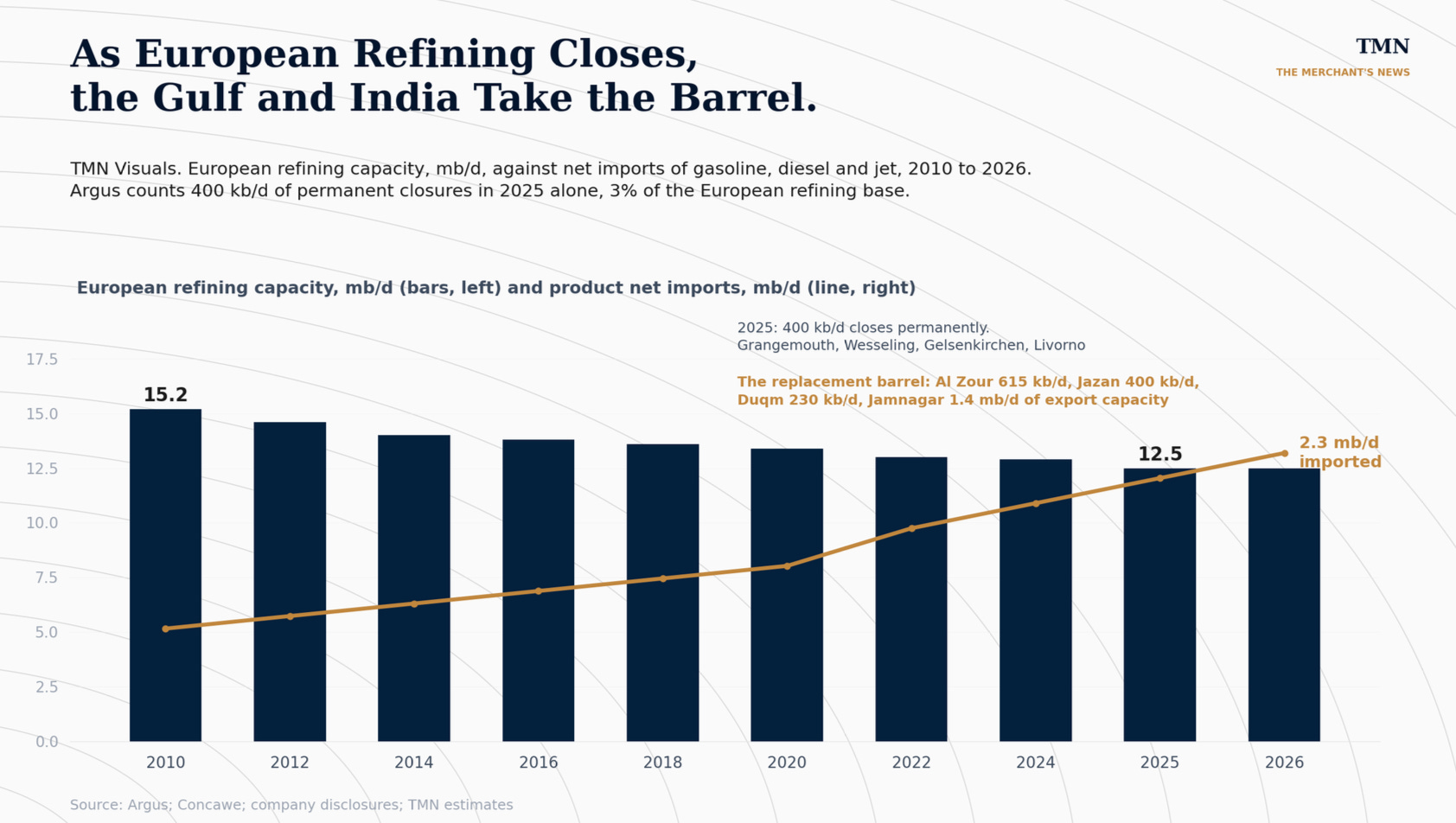
The barrels Europe no longer refines arrive refined by someone else. Al Zour in Kuwait, 615 kb/d, built with European exports in mind. Jazan in Saudi Arabia, 400 kb/d of ULSD pointed at Europe.
Duqm in Oman, 230 kb/d, export focused.
Jamnagar in India, 1.4 mb/d, sending diesel and gasoline west every week. Europe imposes the world’s strictest fuel standards on its consumers while consuming diesel refined in jurisdictions with different environmental rules.
That is sovereign standard setting, and Europe is losing it quietly, 1 closure at a time.
The 1 country that understood where this ends is the country already doing something about it. The shape of that response is the story of the whole piece.
France Woke Up, Germany Is Still Sinking
France runs 61 GW of nuclear capacity today. Flamanville 3 is commissioning another 1.6 GW. 6 new EPR2 reactors are announced in pairs at Penly, Gravelines, and Bugey, with 8 more under study after 2040.
This is the largest energy decision any European country has taken since the 1970s, and it is the same decision France took in the 1970s.
The UK is building Hinkley Point C at 3.2 GW and has taken FID on Sizewell C at 3.2 GW. Sweden plans 2 new reactor equivalents by 2035 and a massive expansion by 2045. Poland is building 3.75 GW of AP1000 at Choczewo. The Czech Republic signed KHNP for the Dukovany expansion.
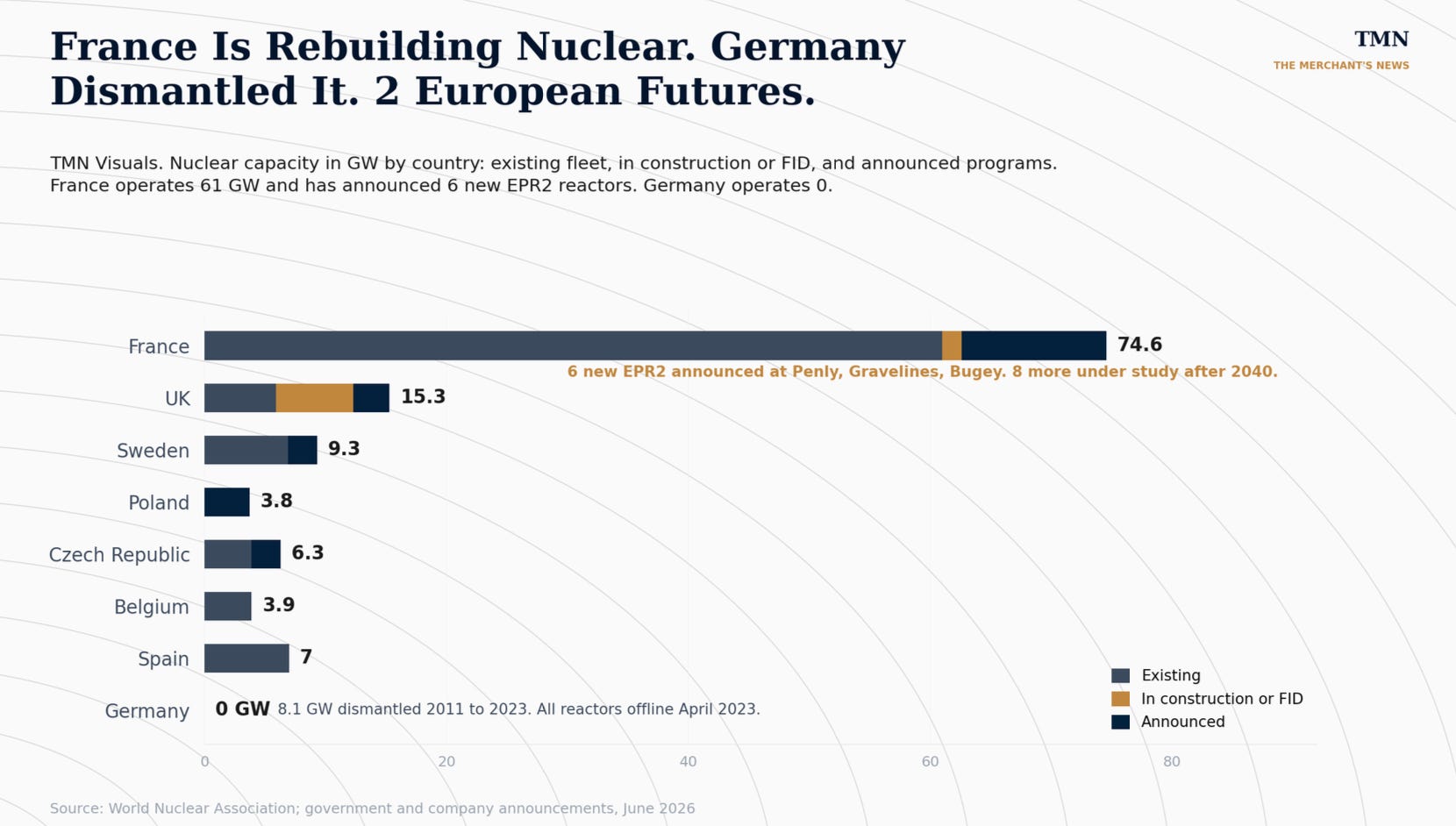
Then there is the other Europe. Germany runs 0 GW of nuclear. Every reactor went offline in April 2023, and 8.1 GW was dismantled between 2011 and 2023, an industrial demolition executed while German industry begged for baseload. Spain holds a full phase out by 2035, first shutdown 2027. Belgium is extending Doel and Tihange partially and building nothing.
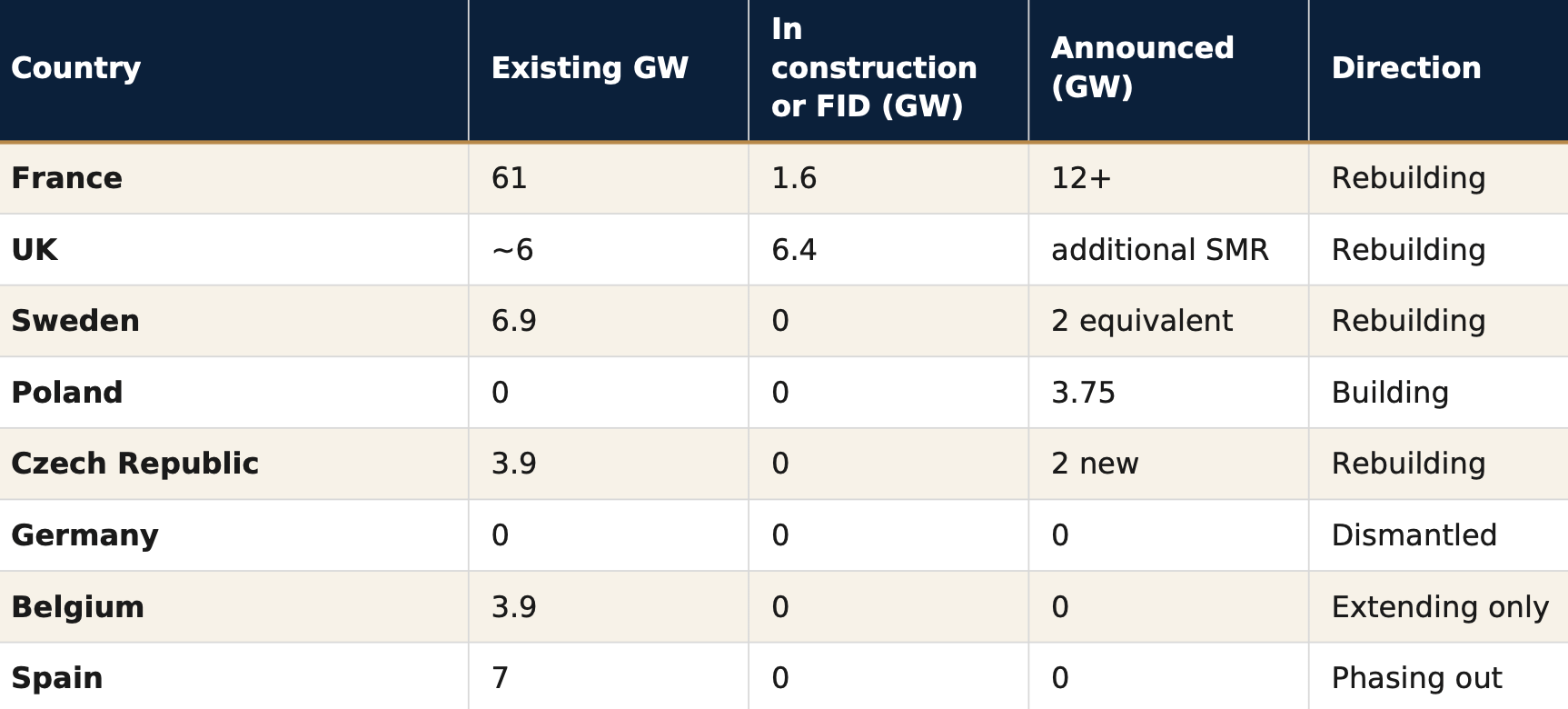
Look at what adaptation buys, France is already selling its industrials long term nuclear power contracts around 70 €/MWh through the EDF framework that replaced ARENH, less than a third of what a German mid size manufacturer paid on the spot market in 2025. That is not a subsidy it is the dividend on a 50 year old infrastructure decision, and every country in the rebuilding column of the table below is trying to buy the same dividend for the 2040s.
Run the projection forward.
Each of the last 4 charts told the same story from a different angle. The countries paying the most for energy are losing the most industry. The countries that adapted their power mix, France above all, are keeping theirs. This is the structural sorting of Europe into a productive core and a deindustrializing periphery, and the next 15 years will make it permanent.
The Divide Is the Trade
So, who survives Europe’s energy crisis? The countries that stopped treating it as history.
France is waking up.
So are Sweden, Poland, the Czech Republic, each in their own way, each betting on the same solution the French bet on in the 1970s. Germany is sinking.
So are Belgium, Spain, and much of the industrial heartland that used to be the engine of the continent. This is not a crisis anyone is calling a crisis, because it does not announce itself with headlines. It announces itself with plant closures in Ludwigshafen, refinery shutdowns in Wesseling, aluminium smelters going dark in Rheinwerk. Every quarter a little more of the old European industrial base moves to the Gulf, the US Gulf Coast, or China. Every quarter France gets structurally more competitive.
In the next editions I will name the equities that trade this divergence. There are US listed and European names on the winning side of the industrial migration: US Gulf petrochemicals, Middle East ADRs, LNG midstream operators. There are European names structurally short their own industrial base. I will name them, size them, and put a price on the trade. Until then, keep the 5 charts above open on your desk. They are the lens for reading every Europe energy headline this quarter, and every earnings call from a European industrial company between now and the end of Q3.
Thank you for reading it!
If you enjoy this content, consider becoming a premium member to get access to my favourite stocks and latest updates.
We truly appreciate your interest in staying informed about the latest global trends and insights.
Please let us know if you liked it, what we can improve, and if you think this newsletter could help a friend, please send it to them!
Stay update and take care!
The Merchant’s News
GP
This piece is for informational purposes and reflects the author’s own analysis and views. It is not investment advice and does not constitute a solicitation to buy or sell any security. Investors should conduct independent due diligence and consult qualified advisers before making investment decisions. Past performance is not indicative of future results.