Dear Merchants,
The entire global mining industry is worth about $1.6 trillion.
NVIDIA alone is worth $4.5 trillion.
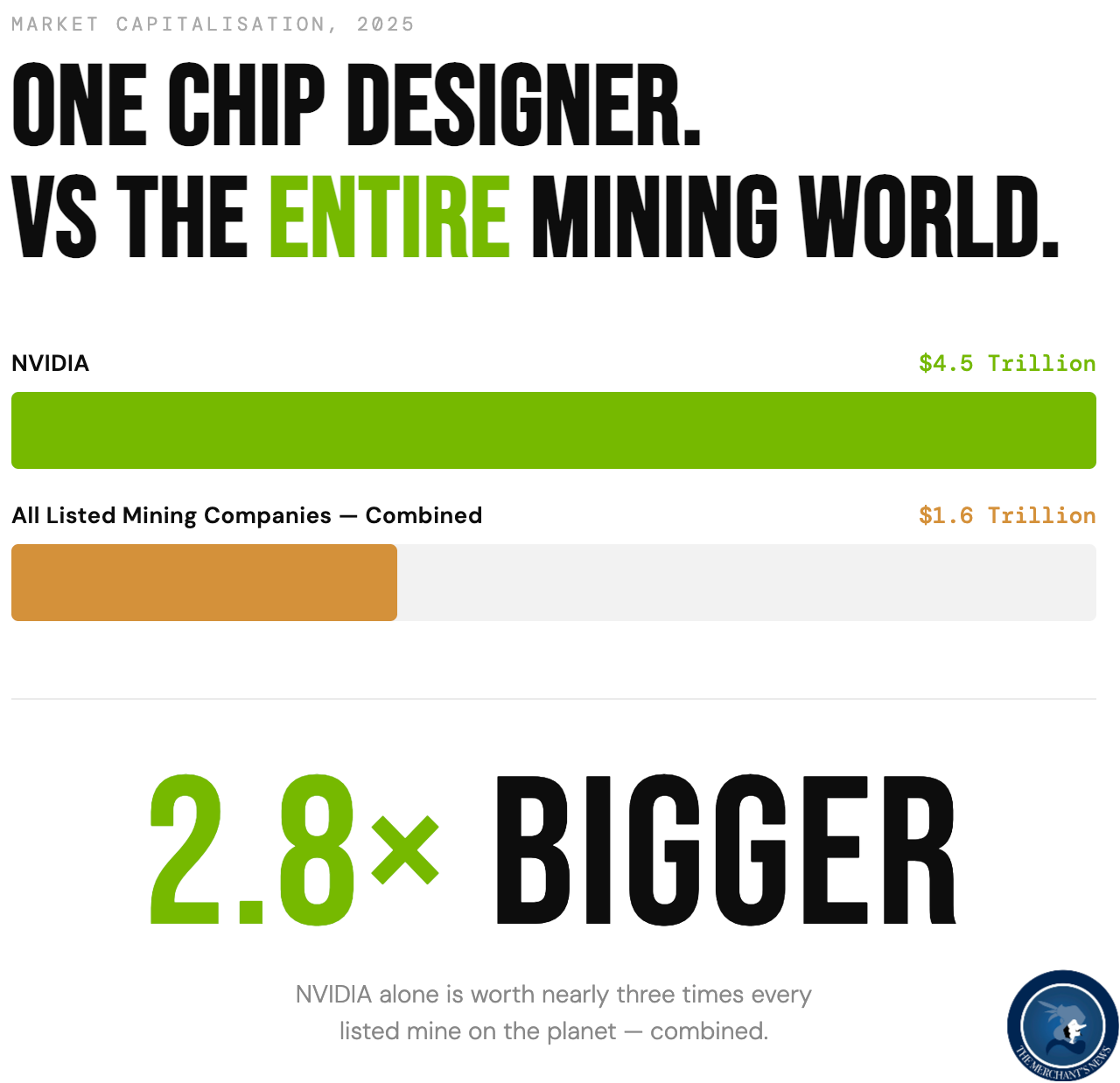
BHP, one of the biggest mining company on earth, has a market cap of $125 billion. NVIDIA can add that in a single good week (sometimes in a single trading day).
I’m not complaint about tech valuations, but it’s worth sitting with, because it tells us something real about where money has been going and where it hasn’t.
Mining sits underneath every supply chain that actually matters right now: semiconductors, power grids, defense systems, electric vehicles, wind turbines, AI data centers. None of it works without the metals that come out of the ground first. But the market, for the past decade, has decided it would rather own the company that designs the chip than the company that digs the copper the chip needs to function.
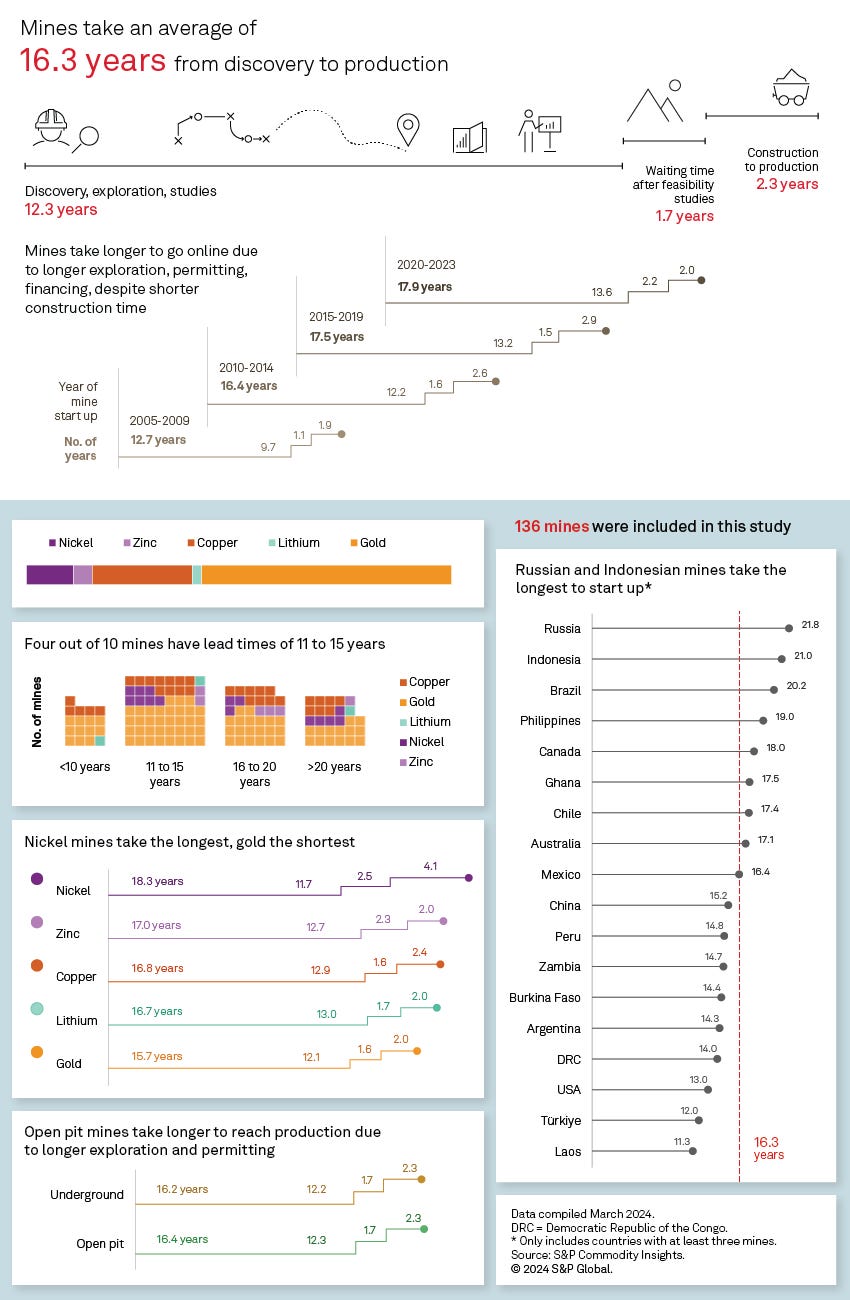
So capital stayed away from mining. Permitting timelines stretched to 15-19 years.
New discoveries dried up. Ore grades kept falling as the easy deposits got mined out. Meanwhile, institutional money chased software, services, and anything that didn’t involve moving millions of tons of rock.
That gap can’t stay hidden forever.
The companies that already own long lived, low cost, permitted copper assets aren’t priced for what those assets are actually worth strategically. They’re priced as though the world doesn’t need what they’ve got. That’s where the opportunity is because the math on supply versus demand simply doesn’t add up, and at some point reality wins.
Why this copper deficit is different from past cycles?
Copper takes roughly 15 years to permit in most developed countries. A GPU takes 15 months to reach a data center.
Previous copper bull markets were mostly driven by Chinese urbanization and synchronized global economic growth….
This one is different, it’s a structural supply shortage colliding with demand that barely responds to price increases.
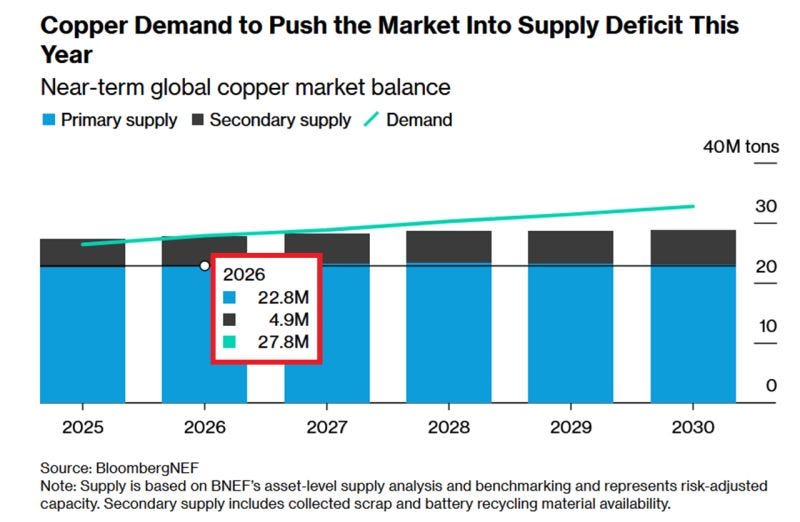
The deficit is already showing up.
The International Copper Study Group now projects a 150,000 metric ton refined copper deficit in 2026, after years of modest surplus.
Global mine production is growing at 2.3% per year. Refined copper output is growing at just 0.9%, down from 3.4% the prior year.
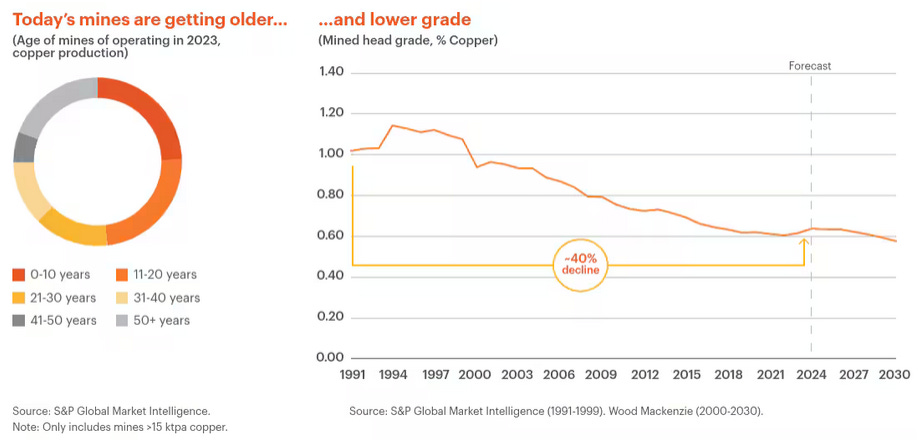
Ore grades have dropped from 1.5% copper content in the 1980s and 90s to below 0.7% today. That’s what happens when you spend a century mining the best deposits first. What’s left requires processing twice as much rock to get the same amount of copper.
The consequences of lower grades ripple through everything:
energy consumption roughly doubles because crushing and grinding scale with the volume of material processed
water usage climbs in the processing stages
waste generation increases
capital costs go up because you need bigger plants and more equipment to handle more ore.
Right now, building new copper production capacity costs around $15,000-$20,000 per tonne of annual output about double what it cost historically. Unlike commodity prices, ore grades don’t recover. They only go one direction.
The industry faces a straightforward but brutal math problem.
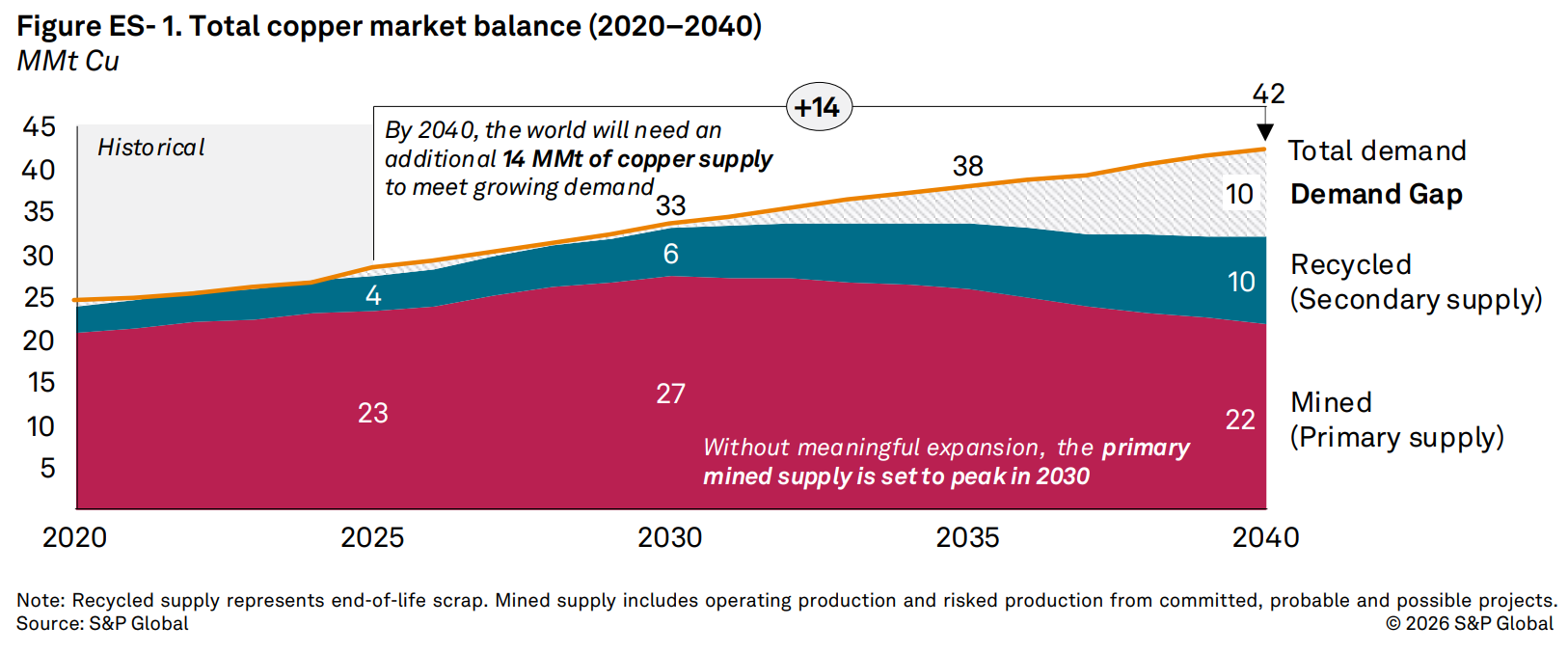
Meeting 2040 demand requires adding roughly 14 million tonnes of new annual mine capacity, the equivalent of building more than 50 very large scale copper mines within the next decade. Given current investment levels, permitting timelines, and declining ore grades, that number is not going to be hit.
In September 2025, Freeport McMoRan’s Grasberg mine in Indonesia, one of the world’s largest copper operations, suffered a catastrophic mudslide that flooded the underground mine with about 800,000 tonnes of wet material. 7 workers were killed. The mine declared force majeure and shut down completely, removing an estimated 500,000 tonnes of copper production across 2025-2026, with operations not expected to resume before mid-2026.
BHP’s Escondida mine in Chile, the world’s largest copper mine, faced shutdowns from labor disputes and operational issues, removing around 50,000 tonnes. Kamoa-Kakula in the DRC had an accident that curtailed about 80,000 tonnes. Chile’s overall output has stayed flat despite massive reinvestment falling grades at aging mines offset any brownfield expansion.
Analysts now estimates that annual mine disruptions should be modeled at 6% of global production, up from the previous 5% assumption. In practice, that’s 300,000 ton of copper removed from the market every year just from accidents, labor disputes, weather, equipment failures, and political instability.
where things actually break?
Even if mine output grew modestly, turning ore into usable copper depends on refining capacity and that’s where the system is most constrained.
Global refined copper production reached about 28.4 million tonnes in 2025, but growth is collapsing. Just 0.9% in 2026, compared to 3.4% the year before.
The reason?
concentrate shortages following the major mine disruptions, combined with China controlling about 40% of global smelting capacity and treatment charges falling to historically low levels, a sign that smelters can’t get enough feed material to run at full capacity.
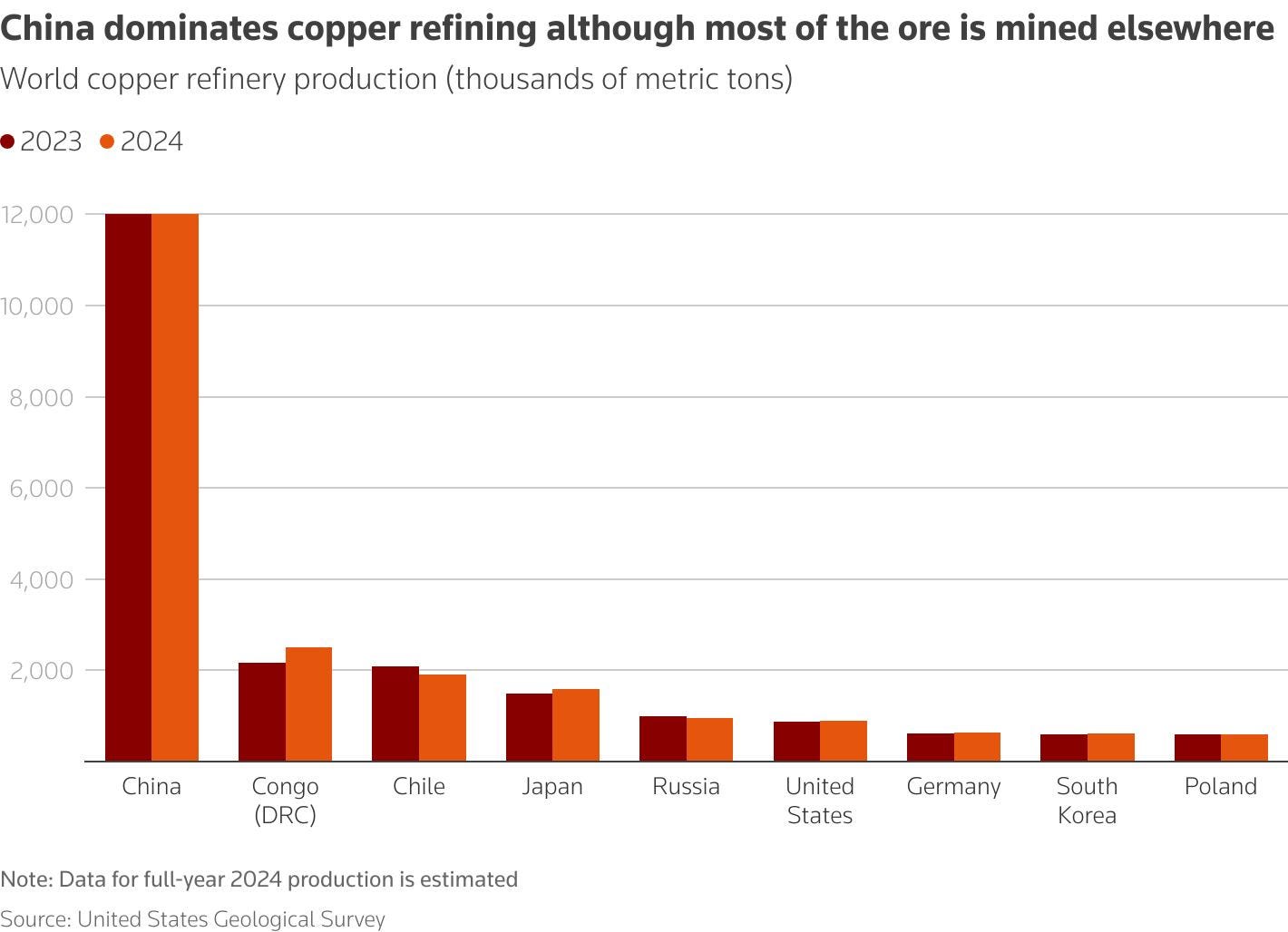
United States produces more raw copper than it consumes, but can’t process it domestically. The US can cover 146% of its domestic copper demand through mine production and scrap combined yet nearly 48% of US mined copper concentrate gets shipped overseas (mostly to China) for smelting, then imported back as refined copper.
The US has only 3 operating copper smelters:
Freeport-McMoRan’s Miami smelter in Arizona
Rio Tinto’s Kennecott smelter in Utah
ASARCO’s Hayden smelter in Arizona (restarting after a four-year shutdown)
The bottleneck is refining infrastructure. The US sends raw material to China for processing, then buys it back as finished copper. That creates supply chain exposure that defense planners, energy officials, and procurement managers are starting to take seriously.
Why demand is harder to push around with price than it used to be?
Copper demand is shifting away from construction and consumer goods (which slow down when copper gets expensive) toward infrastructure and technology applications that barely notice copper price swings.
AI data centers:
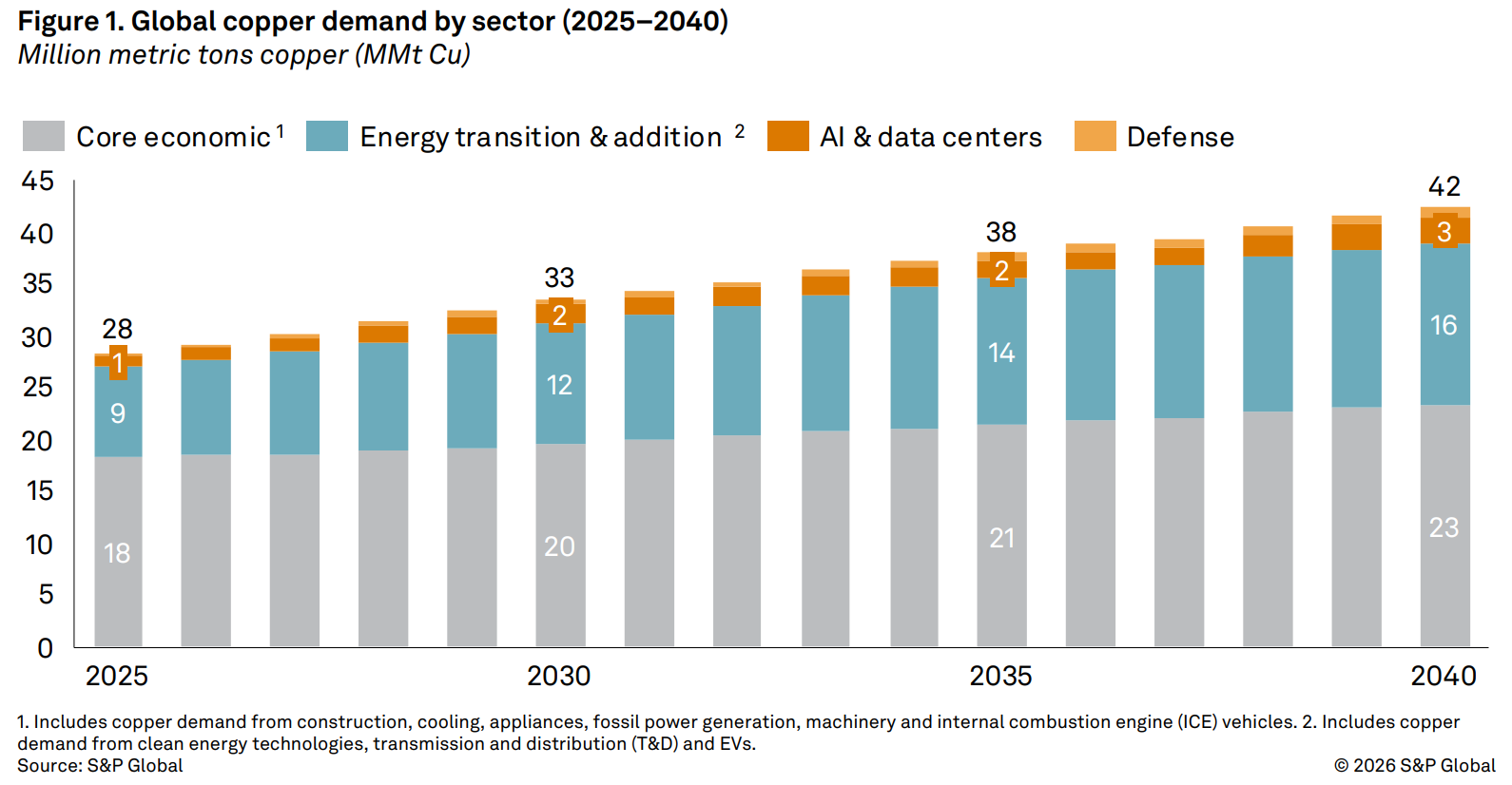
A traditional data center uses 5,000-15,000 tonnes of copper. A 1 gigawatt AI data center uses up to 50,000 tonnes , driven by extreme power density, liquid cooling systems, and high density cabling.
The total installed data center capacity will reach 550 gigawatts globally by 2040, (x 5 compared to 2022). AI alone adds about 700,000 tonnes of incremental copper demand by 2030.
Here’s why this demand is different from, say, housing construction, copper represents less than 0.5% of total data center project cost. When you’re building a $2 billion AI training facility, copper at $4/lb versus $6/lb doesn’t change the decision. The project gets built either way. OpenAI’s $500 billion Stargate initiative is one example of the scale of spending underway, and projects like that pull copper forward into orders placed well in advance to hedge against shortages.
EV
A conventional car uses 15-20 kg of copper. An EV uses 40-80 kg. A single Level 3 fast charger requires more than 200 kg.
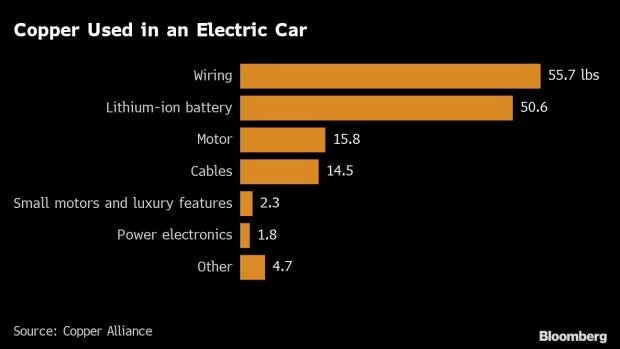
With global EV sales heading toward 40 million units annually by 2030, the incremental copper demand from this transition is enormous and largely locked in by regulatory mandates in California, the EU, and China, plus capital automakers have already committed to multi year production plans.
Grid modernization
The US electrical grid averages more than 40 years old. Replacing aging transformers, substations, and transmission lines requires enormous amounts of copper. Connecting new wind and solar farms to population centers requires new transmission lines and each gigawatt of transmission capacity uses thousands of tonnes of copper.
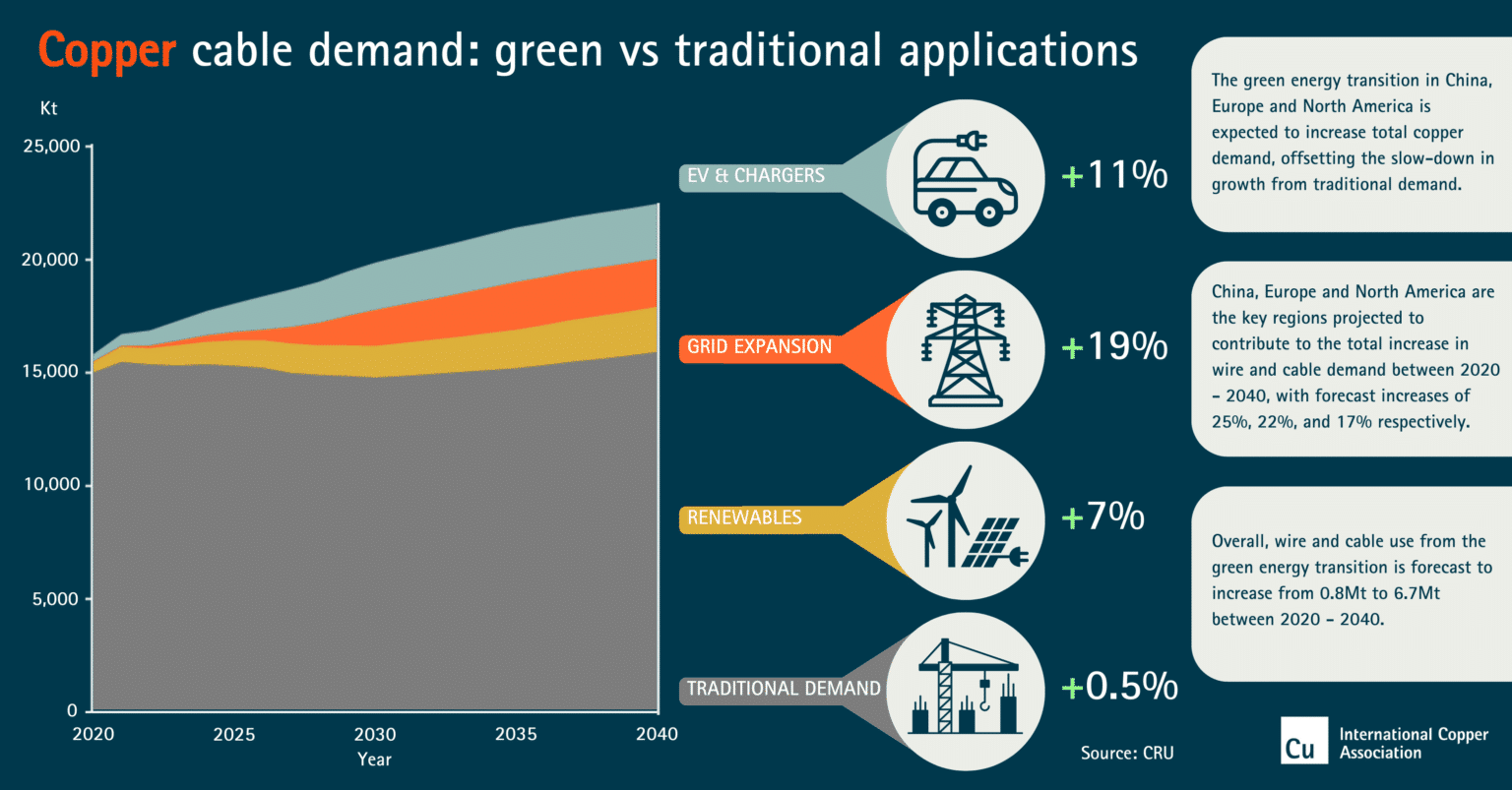
The IEA estimates global grid investment needs to double from roughly $300 billion to $600 billion annually by 2030 just to keep pace with the transition in how electricity is generated and used.
Defense
Missile systems, aircraft, naval vessels, hardened communications networks …all copper intensive. When copper is embedded in national security systems, no one delays procurement because spot prices moved up 20%.
Here’s the part that ties the macro picture to specific opportunity.
The copper industry invested $76 billion over the past 6 years. Meeting 2035 demand requires $210 billion. That’s a $134 billion shortfall, in an industry where it takes 15 years to bring new production online.
Even the optimistic project pipelines currently working through feasibility studies and permitting we can add 1.5-2.0 million tonnes of annual capacity by 2030. That barely covers natural decline at existing operations it doesn’t touch the demand growth coming from AI, electrification, grid buildout, and defense.
New project approvals have averaged under 300,000 tonnes annually for 3 consecutive years, roughly half of what’s needed just to maintain current supply-demand balance.
Why hasn’t capital responded?
Several reasons that are likely to persist:
19-year average permitting timelines in the US
capital costs that have doubled
ESG and community opposition increasing project failure rates
equity markets that continue to value software at 50x earnings while valuing the mines that make the physical world run at single-digit multiples
Global copper demand will reache 42 million metric tons by 2040, a 50% increase from 2024. Without major changes in investment, the supply deficit reaches 14 million metric tons by 2040.
That’s the base case, not a worst case.
With all that said, here is my top pick in the sector to position for a structural copper deficit. This one is my favourite and the name I am most optimistic about. Since I highlighted (in my previous articles) Hudbay Minerals and Capstone Copper, they have delivered approximately +34% and +5% respectively, underlining why I continue to like this part of the copper space👇