Let’s view the world in a positive, logical way unfettered from biases, negative emotions and attitudes
We are all flawed. When we look at the world, we view it with dozens of biases, many negative emotions and attitudes – and the facts that we are attempting to see are already covered by layers of distortions and translation errors. This results in us having completely different views of what is happening and our opinions about what is right and wrong in the world can be diametrically opposite.
So how can we be better at understanding and judging our world? Getting to a single worldview is impossible and neither desirable, but at least we can try to clear the smoke a bit, try to throw away our colorful lenses of bias, try as much as possible to view things as they really are with a positive outlook — hopefully we will understand each other better this way. We would still have different opinions, which is completely acceptable, but we may have more of a common base on which we build our opinions on.
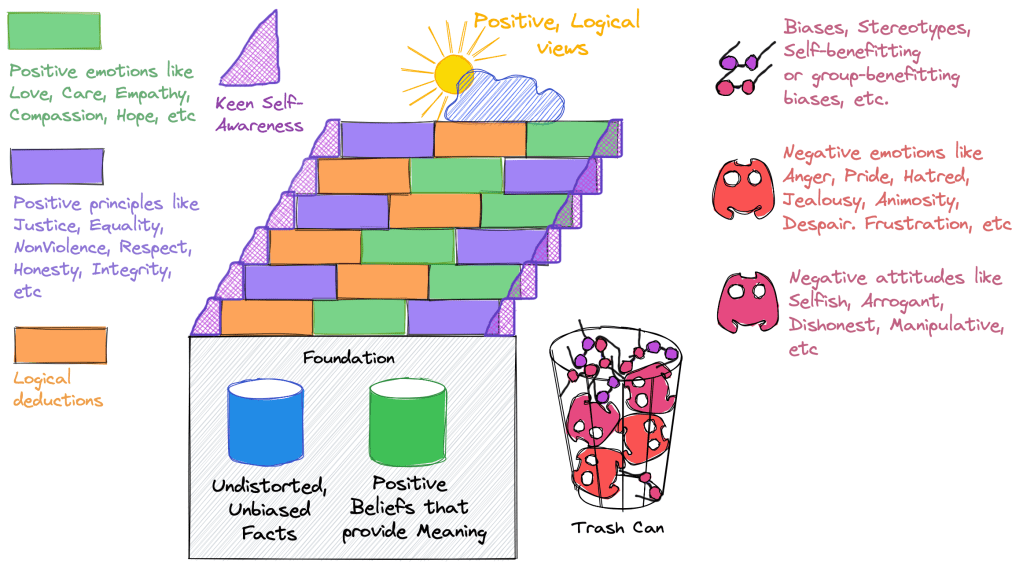
[Note on the structure of this article: Please refer to the accompanying diagram — each section below refers to a component in the diagram]
Guardrail: Keen Self-Awareness
First and foremost, we require a keen awareness of our own thought process.
Ask yourself — why am I thinking or feeling this? Is it due to a bias that I have? Do I have a clear reason to justify this belief? Is it due to some emotion – perhaps hatred of someone or some group? Or it driven by anger, frustration, or pride?
Being able to consciously understand our thought process — determining why exactly we are thinking what we are thinking — is the key to both deeply understanding ourselves and to be able to carefully craft our understanding of what we see.
Keen Self-Awareness helps us create a guardrail to keep our thought process on a positive, logical path. If we cannot be aware, the whole exercise is pointless, since a lot of what we think as logical is heavily influenced by our biases and emotions without us even knowing it.
The need for Self-Awareness may appear simplistic or naive, but it is an extremely powerful tool that’s difficult for us to master. A strong sense of self-awareness can be life-altering in a positive way.
A lot of interpersonal conflict in this world, I believe, is due to a simply a lack of self-awareness. The world is in short supply of this invaluable skill.
To improve this skill, we should develop a strong ability to introspect. We should be able to dissect our own thought process instead of thinking impulsively. Calming down, slowing down, reflecting helps. Meditation can help.
Foundation 1: Undistorted, Unbiased Facts
At the base of it all, we need to start with facts, real facts. We need to carefully cleanse them of various distortions.
Distortions: People and media who communicate information add their own biases to the information. A fact when described in a biased way can be perceived to be almost the opposite of what it is. Added biases could be unintentional — or even intentional when there are agendas to be catered to – by the people or media houses, or journalists even.
Completeness: Biases affect what parts of the story is communicated. Any facts which are against the narrative or agenda could simply be dropped and not communicated at all.
The social media affect: Often unverified, fake stories circulate in this age of social media and peer-to-peer communication. A sender never verifies any story before sharing to his/her connections — the decision to share is based solely on how closely the story adheres to the views/agenda of the sender, and/or how dramatic it is. The sender is no journalist, and has no motivation to present a complete, wholesome and true representation of the situation. The receivers of the story become senders of the same kind, as they re-share, thus exponentially spreading potentially fake news. In groups (say in group messaging apps like WhatsApp, etc), where there’s a personal connection among participants and hence higher trust, the stories shared get accepted as the the gospel, thus creating strong shared narratives among groups, which further deepens as the group serves as an echo chamber. Its clear, and widely accepted now, that social media is prone to amplification of biases, narrow viewpoints, sensationalist views, conspiracy theories, fake news, etc while polarizing and dividing the masses into into groups which have strong belief in viewpoints that are in complete contrast with those in other groups.
Truth, in today’s world, is under strong attack by social media and our need for the dramatic.
We thus need to work hard to get rid of these distortions and biases in our quest for the truth. It may require us to seek out information from several diverse sources, check biases of each source, read and understand opposite viewpoints, tap both professional and raw, direct sources of information, be especially good at separating out opinions and facts in the information we see, take a skeptical view of all information, etc.
On top of all this, we need to be careful in not applying our own biases to the information that we receive! And to ensure we try to obtain complete information, not just the bits that align with our existing beliefs.
Let’s seek out wholesome, undistorted, raw, unbiased and verified facts.
Foundation 2: Positive beliefs
Facts themselves are not enough as a foundation for our assessment framework. As facts themselves are not good or bad, nor can they provide meaning and direction to us humans – we need to adopt a foundational ethical framework that operates at the lowest rungs of morality. And of course we must adopt a system of positive beliefs – for eg, life is better than death, each human life is equally valuable, happiness is better than sadness, common good of the society should be cared about by all individuals, etc. These foundational, moral beliefs provide a framework using which emotions and principles, discussed below, can be judged as positive or negative.
Practically, most people have this base level morality ingrained in their basic thought process and do not need to be consciously aware of it, in most situations.
The Path: A braided staircase of logical deductions and positive emotions, principles
On top of this foundation, we must build our path to the Positive, Logical View using clear logical deductions as building blocks.
However, logical deductions are not enough in most practical situations to come up with any useful opinion for action — we also need to apply subjective judgement to choose the right over wrong in any given situation. In this case, we must carefully use only positive emotions and positive principles for making subjective assessments.
Positive emotions: Love, Care, Empathy, Compassion, Hope, etc.
Positive principles: Justice, Equality, Non-Violence, Respect, Honesty, Integrity, Seeking win-win solutions, etc
Non-violence must include avoidance of physical and emotional harm to others.
These principles and emotions are key for us to come up with the right path in a given situation. Ofcourse, life is not simple — in many scenarios we may find they are in conflict with each other, in which case we need to find the most optimal path which results in the maximum benefit of everyone. And often, each person has a different view of positive emotions, which means there’s never a single, correct opinion.
This path of first-principled logical thinking based on solid foundations and positive principles should lead us to the Positive, Logical View.
However, we must be aware of pitfalls and traps that we must avoid as we proceed on this path.
To the trash 1: Biases and Stereotypes
We all have biases — preconceived notions about things/concepts, people/entities, prejudices and stereotypes about any groups based on race, gender, class, religion, age, region, etc. These biases greatly color our perception of the world as it exists, and all that happens in the world.
Keen Self-Awareness helps us understand whether our thinking is being influenced by our biases.
One way to identify biases is asking probing, repeated “why” questions about why we feel a particular way — until we are unable to explain further.
Another way is to understand how a particular choice among a set of choices is making us feel. Is it making us feel happy? If so, then it is very easy for us to become biased towards that choice.
It would help to educate ourselves about biases – the various kinds and ways to reducing them — there’s a lot of material available online on this.
Once bias is identified, throw it in the trash can.
To be unbiased, we need to consider all choices as equally worthwhile, regardless of how they make us feel emotionally.
To the trash 2: Biases due to Selfishness for self or for group
Selfishness greatly influences biases. It’s very easy to be biased towards choices that help us in some way or are aligned with our goals.
Hence its important to remove yourself out of the equation when assessing the world in an objective, unbiased way. Forget that you exist in this world. Evaluate as though you could be anyone on the planet. Or even an alien who does not live on Earth.
In addition to direct selfish interests, often we get biased towards some choices which benefit a group to which we belong. A group could be based on country, religion, race, region, gender, community, etc. This is a trap very easy to fall into, so requires us to be ultra-vigilant of this. Best is to the imagine that you do not belong to any group that is relevant to the situation at hand.
To the Trash 3: Negative emotions and attitudes
Be careful of negative emotions and attitudes. They can completely impair our ability to think rationally, and view the world logically in a positive way.
Negative Emotions: Anger, Pride, Jealousy, Animosity, Despair, Frustration, etc.
Negative attitudes: Selfish, Dishonest, Arrogant, Manipulative, etc.
These negative emotions and attitudes are very powerful, they can be over-powering to the extent where even the strongest attempts to remain rational and positive can just fade away without us even knowing about it.
The only way to keep them at bay is developing a strong sense of Self-Awareness and formidable willpower to stay positive and logical.
We must not only avoid them ourselves, but understand how people tend to fall prey to them in their own actions as we build our view of the world.
Finally: A Positive, Logical View
Hopefully, doing all this helps us be unbiased in understanding the world, and reasoning and assessing it with a Positive, Logical View. Hopefully we understand each other better this way, are able to exchange thoughts and opinions with a shared base. Hopefully this contributes in moving the world towards a positive direction.
Moreover, a lot of this should also help us in our thinking process for our own personal decisions, though that’s another whole topic that must be discussed separately.