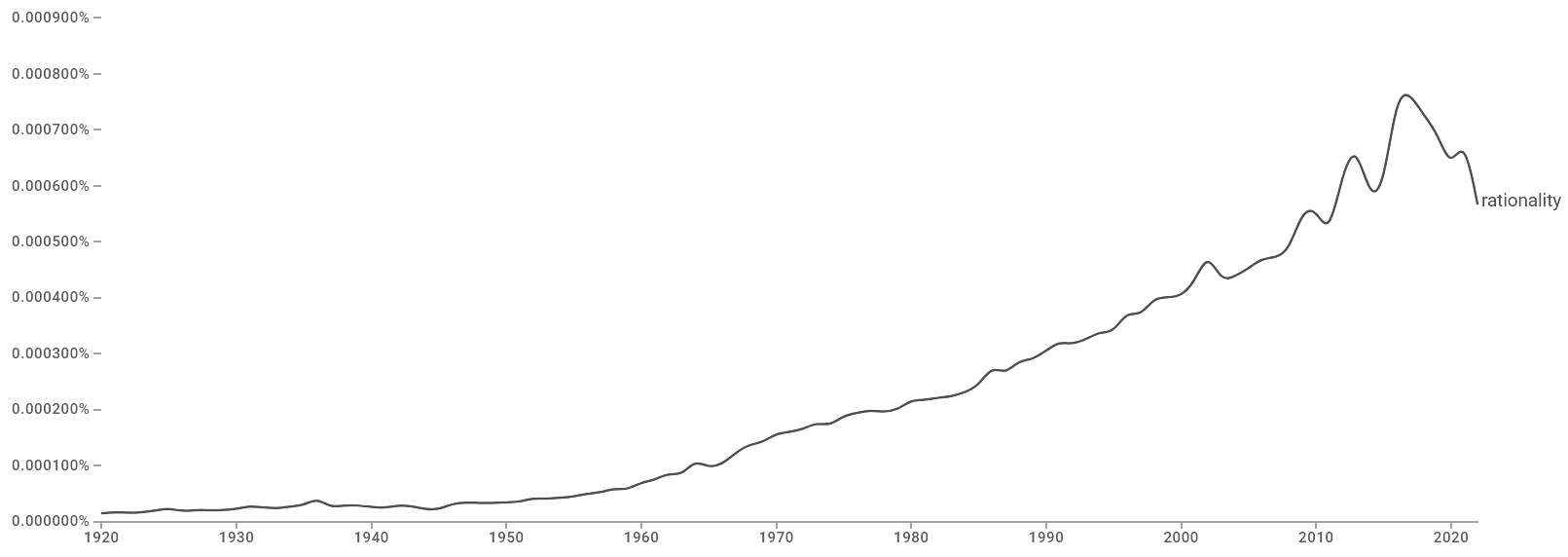
Most societies go through similar patterns of rise, prosper and fall. And while there are many differences, our civilization is no exception. Towards the end of their phases of shared prosperity—brought about by discovering some rational rules on how things work (science) and developing an ability to exploit those observations (technology)—societies hit all sorts of limits. One of them, I argue, is a limit for us humans to explain the world in rational terms and a general breakdown of our worldview. The question thus poses itself: what awaits us at the end of our age of reason…?
Feel free to use this essay as an excuse to take a 15 minute break from the holiday rush. Take a pause and reflect… And if you value this article or any others please share and consider a subscription, or perhaps buying a virtual coffee. At the same time allow me to express my eternal gratitude to those who already support my work — without you this site could not exist. Warm wishes for a wonderful holiday season, may your days be merry and bright!

We, “modern” folk, tend to think of ourselves as highly rational beings. We take pride in building systems based on scientific discoveries and in managing them based on facts and figures—a method enabling further discoveries and ever newer innovations. The great early successes of this approach have led us to think: ‘Hey, what if this could go on indefinitely?’ or ‘There are no limits to human ingenuity!’ Scientific progress has thus not only become the norm, but an outright expectation, presupposing that every “problem” besetting humanity—from climate change to resource depletion—can and will be “solved”. We have lured ourselves into believing that since scientific discoveries and reason, which have brought us to our present state, will always help us innovate our way out every situation.
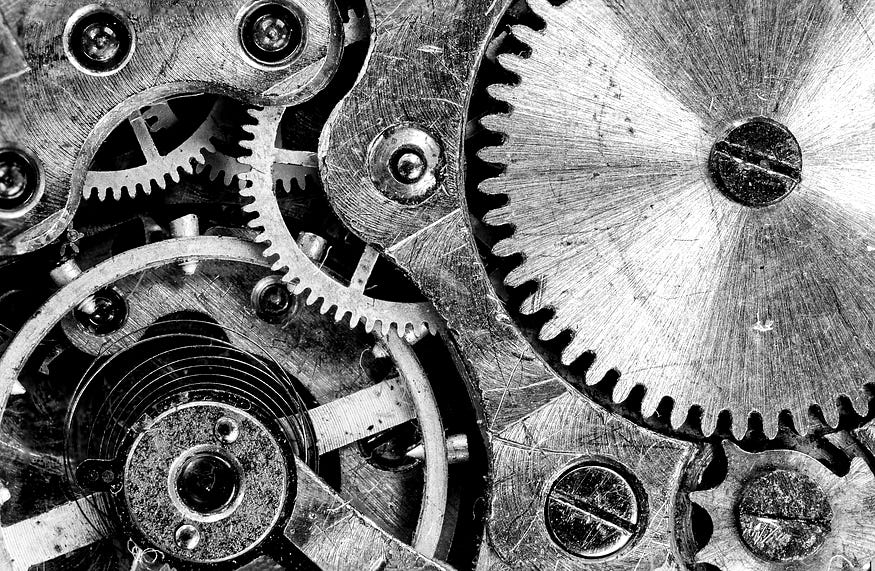
This idea of “infinite progress” made us thinking in linear terms. As a result, when thinking about the past or the future, most people nowadays imagine a straight line starting back in the dark (dumb, stupid, aggressive etc.) times of the stone age, with all its superstitions and ‘false beliefs’, swooshing all the way through history towards the shining victory of reason and knowledge; pointing into infinity and beyond. This mode of thinking—so prevalent throughout our Age of Reason1, or The Enlightenment as we tend to call it—was aided greatly, if not outright invoked, by a mechanistic worldview. According to this perspective ‘the world is a machine, built with a purpose’ and with a perfectly understandable relationship between its parts. As Imre Madach, the famous Hungarian playwright, wrote about the Creation in his masterpiece the Tragedy of Man (1861):
“The mighty masterpiece at last is done;
The wheel revolves; the master on his throne
Doth rest. A million aeons now ’twill move,
Before the smallest spoke shall faulty prove.”
This rather static world view was based firmly on the discovery of ‘natural laws’ proved by countless experimental results. With the number of phenomena thus explained, the mechanistic, deist worldview has become increasingly bulletproof over time; casting all what it couldn’t explain aside, and labeling perplexing ideas mere ‘superstitions’. Mind you, there was nothing wrong with this approach—in fact this method has proved to be quite useful—but only up to a certain point. Beyond a practical limit, however, it became hopelessly inadequate to explain how the world truly operates. Towards the end of our Age of Reason we have stumbled upon enigmas we found increasingly hard to decipher… Or shall we call them predicaments, well beyond our mental capabilities to comprehend? Have we, indeed, reached our limits to reason already?
Two centuries ago, at the early stages of our scientific endeavors, it took only two people, Darwin and Wallace, to figure out evolution and usher in a revolution in biology. Similarly, it took only one Bell to revolutionize telecommunication, two Wright brothers to figure out motorized flight, and one Einstein to crank out a theory of relativity. Now, it literally takes hundreds of scientists to make the next, ever more incremental step towards understanding how Life, Quantum Mechanics or anything else for that matter actually works. By doing so, they only discover that the answer to these questions are as elusive as ever, forcing scientists to push out the deadline for delivering anything substantial by decades, repeatedly. It is no wonder then, that we keep hearing such claims as ‘fusion is just a couple of decades away’ time after time, for more than sixty years now. As Deborah Strumsky, José Lobo and Joseph A. Tainter found in their 2010 study on the Complexity and the productivity of innovation:
“Our investments in science have been producing diminishing returns for some time (Machlup, 1962, p. 172, 173). To sustain the scientific enterprise we have employed increasing shares of wealth and trained personnel (de Solla Price, 1963; Rescher, 1978, 1980). There has been discussion for several years of doubling the budget of the U.S. National Science foundation. Allocating increasing shares of resources to science means that we can allocate comparatively smaller shares to other sectors, such as infrastructure, health care, or consumption. This is a trend that clearly cannot continue forever, and perhaps not even for many more decades. Derek de Solla Price suggested that growth in science could continue for less than another century. As of this writing, that prediction was made 47 years ago (de Solla Price, 1963). Within a few decades, our results suggest, we will have to find new ways to generate material prosperity and solve societal problems.”
Some readers might ask at this point: then what about artificial intelligence? Truth to be told, AI can solve some very complex issues indeed, like figuring out the internal structures of proteins, censoring content online, tracking and identifying people, or telling cats apart from dogs—given there is enough data to train it. The problem is, it can only regurgitate what has been discovered already. It can optimize our search for knowledge, but it cannot replace human ingenuity, now at its limits. Besides, it is a very resource intensive method: requiring vast amounts of digital storage, calculation power, electricity and water. In a world which is heading towards more energy and resource bottlenecks, shortages, political instability and wars—and of course with the AI bubble coming closer and closer to bursting—I find it doubtful that this method could remain useful for much too long.
The expectation that logic and reason will always be capable to deliver results far into the future, following a linear line pointing towards the stars, seems to be at odds with reality. The crux of this predicament is that the world is not a machine which gives reliable results, but an infinitely complex self-adapting system, with all its emergent behavior, tipping points and continuous phase transitions. Thus, our efforts made at decoding it, either through magic, divination or based on a mechanistic approach, bound to fail every time. Much to our frustration, the world remains a largely inexplicable place, with only so many parts of it yielding to our primate logic and simple measurements. The better part of it, however, acts wholly irrational to us — and lie reliably beyond our capabilities to grasp. Contrary to modern beliefs, this world is in no need whatsoever of a reason to exist, or anyone to decode how it operates. We are no masters of this impossibly complex system—we repeatedly mistake for a machine—but integral parts to it. Parts which play an important role, but by no means indispensable.
It is absolutely no wonder then, that a great many followers of the idea (or rather: the religion) of progress refuse to admit this. Especially those people, who draw the most benefits from a world treated as a machine, churning out reliable results in the form of revenues and profit: the professional managerial class. It is thus essential for them to maintain the illusion of progress, and more importantly, their indispensable role in managing things. For a lively example look no further than the all-mighty Central Banks around the world, and how they think they regulate the entire economy (an immensely complex self-adaptive system on its own right) via a single mechanical lever: the interest rate. Or how they disregard much more important factors affecting the real economy—say ecological, energy or resource limits—and how they treat these as completely “exogenous” factors to their model. Problem is, that when you treat the whole universe as something outside your model, then what you are building is not a realistic depiction of the world, but a religion based on dogmas. The fact that this rationalistic-looking model is falling apart before our eyes in the West should serve as a stark warning: reality is a somewhat more complex thing to handle than many among our elites have ever dared to think.
Our Age of Reason, where logic, argument, and reasoned debates rule the scene has slowly come to its logical endpoint. Science and technology has hit diminishing returns, as these once reliable methods now fail to provide scalable and workable answers to our most pressing and ever mounting issues. Heck, in fact most of our problems—from climate change to resource depletion—are a direct consequence of utilizing science and technology to solve other issues in the past. Our problems have thus become predicaments with outcomes, begging for less technology, less science and less authority—not more. At this point in our history, however, instead of realizing limits to our rational approach and scaling back, rationality slowly but duly gives way to unreason and chaos, culminating in a dark age over time. But let’s not get ahead of our skis just yet.
A few years ago, I was introduced to the work of Swiss philosopher and poet Jean Gebser (1905–1973), who made some remarkable contributions to our modern self-understanding2 and whose work on the evolution of human consciousness and culture has proved to be foundational in understanding our present situation. According to his biography “what Gebser succeeded in demonstrating through painstaking documentation and analysis was this: hidden beneath the apparent chaos of our times is an emergent new order. The disappearance of the pre-Einsteinian world-view, with its creator-god and clockwork universe as well as its naive faith in progress, is more than a mere breakdown. It is also a new beginning.”
Gebser’s work provides a vital understanding as to why and how our civilization’s Age of Reason ends, what the underlying dynamics are, and what could come after it. According to him, there are four types of consciousness, or mental structures as he referred to those, through which we view and interpret the world around us. These are fundamentally different modes of thinking, each with its own limitations. Note, however, that contrary to the myth of progress, none of them are superior or ‘more evolved’ than the other. Each has its own intrinsic values and is useful on its own right. Thus, none of them have superseded the other: in fact, all of them are present in any given society at the same time. The only question is: which one is the dominant mode of thinking in a given age?
Let’s start our exploration of Gebser’s four types of consciousness with the most ancient one: the Archaic. This is the classical non-dualist approach to the world where nothing is separate, everything is interrelated and feels just fine as it is. This is the home to the animal spirit: ever vigilant, ever present, but never judging — just observing and acting in a perfect harmony with its environment. This state of mind is the ultimate goal of Buddhist meditation, as well as the famous flow-state (first described by Mihaly Csikszentmihalyi), where the ego dissolves together with all its boundaries between the actor and the environment. No ‘self’ is present or, in fact, is needed here.
The second type of consciousness according to Gebser is: Magic. (And no, not the Harry Potter type.) In its highest form, this mode of thinking and being uses intricate and highly effective rituals to harness magical energy (think qi, ki, mana etc.). For someone harnessing the powers of this mental structure symbols and sacred objects do not merely represent events and persons, but are those same events, objects and persons—thus invoking such powerful symbols move and channel large amounts of spiritual or emotional energy. Contrary to modern beliefs, magic still very much applies to quite a few areas of life with advertisement and politics being just the two most prominent examples. In fact, it is precisely these latter two occupations who made its use so ubiquitous nowadays, and now tend to apply it without self-restraint. As we will see later, Magic already plays a huge role in bringing about the end of our present civilization’s Age of Reason—hand in hand with the next form of consciousness.
Mythic. This mode of thinking is intimately related to the images invoked by stories of heroes, villains, lovers and warriors, as well as classical battles between good and evil. It is founded on cyclical thinking based on nature; seasons, astronomy and cycles of life and death belong to this realm. If the distinguishing characteristic of the magic structure was the emergent awareness of nature, the essential characteristic of the mythical structure is the emergent awareness of the soul. Hence, the hero’s journey with all its moral teachings. Thinking in mythic terms helps us to believe that this chaotic world makes sense, while relieving us from the burden of proof. No myth requires the author to provide scientific evidence that events took place exactly as they were told—the moral message is all what matters. The recent surge in hero movies, viking sagas, or in fact all what Hollywood produces nowadays, are all great examples of this mode of consciousness.
The fourth and last mode of thinking is called Mental consciousness, the dominant mindset in our Age of Reason. It’s characterized by an extreme separation of subject and object, not seen in other modes of thinking, which finally collapsed with Quantum Mechanics. The idea of “progress” and linear time are both hallmarks of this type of consciousness, which has now reached it’s natural apex and started to fail as it hit diminishing returns.3 According to Gebser’s biography:
“Rationalism, for him, was by no means the pinnacle of human existence, but, on the contrary, an evolutionary digression with fatal consequences. He regarded it as a deficient of the inherently balanced mental structure of consciousness. In other words, Gebser did not reject reason, merely its inflation into the sole arbiter of our lives. As he recognized, the human being is a composite of several evolutionary structures of consciousness, and we must live all of them according to their intrinsic value. The individual who is dominated by the rational structure represses all other structures, which are viewed as irrational and hence dispensable. Thus the “reasonable” person is inclined to reject magic, myth, religion, feeling, empathy, and not least ego-transcendence.”
Now, that we have a basic grasp of the underlying structures of human thinking (archaic, magic, mythical, mental), comes the fun part. Let’s try and put all these concepts into practice! As we can see just by looking at the chaotic events around us, together with the frankly irrational behavior of our leadership class, western societies have clearly left Rationalism behind, leaving it up to other modes of consciousness (Magic and Myth) to fill in the gaps. Let’s take mainstream media, with its fake news, war propaganda and the whole post-truth world as our first example. Viewed from a purely reasoned perspective, news and politics make less and less sense. In fact, the media is now full of self-contradicting claims, and frankly an outright Orwellian revision of history. For someone interested in the truth MSM has become a pain to consume.
Viewed from a Mythic perspective, however, the media fulfills a very important role. It presents the citizenry with what the ruling class would like us to think about them, the nation, or our shared values and stories. (It also conveniently tells people who is good and who is evil, so that the average folk don’t have to bother too much with what the elites are actually doing.) In this ‘post-truth’ world events (or what has actually happened) become less and less important, compared to the noble goal of achieving moral victory over the opposing side, party or nation. Events become symbols, politicians become heroes and institutions become churches were people donate for the good cause4. Narrative control is all what matters now. The problem is, that apart from an ever shrinking minority, nobody actually believes anything the media has to say nowadays, and that—as we will see later—will have devastating consequences.
Magic, on the other hand, have now almost completely replaced science. For an example, look no further than Neoclassical Economics, Political Science, or Management Schools. None of the statements churned out by these ‘institutions’ stand even the weakest smell test of logic and a coherent scientific approach but, as I increasingly came to believe, this was never the goal. Building on the magical impact mathematical symbols, formulas and hard to decipher ‘terminus technicus’ have on average humans (by creating an illusion of authority and providing proof without proving anything), these schools of thought have become really good at one thing: building castles in the sky. Beautiful, shiny and elegant, but ultimately filled with nothing just hot air.
In reality, these ideas serve no other goal than to justify greed and exploitation, and to sway the rich into believing that growth can go on indefinitely on a finite planet—so, in return, elites keep funding these institutions to churn out even more magic. Instead of relying on real science, magic has become the sole foundation of expertise for the technocratic elite and the professional managerial caste—culminating in the legendary powers of the High Mages of the Central Bank, the Priesthood of Think Tanks and the Sacred Policy Institutes. You see, this is what happens when true scientific results become unpalatable—with all their blathering about limits, climate change in the pipeline and all the rest—all pointing towards an inevitable end to this version of a global civilization.
Unsurprisingly, there is now an exponentially increasing demand for sorcery, warding all the bad thoughts off and providing much needed tranquility in our age of increasing turmoil.
Lacking adequate understanding of the world, and given the failure of Rationalism to provide answers to our most pressing issues, magical thinking has become the modus operandi for many of these institutions. Complex predicaments—such as climate change—are thus redefined as a problem fitting the nearest solution at hand. This doesn’t happen necessarily through conscious deception, as Mike Brock observed when writing about AI, but through a subtle shift in framing that makes the impossible seem merely difficult. You see, by assuming infinite resources, and an unimpeded shrinkage of costs—both environmental and economic—you can imagine all sorts of things coming true. This is what true magic does to your mind: a change in consciousness, resulting in a belief that your thoughts, words, or actions can directly influence real-world events, despite the lack of any logical or scientific connection.
As our Age of Reason comes closer to its logical endpoint, societies around the world go haywire. Modern institutions applying Myths and Magic in ever greater amounts will slowly erode the last bastions of Rationality, but in the process they’ll also destroy themselves. Well, as the saying goes: ‘Too much magic can kill you.’ As morality erodes, trust in institutions fade into the mist, and rationality gives way to magical thinking, a period of chaos can be expected to set in. Gebser was an optimist in saying that an Integral Consciousness would arise as a result, successfully integrating all modes of thinking into a harmonious whole. He hoped—as opposed to Spengler, who wrote about the fall of the West roughly at the same time—that we will somehow avoid our civilization’s fate and skip the fall and decline part. And while achieving Gebser’s integral consciousness is still perfectly possible on the individual level, it’s now wholly impossible on a civilizational level. That ship’s left. The global turmoil we already have on hand, and especially throughout the West, will prevent that from happening5.
This brings us to the question: then what’s next? While being busy continuing ecocide in search for profits, and being amazed by their own technocratic powers, our elites have completely forgotten about the mounting problems at the bottom half of the society. The unplanned (and unmitigated) de-industrialization of the West, rising food and energy prices, increasing inequality, and an overall cost of living crisis are all begging for a correction… A major adjustment which, if delayed too long, might neither be rational nor technical, but visceral: based on a religious belief that the end times are here and the sinners of the world must burn in a cleansing fire. The Christian far right is on the rise for this very reason. Ditching Mental altogether, they’re doubling down on Mythic consciousness: for them logic does not matter anymore (it has only brought ‘us’ trouble), so now we must ‘do what is right’… And as usual, ‘right makes might’—culminating in religious wars and getting rid of ‘deviants.’
People in times of hardship want the good days to return. At all costs. They will blame their ruling class for their fate, and if things really go awry, start revolutions. Elites in turn will be tempted to double down on everything that is already failing. Mental. Mythic. Magic. The whole nine yards. (Even starting wars, if that’s what’s needed to divert people’s attention away from social decay.) If you wondered how an ultimate battle of mages would look like, then look no further for an answer. It’s already here. So use this time at the end of the year to reflect upon what we as a culture have achieved. Savior the moment. Give thanks for what you have. Think about how you can integrate the archaic, mythic, magical and mental modes of thinking, and how to fend off the constant bombardment attacking your consciousness. Last but not least, the coming times will call for more mental resilience than most can muster—so don’t forget to help others keeping their sanity.
Bless you all.
Until next time,
B
Thank you for reading The Honest Sorcerer. If you value this article or any others please share and consider a subscription, or perhaps buying a virtual coffee. At the same time allow me to express my eternal gratitude to those who already support my work — without you this site could not exist.