January 20, 2026
Dear readers,
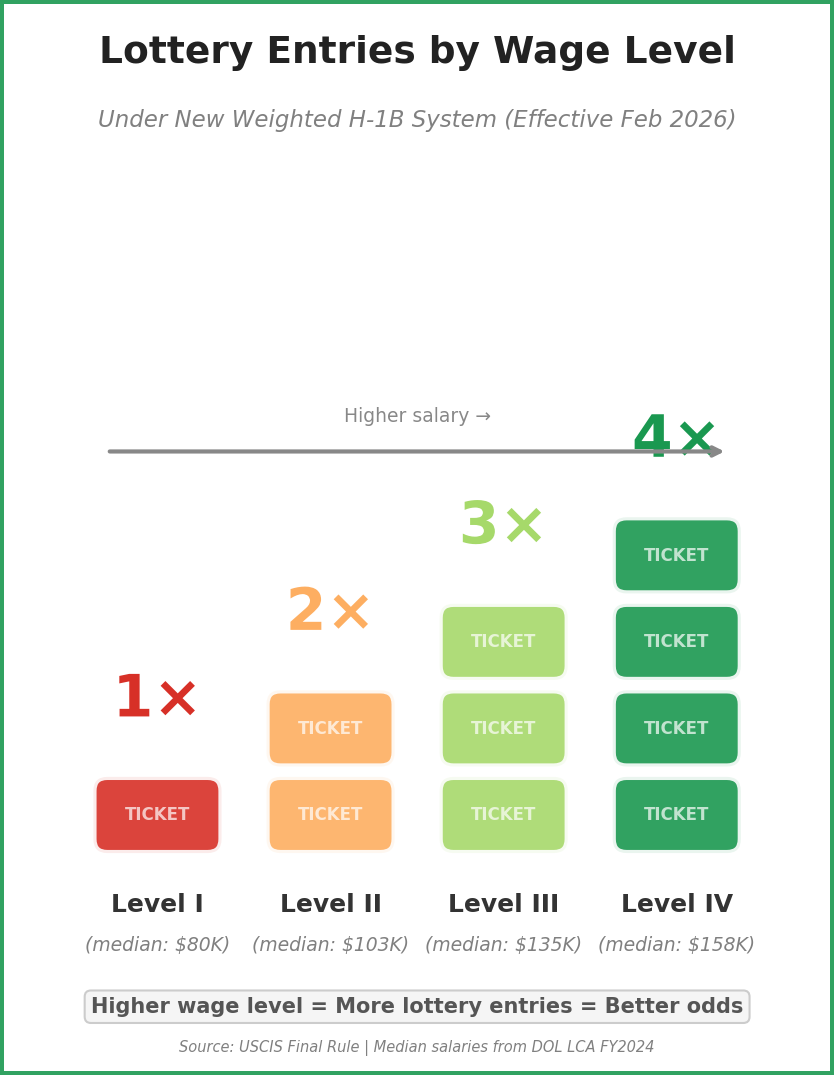
Starting February 27, 2026, a Level IV wage candidate receives 4 lottery entries while a Level I candidate receives only 1. Under the new weighted lottery system, the probability of securing an H-1B visa is no longer random—it is now mathematically determined by the salary offer attached to the application [1].
If you are a software engineer or data scientist negotiating a job offer for the FY2027 season, this structural change means your base salary is now a direct variable in your immigration success. We analyzed 517,874 Labor Condition Applications (LCAs) from Fiscal Year 2024 to model exactly how this weighting shifts the odds for every bracket of the tech workforce [2].
Here is what the data reveals about who wins and who loses in the new pay-to-play H-1B system.
We wanted to understand the magnitude of the shift from a random selection process to a wage-weighted one. The Department of Homeland Security’s stated goal was to select “the most skilled and highest-paid beneficiaries” [3]. But what does that actually look like in practice?
To find out, we filtered FY2024 LCA data by prevailing wage levels and applied the new ticket multipliers (1x, 2x, 3x, 4x) mandated by the USCIS Final Rule. The resulting distribution confirms a radical departure from the egalitarian “random” lottery of the past decade.
Entry-level (Level I) workers lose 57% of their selection probability under the weighted system—Level I’s share of the pool drops from 20.0% to 8.6%.
This is not a minor adjustment; it is a systemic clearing of the bottom tier. For recent graduates and early-career professionals, median salaries of $80,000 (Level I) now come with a severe mathematical handicap. The “ticket” you get for an entry-level role is diluted in a pool flooded by the multi-ticket entries of senior applicants.
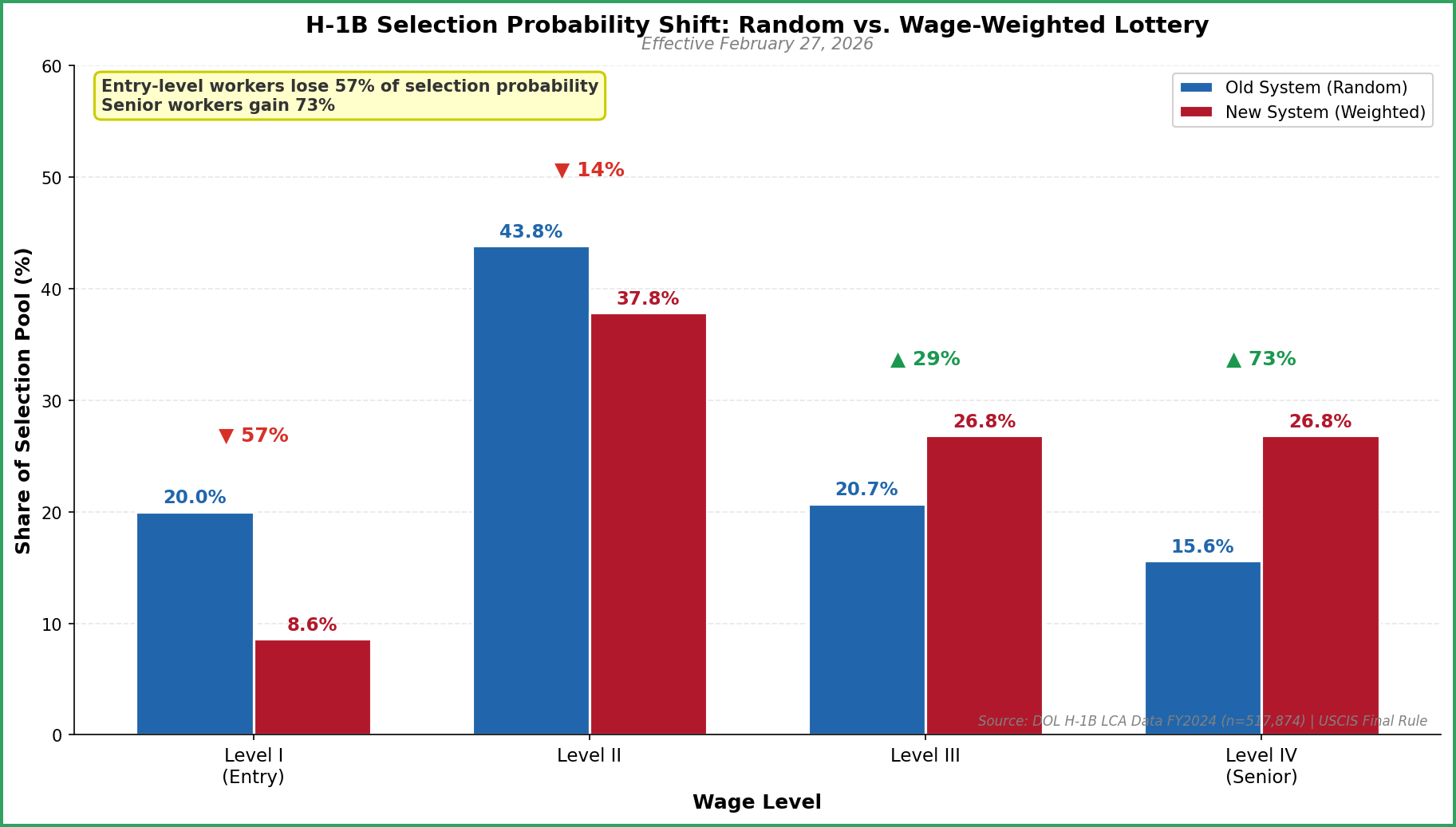
Meanwhile, Level IV (senior) candidates see their selection probability increase by 73%—their pool share rises from 15.6% to 26.8%.
With a median salary of $158,000, Level IV applicants are the unequivocal winners of this policy shift. By granting 4x entries to this cohort, the system effectively aggressively recruits for senior management and principal engineering roles while suppressing the pipeline of junior talent.
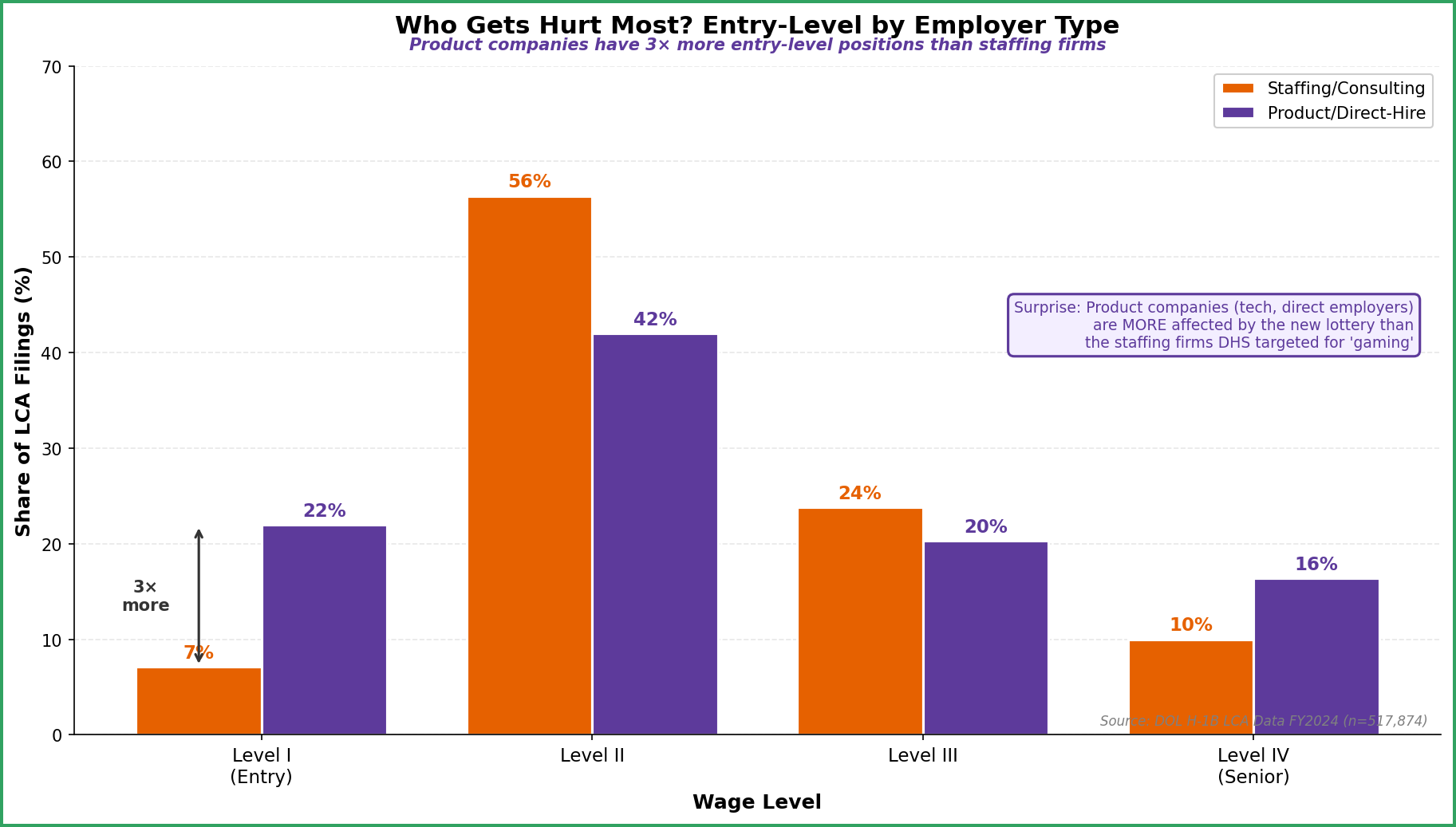
Counter-intuitively, product companies (tech firms, direct employers) have 3× the Level I concentration (22.0%) compared to staffing firms (7.1%).
This means product companies hiring junior talent are more disadvantaged by the new system than the staffing firms DHS targeted for “gaming” the lottery. The narrative that this policy solely hurts “body shops” is contradicted by the data; it disproportionately impacts legitimate tech employers hiring early-career talent.
Some economists might argue that this pattern reflects efficient market sorting rather than system dysfunction. By weighting selection toward higher salaries, the government is theoretically maximizing the economic output of each visa. From this perspective, a Level IV engineer earning $158,000 contributes more immediate tax revenue and economic value than a Level I graduate earning $80,000. If the H-1B cap is a scarce resource, allocating it to the “highest bidder” (in terms of salary) mimics a market-based auction, potentially reducing the suppression of domestic wages at the entry level.
For job seekers on F-1 OPT: The “Level I” offer is now a high-risk zone. If possible, negotiating a role classification to Level II (median $102,900) doubles your lottery tickets from 1 to 2, though the probability drop for Level II (-14%) shows it is still not a safe harbor. The data suggests that unless you are targeting Level III ($135k+) roles, your odds are statistically worse than in previous years.
For Employers: The strategy of hiring fresh graduates on H-1B is now statistically unviable as a reliable pipeline. Organizations may need to rely more heavily on O-1 visas or L-1 transfers for junior talent, reserving H-1B nominations for senior roles where the 4x multiplier provides a competitive advantage. It is also worth noting that if a beneficiary has multiple registrations, USCIS will assign the lowest wage level among them, preventing gaming via concurrent filings [5].
This analysis examines Labor Condition Applications (LCAs), which reflect employer intent to hire, not final USCIS approval decisions. We cannot track the exact conversion rate of every LCA to a selected petition without internal USCIS data. Additionally, wage levels are determined by geographic location; a $100k salary might be Level IV in a rural area but Level I in San Francisco [6]. Our analysis uses national medians, but local realities will vary.
Data Source: U.S. Department of Labor H-1B LCA Disclosure Data, Fiscal Year 2024 (517,874 records) [2].
Analysis: We filtered for certified LCAs, categorized by Wage Level (I-IV), and applied the weighted lottery probability multipliers defined in the USCIS Final Rule (1x, 2x, 3x, 4x).
Reproducibility: Complete code and documentation available upon request.
The H-1B system has fundamentally changed. It is no longer a lottery in the traditional sense, but a tiered meritocracy based on compensation. As the February 27, 2026, deadline approaches, understanding this “pay-to-play” mechanic is the single most important factor for applicants.
If you found this analysis useful, subscribe for weekly data-driven insights into H-1B and immigration trends.
[1] U.S. Citizenship and Immigration Services, “Modernizing H-1B Requirements, Providing Flexibility in the F-1 Program, and Program Improvements Affecting Other Nonimmigrant Workers,” Federal Register (88 FR 72870), effective February 27, 2026.
[2] U.S. Department of Labor, “H-1B LCA Disclosure Data, Fiscal Year 2024,” Employment and Training Administration, accessed January 2026. Available at: https://www.dol.gov/agencies/eta/foreign-labor/performance
[3] Fisher Phillips, “USCIS Final Rule on H-1B Modernization: Impact on Cap-Subject Petitions,” Legal Alerts, accessed January 2026.
[4] Capitol Immigration Law Group, “H-1B Cap Registration and Lottery Selection Process: FY2027 Projections,” accessed January 2026.
[5] Ogletree Deakins, “H-1B Modernization Rule: Beneficiary-Centric Selection and Multiple Registration Bars,” accessed January 2026.
[6] U.S. Department of Agriculture, “Rural-Urban Continuum Codes (2013),” Economic Research Service, used for Geographic Wage Classification context, accessed January 2026.
Disclaimer: This article presents data analysis for informational purposes. It is not legal advice, and readers should consult qualified immigration attorneys for case-specific guidance.
Join readers who get data-driven H-1B insights every week.
Forward this analysis to someone who needs it.