Several weeks ago, I was asked to testify before the U.S. Senate about the impact of educational technology on learning. The very first sentence of my testimony was deliberately candid:
“Our kids are less cognitively capable than we were at their age.”
Perhaps unsurprisingly, that claim traveled quickly.
At first, it circulated in a relatively measured way (Gen Z is Less Cognitively Capable Than Their Parents). More recently, however, it has taken on a far more sensational tone (Gen Z is Officially Less Intelligent Than Millennials).
Such is the media cycle.
But beneath the headlines lies a serious question: is something measurable actually changing in human cognition?
If you’ve read The Digital Delusion, you already know the answer is a clear yes. Still, to help ground the broader discussion, I want to focus on one specific strand of evidence the media has latched onto: IQ Scores.
Throughout the 20th century, IQ scores showed a remarkably consistent pattern: they rose by approximately three points per decade – that’s roughly 6 points per generation.
This phenomenon, known as The Flynn Effect, has been documented across a wide range of countries and contexts, spanning Western and Eastern nations, as well as both developed and developing economies.
Until recently.
Beginning around the turn of the 21st century, reports started to emerge suggesting that full scale IQ scores were no longer rising – they were beginning to decline. Across a handful of well-designed studies, the drop has been estimated at as much as six to eight points per decade.
This reversal, known as The Negative Flynn Effect, has been reported primarily in high-income western nations, though its timing and magnitude vary by cohort and country.
One of the most recent and detailed analyses exploring this phenomenon was published in June of 2025 in a paper called Digging In. Let’s take a closer look.
Intelligence tests typically pool together many different kinds of tasks – ranging from visual to verbal; speeded to deliberate; concrete to abstract. While these tasks are often reported as a single IQ score, they draw on fundamentally different kinds of cognition.
One useful way to divide tasks is by considering whether they’re externally or internally scaffolded.
EXTERNALLY SCAFFOLDED
In these visually mediated tasks, the structure, rules, and relationships are explicitly represented in the environment. A substantial portion of cognition is offloaded onto the task itself, placing minimal demands on sustained memory, prior knowledge, or internal transformation. Success is driven primarily by visual perception, pattern detection, and rapid rule application.
INTERNALLY SCAFFOLDED
In these language-mediated or symbolic tasks, the structure, rules, and relationships must be constructed, mediated, and manipulated internally. This places high demands on working memory, accumulated knowledge, attentional control, and executive functioning. Success is driven by language, memory, and internally generated abstraction, often requiring sustained mental effort over time.
Put simply: externally scaffolded questions show you the structure and ask you to recognize it, while internally scaffolded questions hide the structure and ask you to create it.
As an example of an externally scaffolded task, which image completes the pattern below?

All the relevant information is visible on the screen: the task itself holds the structure.
Now consider an example of an internally scaffolded task:

Here, you must generate the relationship yourself, drawing on language, memory, and abstract reasoning. Thinking happens internally.
Although intelligence tests do not formally classify subtests as “externally” or “internally” scaffolded, the distinction reflects a well-established cognitive divide between stimulus-supported perceptual tasks and internally generated reasoning tasks that depend on memory and executive control.
Returning to the article at hand, these researchers explored IQ change across the last two decades and found a general flattening. The Flynn effect appears to have disappeared for modern teenagers – but with an important underlying pattern.
Adolescent performance on Externally Scaffolded tasks showed moderate growth:
By contrast, adolescent performance on Internally Scaffolded tasks showed significant declines:
At face value, this pattern suggests that Gen Z can still perform well on highly visual, externally guided tasks - perhaps unsurprising given the increasingly visual, heavily guided nature of the digital tools they use daily.
Concerningly, adolescents appear to be struggling with knowledge-based, internally sustained forms of cognition – those that depend on language, memory, and manipulation without visual support. This includes significant declines in core memory functions like working memory and sequential manipulation (abilities psychologists long believed to be biologically grounded and relatively resistant to environmental change).
That said, this is too simple an interpretation. Other studies - using different tests, cohorts, and countries – have documented declines in both internally and externally scaffolded abilities, including measures of abstract visual reasoning. When viewed across the full body of evidence, the neat distinction between what is lost and what is preserved begins to blur.
The more sobering conclusion is this: we are not merely seeing a reshaping of cognitive strengths, but signs of a broad-based cognitive decline – one that first becomes visible in internally sustained thinking, but that does not necessarily stop there.
This leaves us with one final question: is IQ synonymous with Intelligence?
The short answer: no.
If we take the Flynn Effect as read, Millennials average roughly 30 IQ points higher than their great-great-grandparents. If IQ truly measured intelligence itself, that would imply either that over half my generation qualifies as genius – or, conversely, that much of ‘The Great Generation’ was cognitively impaired.
Neither conclusion makes sense.
In truth, IQ is better understood as a measure of school-ability: a particular form of thinking that structured education systems have favored and cultivated for centuries. Crucially, this kind of thinking can be trained.
This is why the relationship between years of schooling and IQ is nearly perfect. In fact, research suggests each additional year of formal education is associated with an increase of roughly 1-5 IQ points – and this relationship appears to be causal, not merely correlational.
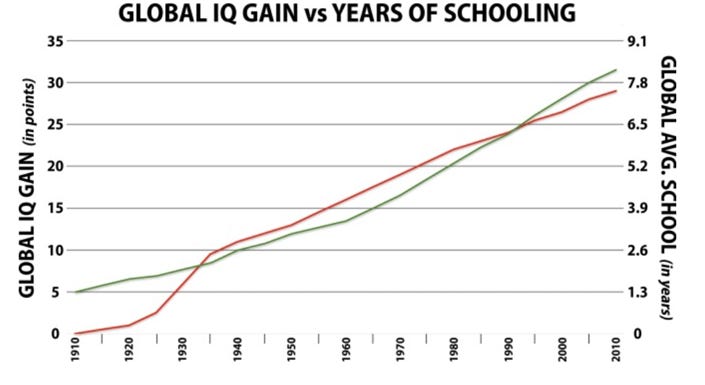
For that reason, we cannot concretely say that Gen Z is less intelligent than Millennials. What this data does suggest is something narrower but arguably more troubling: despite spending more time in school than any generation before, Gen-Z is losing school-ability.
In other words, something has shifted within schools themselves. The values, habits, and cognitive skills that education once reliably supported are no longer being cultivated in the same way.
This shift can’t be blamed on teachers, who remain as dedicated and motivated as ever. Nor can it reasonably be pinned on curriculum, which is arguably more complex and demanding than at any point in history.
The change, I would argue, lies largely in the tools we now use to mediate learning.
Screens tend to support cognitive outsourcing rather than deep thinking. The more students rely on easy, supportive digital tools, the less friction they encounter and the less mental effort they must exert. But friction is not a flaw of learning: it is learning.
When school becomes too smooth, too guided, too effortless, thinking itself begins to erode. Accordingly, we should not be surprised when an entire generation educated under these conditions begins to show cognitive declines unlike any we have previously documented.
So I’ll end where I started:
“Our kids are less cognitively capable than we were at their age.”
What happens next depends on whether we continue to embrace tools that do the thinking for students, or whether schools demand students return to doing the thinking for themselves.