Welcome to the Convivial Society, a newsletter about technology and culture. I once again find myself with two or three post in the works, so while it has been quiet for a month, the pace may pick up a bit now. In this post, I’m thinking about memory (a perennial concern) while following an associational thread that might illuminate the meaning of our experience and help us navigate life with a measure of wisdom. As always, it is left to you the reader to judge whether the writing is helpful in these ways. If so, please feel free to share it with others and/or consider becoming a paid subscriber to support my work.
Consider two related experiences. The first is the experience of setting out to accomplish a specific task on your digital device of choice, and then finding, after several minutes of aimless wandering from app to app or tab to tab, that you no longer remember what it was that you set out to accomplish in the first place.
The second is the experience that starts with sitting down in the late evening, maybe to catch your breath after a day of work. You have other things you need or desire to do, but you decide to check your phone while you give yourself this short break. An hour goes by, maybe two or maybe three. You never get to that thing you wanted to do. You don’t quite feel like you got much of a break either. At various points you thought about pulling away from the feed, but you couldn’t quite manage it. Your will power could not achieve escape velocity from the inertial pull of the infinite scroll.
I presume most if not all of you will readily recognize these experiences. What they have in common are the qualities of aimlessness and forgetfulness. And I wonder whether they do not present us with an important clue into the nature of our digital condition. A condition that might be characterized by various words—burnout, exhaustion, alienation, and outrage among them. To these, I would also add lethargy, personal and perhaps also cultural. Might we not, for example, characterize the doom scrolling state as fundamentally a state of lethargy in which we are unable to rouse ourselves to action?
But if so, why? What induces this state of lethargy?
I can no longer recall the source, it was many years ago, but I once heard someone argue that words are repositories of cultural memory.1 The sense was that you could dig into the history of a word—down to its roots—and thereby learn a great deal about the history of human experience and consciousness just as an archeologist might learn a great deal about our history by digging into the earth.
In that spirit, I was recently struck by the realization that at the root of our word lethargy lies the ancient Greek word lēthē, which means “forgetfulness” or “oblivion.” Etymologically, lethargy is derived from lēthē combined with argos, which means “idle,” suggesting that lethargy is idleness or inactivity induced by forgetfulness. Here, perhaps, was a clue worth investigating.
We can start with the observation that Lethe was also the name of a minor deity associated with oblivion as well as of one of the rivers of the underworld whose waters induce forgetfulness. In his evocative book, A Primer for Forgetting, Lewis Hyde collects a number of relevant reflections and observations from which I’ll draw in the next few paragraphs.
Hyde notes, for instance, the account given of the oracle of Trophonios by the ancient historian Pausanias. Those who sought the oracle’s wisdom underwent an elaborate ritual, which included drinking from two fountains: one bearing the Water of Lethe and the other bearing the Water of Mnemosyne.2 The goddess Mnemosyne was the goddess of memory and, not incidentally, the mother of the Muses.
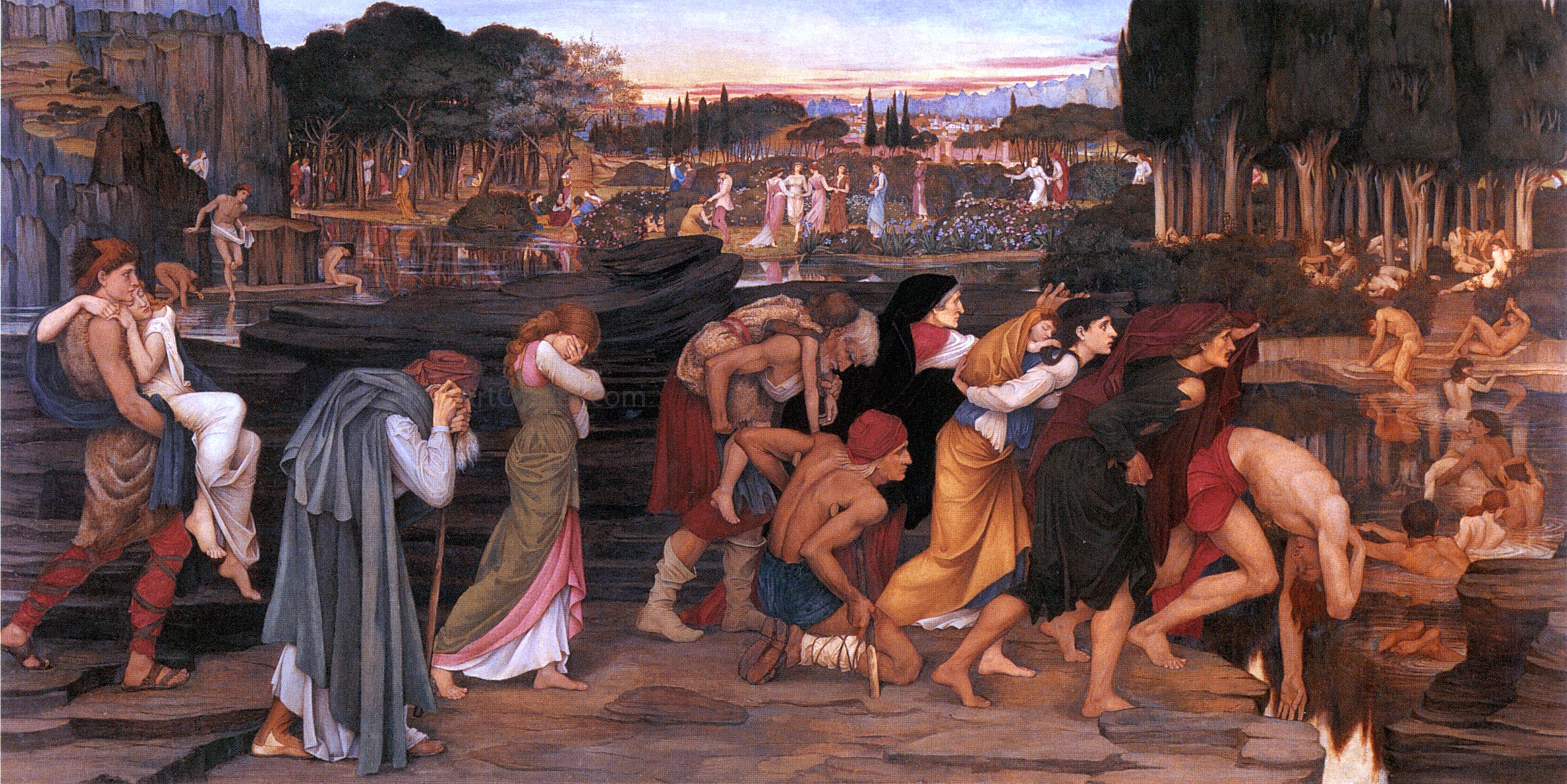
Hyde, who began with a fascination with memory that then developed into an interest in forgetting, observes that “the two waters appear in sequence and are complementary, not contradictory.” Hyde continues: “They bespeak the conjoining or the ambiguity of Forgetting/Not-Forgetting, Covering/Discovering, Lethe/Aletheia, each power inseparable from and shadowed by the other.”
It turns out that lēthē is also at the root of a Greek word for “truth,” alethia—literally, un-forgetting (or un-concealing, the sense of which Heidegger made much). The truth of things lies in our not-forgetting or our remembering.3
Hyde does not mention it, but, more than a millennia later, Dante will complete his journey through the mountain of Purgatory and also encounter two streams:
“To one side, it is Lethe; on the other,
Eunoe; neither stream is efficacious
unless the other’s waters have been tasted:their savor is above all other sweetness.”
In both cases, and as the whole of Hyde’s compendium of reflections on memory and forgetting suggests, we must remember and we must forget in right measure.4 Indeed, much of our present malaise might be traced back to technologically mediated disorders of remembering and forgetting. But to see this we might first need to expand our sense of what memory is and is for, and Hyde once again supplies us with another relevant anecdote.
In Plato’s Republic, we find the story of Er, a soldier who is killed in battle but returns to life to tell the story of his experience in the Land of the Dead. There, he witnessed how souls preparing to re-enter the land of the living were led through the valley of Lethe and brought to the River of Forgetfulness. “Great thirst drove them to drink this water—” Hyde comments, “those without wisdom drinking especially deeply. As each man drank, he forgot everything.”
Naturally, this accords with Plato’s theory of knowledge. For Plato, the highest knowledge, knowledge of the good, is not so much discovered as it is remembered. As Socrates puts it in the Phaedo, “What we call learning is really just recollection.” Anamnesis is the Greek word for this from knowing arrived at by remembering.
You’ll remember that Socrates’ critique of writing in Plato’s Phaedrus, which I sometimes call the ur-text of technology criticism, focused on how writing diminishes memory.5 Lacking Plato’s metaphysics, we tend to have little sympathy for such arguments. They seem like inordinate hand wringing about the fact that we don’t know anyone’s phone number anymore. But even without embracing Plato’s metaphysical package, there’s an insight here that we ought to take seriously: living well entails remembering. To forget certain truths is to be at a loss as to who we are and what we ought to be about, to enter the state of lethargy.6 To overcome such lethargy, we must remember. Or, perhaps better, we need a practice of remembering.
But to be immersed in the digital stream is to drink from the waters of Lethe, and daily we drink for far too long like the unwise souls in Er’s account of the Land of the Dead. The most powerful tools of externalized memory, by a straightforward logic, have induced a profound forgetfulness.
The critique of externalized memory, however, tends to focus our critical attention on the tendency to forget what we have outsourced as well as the vital difference between what we know by heart and what we merely know how to access. This is no small thing. We need certain truths ready to hand, mingling with our imagination, our thoughts, and our desires. But my interest here is not in this form of forgetting, but in the way that we enter an existential state of forgetfulness when we are immersed in our digital Lethe, in how long we allow ourselves to abide in this state, and in the effect over the course of a lifetime of such indiscriminate immersion.
We need a practice of anamnesis, a remembering of reality outside of the digital cave of shadows. Maybe we just need to practice the discipline of refusing to drink from the waters of the digital stream in the first place.7 What matters most in this regard is obviously not our capacity to recall discrete bits of information. Rather it is the practice of remembering what is deep down at the heart of things, and holding that vision before us. This vision of the good, if we might so call it, has the power to move us to action, to sustain our labor and our care, to strengthen us against the alienating and disintegrating forces let loose in our world. Perhaps this is why Mnemosyne is the mother of the muses. Creative, intellectual, and perhaps even moral energy flows from such remembering.
My writing is reader-supported and an important part of how I make a living. But there are no paywalls. My work is supported by those who are both able and willing to do so. If that’s you, you can subscribe at the usual rate of $5/month or $45/year. If that seems a bit steep, you could use the second button below to support the Convivial Society at about $3.50/month or $31/year. You know, a cup of coffee a month or something like that.