All the way back in August 2023, in the midst of a series of posts on the RISC-V architecture, I ran a reader poll on the future of the architecture, with the following introduction:
As we’re in the middle of a short RISC-V series, I thought it might be fun to test how Chip Letter readers feel about RISC-V.
There’s lots of ambition behind the RISC-V project. In “Instruction Sets Should Be Free: The Case For RISC-V” Krste Asanović and David A. Patterson wrote:
“.. our goal is grander: just as Linux has become the standard OS for most computing devices, we envision RISC-V becoming the standard ISA for all computing devices.”
Please note the use of ‘the standard’ (i.e. singular) rather than ‘a standard’.
Rather than make this a binary question as to whether you agree with this or not, I thought it would be worth broadening the options out a bit and asking it in the context of a specific timeframe.
Please vote in the poll and share your thoughts in the comments thread.
The results were very interesting, with a majority of readers indicating that they they believed that RISC-V would be the standard or the most popular architecture in 2043.
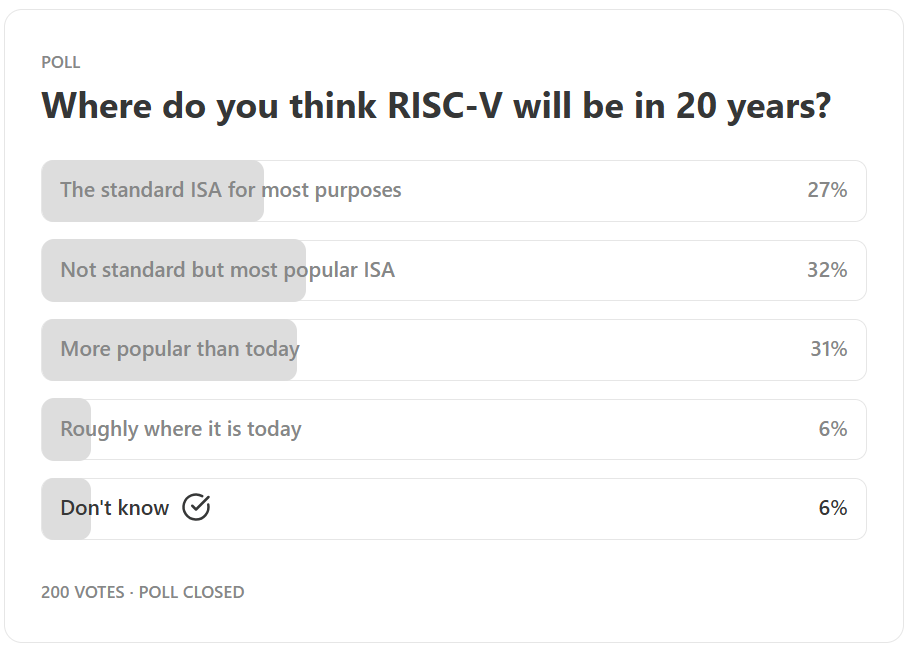
A lot has happened since August 2023. ChatGPT had been launched at the end of 2022 but the full impact of the dramatic build out of AI facilities wasn’t yet clear.
In the world of RISC-V we’ve seen lots of progress on higher performance designs from firms like SiFive and Tenstorrent as well as the ratification of the important RVA23 Profile Standard.
So when I asked the same question in August 2026, I wasn’t sure what to expect.
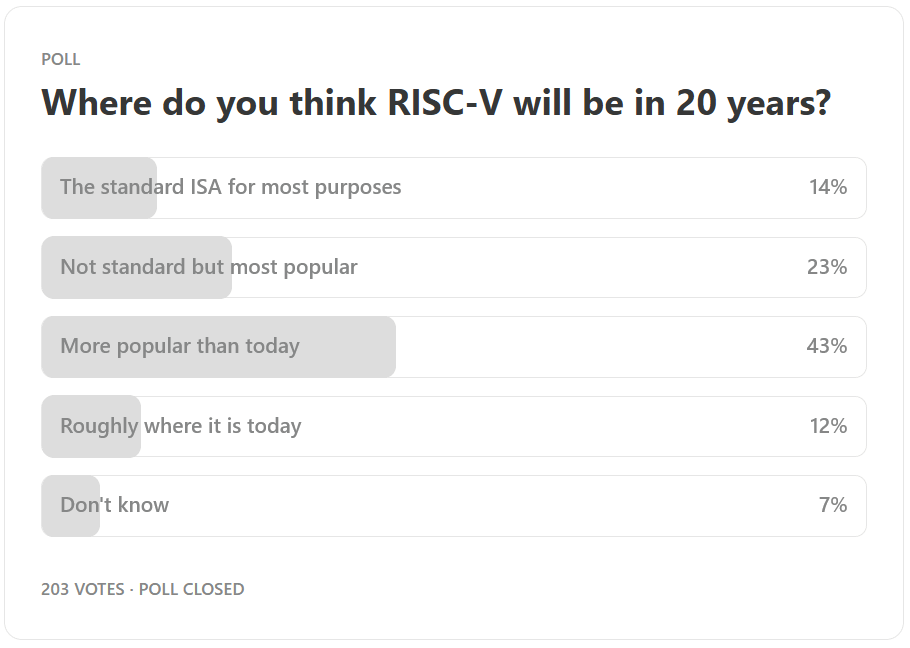
That’s quite different!
Now, much less than half of readers who voted think that RISC-V will be the standard or most popular ISA in 20 years, a drop of 22% from the 2023 poll.
Why this change?
First of all, thanks to everyone who voted!
Without looking into your minds and motivations, it’s impossible to come to a definitive answer.
I have two theories, though.
First, the scale of focus and investment in AI has diverted both resources and attention that might otherwise have been devoted to RISC-V. The ISA has been an important role in many accelerators but has played a subsidiary role to the accelerator itself in these designs.
Second, the development of RISC-V is to a large extent dependent on the strength of competing architectures. The last three years have seen Intel’s resurgence and further progress in the development of the Arm ecosystem with a server SoC from Arm itself and more high performance cores from Nvidia and others.
Combining the two together means that RISC-V has lost ‘mindshare’.
What do you think? Comments are open so do please share your thoughts.
Cover Image: Development board for BluetrumAB32VG1 UG7200 2118 RISC-V microcontroller SoC
Credit: By Popolon - Own work, CC BY-SA 4.0, https://commons.wikimedia.org/w/index.php?curid=142507606