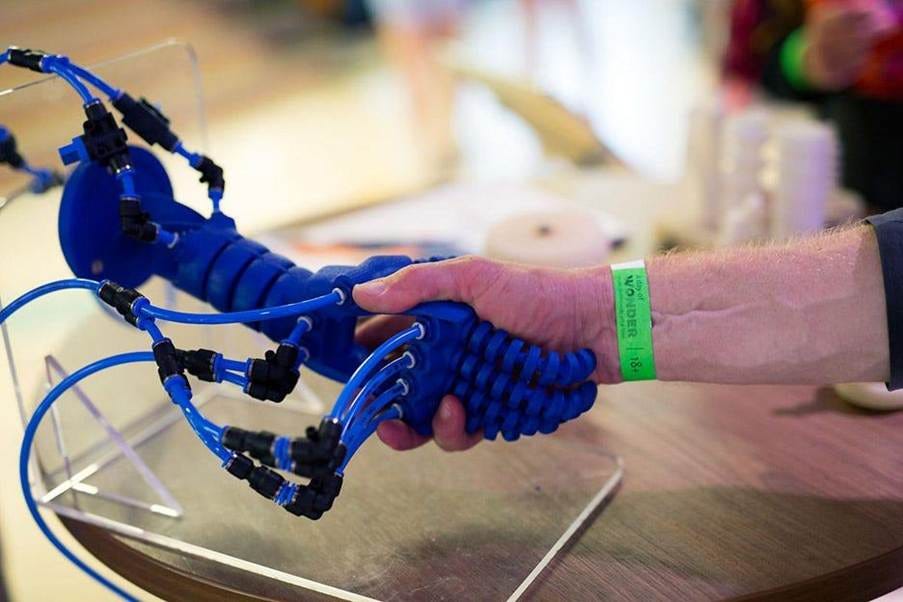
I’m delighted to share a post from one of my favourite Substack writers, Jordan Taylor, otherwise known as Incautious Optimism. Jordan covers a wide range of engineering topics from Hypersonic Flight to Nuclear Power and much more, with a unique blend of insight and humour. I highly recommend that you check out Jordan’s writing.
Today’s post from Jordan’s archive is on a topic that I’m sure will be of interest to Chip Letter readers: computing with air!
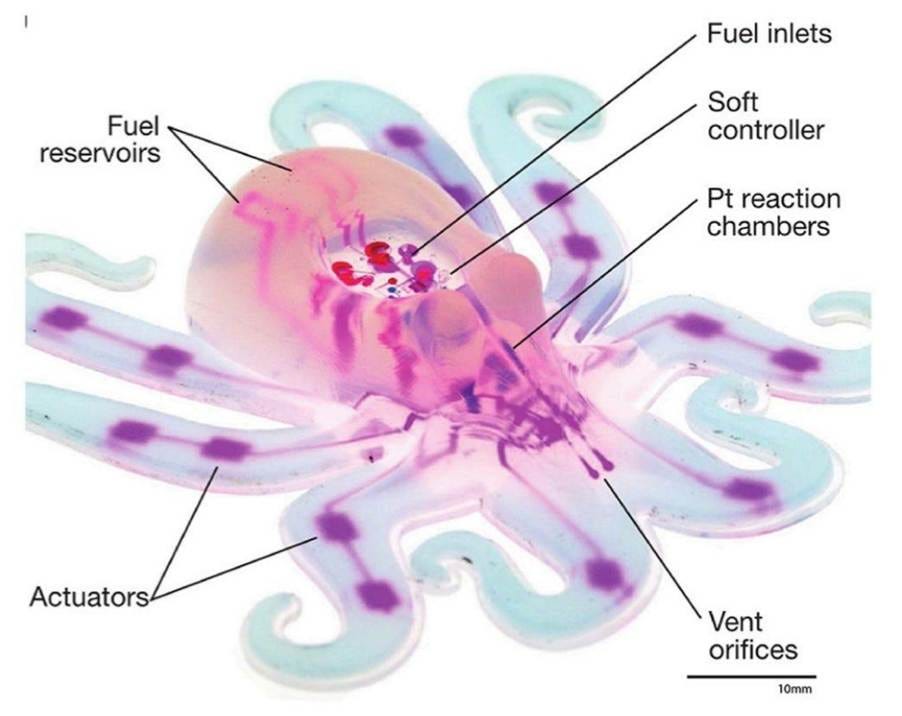
Ten years ago a creature twitched its tentacles in the Wyss Institute, Harvard University. It looked like an octopus, but looks can be deceiving. It wasn’t a robot either, and held not a gram of metal nor spark of electricity, yet it moved under its own steam. Literally!

The Harvard octopus wasn’t alive and had a brain that flowed with vapour, not electrons. It had no cables, no motors, no batteries and no clever little CPU. It was a thing of squishy limbs and chemical power alone, and that was enough.
Because the creature’s brain was pneumatic!
Octobot was a pretty simple affair and could only power itself for eight minutes at a time through a hydrogen peroxide reservoir and a platinum catalyst, but it was enough to prove the idea that logic doesn’t need to be slaved to silicon.
The ersatz synapses firing in that mockery of life weren’t organic and they weren’t electrical either, but an expression of simple physics.
…Not so different from us, then. We are also an expression of physics, but ten billion times more complex, and not pneumatic or hydraulic.
This is fluidic logic. You can make computers this way.
And weird robot octopi are only one application of fluidic logic. It goes far, far further than that, and gets weird.
Want to find out about it?
Beneath our world of silicon sorcery lives a much older one, hidden from view but still alive in those places where air hisses and steam takes orders from mortal men.
After all, we controlled very complex machinery long before the invention of the electronic computer. We used mechanisms, hydraulics and compressed air. In many places we still do.
Electronic computers are undoubtedly powerful; fast, flexible, precise, able to calculate a million things at once and be reprogrammed at will. But we didn’t always need them, and this begs a few questions:
Can you make a computer that runs on fluids & mechanisms instead of air? Is there any reason I’d do that?
And can I make a Commodore 64 that computes with pneumatics, and then play Elite on it?
All good questions, but a lot of it starts with how can I do basic logic processing with just air!? Fortunately, that’s a question with a lot of very good answers, to which we need to look no further than a transistor.
The transistor is the workhorse of modern micro-electronics. Billions of them are etched into every silicon chip in an act of precision miniaturisation that flirts with actual magic. But for all that mystical techno-sorcery, the actual function of a transistor is simplicity itself.
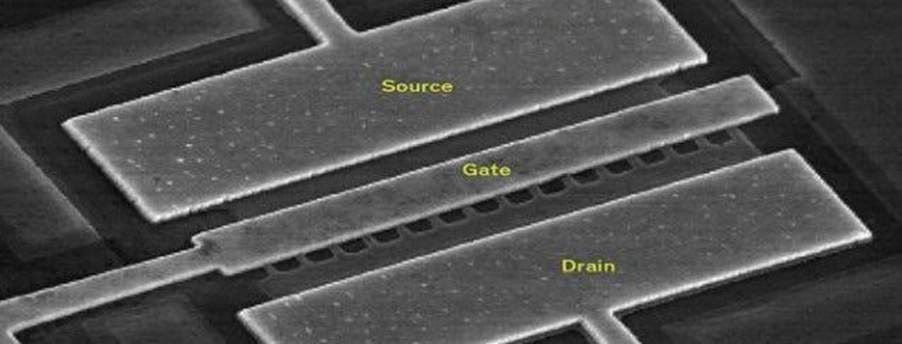
A transistor is part switch, part amplifier. A small current enters, which opens a ‘gate’ for a much larger current to pass through the component. That’s it. Multiply by billions and shrink to the nanometer scale and you’re sorted.
OK. Great. How do I replicate that with fluids?
Using traditional valves it’s easy enough: A small signal flow can move a sprung valve body to one side, allowing a thru-hole to align with a much larger, higher pressure flow that then roars into being. Instant flow amplification! A transistor.
But what if we want to follow the Octobot’s example and run fluidic logic without any moving parts at all? There is a way, and to reveal it we shall look at the DC-10 airliner.
A long time before Octobot there was the DC-10, the archaic three-engined poster boy from the 1970s. This was notable not just for having three engines, but also for being the first commercial aircraft to use fluidic logic, which it used to drive the thrust reverser.

Basically a relatively small compressed air input (the control) would deflect a much higher volume flow into one or more actuation channels.
This can be done in multiple ways: See the example of the bistable Coanda effect amplifier shown below. In this, without a control signal the fluid just blasts straight into a baffle, deflecting it into the vents. Add a control signal in either direction and the main flow is directed into one of two outputs, to actuate whatever equipment you desire.
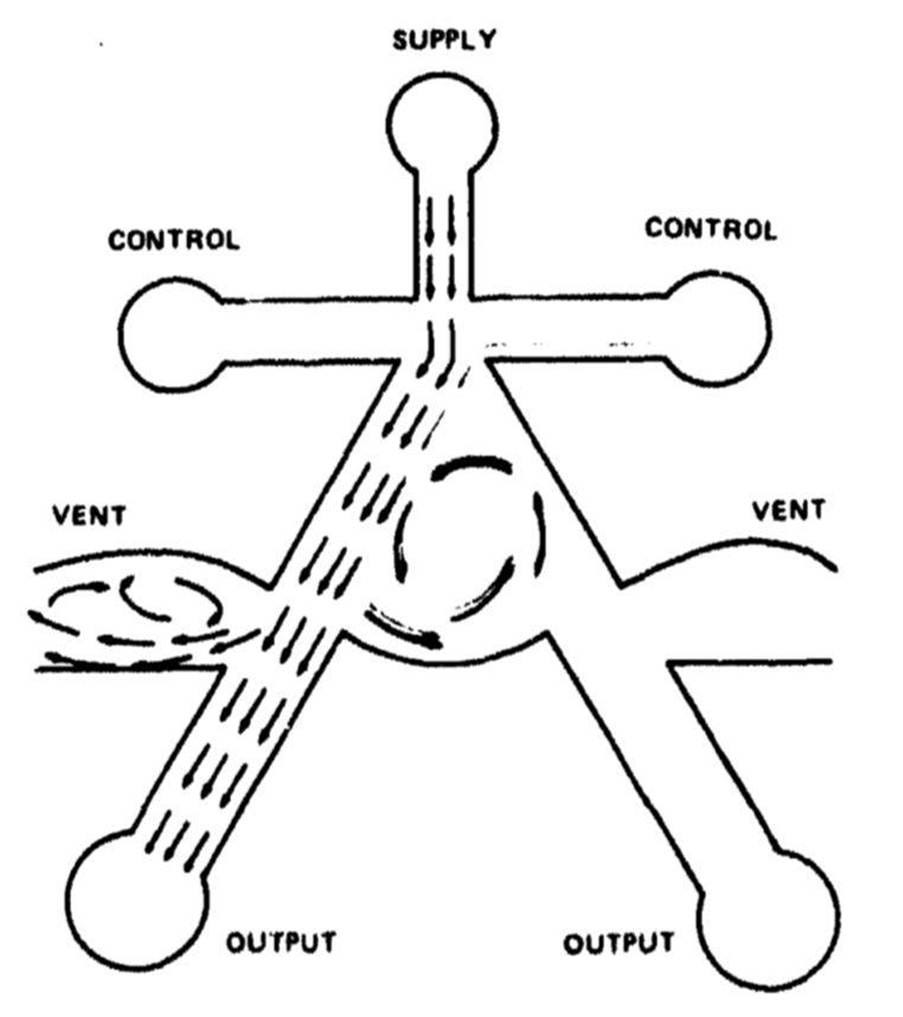
What’s interesting about this example is it’s bistable: A single control signal persistently deflects the output even once the control is turned off, as the jet hugs the wall through the Coanda effect and sets up recirculating vortices over the baffle that keep it there. Another control jet is required to deflect it once set, or both at once to reset the stream.
And just like that we’ve created a transistor and primitive memory storage with nothing more than flow and clever geometry.
That’s fine for actuating a thrust reverser or industrial machinery, but there’s a whole bundle of logical functions in a computer, so transistors alone are insufficient. Can we perform other logical functions?
Can fluids think?
We all know about robots these days, but what comes to your mind when thinking about them? If like me you’re of a manufacturing persuasion, hiding crustacean-like in the nooks and crannies of the industrial reef, then a ‘robot’ means an industrial arm, moving, grasping and placing with scary speed and impossible precision. To the more excitable sort of technophile a ‘robot’ might mean a sleek bipedal tech-demonstrator doing backflips or serving cocktails for photo-ops. Or for those of a more Black-Mirror tendency it might be the iconic figure of Boston Dynamic’s quadrupedal robot ‘dog’, an eyeless yellow oddball that has an uncomfortable hint of Bloodhound about it: It’s all too easy to imagine it chasing you through woodland, stabbing a red targeting laser through writhing ferns.
What you’re unlikely to picture when thinking of a ‘robot’ is something… soft. But why not?

Soft robotics is a new field, borne of the realization that robots, while very useful on their own, could be even more useful if they were collaborative. -And collaboration with humans means not breaking their bones, jabbing them with implements or getting confused by our waffly lack of precision.
A soft robot is one where sinews of cable and muscles of motors are swapped-out and replaced by something squishier and friendlier for us to work with. It might be a collaborative tool, a rehabilitative aid or a questing searcher through the rubble. It’s designed to yield slightly to the chaos of the world, like your hand as it grips or a root working around objects.
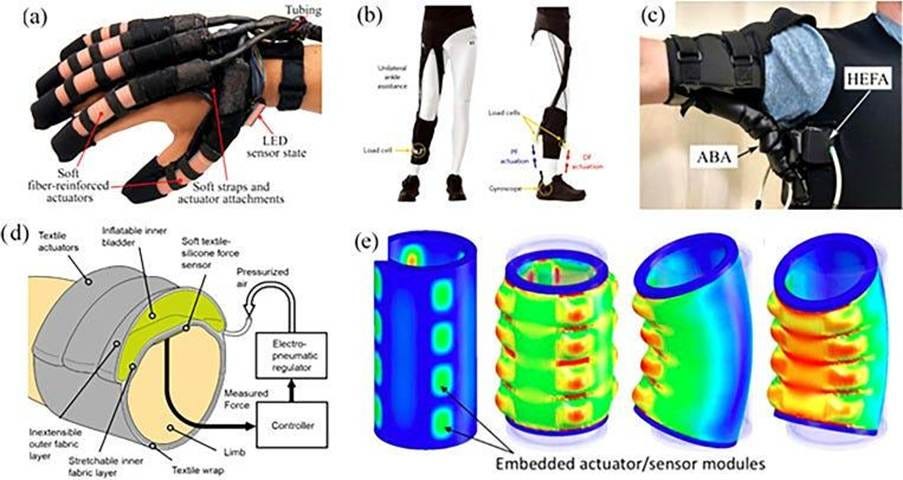
And when one of these objects is a human hand, with its fragile, snappable bones, a soft robot could become a wearable rehabilitative tool for stroke victims. It could be a force amplifier, increasing their grip strength without forcing them into motions outside the normal range of their joints: A soft exoskeleton hydraulically or pneumatically powered through squishy actuator ‘muscles’, helping those injured by trauma come to terms with their body again.
Sounds nice. Where does fluid logic fit in?
Both micro-fluidics and soft robotics are fields mostly working in isolation. This is a shame, because they are natural bedfellows.
A micro-fluidic amplifier, if sufficiently miniaturised in a pliable substrate, is effectively a flow sensor, and if its input is the pressure induced by a stroke victim grasping their hands, and the output is an amplification of this force, then a clever prosthesis controlled by micro-fluidics could wrap around a person’s limbs or fingers and amplify their efforts. Useful for someone recovering from serious physical trauma.
The pressure would have to come from somewhere of course, and you could always use a motor, but a clever person might see something more elegant: Perhaps an inflated bladder, pressurised by the casual movements of a person’s hips or core in any of the hundreds of unconscious movements we make every minute? It could harvest this unconscious corrective load and transmit it to the hand, arms or legs, to charge the fluidic sensors, amplifiers and logic gates that an injured person needs to move again.
Help, from a friendly soft robot.
And the funny thing about this would be that the logic, the ‘brains’ of the operation would be distributed: Sensors and logic circuits in the fingers, arms and joints, near to the action. The user would become a hybrid, like the alien octopus with eight little brains in its arms. Part human, part hydraulic, a creature of pressure that thinks with fluid.
Or why not use soft robotics to make a ‘tapeworm’ for pipe inspection? A ring-shaped hollow softie that undulates its way through the dark places, checking out the flow, feeling the texture of the walls and listening to the sounds of the underground. You could control its undulations with fluidic logic, powered by an electric pump… or if you’re clever, even the flow itself.
Give the worm a ring mouth and it could sample liquid or gas and create pressure differences that could power it using a ram-effect or ringed venturi sections, tapping the flow just enough for propulsion. Do this with a clever soft robot, that twists and gropes its way around obstructions, and you’ll have created an organic-looking inspection worm with infinite range: Feeling the pressure and thinking with flow…
The Chernobyl Wyrm.
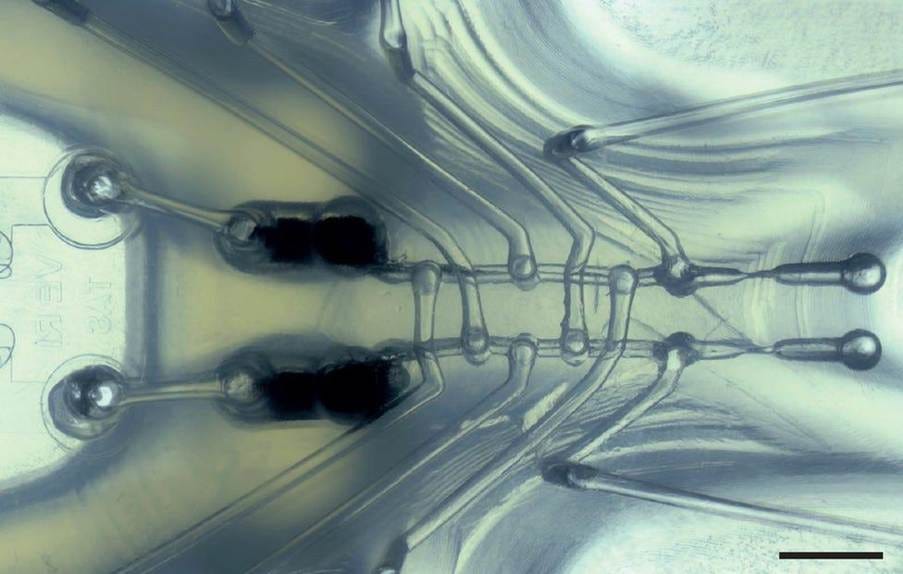
Or perhaps I’m being too poetic. I mean, how do these flow logic gates work anyway?
Let’s get into the fine technical stuff, shall we!
We’ve established that you can supplement an electrical binary signal (on/ off) for a fluidic one (flow/ no flow), then use those signals to amplify, divert or shut-off other flows. Grand, but where’s the logic?
Here are a collection of Boolean logic gates that a computer needs to be able to process (you may recognise them from programming or spreadsheets or any number of things).
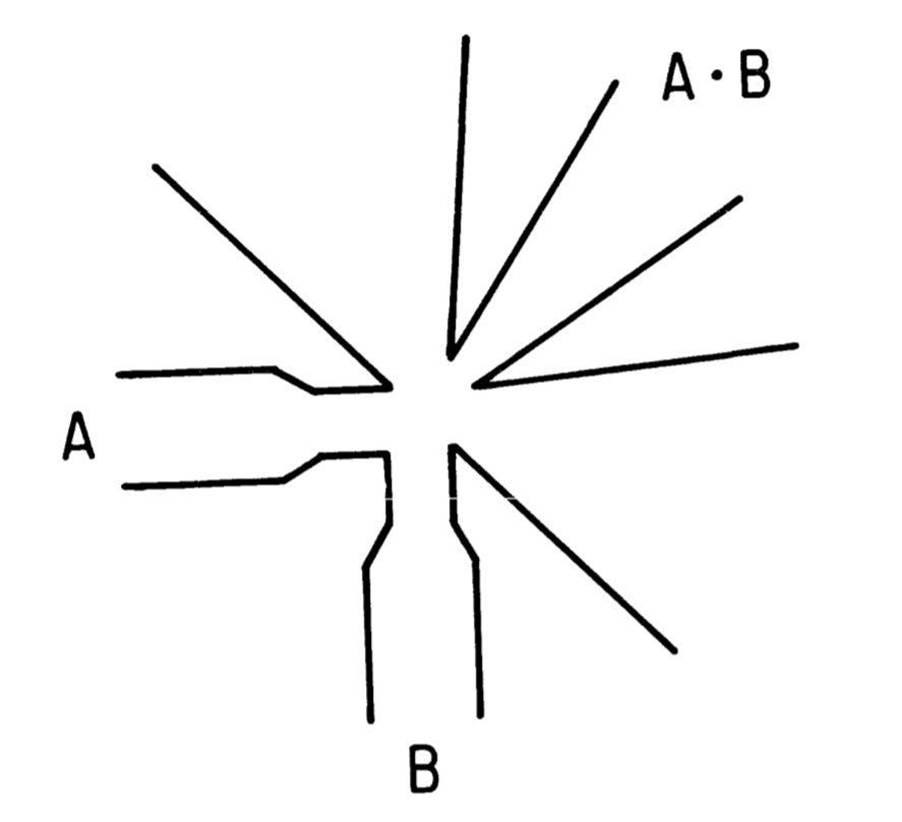
Fluidic AND gate: Both A and B need to be on, or the flow is vented.
AND: Returns positive if both input conditions are met (value ‘Notre Dame is on fire’ is true if arguments ‘that’s Notre Dame’ AND ‘holy crap, it’s on fire!’ are both true).
NOT: Inverts the input from true to false or vice-versa (value ‘the house needs painting’ is true if the value ‘house has been painted in the last five years’ is NOT true).
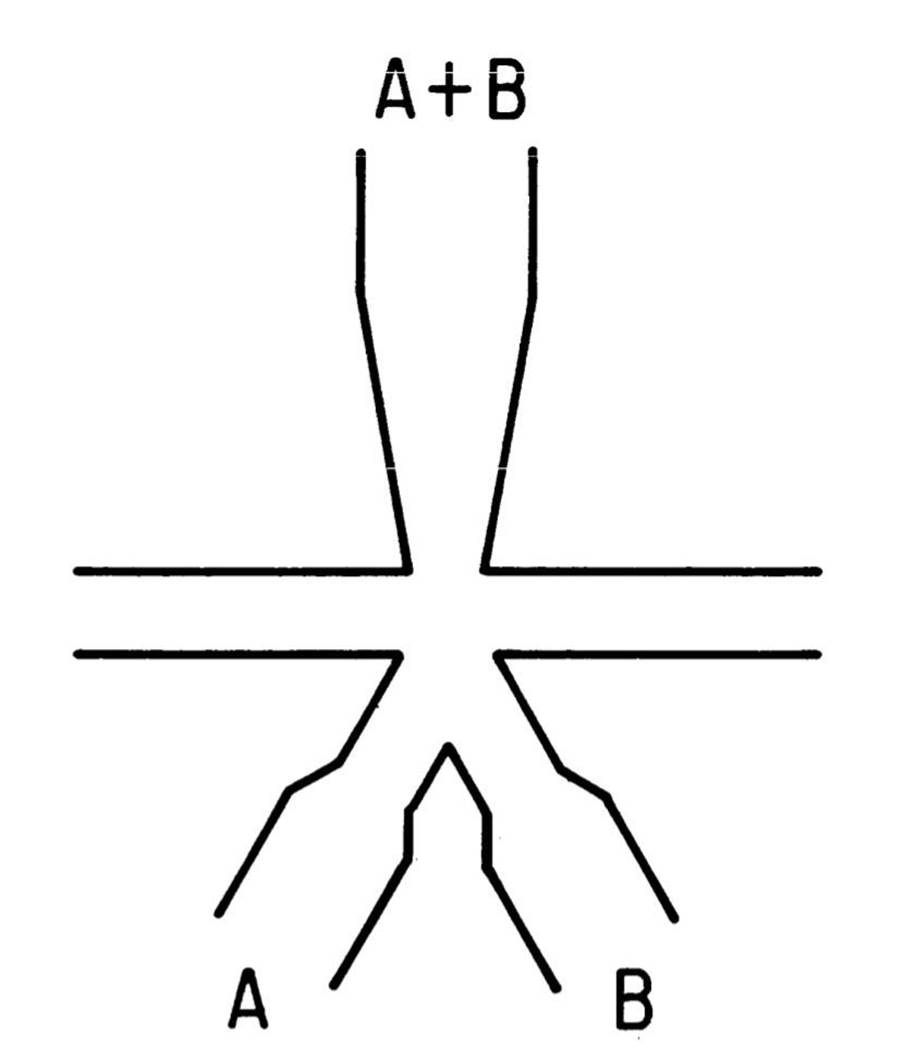
OR: Returns positive if either or both inputs are true (value ‘that lady at the bar is hawt!’ is true if value ‘pretty blonde’ OR ‘pretty brunette’ are true.) If you’re picky, you might want to combine that with a couple of AND statements and a NOT to screen for ‘definitely a woman’ and ‘am I married?’
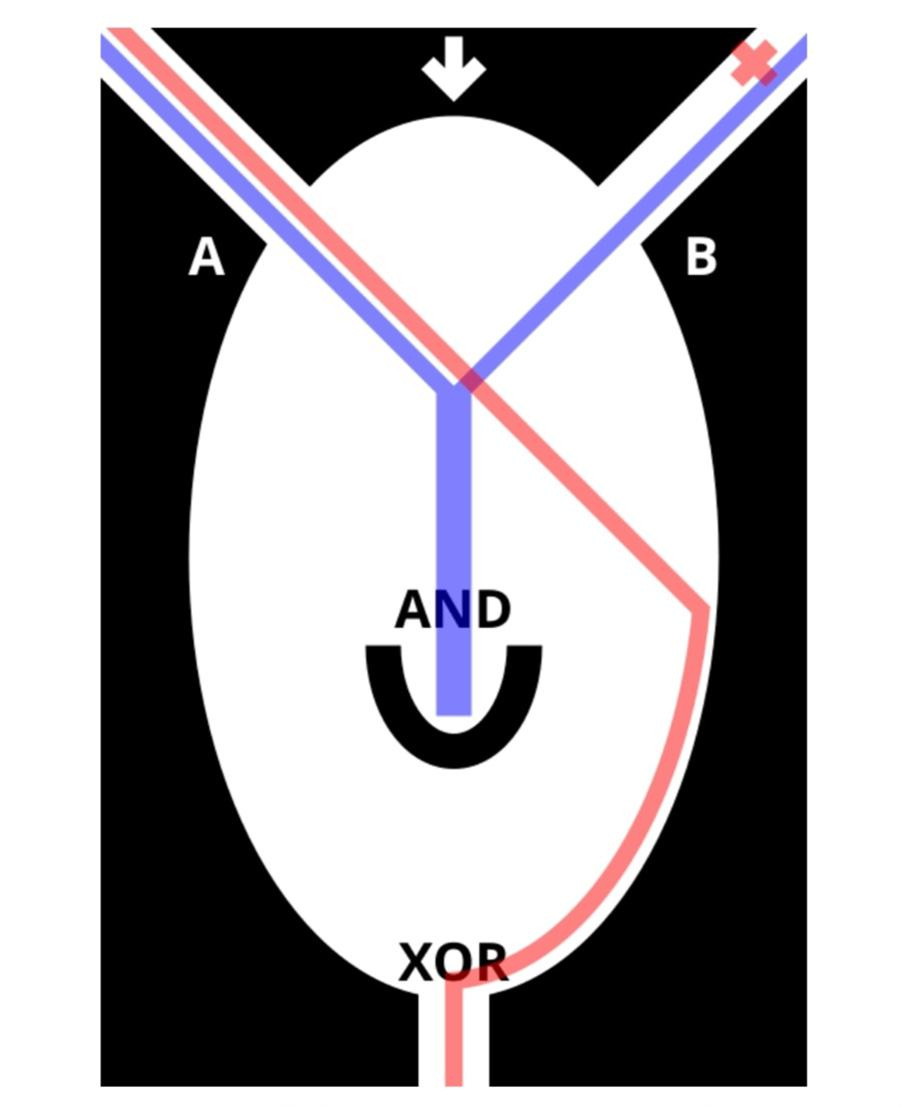
XOR: Similar to OR but is only true if one or the other input is true, not both. This one is vital if you need your computer to be able to do arithmetic.
And so on. You can combine them to create all sorts of effects, and if you want to create something really complicated you’ll need some kind of timekeeping (a pulse oscillator), memory and the allowance for sequential logic: Basically, making use of the fourth dimension (time). Bistable elements such as the one shown further up are a means to achieve this.

Valve based systems using conventional hydraulics & pneumatics can replicate this easily enough, but purely fluidic systems can too, and with a pleasingly curvy geometry that looks evolved rather than engineered.
As well it might be.
A fluidic amplifier, transistor or logic gate will generally make use of either proportional amplification, the Coanda effect or vorticity. Proportional deflection is just using a small perpendicular jet to orientate or deflect a larger one. The Coanda effect is the propensity of a viscous flow stream to ‘cling’ to a gently curved boundary surface. Induced vorticity can be an active or passive effect used to influence flow.
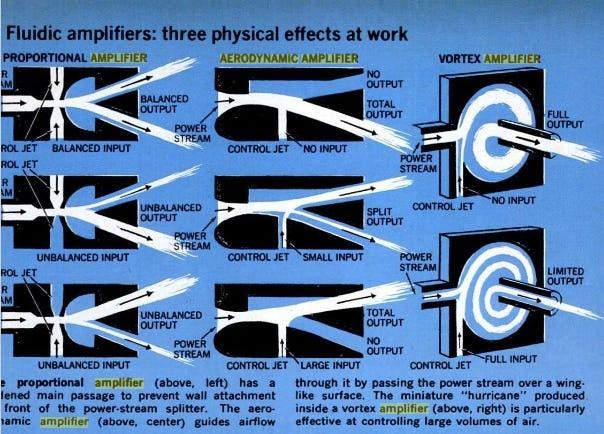
A passive example of induced vorticity working with a proportional amplifier was shown earlier, where a bistable transistor was shown, but there are other examples.
Active induced vorticity is used in air conditioning and glovebox containment systems for efficient flow management or containment of hazardous substances: In it, a jet enters a cylindrical chamber with an exit out of the top of the chamber. When there is no control input, the jet shortcuts from the periphery straight to the centre without a worry.
But when the much smaller control jet is activated, which lies tangential to the cylinder wall, a high speed forced vortex is induced, and dynamic pressure effects choke the input jet and mostly prevent it from leaving the chamber. It finds use in high volume applications with a priority on simplicity and reliability, hence its inclusion in some HVAC and lab gloveboxes, where it’s an effective failsafe.
And, lest it be forgotten, these are all examples of logical gateways… but with the ones and zeroes provided by pressure, not electrical potential.
OK, lovely. So we can do the ones-and-zeroes thing with water or air and no moving parts, and that’s a great trick. Top-notch cleverness I’m sure.
But what is it good for and what are its limitations?

It can be used for responsive soft robots and automatons in hostile environments where electrical systems would croak and die. I’m sure someone, somewhere, is figuring out a way to use fluid logic to control a Venus exploration rover! And fluid logic already controls safety-critical industrial systems in ATEX-rated or similar environments where electrical systems would be an unacceptable spark risk. You see pneumatic fluid logic systems in packaging sequencing where either spark risk must be reduced, or else wash-down cycles must be withstood. Fluidics can laugh at both in ways that electronics can’t.
But what are the limits in building something more complex? Fluidics can form all the basic logic gate systems that we need in computing, and store memory, and amplify output, but can we make an actual computer out of them?
Actually, yes. In the 1960s the FLODAC (Fluid Operated Digital Automatic Computer) was built by Univac as a proof of concept to show that you could perform arithmetic and store memory with fluidics. It incorporated 250 fluidic NOR gates, among other things, which makes it a computational minnow in today’s river of whales, but as a proof of concept it worked.
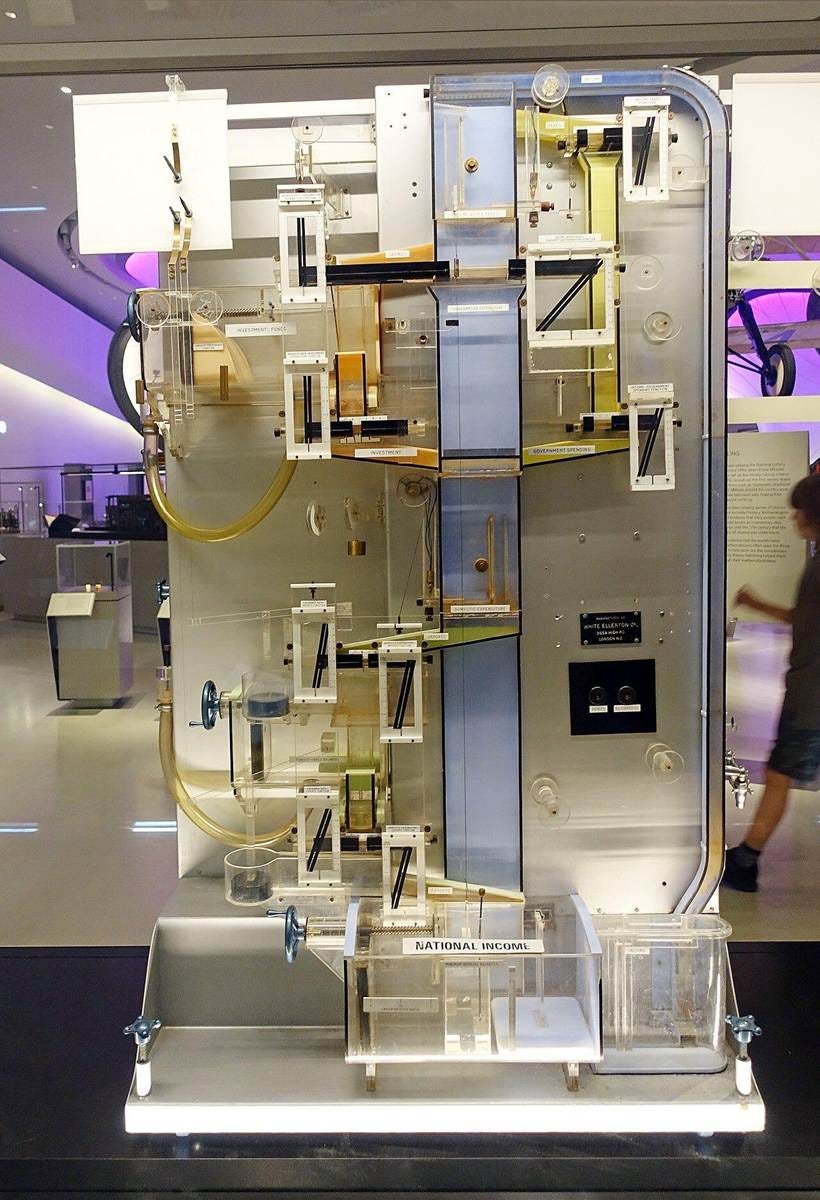
In the late 40s Phillips built several analogue fluidic computers to model the macroeconomy and money flows, tax, spend etc. A dozen machines were built, mostly as teaching aids for universities. They are museum pieces now.
In modern times, microfluidics (think fluidics but teeny tiny, printed using soft lithography) have allowed researchers to take things a little further, creating fluidic microprocessors (the University of Michigan created a miniature 8-bit processor) and a variety of companies have prototyped so-called ‘lab on a chip’ devices: A microfluidic device that can perform laboratory functions on a chip a few square centimetres in size using extremely small volumes of fluid. The prospect is to miniaturize sampling of fluids to the nanolitre/ microlitre scale by performing laboratory operations (mixing, separation, reaction, detection etc) on microfluidic chips controlled by fluid logic. These mix electronic and fluidic components, using fluidics to control the sequence of mixing events on the chip, pump the micro-samples and create mixing structures for reactions to occur. Electronic sensors (optical, chemical or electrical) can then perform the analysis.
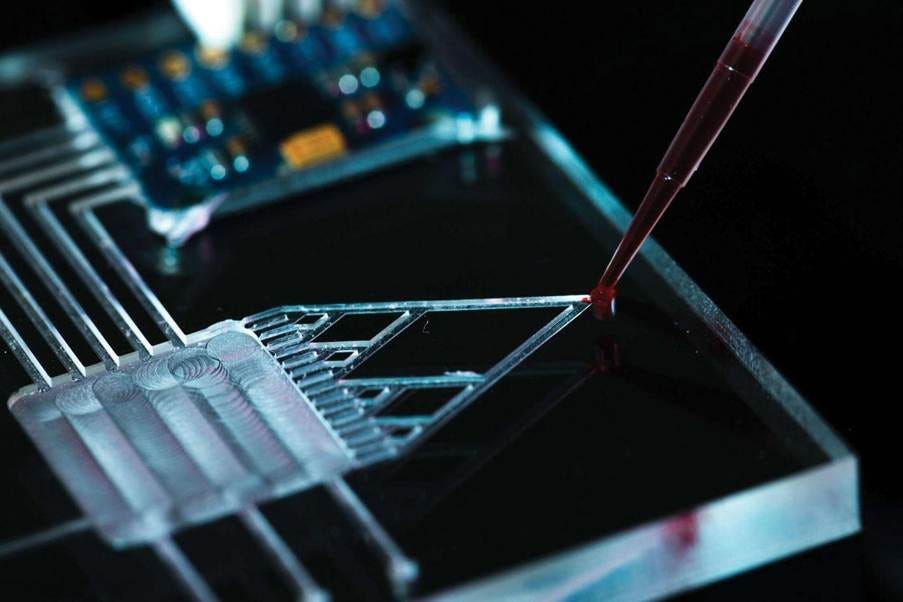
The promise of the lab-on-a-chip concept, somewhat stained by fraudulent outfits such as Theranos, is to miniaturize laboratory sampling operations, make them portable and greatly accelerate the cycle time between sampling and analysis. The most mature application is probably Chepheid’s ‘GeneXpert’ system, which uses integrated microchannels and valves to process fluids automatically for nucleic acid extraction and gene sequencing, with minimum manual intervention. Other portable blood testing systems exist for cell counting, HIV monitoring, infectious disease testing and blood chemistry analysis operate using microfluidic and sometimes fluidic logic principles.
So the technology has promise whatever angle you come at it: Whether it’s running factory pick & place equipment in dangerous environments, operating Concorde’s thrust reverser, gently assisting a stroke victim by moving their hands & arms, inspecting pipes, piloting a Venusian probe, analyzing blood samples or moving a tiny robot octopus.
But will it let me play Elite on a pneumatic Commodore 64?
Most of the functions we’ve talked about are computationally simple, and they have to be: While microfluidics can shrink ‘transistors’ down to a few micrometres, or tens of micrometres, that’s still about ten thousand times larger than the smallest electronic transistors that can be printed on silicon with extreme-ultraviolet lithography and repeat passes.
And not only that, but microfluidics are slower than micro-electronics. A lot slower.

The fastest switching/ response times reported for microfluidic actuators are about one millisecond, which sounds fast until you consider that micro-electronic transistors switch in the picosecond to nanosecond range. So not only are fluidic logic elements at least a thousand times larger than their micro-electronic brethren, but they work between 1,000 and 100,000 times slower as well.
But this doesn’t make them useless. Unlike electronics, the fluidic mode of ‘thinking’ is exactly the same as their mode of actuation. Simply put, a well-designed microfluidic prosthesis that magnifies your grip strength will take input from a pressure variation created by your fingers, amplify it into a flow that will actuate a soft motor and react in the opposite sense when it meets resistance. It could work in exact proportion with your body’s movements, governed by the laws of fluid dynamics rather than awkward motors and sensors. The ‘logic’ becomes a muscle that you are using. A distributed brain in your limbs.
Just like our friend the octopus.
The analogy here is a reflex, not the brain. Fluidics is like a knee-jerk, a hand leaving a hot surface, or a fighter’s trained reactions: Thought isn’t involved, but thought doesn’t need to be involved. The part of you that checks a punch, or recoils from pain, isn’t the same part of you that recites poetry. It shouldn’t be.
But can a reflex be trained to think? If we wanted to create a computational substrate through pure fluidics, it’d be big & impressive but sluggish. The humble Commodore 64, a machine launched over four decades ago and hopelessly antiquated now, incorporated a central processing unit with an 8 bit architecture and three and a half thousand transistors (not the billions present on smartphone chips now). You could certainly build a micro-fluidic CPU that could replicate the C64, but the big challenge is probably memory: The C64 has 64 kilobytes of RAM (hundreds of thousands of bits), and using microfluidics, each bit would require a bistable fluidic element with all the associated plumbing, making for a crazy number of components and huge complexity.

Speed is the next constraint: Electronics are operated at the speed of light, whereas microfluidic logic is limited to the speed of sound, a million times slower. Combine that with the much larger size required of a fluidic system and you quickly hit hard limits. A C64 CPU could potentially be replicated fluidically by very clever design (probably three-dimensional architecture) centimetres to a side, if you assume that a micro-fluidic transistor plus connections needs 100-200 micrometres to a side: Difficult, but not impossible.
RAM would require a meatier chunk of space, and there would be additional support structures, as fluidic systems ‘leak’ between their contacts a lot more than electronic ones do, so you’d need regular signal boosting through waves of amplifiers, meaning more plumbing and more pressure reservoirs everywhere. It might hiss a little.
But in principle, in principle you could use it to play Elite if you were patient: The processing speed would be at least a thousand times slower as well.
But that’s not fair, is it? That’s asking a muscle to think, and it’s not meant to think. Muscles are there to react!
In our silicon world, run by silicon thought, is the fluidic reflex just too damned dumb?
I wouldn’t be so sure. We like to think of ourselves as thinking beings, but a lot of that is self-flattery. We point to our big heads and enjoy the idea that these make us unique in the animal kingdom, a special creative creature with an unmatchable brain. Homo Sapiens: Wise Man.
But we’re not just a being sitting alone in an empty skull, piloting a lumbering marionette and peering through porthole-eyes. We live in our periphery, in our nerves and senses. A human being doesn’t pilot their way through abstractions but feels the world through their fingers. We are the touch of a baby’s hand, the smell after rain, the kiss on the lips and the crackle of fire. Our lives are woven by the slow pulse of chemicals, not the musket-flash of thought.
Without our nimble fingers we would never have used tools. Without our agile lips and jaws we would never have created language, and without that the entire edifice of civilization comes crashing down.
We are Homo Tactilis, the tactile man.
And viewed like this, fluidic logic makes sense: It’s mentality at our own speed, slower than light but as quick as instinct, and it lives in our fingers. The technology that replicates silicon logic with blood or air isn’t just a slow computer, but a biological process. It’s an echo of the divine in the way that a mere computer can never be.
And one day, the biological and the silicon worlds will meet as equals, shake hands…
And come together.