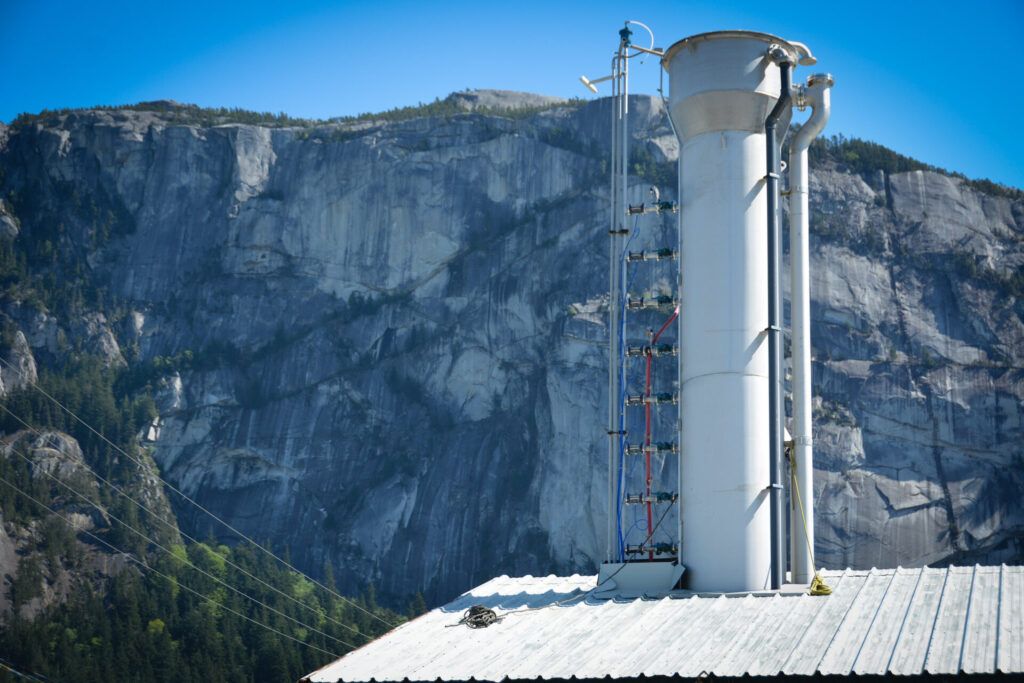
 Carbon Engineering pilot plant in Squamish, B.C. that captures carbon dioxide directly from the atmosphere. April 20, 2016 (Stephen Hui/Pembina Institute/Flickr)
This month elites from 198 nations gathered in the fossil-fuel-rich United Arab Emirates for the 28th annual Conference of the Parties to the United Nations Framework Agreement on Climate Change. Near the top of the agenda is the deployment of technologies to remove carbon dioxide, the principal greenhouse gas causing global warming, from the atmosphere. The week before the conference started, The Economist published an approximately 10,000-word special report on the topic, and the Financial Times reported that direct air capture of carbon dioxide is “grabbing investors attention.”
All year, the zeitgeist has been building toward technologies that separate carbon dioxide from air, referred to as direct air capture (DAC). In September, the United States Department of Energy awarded Occidental Petroleum a $600 million grant to build a DAC machine. As scientists and entrepreneurs who’ve dedicated our careers to help solve global warming, you might expect us to be happy.
We are not.
The reason is simple: Separating carbon dioxide from air, while technically straightforward, is outrageously expensive. In fighting climate change, the obvious question should always be: How can we avoid the most carbon dioxide per dollar invested?
Answering that question can be difficult: Should I buy an electric car or put solar panels on my roof or eat a plant-based diet? Should the government subsidize heat pumps or grid batteries or tree-planting? But, in this case, it’s easy: Air capture is among the most expensive of all climate mitigation options.
Oxy estimates that the project will separate 500,000 tons of carbon dioxide per year and cost about $1 billion to build. Adding in operations and maintenance, we, and others, estimate the total costs will be more than $500 per ton of avoided carbon dioxide.
It is easy to see that $500 per ton is extremely expensive; it implies $6 per gallon to clean up the carbon dioxide put in the atmosphere from burning gasoline. Dealing with all US emissions would cost about $3 trillion per year, every year—about 4 times what we spend on the entire US military—and would require building both air-handling capacity larger than the combined capacity of every HVAC system in the entire country as well as new power plants (all from carbon-free sources!) equal to twice the total power generation capacity of the US today. If this is what’s required to avoid climate change, we’re in big trouble.
Fortunately, there are abundant carbon mitigation opportunities that cost below $25, and even below $0, per ton of carbon dioxide avoided. So the same money we just gave to Oxy could easily have avoided well more than 20 times as much carbon.
Who could possibly have thought it was a good idea to spend so much taxpayer money on such an expensive approach?
Three groups: techno-optimists, who believe big investments will make air capture costs come down dramatically (they won’t); would-be climate central planners, who argue that we need air capture (if we ever do, it won’t be for 50 years, or more); and oil companies, who think they’re positioned to get fat subsidies (they’re right).
Techno-optimists are desperate to believe that air capture won’t always be this expensive: If we make big investments today, it will result in lower costs for air capture through innovation. But there are several reasons why this won’t happen.
First, industry has been separating dilute carbon dioxide from gas mixtures since World War II to purify natural gas and refresh air on submarines and spaceships. Over decades, private competition has driven innovation in these systems to maturity, so the low-hanging fruit was picked long ago.
Further, the major costs of air capture are not the kind that decrease with experience. Unlike high-throughput manufacturing of computer chips or solar panels, infrastructure costs have relentlessly increased with cumulative investment; similarly, industrial construction has consistently gotten more expensive. Air capture plants are large fluid-processing systems consisting of air-intake manifolds, absorption and desorption towers, liquid-handling tanks, and bespoke site-specific engineering. All of those components are built today, at scale, around the world, and they are not getting cheaper.
Finally, the laws of physics constrain how cheap air capture can get. The energy and cost required to separate one gas from a mixture increases as its concentration decreases. The unprecedented carbon dioxide level in our atmosphere, about 400 parts per million, is high enough to drive global warming, but still physically very small: just 0.04 percent. Carbon dioxide separation is much more effective at higher concentrations, like the gases emitted from power plants, which contain up to 400 times more concentrated levels of carbon dioxide than air. This higher concentration translates into 20 times lower capital costs and well more than six times lower operating costs for the same quantity of carbon dioxide separated. So, any air capture system would operate much more effectively by just plumbing the exhaust from a power plant into it.
And yet, carbon capture from smokestacks is already among the most expensive methods of avoiding carbon dioxide emissions. Few projects have succeeded at actually injecting carbon dioxide at all, costs have not declined for decades, and no project has cost less than $100 per ton avoided, unless it also produced natural gas or oil. Smokestack carbon dioxide capture has a grotesque history of failure with costs spiraling out of control—US taxpayers and Mississippi utility customers paid over a billion dollars for such a project that was recently demolished before capturing any carbon. Occidental Petroleum quietly sold off a large carbon capture plant that only ever operated at a small fraction of its nameplate capacity. Now the government is funding an even worse white elephant that’s guaranteed to be many times more expensive per unit of carbon dioxide.
The climate central planners argue that we have to build air capture now to achieve net zero carbon dioxide emissions because we cannot eliminate all uses of fossil fuels.
Air capture sounds appealing. Hard-to-decarbonize sectors like steel, cement, planes, and ships? Air capture can remove the emitted carbon dioxide from those sectors. Countries that keep burning coal and keep building coal plants? Air capture plants built and operated in America can offset emissions from those countries. Carbon dioxide levels already too high? Air capture can lower the concentration in the atmosphere below where it is today.
These are the reasons that central-planners love air capture, and why the US government is funding projects like Oxy’s new plant in Texas and providing unprecedented subsidies of up to $180/ton.
But it’s not possible to realize these benefits if air capture is too expensive—which, as we have discussed, it always will be. So investing in air capture today incurs a grave opportunity cost: If we spend $500 to separate one ton of carbon dioxide, that means that we didn’t spend that $500 elsewhere to avoid 20 tons, or more. Those extra 19 tons will remain in the atmosphere, warming the planet every year for thousands of years.
This year, and every year, government and private investors should deploy our limited money to maximize cumulative carbon avoidance. Every dollar invested in air capture—that would otherwise have been invested in solar, wind, EVs, grid batteries, nuclear, or even carbon capture on power plants—makes the planet hotter. There are abundant opportunities for lower-cost climate mitigation investments; it does not protect the environment to divert money to high-cost carbon dioxide solutions before we have depleted the huge inventory of much less expensive options. The air-capture planners worry about avoiding the last tons of carbon dioxide emissions (those hard-to-decarbonize sectors)—which we shouldn’t focus on until we have reached 100 percent zero-carbon electricity, a fully electrified vehicle fleet, and efficient buildings. It’s just dumb to build today something that we won’t need for 50 years, if ever.
Think of carbon dioxide in the atmosphere like water in a tub, and our mission is to lower the tub’s water level, but it keeps rising because the faucet is on full blast. The free-flowing tap is the global fleet of fossil fuel plants and cars pumping carbon dioxide into the atmosphere at ever greater rates. Investing in expensive, inefficient air capture rather than vastly cheaper measures like renewable energy and electric vehicles is like buying gold-plated thimbles to bail out the tub instead of turning off the faucet.
Oil companies like Oxy claim they’ll have one business extracting carbon as oil and natural gas and another business getting it back out of the air. The problem for Oxy is that it costs way too much to get that carbon dioxide out of the air.
Their solution? Get the taxpayer to build them an air capture machine.
But that’s not enough. Even once Oxy’s new air capture plant is built, it will cost hundreds of dollars per ton of carbon dioxide to operate. Separating and storing carbon dioxide doesn’t intrinsically generate any revenue; instead Oxy gets government subsidies for every ton of carbon dioxide sequestered and sells carbon credits on the voluntary market to other businesses, such as Amazon, for this same carbon dioxide. Oxy is selling carbon credits for sequestration that is already subsidized by the government. But even this combination of huge subsidies and sales of carbon credits likely won’t cover the operating costs. So, how could Oxy make money by running this plant?
Once separated from air, the carbon dioxide must be injected underground, and, if it’s injected into an old oilfield, more oil can be flushed out—a process known as enhanced oil recovery. This process has produced tens of billions of barrels of oil since it was pioneered 51 years ago in the very same Permian Basin where Oxy will build its air capture plant.
Oxy has long led the enhanced oil recovery business in West Texas, where it has a network of pipelines to transport carbon dioxide to oilfields, and they’ve been upfront about their goal to combine air capture with enhanced oil recovery to produce what they call low-carbon fuel or “net-zero oil.”
Likely because of fossil fuel industry lobbying, the Inflation Reduction Act’s subsidies for air capture extend to enhanced oil recovery projects at the gargantuan rate of $130/ton. US taxpayers could end up sending Oxy $65 million each year on top of the $600 million we just gave them. Oxy will then use the captured carbon dioxide to produce as much as two million barrels of extra oil per year; burning this oil will generate about twice as much carbon dioxide as they pulled out in the first place—hardly the carbon-negative project proponents would have you believe.
Unlike other climate technologies, the only way to make air capture a business is with oil production and perpetual giant subsidies. Misallocating resources to air capture makes the planet hotter. The only winners are the recipients of the subsidies and the builders of the boondoggles.