This is my second post on feedback and I’m kind of obsessed; it’s such a useful tool for self-improvement. It is unfortunate— but probably unavoidable— that giving performance reviews and critique is widely perceived as awkward.
In a world with sycophantic LLMs and curated social media feeds that are designed for comfort, person-to-person feedback is one of the few places left to hear something true that you didn’t ask for. I suspect this forced intubation of comfort will only grow. I can ask ChatGPT to give me studies to prove two opposing view points and it will happily oblige. My friends don’t change their minds that easily.
However, giving good feedback is hard. Some studies have found that feedback intervention can decrease a person’s task performance nearly one third of the time.
The first step to giving good feedback is knowing what is good. If you have nothing of value to add, it doesn’t matter how you phrase it or the venue you choose. Good taste is a precursor to meaningful advice. To give better masonry advice, you’ll likely have to become a mason.
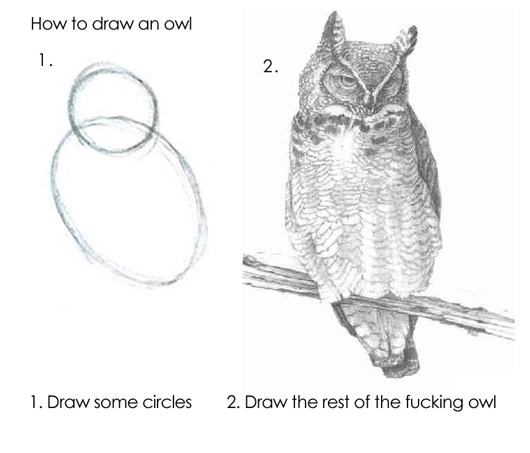
The second step is knowing how to give it. The good news is that this skill is largely transferable, unlike task-specific knowledge. If you’re already a mason/dancer/civil engineer, the characteristics of good instruction are probably pretty similar in most circumstances.
Imagine you’re taking a class on Renaissance Era art, and Professor Bean has just announced that the class’s first assignment is to recreate the Mona Lisa. You are, of course, a practiced artist, and you spend two weeks giving it your best shot.
Twenty eight hours before the due date, you get a text from the guy who sits behind you during the lecture. “Hey,” it reads, “Been working on the project for Professor Bean’s class, and wanted to know if you could gimme me[sic] some tips. I know you’re a mad good artist.”
Immediately underneath these text-filled blue bubbles is the following image:

“Oh boy,” you think.
Notice how the literal answer to their question is obvious. This “painting” resembles the Mona Lisa only if your blood alcohol concentration is above 0.08. It needs to be redone. The color is off, the silhouette is wonky, the background is unrecognizable, even the canvas’ dimensions are wrong. If you’re an artist worth your salt— a claim I unfortunately cannot make— you probably also know the base techniques needed to match the Mona Lisa’s enigmatic qualities.
None of this is relevant to your poor deskmate, because they have only a little more than a day to redo the painting. Telling them to redo the painting is not helpful. Damage control is the name of the game.
It is better to give mediocre actionable advice than advice that is technically correct but impossible to use.
You mull it over for a few minutes, and type up a quick response:
“It doesn’t look like the Mona Lisa at all. I know you only have a day, so try to frame it as a misinterpretation of the project done well. Maybe work on her face, make it less angular? And get rid of that brown thing behind her. What is that, a giant turd? Blend the background and make it more natural looking and less neon green.”
Luckily, your roommate glances over your shoulder. “You can’t send that,” they insist. “You sound psychotic.”
Feedback is a social action, with effects on the giver, the receiver, and their relationship. This is somewhat obvious to anyone who has ever tried to help a misguided friend with a flawed project. You can dance around the issue, but telling your friend that their postmodern, Disney inspired birdhouse they’ve spent the least eight months working on looks like an upside-down toilet will just lead to hurt feelings.
Perhaps the guy who sits behind you is a stoic— an adherent of an ancient Greco-Roman philosophy based on emotional resilience and rationality— which you know because of how much he talks about Marcus Aurelius. He won’t be offended, no matter what you say. He just wants constructive criticism.
Feedback is still a function of societal position. For instance, peer feedback is perceived completely differently than expert critique. To give a personal example from my experience as a PhD student in AI: I can generally say anything about technology and my friends will broadly trust what I have to say, despite being an expert only in a narrow area.
Even in the absence of formal credentials, the relationship between the giver and the receiver mediates the implicit trust between them. A person’s past trustworthiness is nearly as important as their vocation and professional tenure. This is area-specific. Perhaps you’re a fantastic artist but have doled out bad painting advice; in the future, your friends will place less stock in what you say even if your watercolors are amazing.
It is important to be aware of these factors when you give feedback if you truly wish to help someone. From a self-interested perspective, you lose trust when your opinion is wrong. Altruistically, you must accept there are some areas where your critique will fall on deaf ears and thus be of no assistance.
You send a well-worded text, our struggling artist friend does his best, and he gets a mediocre grade. Worse things have happened; your relationship remains unscathed.
A few months later, the professor reveals the final assignment in the class: you’ll have to examine the work of a classmate and write a report designed to help them improve. Professor Bean beams as he announces it: “The real winner will be your own future art, which you can look at from a critical lens!”
You open your email to check who you’ve been assigned. You gasp. It’s Greta Ortiz! She’s the best painter in the class. Professor Bean salivates when she reveals a new piece, which is pretty strange, but maybe he’s just really into art.
You click through her portfolio, admiring every piece. They all look nearly perfect. Sure, there might be features you would have painted lighter, or with small positional changes, but you’re not confident these changes wouldn’t unbalance the work. You could maybe fill one paragraph with the legitimate critique you’re confident about. Unfortunately, you’re still on the hook for the same length report as everyone else has to write.
It takes you almost fifteen hours, but you finally write down ten ways Ms. Ortiz could improve. The color scheme feels slightly off in her rendition of Dogs Playing Poker; in a few oil-on-canvas paintings with pastel palettes, the faces are too angular. Just as you’re ready to send her the final draft, you pause— this all sounds very familiar. It hits you as you open up that “Text Concerning the Mona Lisa” you sent all those months ago. You worded it very differently, but the points are substantively identical. How is that possible?
The difference lies in each statement’s magnitude. With your desk-mate, “round the face” meant “please salvage this wreck.” With Greta, it meant “if you’re bored, you make this already great painting 2% better.” Although the actual advice for both students may be the same, one of them is only a tentative suggestion.
A simple solution is to quantify your suggestions and your confidence in them. For example, in academic peer review, reviewers often rate how confident they are in their assessment on a numerical scale (e.g., 1-5 or 1-10).
This problem is difficult because humans are inherently bad at conveying scale qualitatively. You may think you solve the magnitude of feedback problem by quantifying each point semantically. However, words like ”big,” “major,” or “small,” are interpreted in a myriad of different ways depending on the context.
Complicating this further is the fact that feedback is still a social action. Almost any weakening or strengthening of a point can be construed as navigating a relationship instead of the material point. Are you saying “this is just my opinion” because you legitimately lack strong confidence or because you want Greta to like you? If Greta has low-self-esteem, she might internalize your minor points a little too much. If she’s prideful, she might disregard anything you say as the musings of a jealous competitor.
Forced feedback can reduce some social awkwardness, but it can make it harder to judge how severe the criticism is. If you look hard enough, you can always find something. Conversely, feedback given voluntarily tends to be perceived harshly because the giver chose to say it despite the social cost of being negative. It feels more diagnostic and urgent.
Feedback is useless if it is ignored, and less than useless if it backfires. Think about how your feedback will be perceived, and adjust its scale accordingly.
None of these insights are particularly revolutionary, and pretty much everyone is unconsciously aware of them. Additionally, I haven’t even touched on the multitude of ways that the giver benefits from providing useful feedback. For one, it is good practice for improving one’s own work. For another, the dialogue between receiver and giver can change the giver’s criterion— the receiver may critique the critique, so to speak.
However, at this inflection point in history, where the process of human learning itself is being disrupted by assistive technology, good ol’ fashioned criticism is a potential panacea. As people become more accustomed to seeing content that confirms their beliefs, we may become even more sensitive to constructive criticism. Check the comments section of any Facebook post for an example of how this has played out in the political arena. If the predictions are true, and LLMs become entrenched in the workplace, there is a similar risk of sensitivity to other types of course-correction.
The proponents of the early internet argued that making information accessible would accelerate learning and democratize learning. The frontier AI labs are making the same argument about LLMs. I have my doubts. A world filled with robotic yes-men is a world in which it is easy to ignore even well-meaning advice.
In the software-AI world, the aphorism “you can just do things,” has been popular recently. You don’t need institutional support or anyone else’s help to build a new app that gets millions of users overnight. In my experience, giving good feedback does not fit into this paradigm. It requires thought and introspection for maximum impact.
Say the true thing. But say it right.