«The levels measured are very, very low and we don’t know its origin,» says Bredo Møller with Norway’s radiation agency’s emergency preparedness unit at Svanhovd in the Pasvik valley.
p.p1 {margin: 0.0px 0.0px 0.0px 0.0px; font: 11.0px ‘Helvetica Neue’; color: #000000; -webkit-text-stroke: #000000}p.p2 {margin: 0.0px 0.0px 0.0px 0.0px; font: 11.0px ‘Helvetica Neue’; color: #000000; -webkit-text-stroke: #000000; min-height: 12.0px}span.s1 {font-kerning: none}
Cobalt-60 is an artificial radioactive isotope with a half-life of 5,2 years. It is produced in nuclear reactors, but when the isotope is measured in air it doesn’t necessarily have to be caused by a leakage from a nuclear power plant or naval reactor. Cobalt-60 is used in industry and medical science for x-rays.
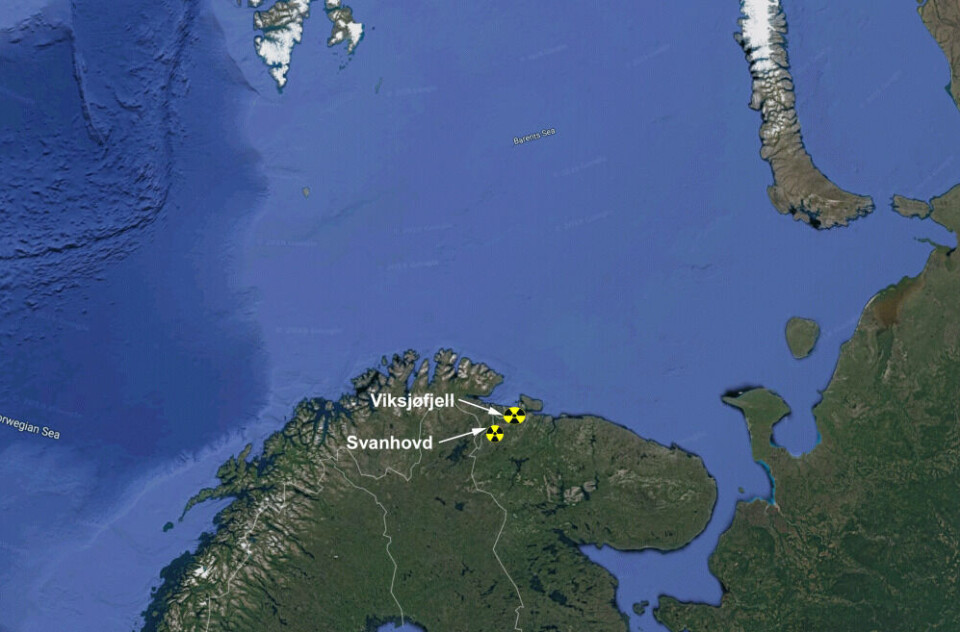
The Norwegian Radiation and Nuclear Safety Authority (DSA) discovered the Cobalt-60 when analyzing its air-filters for week 23 (June 3rd to 9th) at Svanhovd and Viksjøfjell. Both measuring stations are near Norway’s border to Russia’s Kola Peninsula.
p.p1 {margin: 0.0px 0.0px 0.0px 0.0px; font: 11.0px ‘Helvetica Neue’; color: #000000; -webkit-text-stroke: #000000}p.p2 {margin: 0.0px 0.0px 0.0px 0.0px; font: 11.0px ‘Helvetica Neue’; color: #000000; -webkit-text-stroke: #000000; min-height: 12.0px}span.s1 {font-kerning: none}
«We have been in contact with the Radiation and Nuclear Safety Authority in Finland (STUK) and asked if they have seen anything in northern Finland, which they have not,» says Bredo Møller to the Barents Observer.
«As part of our good cooperation with Russian authorities, we have an agreement on sharing data with Murmansk Hydromet. So far we haven’t got any answers from them,» Møller tells. Roshydromet is Russia’s metrological service in charge of measuring radioactivity in the environment.
Bredo Møller underlines that the levels discovered are very low. «We measured 0,5 micro-becquerel per cubic meter air (0,5 μBq/m3). The levels are so tiny that it is hardly detectable and pose no negative risks to humans or nature.» p.p1 {margin: 0.0px 0.0px 0.0px 0.0px; font: 11.0px ‘Helvetica Neue’; color: #000000; -webkit-text-stroke: #000000}span.s1 {font-kerning: none}
p.p1 {margin: 0.0px 0.0px 0.0px 0.0px; font: 11.0px ‘Helvetica Neue’; color: #000000; -webkit-text-stroke: #000000}p.p2 {margin: 0.0px 0.0px 0.0px 0.0px; font: 11.0px ‘Helvetica Neue’; color: #000000; -webkit-text-stroke: #000000; min-height: 12.0px}span.s1 {font-kerning: none}
Small levels of radioactive Cobalt-60 were also measured in Skibotn in Troms county in Northern Norway last May.
In theory, the source to the radioactivity now measured in the eastern part of Norway’s northernmost country Finnmark could origin from any operating nuclear reactor, a reprocessing plant or industry and medical sources.
Over the last few years, the numbers of military nuclear powered submarines sailing Arctic waters have increased substantially with 12 NATO submarines inside Norwegian waters at Hekkingen fyr, Ytre Malangen in Troms in the course of 2018. East of the Norwegian measuring stations at Svanhovd and Viksjøfjell, Russia’s Northern Fleet have five naval bases with nuclear-powered submarines and a surface warship also powered by reactors.
In Murmansk, Russia’s first floating nuclear-power plant, the «Akademik Lomonosov» has tested its two reactors over the last eight months, including to 100% capacity in late April. «Akademik Lomonosov» is moored at Atomflot, the service base just north of Murmansk where Russia’s four operative nuclear icebreakers have homeport.