Mark Zuckerberg has had a few versions of this exchange from The Verge in different publications recently:
Zuckerberg: But there’s still the creative piece, which is basically businesses come to us and they have a sense of what their message is or what their video is or their image, and that’s pretty hard to produce and I think we’re pretty close.
And the more they produce, the better. Because then, you can test it, see what works. Well, what if you could just produce an infinite number?
Zuckerberg: Yeah, or we just make it for them. I mean, obviously, it’ll always be the case that they can come with a suggestion or here’s the creative that they want, especially if they really want to dial it in. But in general, we’re going to get to a point where you’re a business, you come to us, you tell us what your objective is, you connect to your bank account, you don’t need any creative, you don’t need any targeting demographic, you don’t need any measurement, except to be able to read the results that we spit out. I think that’s going to be huge, I think it is a redefinition of the category of advertising.
The overarching point is that one day in the perhaps not-so-far future, if you want to advertise on Meta, you’ll just go give them some info about the product or service you’re selling (or just point them to your website, and they’ll pick up the basics), tell them how much you can afford to spend acquiring a user, and then they’ll handle everything else. No need to create content or figure out targeting or set up a multi-touch ad funnel — Meta’s AI will not only handle those for you but will also continuously test and optimize your advertising to deliver the best results.
As with all things AI, lots of people hate this! People get really riled up about AI in ads for reasons I don’t fully understand. Lately folks are big mad about McDonald’s using AI for a Christmas ad. Were we really that attached to the human craftmanship of 30 second spots trying to sell you fast food?
Anyway, I am naturally of a somewhat different perspective — I see this as an incredible leveler of the playing field for small businesses.
Let’s step back in time for a moment. The year is 1994. You want to set up an e-commerce website. You have to have:
An IT/DevOps guy to set up your own server
A designer to design the site
A software developer to build the site
Relationships with banks to take payments
This is very time consuming and expensive. For all the but the best-resourced firms, selling stuff on the internet is not a possibility. The only thing that stops the world from falling into a collective depression is that they have never tasted the sweet nectar of ordering anything they want and having it delivered the next day.
Now jump to 2015. We’re going to skip over a bunch of incremental developments to the point where Shopify not only exists but has introduced Shopify Payments to really become an all-in-one solution. You just sign up for Shopify and in an hour or so, you can have a fully functioning e-commerce store.
This is, I think, a great parallel to AI and what I expect it to enable. Lots of work that required humans in 1994 was rendered unnecessary by technology. No longer did you need a designer (Shopify has pretty solid templates that make it easy to get a decent-looking site up) or a developer or an IT guy or a business development person to negotiate with banks. You can just do it all yourself!
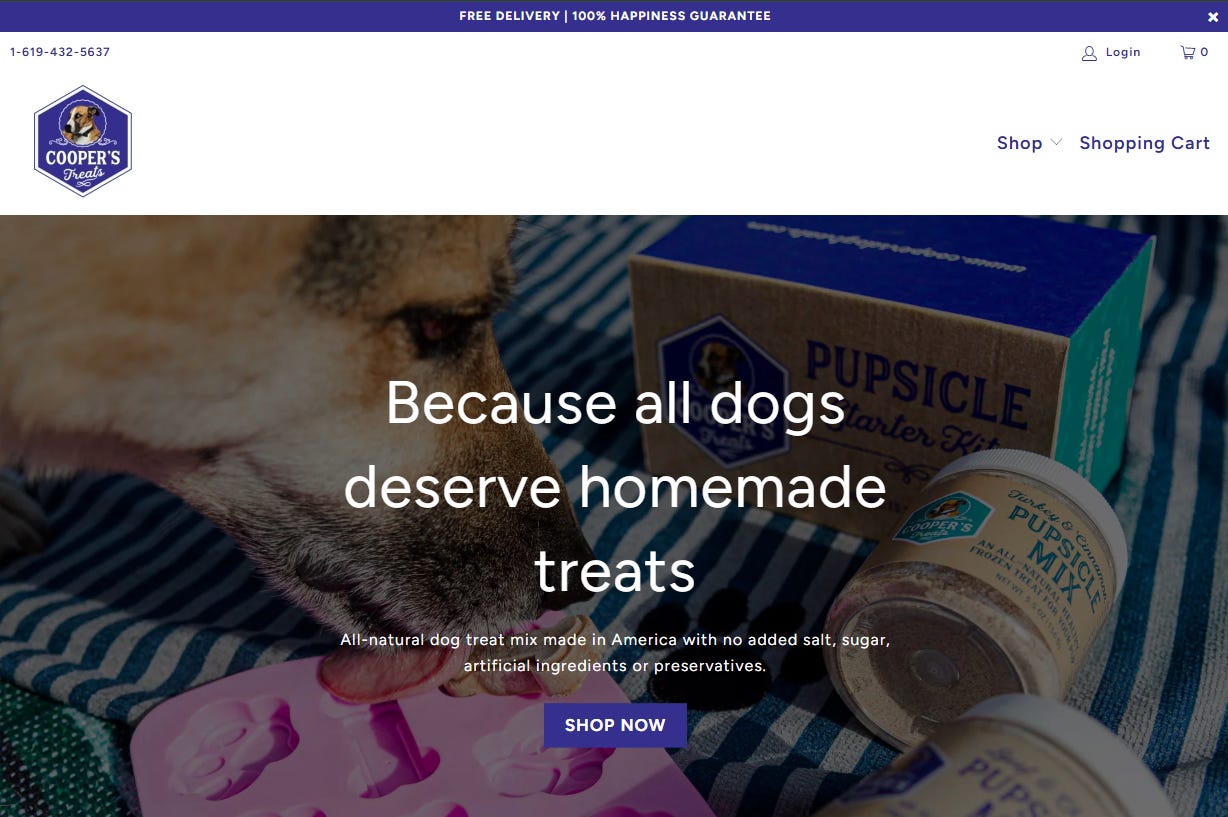
This is, I think, unambiguously good. The critically important playing field of selling stuff on the internet was blown wide open — suddenly your little mom and pop business could sell its products online easily and cheaply. The determiner of whether you could be successful in e-commerce shifted from whether you had the large budget required for a website to whether you were selling products that people wanted.
That’s good for consumers and good for small businesses and pretty much only bad for the big companies that used to have a monopoly on internet sales (and honestly it’s really not even bad for them, since it helped to drive the enormous expansion of the e-commerce market).
I will also note here that in terms of parallels to AI, many of the people who were no longer needed to work on websites were able to do well for themselves by embracing the change and creating new work for themselves. A website designer might not be able to charge each client thousands of dollars anymore, but she could design Shopify templates that sold in larger volumes for $99 a pop. Developers weren’t building websites from the ground up, but thousands and thousands of new stores popping up meant there were a lot of people wishing their Shopify site had a few extra features, which meant a ripe market for customization and plugins.
As more and more folks started selling online, the challenge became getting folks to your store. While you didn’t have to have an IT guy, you started to need an SEO guy and very possibly a digital ad agency. When Facebook started selling ads, they were cheap and very profitable if you had even a vague sense of what you were doing and a decent product. Over time, though, they got increasingly competitive and success required expertise and constant testing of creative, and as always when it becomes costly to compete, the advantage shifted to the largest players.
The amount of effort required to run Meta ads today is one of the reasons that I sell almost entirely on Amazon. While Amazon ads have become more complex over time, the reality is that you can still use them in pretty straightforward fashion and be successful if your products are good. I’ve got eight different brands at the moment, and it would be wildly impractical to manage that many by myself while running Meta ads. Each one requires lifestyle photos and influencer videos and more, all of which takes time and money.
This is all to say that we are ripe for another technological leveling of the e-commerce playing field, and love him or hate him, Zuckerberg may just be the man to deliver it. Meta has troves of data on all aspects of digital advertising, so it’s not hard to imagine that they can deliver an AI system that can just handle it for you. We’ve got increasingly capable video and image models, so generating creative ought not to be an issue, and Meta’s been using AI to optimize ad targeting since long before ChatGPT.
Once that all comes together, and I suspect we’re not talking about more than a couple of years, we’ll have that Shopify moment for digital advertising. Just like you could get a Shopify store running in an hour, you’ll be able to get ad campaigns that compete with the best of them running in a similar amount of time.
For all the complaints about AI slop ads (and let’s be honest, it’s not like the ads you were seeing on Instagram pre-AI were exactly slop-free), the reality is that the likely outcome of this is that the best products win, and I think that’s a really good thing! The more we remove all of the peripheral (and expensive) parts of running businesses and let them compete solely on the thing they’re selling, the better off consumers are, and the more markets reward the people making things that consumers really love.
History is littered with people who created things that made people’s lives better but died in penury because they weren’t good at business. Nikola Tesla created some of the core technology we use today but made no money because he was terrible at negotiating contracts and protecting IP. Edwin Armstrong created FM radio but ended up spending all of his money fighting the vastly better-resourced RCA in court. Johann Gutenberg’s eponymous printing press was unquestionably one of the most important inventions in the history of human civilization, but he was bad with money and lost everything (including control of the technology he created) because he took a loan that he couldn’t repay.
My life is better because those people spent enormous amounts of time and effort creating things that improved the world, and I think it would have been a better outcome for Gutenberg to have been rewarded with commercial success. Maybe if he’d had an AI advisor to talk to about contract terms and financial projections, things would’ve turned out differently for him.
Ultimately, AI promises the democratization of expertise. Just like Meta’s going to use AI to give you the same expertise that you used to have to get from an agency for thousands of dollars a month, I expect other firms to offer the same in different fields.
Today, the very best professional services are scarce. If you’re poor and you get arrested, you aren’t going to get the best defense attorney, because the best defense attorney is a scarce resource and can thus charge thousands of dollars an hour. The same is true of the best tax advisors and oncologists and tutors.
AI offers the promise of eliminating scarcity in all of these fields. I’ve already written about how Nano Banana Pro saved me paying my product photographer a couple thousand dollars. AI has also helped me with my taxes — I have asked it some questions about my particular tax situation and run its suggestions by my CPA, who agreed with some of them, which ultimately reduced my tax bill. (Patio11 has a good thread on a similar experience.) You could say that this is a problem with my CPA and that he should’ve found these things, but that’s not necessarily true. I pay him by the hour, so there’s always a tradeoff. I could spend all day giving him every detail of my business and finances to see if he could find additional deductions, but odds are I’d end up paying him more than the value of whatever he found.
Instead, I now have the AI + human expert hybrid situation that I think will be the best case for a few years (until the AI is just a better CPA than my CPA, which I would wager a lot will be the case at some point this decade). The AI has an enormous amount of expertise and infinite time to listen to me but some tendency to make mistakes. I can throw every possible piece of information at it, get its best ideas and give those to my CPA, who I can trust to only implement the ones that are valid. As an AI assistant is able to retain increasing context about my life, this will become a more passive process; I’m already talking to it about my businesses pretty regular, so come tax time it ought to be able to spit out some things I should run by my CPA.
I look forward to world where AI gives everyone the equivalent of a world-class expert in every domain. Every year as we get more technology and more regulations and more information, the amount of effort it takes to just exist in the world increases. This is even more true for businesses; you don’t realize until you start one just how much work is required just for your business to exist, let alone make money. I don’t see a path to reducing the amount of complexity in our lives, but AI might just… take care of it for us. One day my AI assistant might just get my taxes done and handle the paperwork for my kid’s school and set up vet appointments for my dog. Dare to dream!