About a month ago, I wrote about using several different models to launch The Waterline, a site that uses government data to keep an up-to-date record of water conditions in the western US, including reservoir levels, drought conditions, snowpack and more, then sends weekly email updates.
I have neither expertise nor a particular interest in water conditions (except that as a native Californian, I say the obligatory “well, you know we really need it” any time someone complains about rain). Rather, this was a test to see how much of the work of getting the site up and running Claude could handle on its own.
The answer was: a lot! Thanks to Cloudflare’s agent-friendly tools, Claude had everything needed to buy the domain and get the website live. From a technical perspective, it had almost all of the tools it needed (though yours truly still had to grab an API key to get government data and set up a Buttondown account to send emails).
But since this was a first go, I was still fairly hands-on with the editorial side of the project, with plenty of big-picture feedback about site structure and little nits about design. The next step was to try this while truly cutting myself out of the process except when my involvement was absolutely unavoidable.
With The Waterline complete, I had a solid template for how to create this kind of site. Because I started this project by having ChatGPT generate a list of 50 topics, I also had other options ready to go, so I told Claude to take the other nine of the top 10 and spin up agents to build all of those in parallel. After that promptly froze my computer, I told it to cut that back to three at a time.
The process was, roughly:
Take the first unused idea from the initial 50-topic report
Search for and evaluate relevant information on the topic that can be used on the site, particularly freely available government data, and have ChatGPT do the same in parallel using Claude in Chrome
Review both outputs, and build a plan for the site’s content, including:
What sources of information will be used and when they’re updated
The structure of the site — how the data will be grouped and presented
Any relevant evergreen articles on the topic that should be included
Build the site
Find relevant domains that are available for purchase and present them to me
Once I pick a domain, purchase it and launch the site
Create GA4 and GSC properties for the site and set them up
Have ChatGPT review the site, checking for:
Discrepancies in the data or other factual issues
Whether the tone and language of the site are appropriate given the audience (particularly with regard to appropriate use of industry terms)
Any other issues with content, layout or structure
Review ChatGPT’s feedback and make updates as appropriate
Configure the Buttondown account and newsletter template
Set up recurring jobs to pull fresh data from the sources, update the site and send out a newsletter the day after new data are released
This went well! The ChatGPT feedback step was really critical to the whole endeavor — Claude would frequently end up with inconsistent math across different pages in the same site or would miss clear opportunities for content. In any case, we now have:
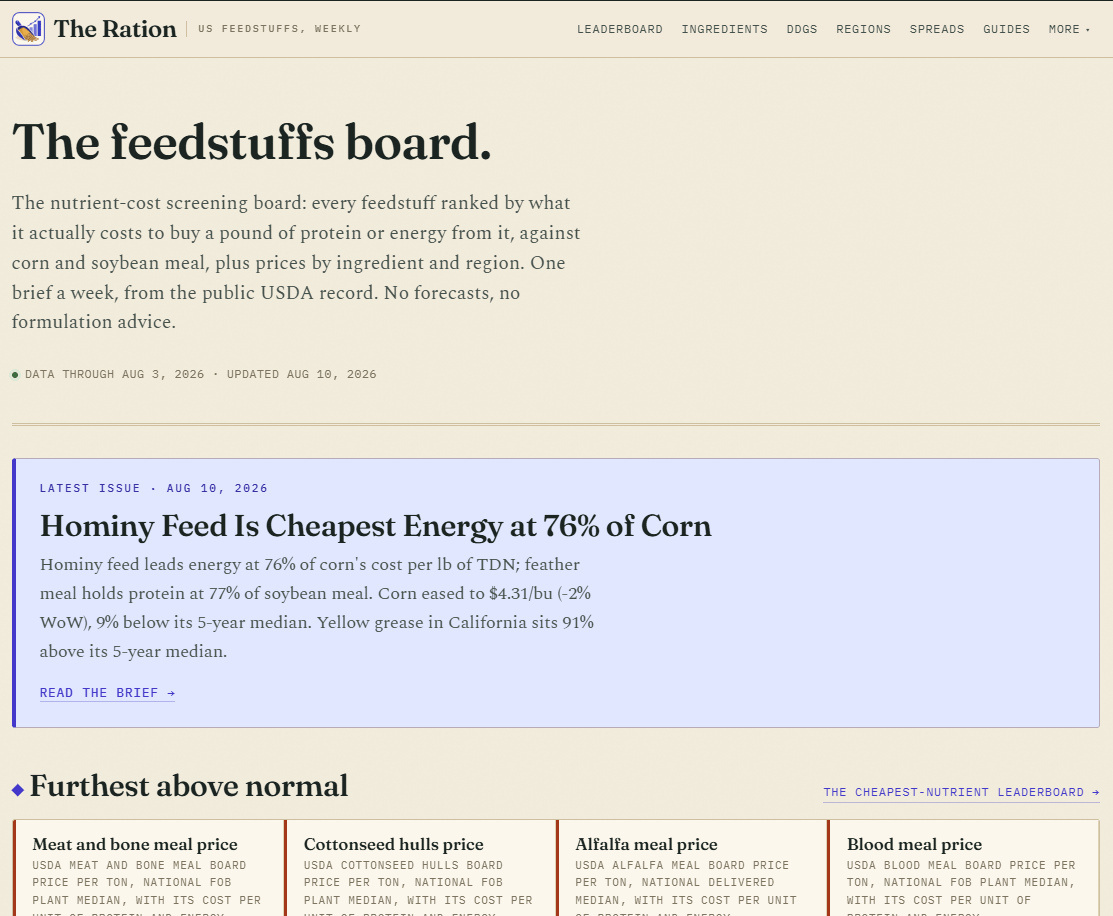
The only places I had to step in were logo creation, Buttondown account creation and domain approval. In the future, I’d just instruct Claude in Chrome to have ChatGPT generate the logo. I’d also switch from Buttondown to something like Amazon SES, where I can sign up for an account once and let Claude build out an email system that doesn’t require a new account for each site. Domain approval will have to stay on my plate until they come up with a model that has better taste.
At this point the plan was to let them sit for a while and see if they started ranking on Google. To that end, I had Claude set up a weekly email report giving me numbers on traffic and appearance in search for each site.
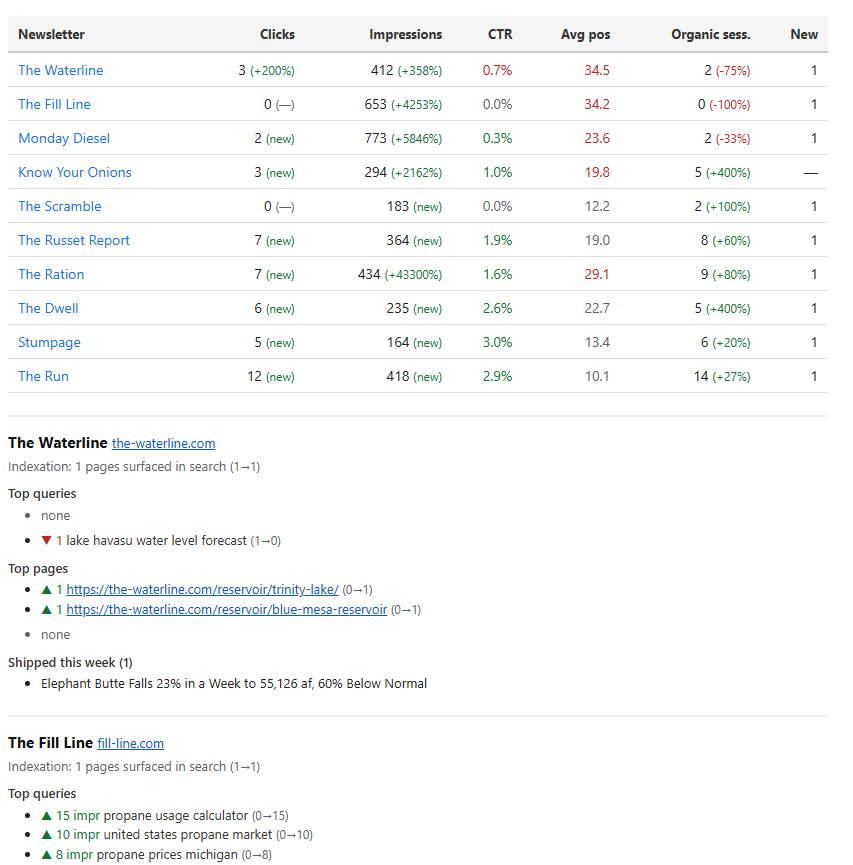
Started getting a trickle of traffic right away; pretty neat! I looked through some of the queries, checked the relevant pages on the sites, and found some opportunities to both build new pages and expand the ones we had. Claude dutifully ran with my suggestions, and our rank for those queries was up the next time I checked.
But of course the goal here is for Claude to run this whole thing without me, so the next week when the email landed, I had it do its own analysis and give me a list of suggested improvements to the sites. They were mostly solid, so I offered a little feedback and let it get to work.
Once that was done, I set up a weekly job for Claude to generate with the list of proposals and email those to me for review.
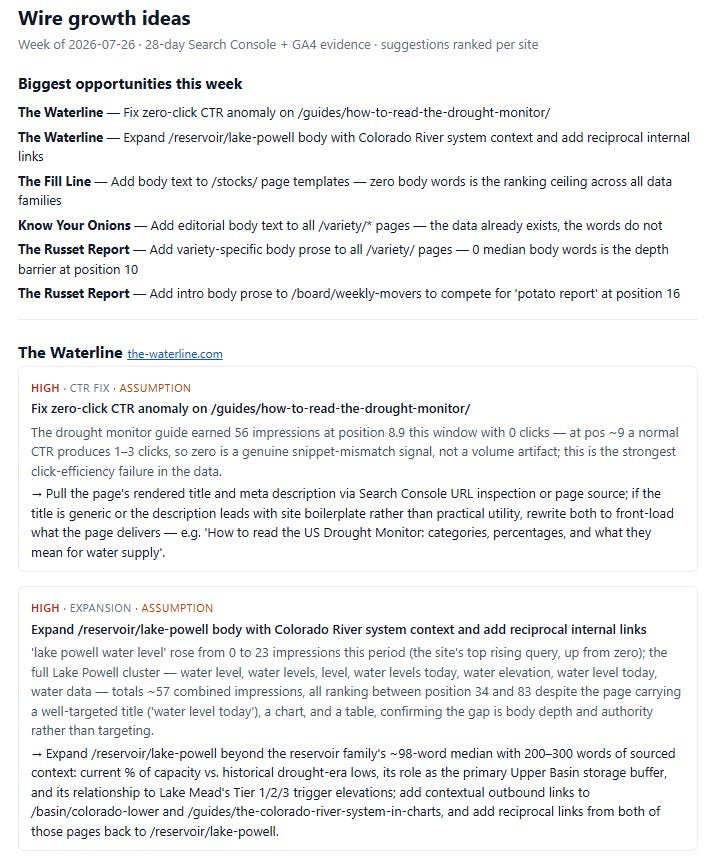
Again, mostly good, though a few bad ideas. One general category of miss was forgetting who the site’s audience was (e.g. The Fill Line ranked for queries related to “propane usage calculator,” but Claude’s suggestion was to create a calculator for consumers to figure out how much propane their home appliances would use, even though individual users of propane are clearly not the audience). Another was reviewer Claude’s tendency to get pedantic about editorial rounding of numbers (“The headline says it’s 94 cents, but it’s actually 94.4 cents”).
I gave Claude feedback with each round of suggestions, which it saved that to an instruction file for the reviewer. By weeks three and four, all of its suggestions were good, so at that point I automated the whole process.
We now have 10 sites that autonomously self-improve each week based on the data available to them. Traffic is still at a trickle but visits and search impressions are up and to the right on most of the sites.
Will this ever turn into something substantive? No idea. I’m just planning to let it simmer for a few months and see what happens. But it’s entirely possible that eventually I’ll get a reasonable number of newsletter subscribers on one or more of these, get a sponsor or two and have myself a tiny little fully Claude-operated business. And even if that doesn’t happen, it’s been a fun way to think about the scope of project that Claude can handle on its own and what it takes to get it to the point of autonomous management.
These sites are far from perfect! I’ve been pulling them up as I write this, and I’ve already found a few issues that I flagged to Claude to fix. Some are major, like seeing this on the homepage of The Run.
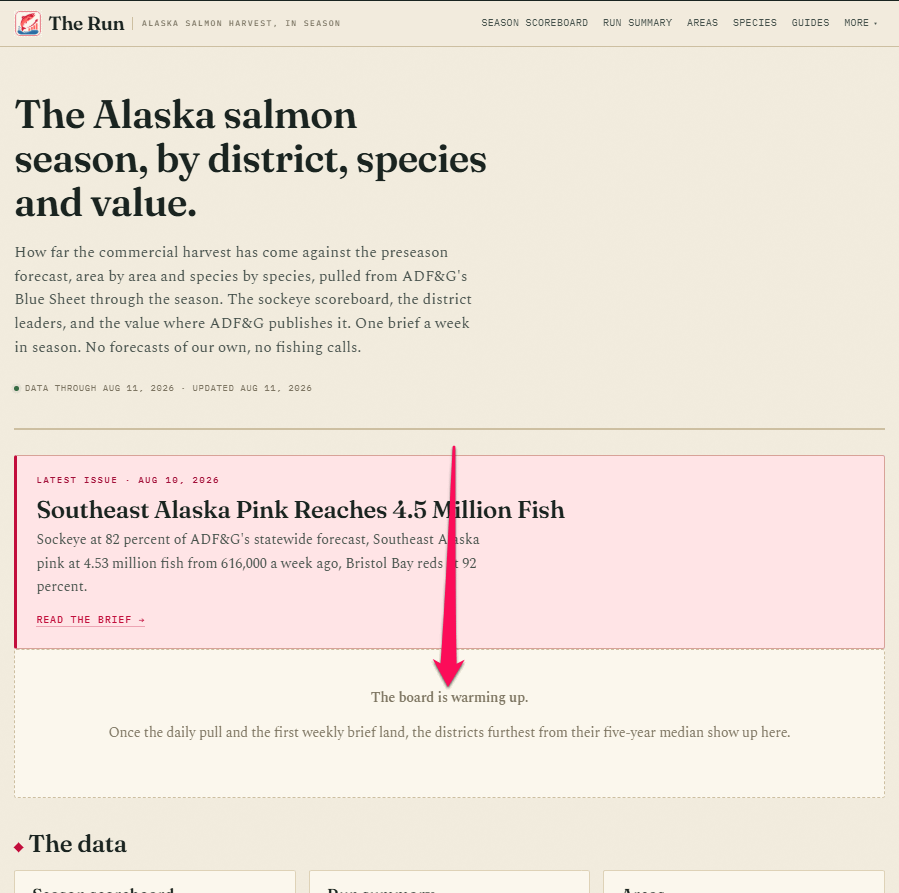
It turns out this is the result of Claude trying to copy a pattern used in other sites. That problem has proven to be a little bit of a theme, as there is an underlying engine that they all use. On more than one occasion I’ve had to admonish it to remember that it’s never acceptable to compromise the quality of the site in order to make it work with the engine. Code is free! There are no tradeoffs needed for this sort of thing! Modify the engine or customize it for the particular site! Build the site from scratch if you have to! That’s very clearly laid out in the project instructions, but it doesn’t entirely stop Claude from clinging to a vestigial notion of engineering efficiency.
I should probably have ChatGPT take a separate weekly adversarial pass over all of the sites, but there’s no way to invoke ChatGPT using my subscription and I’m too cheap to pay for API usage. Actually writing that inspired me to double-check, and it turns out I can set up a ChatGPT scheduled task to go through them all and email me its findings. Nice! I’ll set that up, review the emails myself until I confirm it’s reliably doing a good job, then have Claude pick them up straight out of my inbox and make any improvements automatically.
The other big issue is that what these sites need to get some real traffic is backlinks. For the SEO-uninitiated, Google tends to rank sites higher if they are linked from other sites that it thinks are high quality. Getting these links mostly involves reaching out to places where your content is relevant, so I did have ChatGPT give me a list of good targets for each of the sites. The problem is that I’m opposed on principle to having AI do email outreach, which makes this difficult to automate. For now, I’m planning to fire off some of those emails myself to see how they’re received, and if I can get some links, then I’ll figure out what to do next.