Disclaimer : This is not a typical blog with a conclusion, rather, this blog is more like a journey where I walk you through how to decompile APK and understand a sample of what fullMode do to your APKs.

🙏 Introduction
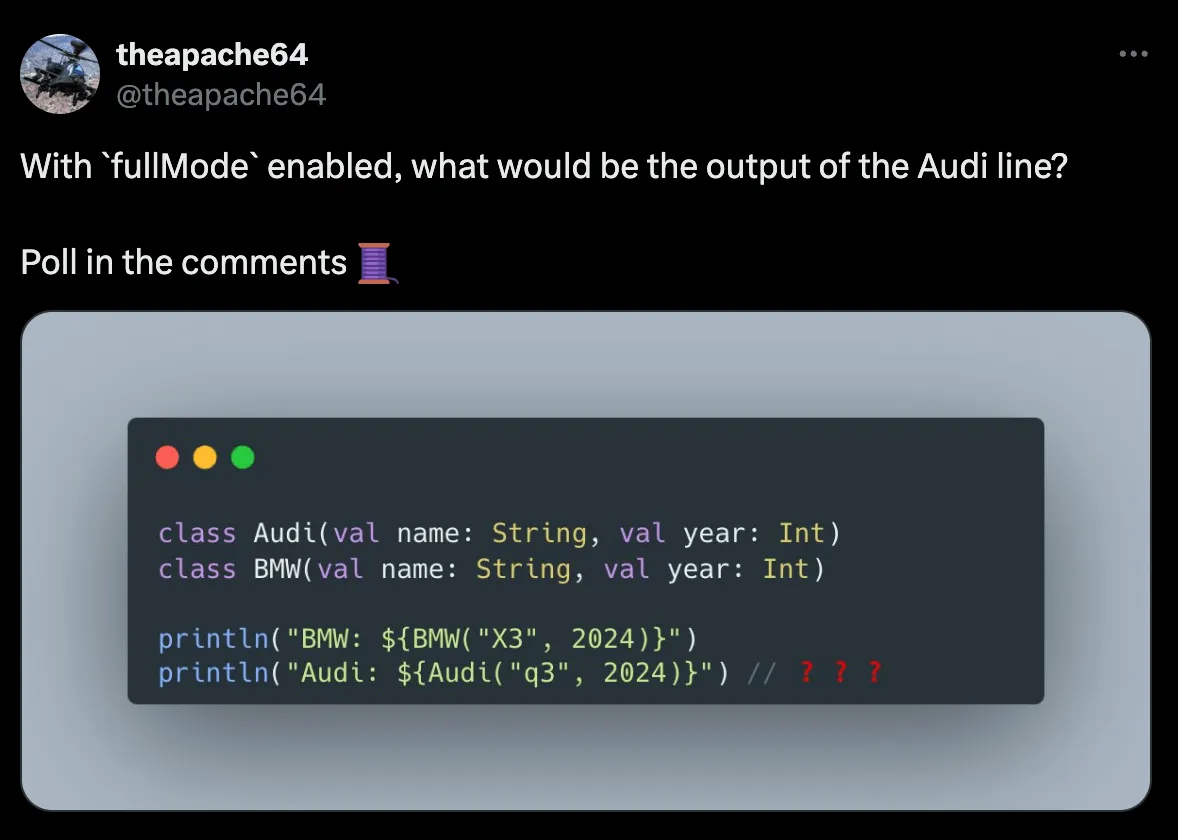
Few days back I posted this tweet in X
and this was the result
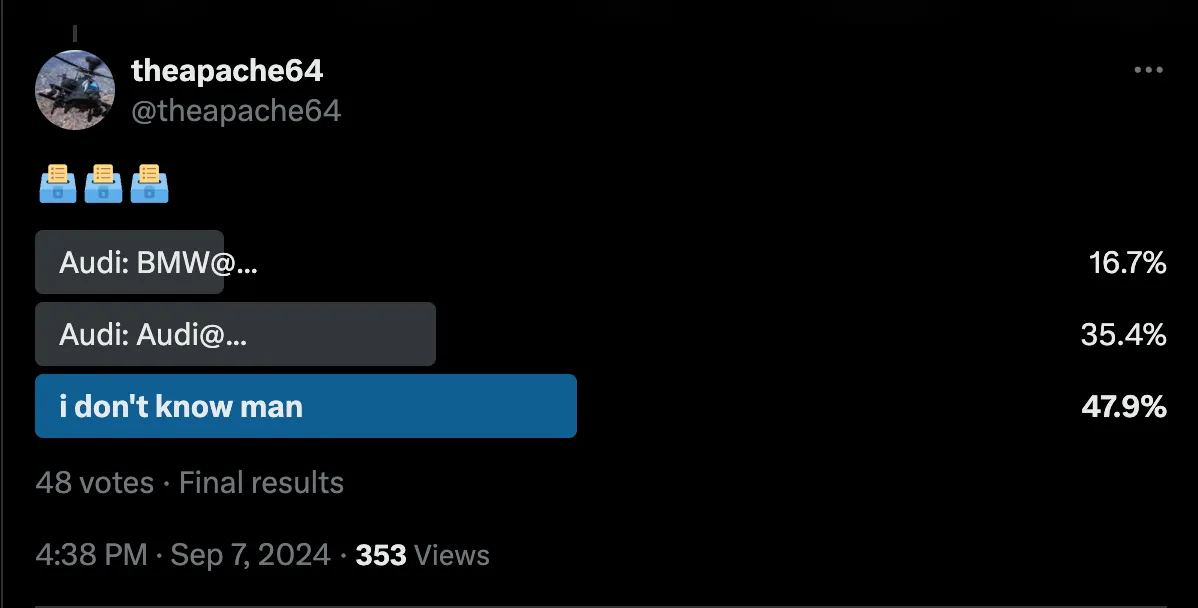
I don’t want to keep you in suspense. The correct answer is Audi: BMW@.... That means 35.4% of people got it wrong and 47.9% of people got confused about the output. That’s a really big number and that’s the inspiration to write this blog and analyse “why” R8 preferred BMW over Audi
📗 Context
A little bit of context if you’re hearing fullMode or r8 for the first time.
What’s r8?
R8 is a tool that shrinks, optimizes, and secures Android applications and libraries: Shrinking: R8 removes unused classes, members, and resources to reduce the size of your app. Optimizing: R8 rewrites code to improve performance.
What’s fullMode?
fullMode, also known as non-compat mode, is a feature in Android that allows R8 to perform more aggressive optimizations. This can help reduce the size of an app’s APK and improve its performance. fullMode is enabled by default from AGP 8 onwards
Source: Google
👨💻 Code
Talk is cheap. Show me the code!
class Audi(val name: String, val year: Int)
class BMW(val name: String, val year: Int )

class MainActivity : ComponentActivity() {

    override fun onCreate(savedInstanceState: Bundle?) {
        super.onCreate(savedInstanceState)

        println("BMW: ${BMW("X3", 2024)}")
        println("Audi: ${Audi("Q3", 2024)}")
    }
}
- Two classes
- Different names but similar dataTypes; 1
Stringand 1Int
▶︎ Run
Let’s run this and see what happens. Please note that we’re using AGP 8+, hence fullMode is enabled by default.
Debug mode
BMW: BMW@1b51a2
Audi: Audi@3cd4e33
Everything looks good ✅
Release mode
BMW: BMW@a8d4f97
Audi: BMW@2351584
Wow, why am I getting only BMW? What happened to my Audi? What did fullMode do to my Audi? 🤔
📊 Comparison
To clearly understand what exactly happened, we need to compare the two APKs: one with fullMode and one without fullMode. Luckily, I have a tiny tool created, called dex-diff to do just that (this is not a promotion… I’d use another tool if there’s a better one out there… oops, did I promote the tool again 🙊).
Anyway, moving on, I’ve dex-diff already installed and also both APKs generated

Now I need to pass these two APKs to dex-diff and ask it to generate the diff. To do that, i need to execute this command
dex-diff without-fullMode.apk with-fullMode.apk com.example.app
After executing the command dex-diff will start decompile and diff for each class and will generate a html report.
⚔️ dex-diff v0.1.4
🚀 Initialising...
➡️ Decompiling APKs... (this may take some time)
✅ Decompile finished (10.34s)
➡️ Comparing before and after... (this may take some time)
✅ Comparing finished (1.12s)
➡️ Making report...
✅ Report ready (11.66s) -> report.html
Let’s look at the report file
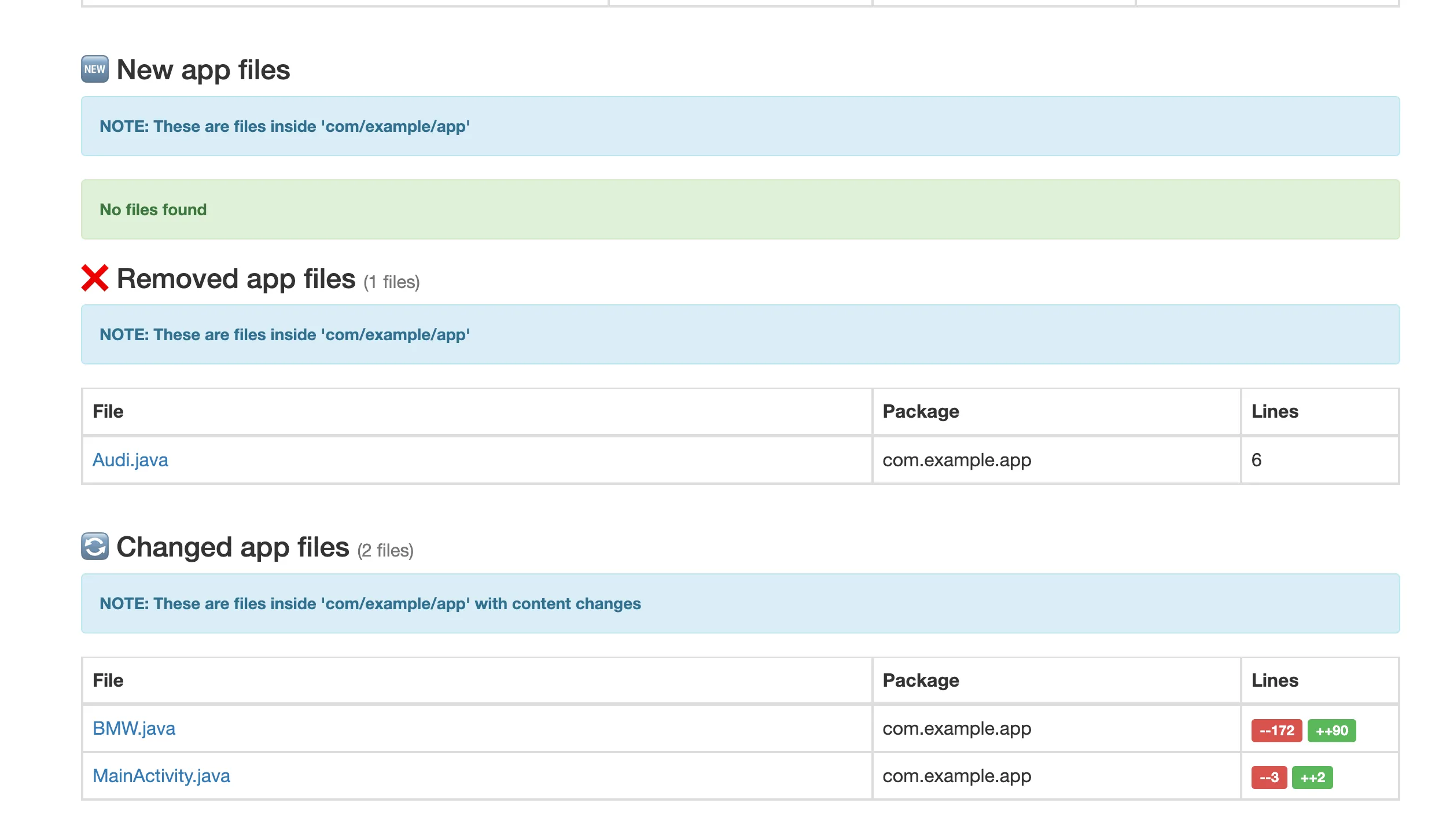
There’s my Audi in the removed files list :(, but why Audi and why not BMW? My best guess is, its the no of characters (CMIIW).
BMW - 3 chars
Audi - 4 chars
Now let’s see what happened at MainActivity side, and why its printing BMW always.
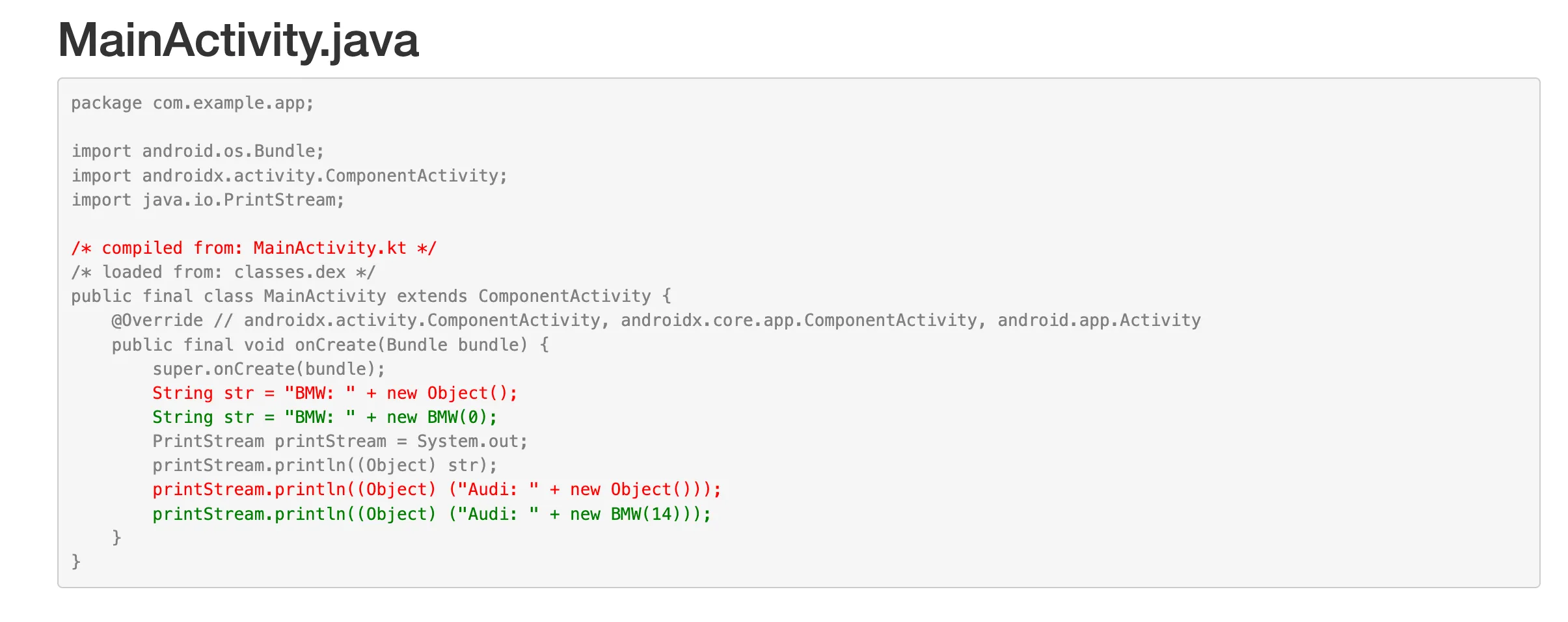
Looks like,
- without
fullMode, instead of using the corresponding class, r8 used theObjectclass. This makes sense as I was not using the properties of the class (name :String and year : Int) but after fullModeis enabled, its now started using a proper class, but it started using theBMWclass for bothAudiandBMW
This possibly happened because Audi and BMW had same structure and r8 decided to save some memory by removing one of them. (I’d like to modify the structure of the class and play with it to see what happens, but maybe that’s for Part 2? Let’s focus on this particular example for now - comment below if you’d like to see that pls)
and if you look closely, you’ll see BMW now accepts an Int, and we’re passing 0 and 14
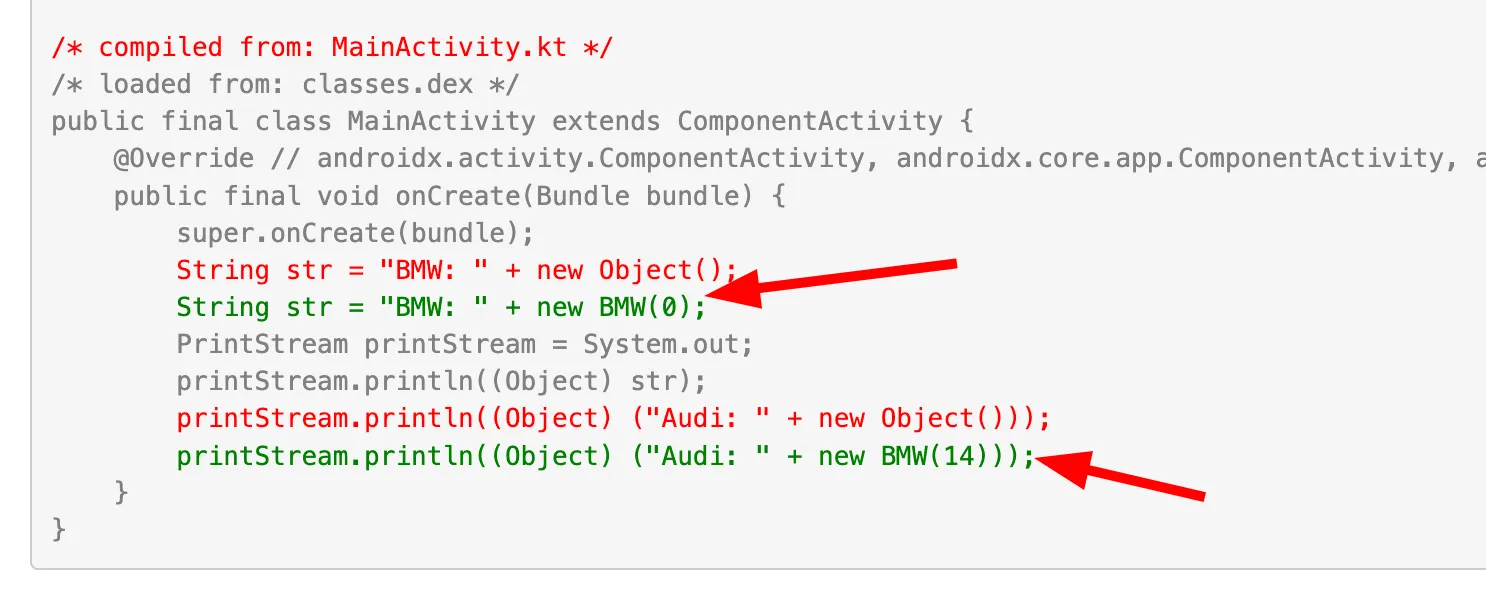
What are these integers? What are they doing inside the BMW class? By the way, what’s the current situation of the BMW class? Let’s check that.
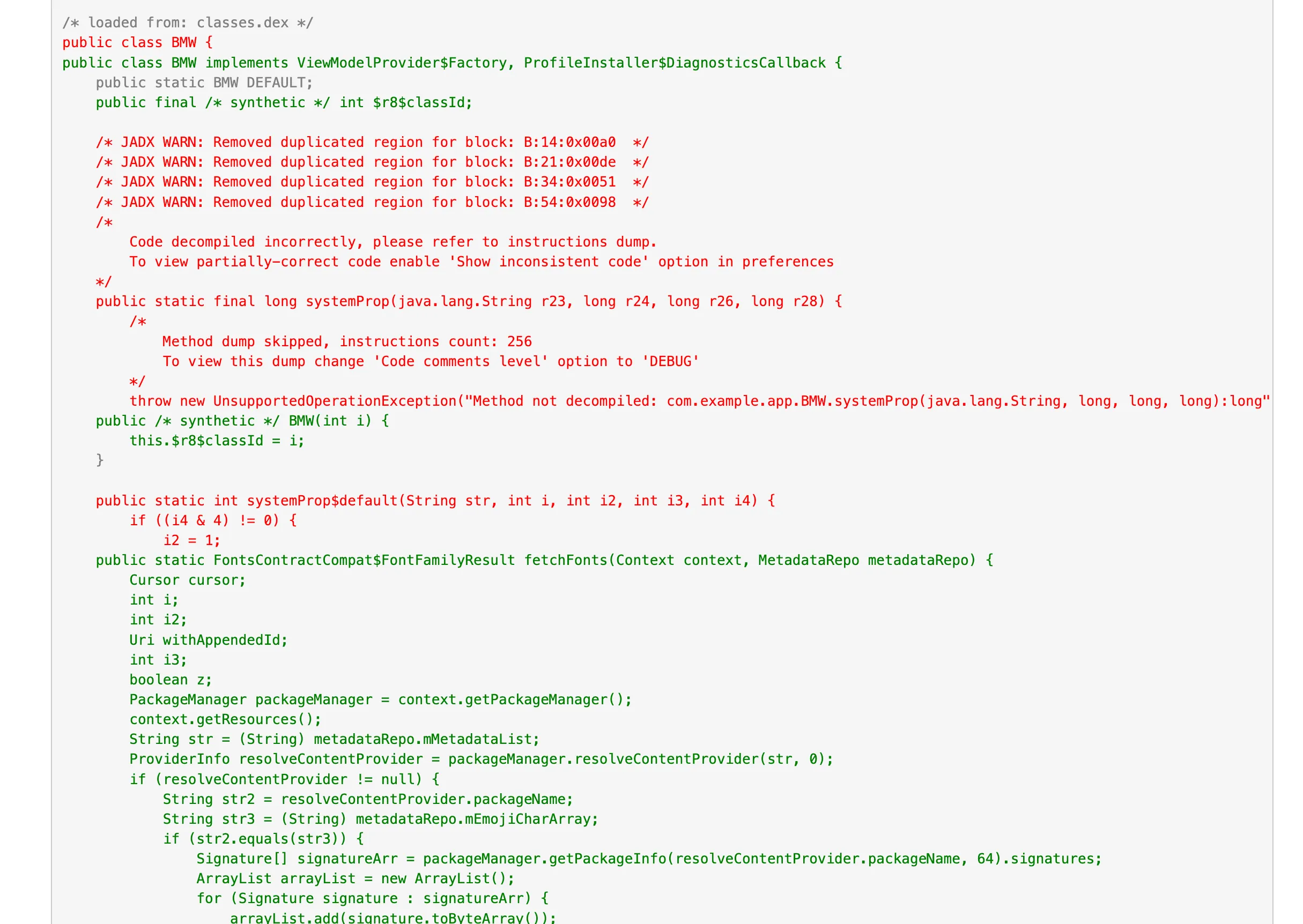
Oh my god! BMW is not BMW right now. To me, it looks more like this

but what was that 0 and 14. For now let’s just calm down and check that (focus…focus…)
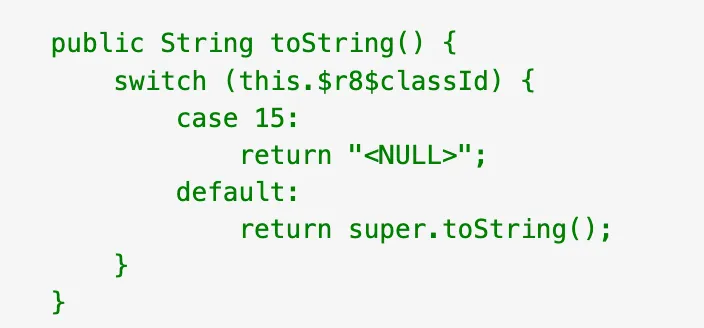
The class surprisingly doesn’t have a case checking for 0 and 14, hence it will fallback to the super.toString() method in this particular case. However, why was an integer passed here then? What lies between 0 and 14?
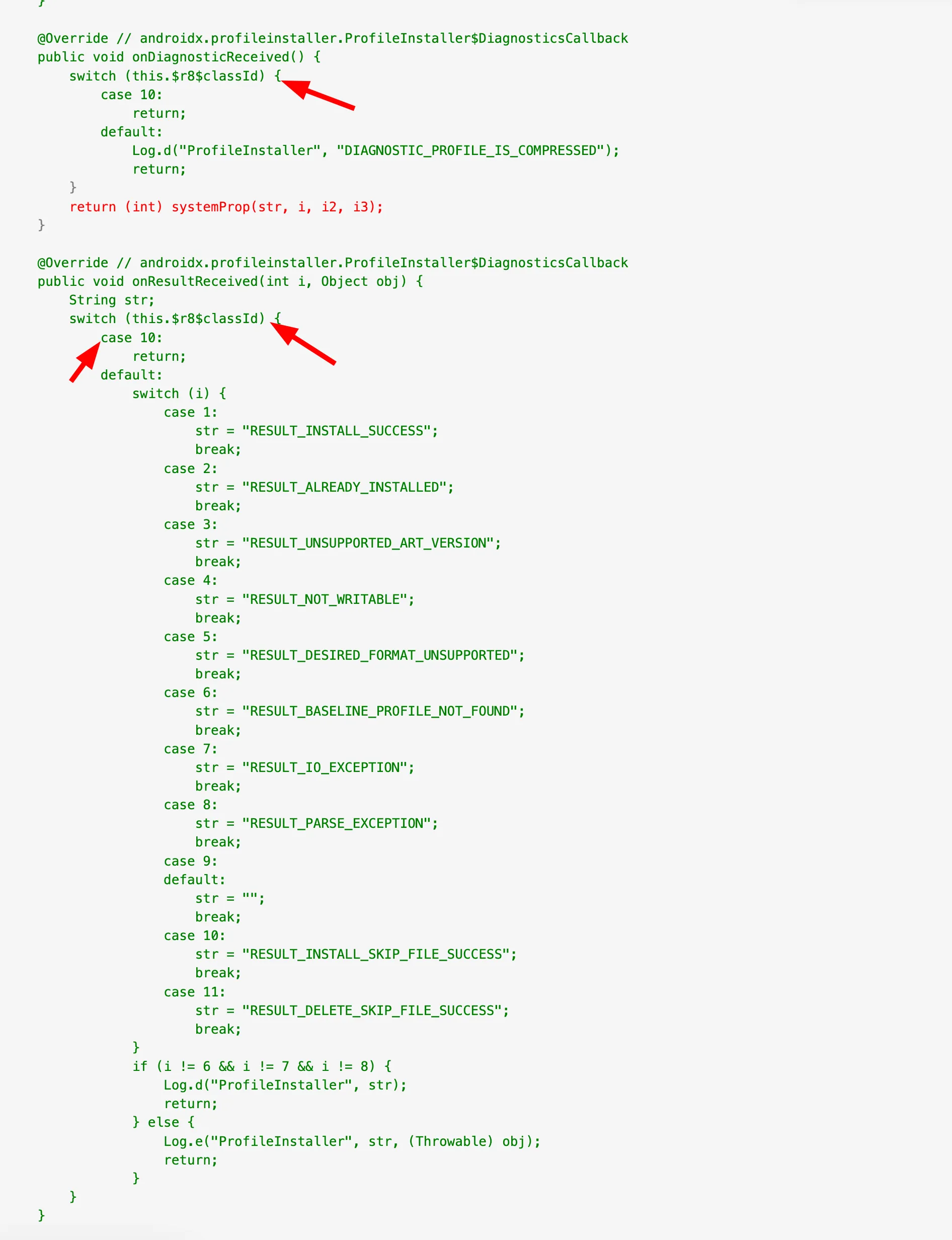
Looks like the Int that was passed will be used to define the behavior of the call to each method. Wow, now I know why they call it an “aggressive” optimization.
📖 Major Learnings
When fullMode is enabled,
- Don’t play with reflection APIs or don’t play with class name and structures (eg:
MyClass::java.class.simpleNamewon’t neccesarly printMyClass) - Use proguard rules if there’s a class depends on reflection. (eg: Gson models)
🤝 Thanks
Thanks for reading! If you’d like me to dive deeper into the topic or continue with a part two, let me know. I’m not a regular blogger, so if you found this post helpful or interesting or it didn’t hit the mark, I’d love your feedback for that as well in the comments 👇