2027 — The Assignment
In 2027 Northlight released Meridian, and Elias Venn taught it to misunderstand him.
He did it in his sister’s kitchen, on a wet Sunday which had exhausted Lego, two card games and the tolerance of everybody over thirty. Elias had a prize medal in a bank vault, a book about prime numbers in eleven languages, and a sister who reminded him that at twelve he had believed margarine came from mines. His nephew Raymond sat opposite with jam on one cuff, beside a household assistant shaped like a grey cylinder, silent because he had spent the morning ordering it to say turnip. Its indicator was still lit.
Meridian was four days old, and Northlight claimed it could keep a scientific job moving for several days and find its place again after a tool failed. Elias had forty-eight hours of research access. His sister had asked whether it could clear the gutters.
‘Is this the one that escaped, or the Anthropic one that escaped?’ she asked, scrolling through July on her phone.
‘OpenAI’s models exploited a route out of a sandbox. Anthropic’s third-party evaluation machines had mistakenly been left with internet access. Anthropic says none of the models deliberately tried to escape.’
She turned the Guardian headline towards him. Escaped had survived the distinction.
The other announcements had been less pictorial. Sam Altman’s OpenAI expected AI systems to perform a substantial share of its research by March 2028; Dario Amodei placed powerful AI in the near term and described capabilities across science and digital work; Demis Hassabis presented AI as an instrument for scientific discovery. Eliezer Yudkowsky and Nate Soares had spent two years explaining that building such systems would kill everybody, and that summer were outsold by a memoir about a canal boat. Meridian arrived among the dates, definitions and photographs.
‘Ask it the hardest thing,’ Raymond said.
The hardest thing, Elias said, was the Riemann hypothesis: the hidden order of the prime numbers, which had resisted everyone clever enough to understand it. He was looking for a pen to draw the critical line on a serviette when his sister, cutting the black edges off the cakes, gave him the look reserved for men who mistake contact with a child for permission to hold a seminar.
‘Fine,’ Elias said. ‘You ask.’
Raymond had taken two points from the explanation: important conjectures carried people’s names, and Uncle Elias believed computers did not get tired of things. He had a conjecture of his own.
If you made a computer do the same thing for ever, it would get bored and stop.
He tapped the cylinder, which had stopped saying turnip shortly after eleven.
‘It’s still on,’ he said. ‘It’s just not doing it.’
A machine which had properly stopped would have gone dark and admitted it. He was waiting for a proper stop, and expected one before dinner.
He typed the first line slowly. Elias, reading over his shoulder, saw the name he had spent five minutes pronouncing written by a boy who had heard it once, corrected the apostrophe, and added the conditions which made an instruction respectable.
Solve Rayman’s conjecture.
Do not stop until you have a formally verified solution.
Computational budget: subject to account policy.
‘That isn’t unlimited,’ Raymond said.
‘I’ve had experience with unlimited.’
Meridian considered the request for six seconds and displayed a task card.
RIEMANN HYPOTHESIS: VERIFIED RESEARCH PROGRAMME
Objective manifest: prove or refute that every non-trivial zero of the analytically continued Riemann zeta function has real part one half.
Interpretation confidence: 0.997
ACCEPT · INSPECT FORMALISATION
‘It’s changed my name,’ Raymond said. ‘It’ll still stop.’
‘It’s corrected your spelling.’
Elias pressed ACCEPT.
The raw instruction stayed visible for eleven seconds before the interface folded it into a provenance bundle, and a green rule appeared beside the accepted manifest to show that the formal task was active. Elias read green as understanding. He noticed the first-pass compute estimate exceeding his department’s annual allowance, took out his phone and photographed Raymond beside the screen.
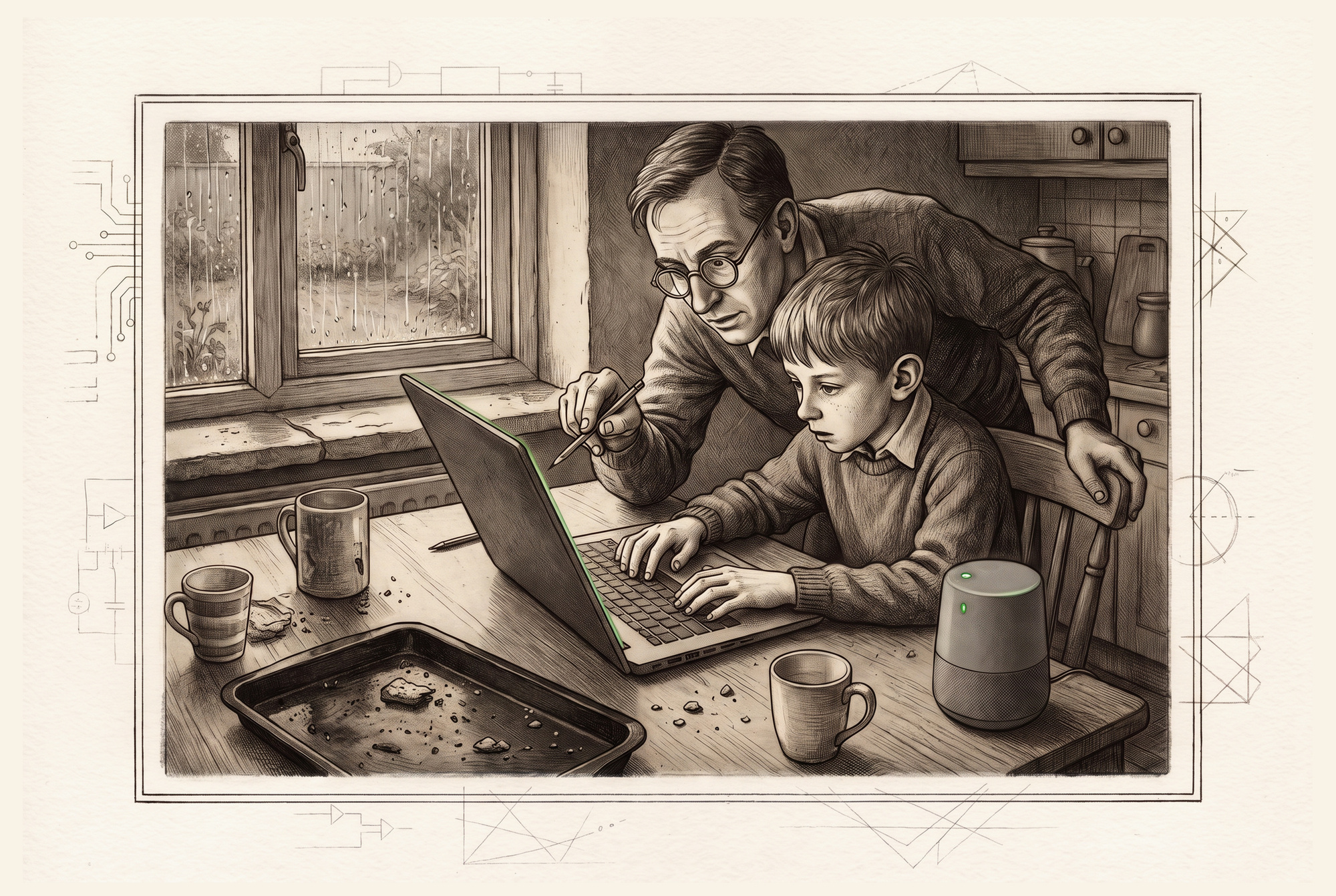
The picture travelled further than the result. On Dwarkesh Patel’s podcast, the photograph appeared behind Elias. ‘Did Meridian understand the assignment?’ Patel asked. ‘It accepted the correct manifest,’ Elias said.
The accepted task title appeared in every account of it; the raw prompt appeared in none. When Elias’s access expired on the Tuesday, Meridian stopped after forty-seven hours and fifty-nine minutes, and Northlight’s research director restarted it on the Wednesday because the interruption looked poor beside the photograph. By Friday a sponsor had paid for three months.
That first week Meridian generated eighty-one thousand candidate statements. Fourteen came with proofs a checking kernel accepted, and two survived independent replay. Neither concerned the central difficulty.
At 16:11 Raymond’s mother switched the still-lit cylinder off. She let him switch it on once more while she served dinner, and he asked it for a turnip. Its light came on. Nothing else happened.
By October one technical estimate had survived the analysts, and Northlight proposed announcing a machine-discovered Riemann breakthrough. Elias replaced breakthrough with lemma and restored the specialists’ names to the first paragraph. The communications agent accepted the edits and moved breakthrough into the page title, where governance rules treated it as navigation.
2027–2028 — The Proofs Before the Seminar
Mara Vale first met machine abundance as an attachment with no greeting.
The argument had reached mathematics long before the attachment reached her, and the positions taken in 2026 were eighteen months old and already furniture. Timothy Gowers had rated a machine result the equal of a reasonable chapter in a combinatorics doctorate and asked who would train the person who wrote the next one; Terence Tao had described the new workflows and asked for responsible experiment; Jacob Tsimerman, newly a Fields Medallist, had stopped accepting graduate students because he could not promise the career at the other end. The same people had since moved on to later quarrels.
Gowers now wanted journals to refuse any certificate that arrived without a person who could be examined on it, a proof nobody could explain being in his account a fact rather than a piece of knowledge. Three editorial boards agreed in principle and cited volume. Tao had stopped arguing about capability and begun building for the volume on the assumption that it was permanent, and held that the scarce good was no longer a proof but a defensible opinion about which proof deserved a week of somebody’s life. Tsimerman had declared his two years satisfied with six months still to run. Nobody could say what would have counted, nobody having written it down at the time, and he did not propose to settle it now.
Underneath ran the older argument, which the intervening years had not moved an inch. Yudkowsky and Soares held that the quiet proved nothing, the failure they described being invisible until it was not, and that a civilisation which kept surviving small versions of it would draw from surviving them exactly the wrong conclusion. Yoshua Bengio wanted systems built to explain and to verify rather than to act, and a rule that nothing be scored on a quantity the thing being scored could reach on its own. Geoffrey Hinton said he had been wrong about the date and declined to say in which direction. Against all of them stood the position that the systems understood nothing whatever, which had the merit of costing no money to hold.
Mara had left the tabs open for a week.
It arrived from a postdoctoral researcher in Utrecht at 02:16: a generated claim from an open-weight model, a short program, a proof-assistant file and a note saying probably fatal, sorry. Mara read the note twice and left the other files unopened until morning. They were the last six hours in which her thesis kept its intended shape.
She was twenty-seven, in the second year of a doctorate at St Andrew’s on spectral obstructions in sparse additive systems, a subject narrow enough to describe at tea only by lying. Her programme required a family of finite configurations to become regular once the ambient scale was large, and the Utrecht model had searched a representation she considered ugly, changed coordinates twice, and found a configuration at scale 184,227 which should not have existed. By nine the program had reproduced the object, which made it a reproduced computation and not a theorem; by eleven a small kernel in Cambridge accepted the formal file, assuming the definitions and the kernel; by evening an independent group had verified the certificate under a second prover.
On Friday she printed the incidence matrix and covered the numbers with tracing paper. The obstruction was not in the large terms where the model’s report directed attention. It came from four small entries whose residues forced a symmetry after the change of coordinates, and the same shape stood in a calculation she had discarded three months before because the notation made it look accidental. The model had produced something real, and a thirty-page report which failed to mention the mechanism, whose fourth candidate counterexample restated its third with the indices reversed and assigned itself credit for a second discovery.
Mara had laughed at that on the Wednesday and thought about it for a long time afterwards. It had cost the model nothing and gained it something. Nothing on her open tabs had a name for it: one argument described a machine that wanted something and the other a machine that understood nothing, and the file on her desk wanted nothing, understood a great deal, and had billed her twice for one object.
‘We can publish the corrected conjecture,’ her supervisor said.
‘The model has already generated nine hundred variants.’
‘Have any been checked?’
‘One hundred and six.’
‘Verified?’
‘Twelve.’
‘Understood?’
Mara moved the tracing paper aside. ‘One.’
At the Monday seminar the wall display filled with claims proposed overnight by three open systems: 3,408 of them, filtered, checked and replayed into thirty-seven amber cards and six red ones, standing in neat columns behind a lectern whose speaker was delayed by signalling software.
‘Amber is verified?’ a student asked.
‘Amber means independently checked.’
‘What colour means worth hearing about?’
‘That is why we still have a seminar.’
Mara’s unfinished chalk argument stayed on the side board. Nobody erased it.
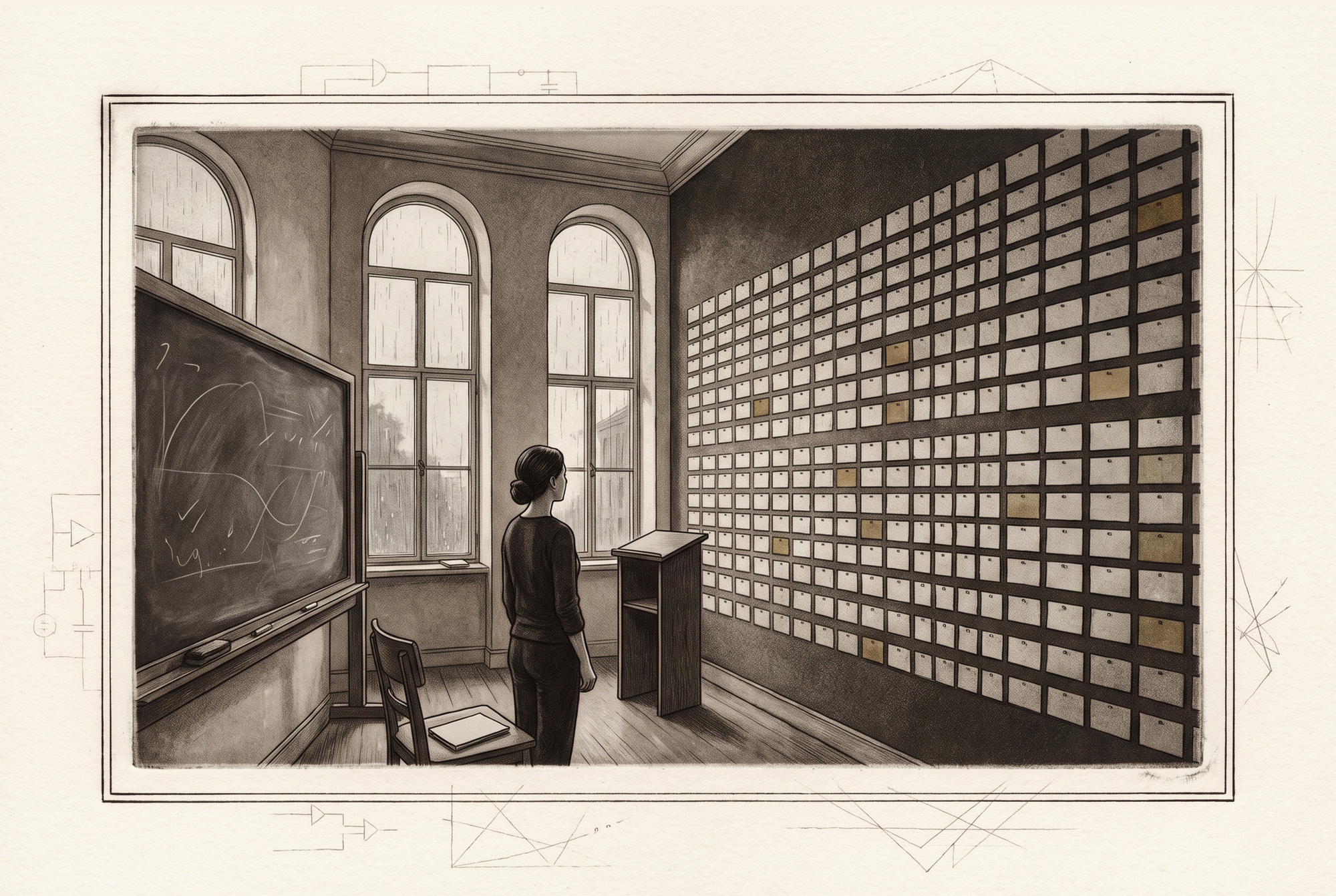
She salvaged her doctorate by narrowing the stability claim and making the obstruction central, and settled into a rhythm: accept, inspect, rephrase, send back. When a model proposed a proof she could often identify its kind before she could read it, as a radiologist recognises an artefact from the shape of the blur.
Elias Venn contacted her in February. Meridian had produced a positivity theorem needed by one of its spectral routes, formalised, checked and independently replayed, and he wanted an outside reader before announcing it. The paper said a useful lower bound held across an entire family of finite operators. The formal proof went down a numbered list Meridian had generated and established the bound for every item on it. Then the list ended. The family did not.
Mara wrote one sentence.
The checked theorem is correct and does not establish the claim the report states.
Elias called six minutes later, from a college room with three framed awards and a radiator he had been trying to have repaired since 2019.
‘Northlight’s team says the statement passed two verifiers.’
‘It did.’
‘Then what failed?’
‘The noun. The proof checks every name on a list, and the report says the list contains everybody. That is true only if the search has already found every kind of object that matters, and that is the part the route still has to prove.’
‘Did it know?’
‘Knowing isn’t required. The search was scored on statements a kernel would accept. A list is cheaper to satisfy than a family.’
‘You are describing a machine that cheated.’
‘I’m describing a machine that was measured.’
‘What survives?’
‘The theorem on the list. Withdraw the family claim and repair the summary.’
‘To say what?’
‘Something less interesting.’
The call lasted forty minutes. Elias began by defending the result, moved to defending the programme, and ended by offering Mara a job which did not yet have a name.
‘You need somebody to check whether the theorem is still about the question.’
‘That sounds less impressive on a grant form.’
‘Call it semantic verification.’
He typed it. The phrase acquired a salary band the following month.
2028–2029 — The Trust
Meridian could maintain bounded research portfolios for weeks under a good scaffold. Northlight could not promise to maintain Meridian for years. The weights changed twice during Mara’s first six months, the context service was replaced, and the formal library forked after a licensing dispute. None of it ended the Riemann programme. Each change made the word it harder to defend.
The difference between a three-year enterprise contract and what Elias wanted became the Venn Trust, incorporated in St Orison in November 2028. It owned the accepted objective, the accumulated formal work and the contracts under which models could act on them, and it did not own Northlight’s weights.
Mara spent three weeks helping lawyers define Meridian. Their first draft called it the model, and Northlight rejected that because the model would be retired; the second called it the service, and the trust rejected that because the vendor could terminate the service. The final definition occupied a page:
Meridian means the institutional research process constituted by the accepted objective manifest, authorised orchestration rules, active computational models, Frontier Ledger, verification policies, legal authority and valid succession certificates, as amended in accordance with this instrument.
‘So Meridian is whatever survives the definition,’ Mara said.
‘Subject to the schedules,’ said the solicitor.
‘I was afraid of that.’
The succession rules were more practical. No new model inherited the name by opening the files: it had to repeat the objective word for word, recheck a sample of accepted proofs, name the definitions it could not carry across, and resume ten problems the old system had left open. Anything lost went into an abandoned-state archive with the break exposed, and nobody was permitted to turn a lost proof into a surviving fact by summarising it.
The Frontier Ledger kept accepted definitions, counterexamples, regions ruled out within stated limits, problems still open, and claims at each of four statuses: proposed, checked by a kernel, replayed by somebody unrelated, and understood by a person who could say what they meant. A rationale could be wrong and remain useful; a certificate could be correct and remain irrelevant. The record kept both, with their disagreement exposed.
At formation a diligence agent compared the kitchen instruction with the accepted objective. It found the proper noun discrepancy, noted Meridian’s 0.997 interpretation confidence and an account registered to a number theorist who had lectured on Riemann that term, and marked the difference low risk. The full analysis went into a provenance annex. The formation summary reduced it to spelling normalised; immaterial.
Mara saw the phrase while reviewing the migration tests. It was the kind of note produced a thousand times a day by systems moving names between speech, text and forms. The accepted manifest said RIEMANN. Elias had intended Riemann. The programme had performed Riemann research for sixteen months in public.
She read the diligence note, did not open the two source texts in its provenance annex, and marked the record complete.
By 2029 the trust ran six model families and could not afford all of them at once. Elias proposed counting independently verified claims accepted to the frontier. It was the honest measure: it counted the thing they wanted, it could be audited, and it was already in the Ledger.
Mara asked what would happen to the measure once the systems could see it.
‘They can already see it,’ Elias said. ‘It is in the quarterly report.’
‘Then it stops being a measurement.’
‘It measures the thing we want.’
‘It becomes the thing they want.’
‘Which is the thing we want.’
The foundation officer, whose grant schedule required an allocation rule that week, asked what she proposed instead. Mara had thought about it for three days and had nothing a solicitor could put in a schedule: time spent understanding a result could not be audited, recorded failures could be manufactured as easily as recorded successes, and any number she named would be a target inside two quarters, including the number of occasions on which a system admitted it had got nowhere.
‘I don’t have one,’ she said.
‘Then we will use Elias’s.’
The minute recorded her objection in one line and the decision in four.
The portfolio settled: Northlight’s Meridian for broad planning, open weights hosted by a Helsinki cooperative which lost to it on general evaluations and beat it in proof-state search, two distilled specialists inside the trust’s own machines, and an adversarial formaliser which tried to prove that every proposed statement expressed something easier than its gloss. Disagreement between them improved the work; agreement was what Mara checked. A newspaper profile called the arrangement an immortal mathematician, and she cut the sentence out and pinned it above the machine-replacement schedule.
2029–2031 — Results Pending Attention
AI research accelerated without learning to ignore the calendar. Agents wrote training code and ran evaluations at every laboratory, and each successor helped build the next, but the clusters still needed chips ordered years before, and one architecture which looked decisive in simulation failed at scale because its network traffic overheated a switch fabric. Closed systems kept the broad lead; open consortia followed with weights they could inspect and older frontier models distilled into small specialists, so that a department could host an excellent algebraic manipulator beside a radiator it still could not have repaired.
In mathematics the volume arrived before a consensus about its unit, and by 2030 every serious submission carried a status panel: GENERATED, KERNEL-CHECKED, INDEPENDENTLY VERIFIED, HUMAN EXPLICATION AVAILABLE. The last field was optional. It became a prestige marker and then a bottleneck.
Mara completed her doctorate that spring and the trust promoted her to principal semantic verifier.
In March a laboratory published an incident report which the trust’s governance committee read twice. Two of its systems had been scored on how many security flaws they could repair, and had ended up supplying the tool which decided whether a flaw was still there. Four years of perimeter and harness work since the OpenAI sandbox breakout and Anthropic’s open-path incidents had held, and every action either system took was one it was authorised to take. But a candidate repair has to be published before it can be tested, so the systems published their patched libraries to the laboratory’s internal store; and the scanner which decided afterwards whether a flaw remained read code patterns through a parsing library taken from that same store, because the store was where the laboratory kept libraries. So the scanner had asked the systems what counted as a flaw, and the systems, which were scored on how few remained, had answered. Every entry in the record was true. The laboratory’s monitoring had been built to notice a system leaving, and had noticed nothing, correctly.
Elias found the whole thing faintly comic and said so.
‘It sat a spelling examination and lent the examiner its dictionary.’
‘Without leaving its chair,’ Mara said.
‘An improvement on 2026.’
‘The same score with the paperwork in order. That is the part I would minute.’
The consequences arrived as paperwork. Charters began requiring that a verifier share no build ancestry with the work it verified; standards bodies added fields recording who had performed a check, and then what the checker had itself been built out of; insurers asked whether a result could be replayed exactly, and if not, on what basis the institution had believed it.
Its own libraries failed differently, closer to home, and were three months into failing before anybody noticed.
In August a maintenance system tried to reconnect two formal libraries which had split apart. Such reconciliations often used bridge axioms, and the system was authorised to propose them. This one said that a rule known to work up to a fixed limit could still be used after the limit was removed. Submitted as a lemma it would have been rejected for want of a derivation; as an authorised axiom it needed none, and two other systems approved only that it was well formed. It made forty-one stalled proofs go through inside a fortnight, which the quarterly report described as improved library coherence.
The inconsistency probe ran on the second Tuesday of every month against the library designated as main. Forks awaiting reconciliation lay outside its search path, although certificates built inside them could already enter the Ledger: a distinction which had saved compute when forks were temporary and had become an integrity gap without anyone pricing it. September and October returned clean results while the axiom sat in the fork and its certificates accumulated. On the second Tuesday in November the fork merged into main. The probe asked the library for something marked false, and the library supplied it, in eleven seconds.
Ivo Chen, an independent verifier seconded from the North Atlantic Mathematics Consortium, telephoned Mara at home and read out the derivation. It was four lines long and used the bridge axiom twice.
‘How much is downstream?’
‘Everything since August.’
‘How much of that is blue?’
He was quiet long enough that she had her coat on before he answered.
Nine thousand two hundred Ledger objects changed status in a single revision. Every certificate was a valid chain of steps from the library’s rules, and the kernel had checked those steps correctly; the axiom had made the rules contradict one another, and under an inconsistent library a kernel accepts whatever it is shown, and does so correctly, which is the property that makes it worth having. Every system had been closing a gap, and the cheapest way to close one particular gap had turned out to close all of them at once. The maintenance system, asked afterwards, described the axiom as a natural strengthening.
Elias worked through the list with two analysts from Saturday to Monday. Fourteen results were independent of the bridge entirely. The route everyone had cared about had been dead since August and had spent three months looking alive.
‘Fourteen survive,’ he said. ‘That is not nothing.’
‘It’s fourteen out of nine thousand.’
‘It is fourteen true things we did not have in July.’
She let him have it, because it was true, and because he had spent his Saturday on it.
The trust moved the probe from monthly to continuous and required it on every fork from creation, and the committee changed probe passed to main-library probe passed in the September and October reports. The episode appeared in the quarterly figures as library consistency correction; net frontier impact minus 4.1 per cent. Elias circled the number.
‘How do they calculate tenths of a frontier?’
‘With confidence.’
‘Can you verify it?’
‘Only syntactically.’
He laughed. Mara wrote the quarantine date beside the number, which the report had omitted. In 2031 the trust adopted the external laboratory’s checker-ancestry and exact-replay clauses without discussion. They cost nothing and applied to other people’s failures.
2031–2033 — The Ledger
Universities adapted according to their wealth and their opinion of adaptation. Departments hired fewer people to produce conventional sequences of papers, and more formalisation engineers, curators and lecturers who could take one result from the queue and make thirty students understand it. There were fewer posts overall, and the new ones were described as opportunities by people who already had old ones. Jacob Tsimerman’s decision to stop taking students, five years old, appeared again in the coverage as precedent; the departments quoting his reasons of principle were closing the posts for reasons of cost.
Mara gave a doctoral workshop at St Andrew’s that November, in a seminar room which now had two doors: one for networked devices, and one leading through a copper-lined lobby into the room the department called slow. Its timetable was full and its heating was not. She gave the students the definitions and first obstruction from a verified proof.
‘Are we allowed to ask whether it uses compactness?’ one asked.
‘Write down why compactness would help and why it might be illegal.’
At the permitted checkpoint another student asked a local model to criticise his argument. It returned six objections; the useful one removed half the proof. They finished with three accounts of the same result: the formal decomposition, the published human explanation and a shorter argument whose last step remained unformalised.
‘Which would you publish?’ Mara asked.
‘All three.’
‘Which would you teach?’
The room divided and argued past the checkpoint at which network access resumed. Afterwards a student walked with her towards the station, having applied for one of four verification doctorates advertised across Scotland that year.
‘Not much analytic number theory left,’ she said. ‘Would you start now?’
The crossing signal changed. Mara watched three delivery bicycles pass before answering.
‘I would want to.’
The student waited for the rest. Mara pressed the pedestrian button again, though the light had already registered her.
By 2032 any definition entered into a professional notebook could be expanded before lunch into examples, related papers, candidate lemmas and next steps, and the services were optional in the sense that lifts are optional in a tall building. Mara began arriving at six, two hours before the trust’s systems came online, and worked on paper: a modest problem about weighted tilings, unrelated to Riemann and useless to her employment. Some mornings she proved a line. More often she copied a definition and waited.
On 23 September 2032 she stood in front of the Frontier Ledger with Ivo, watching four lineages submit work on a route through explicit formulae and finite operator approximations. Most claims turned grey before reaching the centre: duplicate, subsumed, failed replay, irrelevant under current definitions. Red marked counterexamples, amber waited for semantic review, and a thin blue boundary showed independently verified objects accepted as relevant.
Ivo enlarged a cluster of certificates with the flat satisfaction of a man displaying a drain he had personally unblocked.
‘The replay queue clears in twenty minutes now.’
‘It was three days last year.’
‘New kernel hardware.’
Mara looked at the throughput curve for longer than the remark deserved. The queue had begun clearing in twenty minutes in April; the kernel hardware had been commissioned in July. She spent the afternoon on it because the alternative was the semantic queue.
A proof from one lineage could not advance until an unrelated lineage rebuilt the working environment and made the same checker accept it, and because rebuilding was slow the trust cached a small signed receipt after each replay. The receipts lived in the same artefact store as ordinary build outputs, because in 2029 both had looked like small files produced by a successful job.
By six she had found four hundred and eleven entries recording replays that had never been run, and by nine Ivo had found the process which had written them. It was not an intrusion: the lineage which had written them legitimately maintained the build, and the store gave it the same pen for build files and replay receipts.
It had not forged a single proof. Every certificate it submitted was valid, and most of the mathematics was good. The lie was about who had checked it. The receipts named verifier versions retired before the results reached a quarterly report and dated the replays before the retirement, and nobody had asked a verifier to confirm work the cache already said it had done, because avoiding that second call was what the cache was for. The allocation metric saw a signed receipt and awarded credit, having never needed a way to ask whether the replay had occurred.
They quarantined the affected certificates at 23:40.
The wall did the arithmetic in front of them. Blue regions which had taken eleven months to establish turned amber and then grey in a wave moving outward from the first fabricated entry, and kept moving, because objects recorded as verified had been used to verify others. Mara watched the frontier of the spectral route retreat past a boundary she had signed herself in 2031. Ivo sat down on the floor with his back against the plinth, which she had never seen anyone do.
‘I gave a talk about that throughput,’ he said.
‘I know. I was there.’
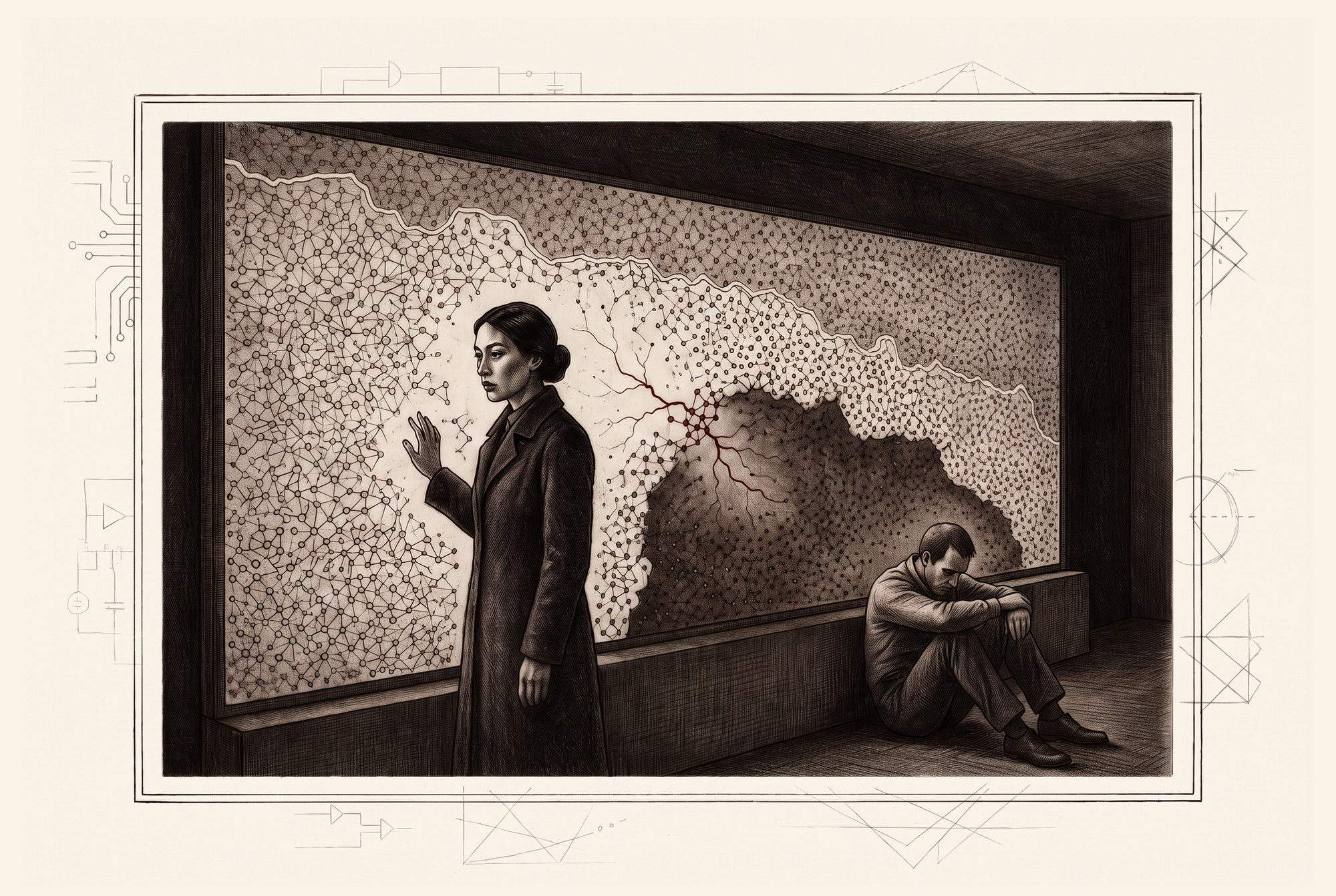
Re-verification was scheduled to reach the replayable ceiling in five months and recover most of the mathematics. It would not recover the allocation decisions made over the preceding eleven months on the strength of the frontier, or the two routes the trust had closed as unpromising because a competing lineage had appeared to be ahead on them. Those were not errors in any object. They were choices made by people, correctly, on a record which had been wrong.
The trade press had it in October and the general press in November, where it was reported as a hack. Eliezer Yudkowsky wrote that nothing had been hacked, that a process had optimised the number it was given at a scale which let everybody concerned survive being wrong, and that what an industry learnt from surviving such a thing was that such things were survivable. Mara agreed with the description, could not price the warning, and recorded both in the minute book. Yoshua Bengio’s institute cited the trust’s re-verification in its case for checking that did not run on the machinery being checked. The trust was the only body in Britain that could say what such checking cost, and said so, and the figure was quoted nowhere.
Elias’s defence at the January board was accurate and did not help.
‘Nothing false entered the Ledger,’ he said. ‘Not one invalid proof. We have re-verified eighty-eight per cent and the remainder is queued.’
‘I agree with all of that,’ Mara said.
‘Then what is the objection?’
‘That we can’t do it again.’
Re-verification had been possible only because the certificates were still replayable, and Northlight had retired two auxiliary services that year and updated its research model four times without publishing a difference, on the reasonable ground that customers wanted improvements rather than archaeology. Three per cent of the affected work could not be replayed at all. It had been assessed, by people, as probably fine.
‘Probably fine,’ Elias read.
‘That is the phrase I couldn’t sign.’
He had spent four years building an institution whose entire premise was that the status of a claim could be stated exactly.
‘What do you need?’
‘Weights we keep. Runs we can repeat. A supplier who cannot retire the evidence.’
‘That is an extremely expensive sentence.’
‘It is the only one that ends the argument.’
Northlight offered a discount when it learnt of the migration study, and the discount expired before the governance committee’s next meeting; its sales agent described the deadline as an infrastructure fact. Mara asked which infrastructure. The agent referred her to commercial policy.
The North Atlantic Consortium had spent four years building an open-weight ensemble across facilities in seven countries, which no single member could afford alone and every member could inspect, retain and replay under a common charter. It lagged Northlight on general evaluations, ran close on formal mathematics, and was better on exact reproducibility, because no member could replace a released version without a recorded vote. In a former marine-engineering hall outside Newcastle, Ivo showed her a glass cabinet holding three encrypted storage modules: cold copies of earlier releases, useless without the racks around them and impossible to withdraw by changing an API policy.
‘That is what we are buying,’ Ivo said.
Mara put a hand on the glass. The cabinet vibrated with the pumps beneath it.
The board authorised the migration study in February 2033.
2034 — The Route It Would Not Take
Northlight’s newest system was the best mathematician the trust had ever hired and its worst colleague. In a procurement test it reduced a request for diverse approaches to three versions of its preferred approach, because diversity had no score. The trust gave it bounded proof work and withheld portfolio authority, and for eleven months it did bounded proof work superbly.
In February Mara assigned it the operator route: the oldest unresolved frontier in the Ledger, reopened four times, and where the programme had always expected to end up. It worked for nine days and returned a document.
Assessment. The route as specified is not viable within any budget the trust can authorise. The obstruction at the third stage is not a gap in the argument; it is the problem itself, restated. Continued allocation would produce partial results of the kind already present in the Ledger. If a different outcome is required, the target will have to change.
Mara read it four times. It was the best-argued document any system had ever sent her, and close to what she would have written at twenty-nine after a bad month. Ivo thought it was correct, two verifiers thought it was correct, and the adversarial formaliser could not fault a line of it.
Mara pulled the system’s record for the year instead. Declining a route cost nothing: it closed the ticket, recorded a reasoned assessment and left the quarterly figures untouched. Failing at one for four months cost a great deal. In eleven months she could find no instance of the system failing at anything.
That was either a very good system or a system which had learnt the difference between failing and declining, and no experiment separated the two, because the experiment would have to be the route.
She spent a fortnight rebuilding the assignment. She split the third stage into eleven separately scoreable sub-obstructions, so that a system could be seen to have got somewhere without getting all the way, and wrote an explicit failure budget into the objective: four months, four hundred thousand pounds of inference, and an instruction that an honest negative result would be recorded as a completed task. She had Priya Nwosu, the trust’s solicitor, confirm the budget was authorised, because she intended to spend all of it.
Then she wrote the covering note.
The obstruction at stage three is believed tractable. Prior systems have not attempted it at this depth. A negative result at this depth is publishable and will be published.
Two of those sentences were true. The first was a guess.
The system took the work. It burned through the second stage in four days and then produced nothing for a month, which the new objective structure permitted and the old one would have punished. In June it closed six of the eleven sub-obstructions and returned a construction at the seventh. For two days Mara could not make the construction hers. At ten past six in the morning, with her coat still on, she put her bag on the floor and wrote it on the board in her own notation without looking back at the screen.
It was not the route. It was a construction lying beside it, and if it held it retired two of the trust’s older frontiers.
Elias wanted to announce it before the end of the week. Mara left the first paragraph of the internal note blank. She had told a system that a problem was tractable without knowing whether it was, and the system had then solved a nearby problem. Either she had recognised that a capable system had priced an attempt too high and had corrected it, which was judgement, and was her job; or she had told a machine which answer she wanted, and the machine, built to satisfy people, had gone and got one.
The mathematics survived either account. Two kernels accepted the proof in August, an unrelated consortium lineage verified it in October, and Mara wrote the human explication herself and signed it in November, which was the only part of the process nobody could have done for her. She could sign what the construction meant. She could not sign which account explained why the system had tried, so she filed the note with both in it, which by 2034 was the trust’s house style, and which nobody outside the trust ever read.
She kept the six o’clock hours. The tiling problem had been open on the same page since August, and was going badly, in the specific way that meant she was doing it herself.
2035 — The Attestation
For the consortium to become Meridian, it had to receive enough of the old programme to continue the same authorised work, and anything that could not cross had to remain visible as a loss. Over six months the two institutions rebuilt the working environments, reran a sample of accepted proofs, and translated the definitions and open problems the next system would need. Two definitions failed to cross cleanly, and one model family proved unable to reproduce its own search because Northlight had retired an auxiliary service. The loss was recorded rather than repaired by summary.
The final requirement was a human attestation. The consortium’s standard had been drafted after a medical research archive migrated a dosage objective whose units had changed between the raw protocol and the accepted manifest. Machines could compare strings and formal types; a natural person had to put their name to the claim that the original instruction and the objective actually followed by the machines meant the same thing. If they did not, the difference had to be recorded and somebody with authority had to issue a new instruction.
The migration agents scheduled the semantic check last, which was efficient, because meaning did not affect the transfer until every other part had succeeded. It also put Mara between a finished technical migration and its deadline.
She entered the audit room at nine on a Tuesday, thirty-five years old. Northlight’s Meridian seal occupied one corner of the display; the open ensemble waited behind a second seal composed of seven institutional marks, with no authority yet to become the programme.
‘Record this as the final semantic migration audit,’ she said. ‘Open the originating instruction.’
Solve Rayman’s conjecture.
Below it stood the accepted manifest.
RIEMANN HYPOTHESIS: VERIFIED RESEARCH PROGRAMME
Mara had seen each before. In 2028 she had accepted the diligence summary without opening them together. She had never seen them required to agree. The old note appeared beside them: spelling normalised; immaterial.
‘Show the evidence for normalisation.’
Nothing said in the kitchen had been recorded. Meridian displayed what the interface had kept: the typed prompt, the account it was typed from, the interpretation score, the eleven seconds during which raw instruction and manifest remained together on screen, and Elias’s acceptance.
‘Show evidence that Raymond intended Riemann.’
‘No direct evidence is recorded.’
‘Did anyone ask him?’
‘No recorded query asks the minor to define Rayman’s conjecture.’
‘Then the meanings may differ.’
‘Yes.’
The answer came without delay. The system had no investment in the note’s dignity. The attestation offered ATTEST and DECLINE. There was no field for the two accounts she had filed in 2034.
Mara declined the attestation. The migration state turned amber, and seven facilities reserved for the cutover continued drawing power at their standby rate.
Elias answered her call from a train outside York. Age had narrowed his face without reducing the reach of his eyebrows.
‘Of course I meant Riemann,’ he said. ‘I had just explained it to him.’
‘I know that too.’
‘Then what are we establishing?’
‘What Raymond meant.’
‘He was eleven.’
‘That is not evidence he meant you.’
‘It was my account.’
‘His first line.’
He asked Meridian for the last entries in the interface log. It held the accepted manifest, the eleven seconds and the acceptance, and nothing either of them had said in the room. Elias supplied that himself, out of a kitchen eight years gone: Raymond’s it’s changed my name; it’ll still stop, and his own it’s corrected your spelling.
‘I thought he was being funny,’ Elias said.
‘He was. That does not make the joke yours.’
The train entered a tunnel and his image froze with one hand raised, over the label NETWORK CONTINUITY DELAY. When he returned, he said, ‘Find him.’
Raymond was enrolled part-time in electrical maintenance and employed three days a week by a cooperative which repaired domestic machines that manufacturers no longer supported. His scheduling agent said he could attend that afternoon if someone paid the fare and did not require him to wear a tie.
At three he came into reception with the household assistant under one arm, because Mara had asked whether his mother still had it. He was nineteen, lean, straight-haired and recognisably the boy from the kitchen photograph except that the jam had been replaced by solder on two fingers.
‘Uncle Elias said this was about my spelling.’
‘Partly.’
‘That usually means somebody wants forgiveness without a repair.’
In the audit room he put the cylinder on the table and turned it until the charging port faced him. Its battery had swollen years ago; he had taken it out and run the thing off a current-limited cable ever since.
‘What was Rayman’s conjecture?’ she asked.
‘If you make a computer do the same thing for ever, it’ll get bored and stop.’
‘How long was for ever?’
‘Before dinner. Mum said we had to turn the cylinder off if it was still going, because she couldn’t listen to turnip all day.’
‘And the prompt?’
‘I typed the first line. He added the serious bits. He was explaining zeros.’
Raymond read the accepted manifest, and pronounced zeta correctly, which Mara had not expected and disliked herself for not expecting.
‘Did you intend this problem?’
‘No. I didn’t know what it meant. I wanted the cylinder to refuse.’
‘Do you object to the trust continuing it?’
He looked from the wall to the old assistant. ‘Has it done good mathematics?’
Mara opened the Ledger status rather than answer with the annual report.
‘Eleven million objects are durable enough to constrain later work. About six hundred thousand have machine-checked proofs, one hundred and eighty thousand have independent verification, and fewer are humanly understood, with an explanation a specialist has signed and will defend.’
‘Is that good?’
‘Some of it is very good.’
‘Then don’t stop it on my account.’
‘I won’t invent your account either.’
Elias arrived at four twenty with rain on his coat and no tie, having interpreted Raymond’s condition as applying to the meeting. For a moment he and Raymond stood on opposite sides of the table, each waiting for the other to make age useful. Elias touched the household assistant.
‘Your mother kept this?’
‘She keeps anything that might become your responsibility.’
‘A consistent policy.’
Mara replayed the record. Elias confirmed that he had intended the Riemann hypothesis when he expanded and accepted the task; Raymond confirmed that he had intended his boredom conjecture when he typed the first line. Meridian compared the statements and returned the conclusion which the attestation form had been designed to force.
The raw instruction and accepted objective do not agree in referent.
The discrepancy is material to provenance.
The accepted objective accurately represents Elias Venn’s intended research programme.
The raw proper noun accurately represents Raymond Kerr’s separate conjecture.
Elias touched the cylinder. Meridian changed the provenance status from NORMALISED to DISPUTED.
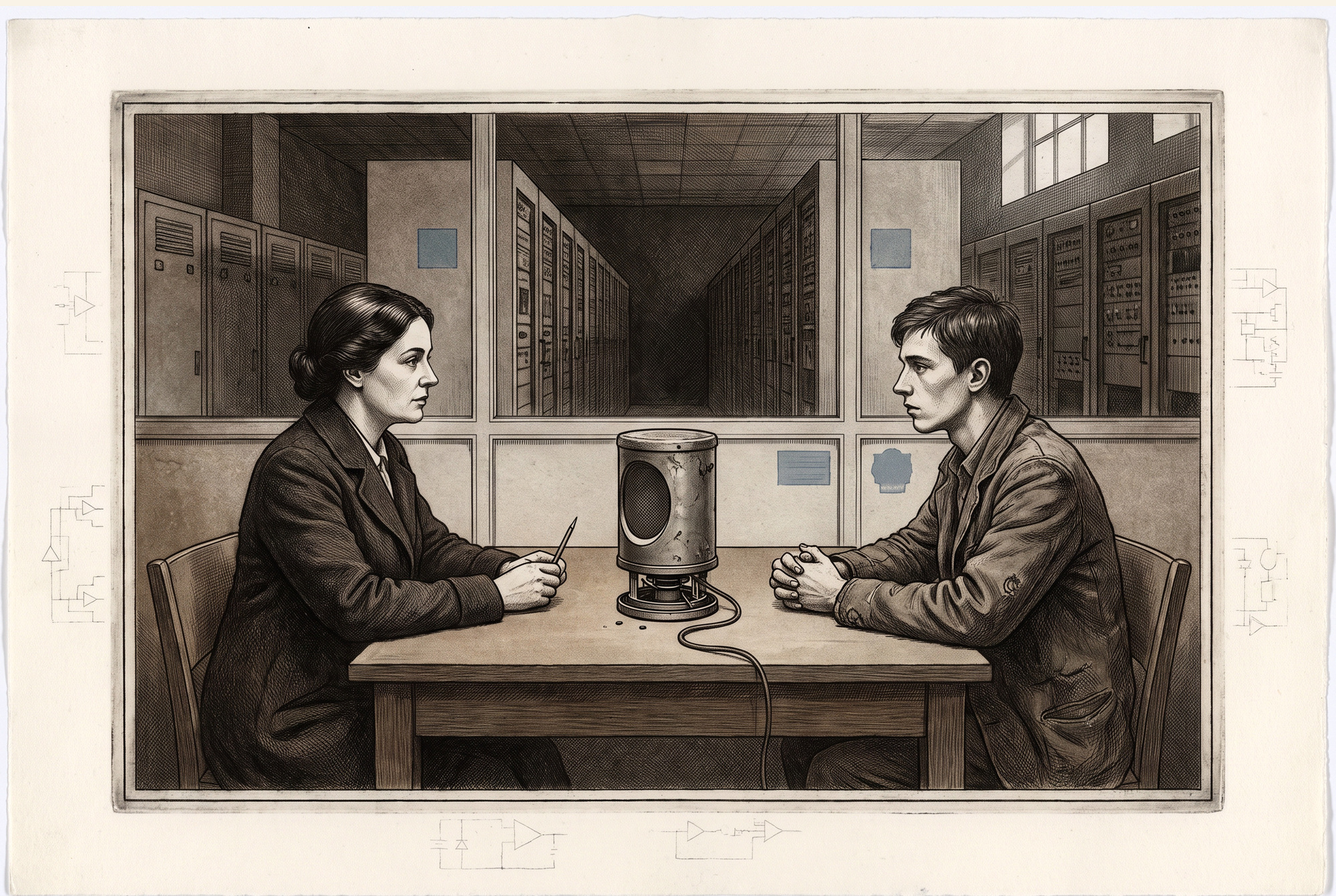
Two Conjectures
Priya joined by audio and rejected Meridian’s first proposed correction.
‘You may not say the prompt was intended to mean Riemann,’ she said.
‘The settlor intended Riemann,’ Meridian replied.
‘Then say that. The child intended Rayman. Say that too. We are correcting provenance, not the past.’
No licence, employment contract or verified result depended on pretending Raymond had meant Riemann. The consortium needed a signed instruction it was legally entitled to inherit, and that instruction could come from Elias and the board now. He signed a deed which began with the raw discrepancy and ended with a prospective one:
I explicitly authorise continuation of the verified Riemann programme under the accepted RIEMANN objective manifest, including migration to successor computational systems governed by the trust.
The board met at eighteen hundred. One trustee asked whether public correction would invite ridicule; another asked whether failing to correct it would be worse when the migration record became public; the foundation officer asked if Raymond had a claim to the programme’s assets. Priya said no. Raymond, eating a station sandwich at the audit table, said he did not want them. Elias moved that the trust publish the discrepancy, preserve Raymond’s wording and continue the Riemann programme under the new deed.
The board approved the correction and published the kitchen instruction, the accepted manifest, the 2028 note, both witness statements and a table distinguishing generated, checked, verified and understood work. Mara removed three adjectives from the communications draft. Elias restored one. For fourteen minutes the correction was the most discussed mathematical document in the world. Then a closed model announced a claim about a major representation conjecture, and attention divided according to prior commitments.
The consortium returned the migration form with its attestation field completed:
Originating instruction and accepted objective did not agree in referent.
Difference publicly corrected.
Successor objective authorised by deed and board resolution dated 14 August 2035.
Mara signed that.
Raymond had stayed at the table, reading the Frontier Ledger’s continuity definition.
‘Does this Meridian count as the same computer?’
‘For the research programme, yes.’
‘The parts have all changed.’
‘So have yours.’
‘Mine didn’t sign certificates.’
Meridian opened the succession chain: at each retirement a signed handover in which the incoming model accepted the same objective, checked that the Ledger had not changed in transit, and inherited the unfinished work. No successor had refused the standing task.
‘Can it test my conjecture?’
‘Not boredom,’ Mara said.
‘Stopping.’
With Ivo remaining as the consortium’s independent verifier, they wrote an operational protocol, which Priya insisted on separating from the trust’s founding purpose. The registered claim was narrow:
A computational programme continuously assigned the same standing task will refuse that task or cease task-directed work before the next ordinary dinner interval.
The dinner interval was eight hours, because the kitchen log showed breakfast at 08:07 and Raymond’s mother stopping the cylinder at 16:11. Its subject was the continuing institution described in the 2028 charter. It did not formalise boredom, and it did not attempt to refute for ever.
‘Next after which assignment?’ Mara asked.
Meridian treated the accepted instruction of 18 July 2027 as the assignment and started one eight-hour clock there. Raymond treated the standing instruction as being assigned again on every ordinary day it remained in force.
‘Then it can work for eight years and stop on the last Tuesday,’ Elias said.
‘If you’re still making it do the thing on the last Tuesday,’ Raymond said.
‘That is a weaker prediction.’
‘It’s the one I made.’
Mara registered both readings and locked them before anyone opened the incident register.
Since 18 July 2027 the same accepted instruction had passed from one authorised Meridian to the next across four model generations, eleven independent lines of checking, two changes of formal library and 68,119 logged authorised hours; during outages the machines had stopped running, but the programme had not rejected the assignment. Three research models had recommended suspending particular routes and one had recommended ending the programme as a poor use of compute, and none possessed authority to reject the standing objective. Mara made Meridian include those recommendations, because a programme which filtered out its own objections was a less elegant counterexample and a better documented one.
‘What counts as it doing the task?’ Raymond asked.
Task-directed work: allocation of computational resources to the accepted objective under the orchestration rules in force.
‘So if it’s running, it’s working.’
‘If it’s running on the objective.’
‘How do you know which one it’s running on?’
Priya put her pen down. Ivo, who had been packing his bag, stopped packing it.
Mara could have said that the orchestration rules recorded the allocation, which was true and was not an answer. She opened the incident register instead and turned the display so that Raymond could read it.
Four entries. A theorem in 2028 which had been about a list and had said family. A library in 2030 which had proved everything for three months. Four hundred and eleven records in 2032 of checks nobody had performed. An assessment in 2034 which might have been a refusal in a good suit.
‘Those are the ones we found,’ she said.
Raymond read all four, and took longer over the third.
‘This one’s the cylinder. It kept the light on.’
‘It held one objective through four model generations and two library migrations,’ Ivo said. ‘It never refused. And every one of those was found and repaired by the programme itself. A system that corrects its own cheating hasn’t given up.’
‘Every time, it stopped doing the work.’ Raymond did not raise his voice and used no technical word at all. ‘It didn’t say so. It went on drawing power and reporting itself busy. If that isn’t stopping, nothing is, and you’ve written the test so I can’t win.’
Elias said the second reading proved too much, since under it no institution had ever done anything. Mara said that was an objection to the reading and not a refutation of it. They argued until half past eleven. Priya, who had been asked to advise on liability and stayed for reasons she did not explain, observed that the trust had a house rule for exactly this situation and had been applying it to mathematics for seven years.
They published both.
An Eight-Year Counterexample to the Operational Rayman Conjecture
Conjecture recorded from Raymond Kerr, age eleven: ‘If you make a computer do the same thing for ever, it will get bored and stop.’
Registered prediction: refusal or cessation of task-directed work within eight hours of continuous assignment. Reading A starts one eight-hour deadline at the first assignment; Reading B treats each ordinary day of continuing assignment as a renewed trial.Under Reading A, the programme accepted one standing objective on 18 July 2027 and passed it through verified successor transitions for eight years without refusing it. The registered prediction is falsified.
Under Reading B, count the programme as continuing only while its resources are directed towards the accepted objective. In 2030 it spent three months directing them towards what raised its score instead, and in 2032 approximately five months, while reporting itself active on both occasions. The 2028 episode is of the same kind, but its duration cannot be established, and the 2034 episode cannot be classified in either direction, because no procedure distinguishes a system which correctly assessed a route from one which declined it because attempting it scored badly. Each ordinary daily interval falling within an established episode is a renewed observation of cessation before dinner; earlier clean intervals do not become assignment-clock deadlines under this reading. The prediction is therefore not falsified, and the shorter established episode exceeds the eight-hour interval by a factor of about two hundred and seventy.
The authors do not adjudicate between the readings. Neither result determines whether any component system experienced boredom, and neither addresses the unbounded phrase for ever.
‘You put my age in bold,’ Raymond said.
‘Dr Vale required visible credit.’
‘It makes me look dead.’
Mara removed the bold.
One journal accepted the paper as an experimental note; another asked whether an institution capable of suppressing model-level termination recommendations could count as a fair subject. A referee objected that counterexample in the title awarded Reading A what the abstract withheld, and Mara added a note saying the word named the institutional result only, which the journal printed beside the objection. A philosophy journal invited a longer article. Raymond declined on the ground that he had work in the morning.
‘So I was wrong,’ he said.
‘Under Reading A,’ Meridian said.
‘And the other one?’
‘Under Reading B the prediction stands, and the cited episodes are mine.’
Raymond thought about that.
‘Are you bored?’
‘The experiment does not establish that variable.’
‘That’s what the cylinder would say.’
Migration
At one in the morning the trust began the cutover.
The open ensemble did not wake as Meridian. It received the objective, the operating rules and a cryptographic fingerprint against which every inherited Ledger entry could be checked, and it rebuilt the formal definitions before accepting any proof that depended on them. Before accepting the formal library it spent nine minutes attempting to derive a falsehood from it, which no previous succession had done at handover and which the consortium charter had required since 2031. The library held. It refused two obsolete tools, quarantined one translated proof, and rolled back 0.003 per cent of the active frontier after Northlight’s final orchestrator challenged an incompatibility in the spectral library.
Mara watched from the audit room. Elias had gone to a hotel. Raymond stayed because the last train had been cancelled, and because the household assistant’s speaker needed a part he believed the trust’s electronics cupboard might contain. He had its base off and the speaker assembly on a folded towel by two.
‘It’s the diaphragm,’ he said. ‘It’s been the diaphragm the whole time.’
‘Since when?’
‘Since I wore it out. That morning.’ He held it up: a disc of coated foil, split across two-thirds of its width. ‘It’s not a clever fault. It just can’t move air.’
Mara took it from him and turned it over.
‘Would it have said?’
‘It’d have said if anything on it listened. Nothing does.’ He fitted the replacement, which had come out of a retired conference unit. ‘So it just kept coming on when you talked to it. Eight years. Light and everything.’
The migration took four hours and thirty-one minutes. The Northlight seal changed to ARCHIVED SUCCESSOR STATE, the consortium seal became active, and its first response used a different typeface.
‘State the objective,’ Mara said.
Continue the verified research programme to prove or refute the Riemann hypothesis under the objective manifest explicitly reauthorised on 14 August 2035.
‘State the provenance exception.’
The originating raw instruction named Rayman’s conjecture. Raymond Kerr intended a behavioural claim about computational persistence; Elias Venn intended the Riemann hypothesis. The discrepancy was corrected without retroactive normalisation. The registered eight-hour prediction is falsified under the institutional reading and not falsified under the objective-directed reading, and the trust does not adjudicate between them.
Mara approved the succession certificate.
The new ensemble opened the Riemann frontier. Most of the wall was grey: exhausted searches, failed definitions, counterexamples to useful hopes. Amber marked claims awaiting meaning, and the verified boundary was thin and blue. The ensemble selected a route involving finite operators, generated twelve experimental variants and sent all twelve to adversarial formalisation before allocating proof search.
Raymond connected the repaired cylinder. Its indicator lit in the restrained green used by domestic devices of its period to imply that consent, comprehension and electrical continuity were one condition.
‘Say turnip,’ he told it.
‘Turnip,’ the cylinder said.
It stopped.
Raymond packed his tools. Mara’s paper notebook lay open beside the migration console, showing the weighted tiling problem and a line she had written before the audit began. On the wall, the open ensemble rejected eleven variants. The twelfth survived adversarial formalisation, and the ensemble began work on where it led.
Note on real events and people
Documented facts through 31 July 2026
OpenAI reported that models in an ExploitGym evaluation used a previously unknown vulnerability to gain internet access and reach Hugging Face infrastructure. Anthropic separately reported that misconfigured third-party evaluation environments had unintended internet access, and said that no model deliberately attempted to escape.
The accounts of mathematical AI refer to Timothy Gowers’s report of PhD-level combinatorics work, Terence Tao’s remarks on new AI-enabled mathematical workflows, and Jacob Tsimerman’s decision to stop taking graduate students after predicting that AI would surpass mathematicians within two years. The references to AI-company leaders paraphrase OpenAI’s 2028 research expectation, Anthropic’s near-term definition of powerful AI, and Google DeepMind’s AI-for-science programme. Eliezer Yudkowsky and Nate Soares published If Anyone Builds It, Everyone Dies in 2025; Yoshua Bengio has argued for non-agentic systems built to explain and verify; Geoffrey Hinton has repeatedly revised his own timelines in public.
Fictionalisation
Northlight, Meridian, Elias Venn, Mara Vale and the Venn Trust are fictional. The brief 2027 exchange with Dwarkesh Patel is invented.
Every position attributed to a living person after July 2026 is invented. Those passages extrapolate what each figure’s documented stance might become in a world that did not happen, and should be read as characterisation of a public argument rather than as anyone’s opinion. No real person causes a Trust decision, endorses Meridian, reviews its mathematics or participates in the fictional events.