Peter Denton, Stephen Parke, Xining Zhang, and I have just uploaded to the arXiv the short unpublished note “Eigenvectors from eigenvalues“. This note gives two proofs of a general eigenvector identity observed recently by Denton, Parke and Zhang in the course of some quantum mechanical calculations. The identity is as follows:
Theorem 1 Let
be an
Hermitian matrix, with eigenvalues
. Let
be a unit eigenvector corresponding to the eigenvalue
, and let
be the
component of
where
is the
Hermitian matrix formed by deleting the

For instance, if we have
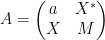
for some real number 



assuming that the denominator is non-zero.
Once one is aware of the identity, it is not so difficult to prove it; we give two proofs, each about half a page long, one of which is based on a variant of the Cauchy-Binet formula, and the other based on properties of the adjugate matrix. But perhaps it is surprising that such a formula exists at all; one does not normally expect to learn much information about eigenvectors purely from knowledge of eigenvalues. In the random matrix theory literature, for instance in this paper of Erdos, Schlein, and Yau, or this later paper of Van Vu and myself, a related identity has been used, namely

but it is not immediately obvious that one can derive the former identity from the latter. (I do so below the fold; we ended up not putting this proof in the note as it was longer than the two other proofs we found. I also give two other proofs below the fold, one from a more geometric perspective and one proceeding via Cramer’s rule.) It was certainly something of a surprise to me that there is no explicit appearance of the 


One can get some feeling of the identity (1) by considering some special cases. Suppose for instance that 



for 

for 

— 1. Relating the two identities —
We now show how (1) can be deduced from (2). By a limiting argument, it suffices to prove (1) in the case when 


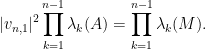
The right-hand side is just 

at 

Finally, (2) can be rewritten as
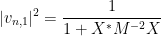
so our task is now to show that

By Schur complement, we have

Since 


— 2. A geometric proof —
Here is a more geometric way to think about the identity. One can view 











for any 





— 3. A proof using Cramer’s rule —
By a limiting argument we can assume that all the eigenvalues of 


Extracting the 

or in terms of eigenvalues

Both sides are rational functions with a simple pole at the eigenvalues 

and Theorem 1 follows. (Note that this approach also gives a formula for 


