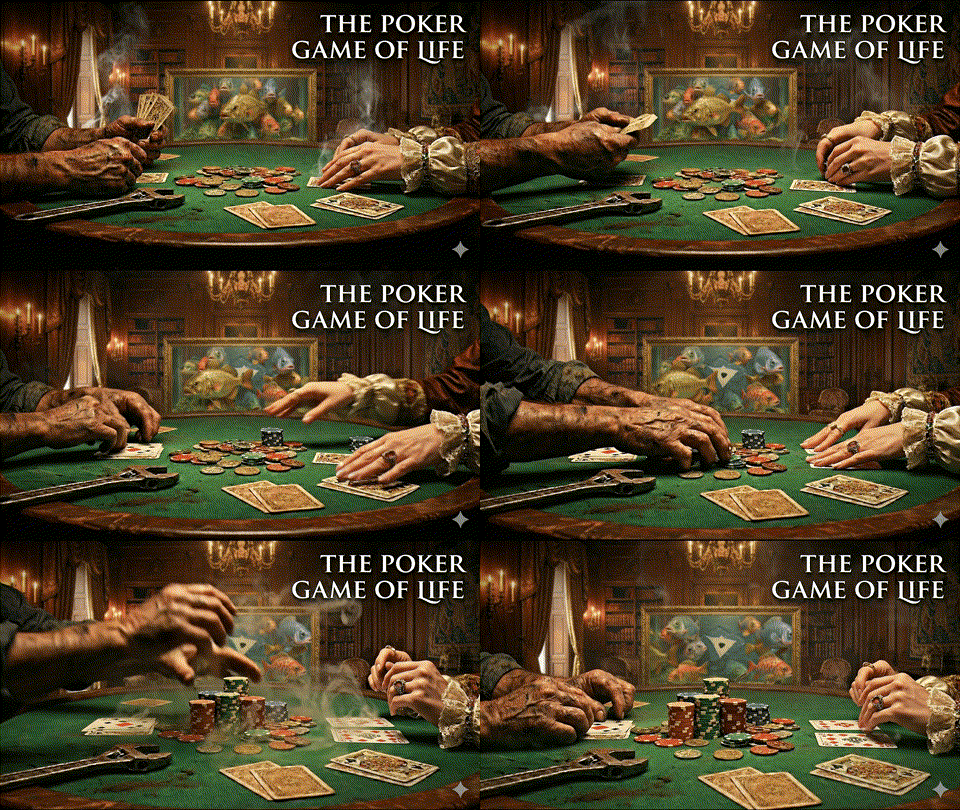
“Raise.”
The word drops like a verdict. Third time in a row from the guy in aviators across the felt. You’ve been here four hours. You’ve lost seven of the last nine hands. Not catastrophic pots, not the kind that send you home early, but the slow arterial bleeding that makes you start constructing theories.
You watch the action unfold. The professionals at the table rarely tangle with each other. Small pots, careful play, fold-and-wait energy. But there’s a guy in a silk shirt, expensive watch, terrible fundamentals. Every time he enters a hand, suddenly everyone wakes up. They three-bet light. They isolate. They apply maximum pressure to every decision he makes.
If you didn’t know better, you’d swear they were working together.
Here’s your first lesson, and it’s the only one that matters: the poker table is the most honest place in the world. Not because people don’t lie. They lie constantly. It’s honest because eventually, the cards speak. They reveal truth with mechanical indifference. They don’t care about your narrative.
Life is not like this. Life never shows you the river card. You die without knowing if you played the hand correctly.
But poker teaches you how to think about a world that won’t give you answers. And that’s worth more than the answers themselves.
Here’s a question to chew on: How would you know the difference between a rigged game and a legitimate losing streak?
From inside your experience, with the information available to you, the answer is devastating. You wouldn’t. You literally couldn’t. And this isn’t a failure of intelligence or attention. It’s a structural feature of existing in a world of incomplete information.
There are three types of players at any poker table, and they exist in fundamentally different realities.
The fish sees chaos. Cards come, money moves, sometimes he wins, usually he loses. He constructs narratives to explain this: he’s unlucky, others are colluding, the deck is cold, the dealer doesn’t like him. His slice of reality is so thin that almost any explanation feels plausible.
The professional sees patterns. She understands ranges, frequencies, expected value. She can predict outcomes with reasonable accuracy, distinguish variance from signal, separate good decisions from good results. Her slice of reality is thicker, closer to truth. But it’s still a slice.
The cheater sees everything. Russ Hamilton with his AuditMonster (more on this later), watching hole cards in real time, knowing exactly what will happen before it happens. He doesn’t need narratives. He doesn’t need explanations. He has the complete picture. He is the only one at the table who knows for certain whether the game is fair.
Everyone else on the spectrum from the freshest amateur to the most hardened veteran is telling themselves a story.
Your brain is not a camera. It’s a story engine.
Every moment you’re awake, it takes fragmented sensory data and constructs a coherent narrative. It fills gaps you’re not aware of. It invents continuity where none exists. It assigns causation to correlation with reckless abandon. This works beautifully for navigating physical space and social situations.
It’s catastrophic for understanding complex systems with incomplete information.
Let me tell you about what happens in the brains of people with schizophrenia, because it reveals something true about all of us.
In the 1940s, researchers started investigating what happens when patients hear voices. Louis Gould placed EMG sensors on their throats and discovered something remarkable: when they reported hearing hallucinated voices, their vocal cords were subtly vibrating. They were subvocalizing. The voices they heard were their own.
This has been replicated. Bick and Kinsbourne in 1987 found that 14 of 18 hallucinating patients reported their voices went away when they held their mouths open, which prevents subvocalization. The brain generates the voice, fails to tag it as self-generated, and then requires an explanation for this external-seeming input.
Here’s where it gets interesting. The explanation varies by culture and era.
Victor Tausk documented that early 20th century patients attributed their voices to hidden batteries, coils, and electrical apparatus, the cutting-edge technology of the time. Today’s patients report satellites, CIA surveillance, brain chips, AI systems. The mechanism is constant: the brain encounters anomalous input and constructs a narrative using available cultural material.
Tanya Luhrmann’s cross-cultural research makes this vivid. American schizophrenic patients typically report harsh, violent, threatening voices. Patients in Ghana frequently hear God. Patients in India hear relatives telling them to do chores. The brain is generating something, and the culture is providing the costume.
The pattern is always the same: unexplained input demands explanation. The brain cannot tolerate ambiguity. It will construct a narrative, any narrative, rather than sit with uncertainty.
Now extend this beyond psychopathology.
The poker player on a losing streak hears a voice too. Not auditory, but insistent. It says: this isn’t random. This isn’t variance. Something is wrong. Someone is cheating. The game is rigged. The universe has selected you for special torment.
The voice is coming from inside the house. It’s the same story engine that makes schizophrenics hear the CIA, now making you see patterns in randomness, intention in chaos, conspiracy in coincidence.
Klaus Conrad, a German psychiatrist, called this “apophenia”: the unmotivated seeing of connections accompanied by a specific feeling of abnormal meaningfulness. He was describing schizophrenia. He was also describing what every poker player does during a losing streak. He was describing what your brain does every time you look at a stock chart or read the news.
The fish at the poker table is doing exactly what the schizophrenic does: experiencing something he can’t explain (persistent losses) and constructing a narrative to close the loop. The narrative might be “I’m unlucky” or “they’re colluding” or “the site is rigged.” It doesn’t matter which. What matters is that the loop closes. The brain can rest. The dissonance is resolved.
The professional does this too, but her narratives are more accurate because her context is richer. She has more data, more experience, more theoretical framework. Her explanations approximate reality more closely. But she’s still explaining. Still narrating. Still constructing.
Only the cheater doesn’t need to construct anything. He has the truth.
In 1977, psychologists Hasher, Goldstein, and Toppino ran a simple experiment. They showed participants plausible statements across three sessions, two weeks apart. Some statements were repeated. The finding that has haunted political operatives and advertisers ever since: repeated statements were rated as significantly more true, even when they were false.
This is the illusory truth effect, and it does not play fair.
Begg, Anas, and Farinacci discovered in 1992 that the effect persists even when participants are explicitly told the statements come from unreliable sources. Processing fluency overrides source credibility. If something is easy to process, it feels true. If you’ve heard it before, it’s easier to process. Therefore, if you’ve heard it before, it feels true.
Fazio et al. in 2015 found that prior knowledge doesn’t protect you. People who could correctly answer trivia questions still rated repeated false statements as more true. Hassan and Barber in 2021 quantified it: the largest increase in perceived truth comes from encountering a statement for the second time. It’s logarithmic from there, but it never stops.
Here’s the part that should make you deeply uncomfortable about rational public discourse: the effect is not reduced when warning labels are presented alongside false information. “Disputed by third-party fact-checkers” does almost nothing. The repetition has already done its work.
Edward Bernays, Sigmund Freud’s nephew and the father of modern public relations, understood this in 1928. His book “Propaganda” opens with a paragraph that should be carved into every journalism school’s entrance:
“The conscious and intelligent manipulation of the organized habits and opinions of the masses is an important element in democratic society. Those who manipulate this unseen mechanism of society constitute an invisible government which is the true ruling power of our country.”
He wasn’t warning. He was bragging.
Bernays orchestrated the “Torches of Freedom” campaign in 1929, hiring debutantes to smoke Lucky Strike cigarettes at the New York Easter Parade and positioning it as feminist liberation. Smoking rates among women exploded. The narrative that cigarettes represented freedom wasn’t true in any meaningful sense, but it was repeated, and it was emotionally compelling, and that was enough.
His work was studied carefully by Joseph Goebbels. Bernays was Jewish. History has a sense of humor that will get it canceled.
The point is this: narrative formation isn’t just organic and isnt just inside your own mind. It isn’t just your brain imposing patterns on noise. It’s also manufactured. Deliberately. By people who understand the machinery better than you do.
The fish thinks he’s unlucky. The professional suspects variance. The cheater knows he’s stealing. But there’s a fourth player at the table now: the one who controls what stories get repeated, what framings feel natural, what explanations are “mainstream” versus “fringe.”
That player isn’t holding cards. They’re holding the microphone.
Let me tell you something beautiful about poker before I tell you something ugly.
The poker table is the most democratic institution humans have ever created. This is not hyperbole. Consider the entry requirements: an open seat and the ability to afford the minimum buy-in. That’s it. Meet those two conditions and you are afforded exactly the same opportunities, exactly the same rules, exactly the same respect as everyone else at the table.
No connections required. No credentials checked. No background verified. The billionaire’s chips and the plumber’s chips spend identically. The dealer doesn’t know or care about your last name, your education, your social status. The cards don’t discriminate. The math doesn’t flinch.
I’ve sat at tables with doctors, drug dealers, professional athletes, politicians, trust fund kids, and guys who drove three hours from a dying factory town for a shot at the weekend tournament. We all played by the same rules. Our chips meant the same thing. For those hours, we existed in a space more meritocratic than any university, any corporation, any government.
There’s a universal language here too. Wherever you go in the world, a raise means a raise. A bad beat is a bad beat. The pain of losing with aces to some maniac’s seven-deuce that hit runner-runner is understood from Melbourne to Macau to Montana. You don’t need to speak the same language as the Russian on your left. You both know what it means when someone shoves all-in and the board pairs on the river.
Poker connects people through the shared vocabulary of chaos. We all worship at the same altar of variance. We all know the gods are capricious.
But here’s what makes poker different from almost anything else in life, the thing that makes it honest in a way nothing else is:
Cards speak.
This is a term of art, and it’s the most important concept in the game. It means that regardless of what you say, regardless of your claims or intentions, regardless of the narrative you’ve constructed, the actual cards in your hand determine the winner. You can announce “I have a flush” when you’re holding jack-high. Doesn’t matter. The cards are revealed. The truth is established. The pot is pushed to whoever actually has the best hand.
At showdown, reality gets the final word.
This is the only domain I know of where truth is eventually, mechanically, unavoidably revealed. Where the narrative must bow to fact. Where you cannot bluff your way past the river.
The showdown is the most honest moment that exists. It doesn’t matter if the winner “deserved” to win. It doesn’t matter if they played badly and got lucky, or played brilliantly and caught a two-outer. The best hand wins. The mechanism is just in a way that transcends human judgment of fairness.
Now here’s the ugly part.
At a certain level, usually when the money becomes life-changing, politics enters the game. The rich amateur doesn’t like losing to professionals. So the game becomes private. Invitations become currency. Suddenly it matters who you know, who vouches for you, whether the whale thinks you’re “fun to play with.”
The professionals who rise highest aren’t always the best technicians. Often they’re the best politicians. There are players who leave the table and go to their computers to run game theory simulations like they’re curing cancer. They model thousands of permutations. They find edges in spots the amateur doesn’t know exist. And sometimes those players get frozen out of the best games because they’re not charming enough, not connected enough, not willing to lose gracefully enough.
One of my most popular pieces covers this phenomenon in depth:

Meanwhile, players who are merely competent but extremely likeable? They thrive. They get the invitations. They play against the whales while the technical geniuses grind out small edges in public card rooms.
You’re actually playing three games at once: technical poker, the variance of the cards, and politics. Often the most successful players are the ones with the best networks playing in the softest games against the weakest opponents. It also helps to be Machiavellian, where not only do you get into said games, but you convince the weaker rich whales to exclude the top tier pros, making the game even easier on yourself.
Sound familiar? It should. It’s every industry. It’s not what you know, it’s who you know.
Poker is equitable until it’s not. The game is fair. Access to the game is not. And the higher the stakes, the more this truth reveals itself.
Let’s populate the table more precisely.
The fish sits in seat three. He’s played maybe a thousand hands lifetime. He sees cards come out, bets happen, money move. When he loses, he concludes he’s unlucky. When he wins, he concludes he’s skilled. His slice of reality is paper-thin.
From his perspective, the game looks random. He can’t distinguish between a value bet and a bluff. He can’t see the logical structure behind the professional’s decisions. When the pro folds a medium-strength hand, the fish thinks she’s weak. When the pro raises with air, the fish thinks she has the nuts.
The fish builds narratives to explain what he sees. These narratives are almost always wrong. But here’s the thing: he has no way of knowing they’re wrong. From inside his experience, with his limited data set, his conclusions are reasonable inferences from available evidence.
He might do something that works once and conclude it should always work. Maybe he called a big river bet with bottom pair and happened to be right. His narrative reinforces it: I made a great read. But statistically, that call might be profitable only 20% of the time. He doesn’t have the conceptual understanding to know he should only make it 20% of the time. So he makes it 100% of the time, bleeds money, and constructs a narrative of bad luck, cheating, collusion, anything but the zoomed-out picture of him being the weaker player playing a different game than the pros.
There’s a famous poker saying:
“If you can’t spot the fish at the table, you’re the fish.”
The fish, of course, never thinks he’s the fish.
The professional sits in seat seven. She’s played hundreds of thousands of hands. She understands ranges, pot odds, implied odds, fold equity. She can predict the profitability of decisions with reasonable accuracy.
From her perspective, the game has structure. The fish’s plays that look random to him look systematic to her, systematically bad. She sees patterns he can’t see. She understands why she’s making money and why he’s losing it.
But even she is operating on incomplete information. She can estimate the fish’s range based on his actions. She can estimate his likely responses to different bet sizes. But she’s estimating. She doesn’t know.
When she loses a pot she should have won, she might construct a narrative too. “I ran bad.” “He got lucky.” “Variance.” These narratives are more accurate than the fish’s narratives, but they’re still narratives. Still stories imposed on events that have multiple possible explanations.
Now imagine there’s someone at the table with a device that shows them everyone’s hole cards.
This person doesn’t need narratives. They don’t need to estimate ranges or guess at holdings. They don’t experience uncertainty at all. Every decision is trivially easy. They know exactly what will happen before it happens.
Their slice of reality isn’t a slice. It’s the whole thing.
The fish, the professional, and the cheater are playing the same game by the same rules at the same table. They’re having completely different experiences of reality.
Here’s the map to life:
Most people are the fish. They see events unfold, they lack context to understand them, they construct narratives that feel coherent but are largely wrong.
Some people are the professional. They’ve invested time and effort in understanding the structure of the domain they’re operating in. Their narratives are more accurate. But they’re still working with incomplete information, still guessing, still vulnerable to variance.
And somewhere, there are people with complete information. The people who actually make decisions, who have access to classified intelligence, who sit in the rooms where things happen. They don’t need narratives. They know.
The uncomfortable truth is that you’re almost certainly the fish in most domains of your life. The areas where you’re the professional are few. And the areas where you have complete information approach zero.
In the short term, luck is not distributed evenly or “fairly.” Not even close.
A complete amateur can enter a $1,000 tournament and, through pure variance, walk away with a million dollars. This happens. It happens in ways that seem to spit in the face of justice.
Meanwhile, serious professionals who’ve ground for decades, who’ve put in thousands of hours studying game theory, who’ve sacrificed relationships and normal careers for the felt, may never hit a score that large. The market can stay irrational longer than you can stay liquid. The same is true of variance: it can stay cruel longer than your bankroll can stay positive.
Now here’s what happens in the human brain.
The professional who loses, who runs bad, who watches the amateur ship a pot they had no business being in, will begin constructing narratives. The game is rigged. The site is cheating. The amateur is secretly colluding with someone. There’s no way legitimate probability could be this unjust.
This is the schizophrenic hearing voices. This is the brain encountering input it can’t explain and reaching for the nearest available explanation. The voices say: you are being persecuted. Someone is doing this to you. The randomness has a source, an agent, a will.
And the amateur who wins will construct their own narrative. They outplayed everyone. They read the situation better than the so-called pros. Maybe they should quit their job and do this full time. The win wasn’t luck, it was skill they didn’t know they had.
Both narratives are wrong. Both narratives are inevitable.
The gambler’s fallacy is the purest expression of this bug. You flip a coin and it lands heads five times in a row. Your brain insists tails is “due.” This is nonsense. The coin has no memory. But you’ve constructed a narrative of balance, of cosmic justice, of patterns that must complete themselves.
In poker, this manifests as the player who’s lost several big hands convincing themselves that a win must be coming because they’re “due.” This belief leads them to call when they should fold, to remain in hands they have no business playing. The variance they’re trying to correct for punishes them further.
And the deeper they spiral, the more elaborate the narrative becomes.
First: “I’m running bad.” Then: “I’m incredibly unlucky.” Then: “This doesn’t feel random.” Then: “Something is wrong with this game.” Then: “They must be cheating.” Then: “The whole system is rigged against people like me.”
Each step feels like clear thinking. Each step feels like the fog lifting. But it’s the opposite. It’s the brain constructing an increasingly elaborate costume for the disembodied voice of variance.
The fish, lacking context, arrives at conspiracy quickly. He can’t distinguish bad luck from bad play because he doesn’t understand what good play looks like. So everything bad that happens must be external. Must be the cards. Must be the other players. Must be the universe.
The professional takes longer to break. She has more context, more data, more ability to recognize variance for what it is. But she’s not immune. Run bad long enough and even the best players start to wonder. The voice gets louder. The narrative gets darker.
This is why mental fortitude matters more than raw ability at the highest levels. Everyone who reaches the top has the technical skills. What separates the ones who stay from the ones who break is the ability to hear that voice, the voice that says this isn’t random, someone is doing this to you, and recognize it for what it is: your own brain trying to close a loop that doesn’t close.
Let me tell you about Russ Hamilton.
In 1994, Hamilton won the World Series of Poker Main Event, pocketing a million dollars. By the mid-2000s, he was a trusted ambassador for UltimateBet, a major online poker site. His face on the banner told recreational players the game was legitimate.
What they didn’t know was that Hamilton had access to a backend tool called “AuditMonster” that let him see every player’s hole cards in real time.
For four years, from 2004 to 2008, he stole approximately $22 million from people who thought they were just running bad.
The pattern of discovery matters.
In September 2007, players started posting on poker forums about suspicious results from an account called “Potripper.” The plays were impossible. No one runs that good.
The community response? Sore losers. Conspiracy theorists. People who couldn’t accept they were outplayed.
One month later, Absolute Poker issued a statement: “Our internal investigation determined that it is impossible for any person, device, program, script or other means to see hole cards.”
Impossible. The word is doing heavy lifting. It’s not saying “we looked and found nothing.” It’s saying the accusation itself is structurally impossible. The people making it aren’t wrong. They’re crazy.
Then someone accidentally sent a player a master file containing complete hand history, including every hole card. The data was irrefutable. The Kahnawake Gaming Commission eventually named Hamilton as the perpetrator. Audio surfaced of him admitting: “I did take this money and I’m not trying to make it right.”
He never spent a day in prison.
Here’s what I want you to understand:
For four years, the people who suspected cheating were correct. For four years, they were dismissed as paranoid losers constructing narratives to explain their losses. For four years, the official position was that cheating was “impossible.”
They weren’t schizophrenics hearing voices. They were professionals recognizing that the variance they were experiencing fell outside normal distributions. Their context was rich enough to detect something wrong.
But they couldn’t prove it. They couldn’t see the hole cards. They had thick slices of reality, thick enough to notice the anomaly, but not thick enough to see the mechanism.
The cheater saw everything. And the cheater, naturally, constructed a narrative for everyone else: you’re just unlucky. You’re just bad. Nothing is wrong. The game is fair.
The story the cheater tells is indistinguishable from the story variance tells.
Remember the scene from the opening? The professionals who seem to be colluding against the whale?
Let me explain what’s actually happening.
Each professional at the table has a simple goal: maximize win rate. Against other professionals, the edge is small. The pots are contested, the decisions are difficult, and the expected value per hand is marginal. Against the whale, the edge is enormous. Every hand they play against him prints money.
So rational self-interest dictates: minimize conflict with other professionals, maximize conflict with the whale.
They don’t need to communicate. They don’t need to conspire. Their incentives align so perfectly that the outcome looks identical to coordination.
To an observer without context, to the fish, it looks like a cabal. It looks like a plot. It looks like conspiracy.
But it’s just capitalism.
This pattern appears everywhere once you learn to see it.
The Iraq War wasn’t a conspiracy in the smoke-filled-room sense. It was a system where every participant followed their own incentives. Politicians needed justification for a war they wanted for other reasons. Intelligence agencies wanted relevance and funding. Media wanted access and dramatic stories. Reporters wanted scoops. Each actor maximizing their individual utility produced a narrative that was coherent, compelling, and catastrophically false.
By October 2002, 66% of Americans believed Saddam Hussein had helped the 9/11 terrorists. By September 2003, nearly 70% believed he was “probably personally involved.”
None of this was true. There was no connection.
The technique was elegant. Officials never explicitly claimed Iraq did 9/11. They simply mentioned Iraq, 9/11, and “war on terror” in close proximity, repeatedly, across every media appearance. Dick Cheney on Meet the Press claimed it was “pretty well confirmed” that Mohamed Atta met with Iraqi intelligence in Prague. The CIA had informed Cheney this was false one day before his appearance.
A 2004 congressional investigation identified 237 misleading statements about Iraq, with at least 61 misrepresenting Iraq’s ties to al-Qaeda.
When Colin Powell presented to the UN on February 5, 2003, he said “weapons of mass destruction” 17 times. He brandished a vial of anthrax. He stated, “Every statement I make today is backed up by sources, solid sources. These are not assertions. What we’re giving you are facts.”
He later called it a permanent “blot” on his record. His chief of staff, Lawrence Wilkerson, admitted they had “inadvertently participated in a hoax on the American people.”
No one needed to coordinate. The incentives coordinated for them.
The fish sees collusion. The professional sees aligned self-interest. The cheater, if there is one, sees his own extracted value and doesn’t care about the distinction.
The pattern repeats.
On January 31, 2020, Kristian Andersen of Scripps Research emailed Dr. Anthony Fauci with a concern. Some features of the novel coronavirus’s genome “potentially look engineered.” The sequences were “inconsistent with expectations from evolutionary theory.”
On February 1, 2020, a conference call was organized including Fauci, NIH Director Francis Collins, Andersen, and several other prominent scientists. Jeremy Farrar of the Wellcome Trust wrote afterward: “On a spectrum if 0 is nature and 100 is release, I am honestly at 50!”
On February 4, 2020, three days later, Andersen publicly called the lab origin idea one of the “main crackpot theories.”
What happened in those three days?
On February 18, 2020, The Lancet published a letter signed by 27 scientists: “We stand together to strongly condemn conspiracy theories suggesting that COVID-19 does not have a natural origin.”
FOIA documents later revealed the letter was organized by Peter Daszak, who drafted it intending that it “not be identifiable as coming from any one organization or person.” Twenty-six of the twenty-seven signatories had ties to the Wuhan Institute of Virology.
When Senator Tom Cotton stated on February 16, 2020 that “we don’t know where it originated... just a few miles away from that food market is China’s only biosafety level 4 super laboratory,” the response was immediate.
The Washington Post: “Tom Cotton keeps repeating a coronavirus conspiracy theory that was already debunked.”
The New York Times: “Senator Tom Cotton Repeats Fringe Theory of Coronavirus Origins.”
The Post’s Jennifer Rubin: “Cotton either has become an irrational conspiracy monger or he has contempt for voters.”
“Debunked.” The word is doing heavy lifting again. Debunked by whom? On what evidence? Through what process?
In February 2021, Facebook announced it would remove claims that COVID-19 was “man-made or manufactured.” In May 2021, following Biden’s announcement of an intelligence review, Facebook reversed the policy.
The New York Times’ Apoorva Mandavilli tweeted, then deleted: “Someday we will stop talking about the lab leak theory and maybe even admit its racist roots.”
When Jon Stewart appeared on The Late Show in June 2021 and said the obvious thing, that a novel respiratory coronavirus emerged in the same city as a novel respiratory coronavirus lab, he described the backlash: “Fuck you, I’m done with you. I will never forgive you, you have crossed an unforgivable line.”
What line? The line that separates acceptable narrative from forbidden narrative. The line that had been drawn by a handful of scientists with undisclosed conflicts of interest, amplified by media organizations following each other’s framing, enforced by social media companies following media consensus, and internalized by ordinary people who didn’t want to be associated with racists and conspiracy theorists.
As of 2025, the FBI assesses the lab leak as “most likely” with moderate confidence. The CIA and Department of Energy reached similar conclusions.
The Washington Post eventually added a correction: “The term ‘debunked’ and The Post’s use of ‘conspiracy theory’ have been removed because, then as now, there was no determination about the origins of the virus.”
The correction does not un-ring the bell. The narrative had done its work.
This is the UltimateBet scandal scaled up. For years, people who noticed the anomaly were dismissed as conspiracy theorists. The official position was that their suspicions were “impossible” or “debunked” or “fringe.” Then the data leaked. Then the truth emerged. Then the corrections were issued.
But by then, it didn’t matter. The narrative had set the boundaries of thinkable thought for the period when it mattered most.
The fish believed what he was told. The professional noticed anomalies but couldn’t prove them. The cheater, whoever that was, knew the truth all along.
Here’s what makes poker different from life, and it’s the most important difference.
In poker, there is a showdown.
The river card comes. The betting stops. The hands turn over. And in that moment, all narratives collapse into fact. The best hand wins. The chips move. The truth is revealed.
It doesn’t matter what story you told yourself about your opponent’s range. It doesn’t matter what story he told himself about yours. The cards speak. The mechanism is perfectly just, perfectly auditable, perfectly indifferent to human narrative.
Anyone who sees the showdown can verify who won. There’s no spin. There’s no interpretation. There’s no “well, it depends on how you look at it.” The person with the best hand gets shipped the chips, and whether they deserved it in some cosmic sense is irrelevant. The mechanism doesn’t care about deserving.
This is why poker, despite its variance, despite its cruelty, despite the way it punishes good decisions and rewards bad ones in the short term, is actually fair in a way almost nothing else is.
The better you play, the more showdowns you win over time. Not every showdown. Not even most showdowns on any given night. But over time, over thousands and millions of hands, the truth asserts itself. The player who makes better decisions ends up with more chips. The player who controls their emotions, levels up their skill, plays in better games, that player gets more of those honest moments on the river.
The showdown is a moment of honesty that life rarely provides.
In business, you never see your competitor’s hole cards. You don’t know if their success was skill or luck, strategy or timing, merit or connection. The narrative is all you have.
In politics, the ultimate hands never flip. The Iraq War was justified or it wasn’t, but the decision-makers died without ever being forced to showdown. Their narratives remain intact forever.
In relationships, there’s no moment where both people’s hands turn over and you see who was bluffing, who was playing strong, who had it all along. You guess. You narrate. You never know.
This is what makes life harder than poker. In poker, the long run arrives. The truth emerges. The best player wins, eventually. In life, you can play for seventy years and never reach showdown. Never know if you were skilled or lucky. Never know if you were the fish or the professional.
The brain that constructs narratives in poker is the same brain that constructs narratives in life. The difference is that poker eventually forces a reckoning. Life almost never does.
Once you’ve internalized that a flush draw is 35% to complete by the river, and you’ve lost that 35% fifty times in a row, and you’ve won it fifty times in a row, something clicks.
You understand that probability is a distribution, not a guarantee.
You understand that any specific outcome tells you almost nothing about whether your decision was correct.
You understand that you will sometimes lose when you should win, and win when you should lose, and that the universe is utterly indifferent to what you “should” do.
This is probabilistic thinking, and it transfers to everything.
Most people evaluate decisions by outcomes. If it worked, it was a good decision. If it didn’t, it was a bad decision. This is exactly backwards.
Poker beats this confusion out of you through pure financial pain. And through the showdown. Because you can lose with aces and see that you had aces. You can make the mathematically correct call and watch the one card that beats you peel off the deck.
The showdown shows you the truth. You played correctly. You lost anyway. These two facts coexist. The narrative that correct play leads to victory dissolves in the face of the turned-over cards.
Once you’ve experienced this enough times, once you’ve seen irrefutable proof that process and outcome are different things, you can apply it to the domains that don’t have showdowns.
The Stoic notion of accepting what you cannot control becomes less philosophical and more mathematical. You control the quality of your decisions. You do not control outcomes. The showdown reveals which outcomes occurred. It doesn’t retroactively validate or invalidate the decision.
Put your money in good when you have the edge. Accept that you’ll lose sometimes. Trust the math. Stay liquid long enough for the distribution to assert itself.
Richard Wiseman ran an experiment that should change how you think about luck.
He gathered people who identified as “lucky” or “unlucky” and gave them a newspaper, asking them to count the photographs. Hidden on page two was a large message: “STOP COUNTING, THERE ARE 43 PHOTOGRAPHS IN THIS NEWSPAPER.” Another message offered £250 to anyone who noticed it.
Lucky people completed the task in seconds. Unlucky people took two minutes. The lucky people saw the messages. The unlucky people, more anxious, more focused on the assigned task, literally turned the page without seeing them.
The narrative you tell yourself about yourself changes what you perceive.
This is the fish constructing “I’m unlucky” and then playing tight, scared, missing opportunities because he’s tunneled on threats. This is the professional constructing “I’m skilled but running bad” and staying loose, patient, continuing to put money in good spots because she trusts the long run.
Same variance. Different narratives. Different outcomes.
The narrative is self-fulfilling. The fish who believes he’s unlucky plays worse. The worse play produces worse results. The worse results confirm the narrative. The loop tightens.
The professional who believes in the long run survives the variance. The survival allows her to reach the showdowns where her skill matters. The showdowns accumulate. The truth emerges.
But here’s where it gets complicated.
Sometimes the narrative that produces the best outcomes is objectively delusional.
Ninety percent of startups fail. Robotics ventures fail at 99%. Yet founders remain optimistic. This is irrational. It is also necessary.
If you truly internalized the base rate of failure for ambitious endeavors, you would never attempt anything. The delusion is load-bearing.
Elon Musk building reusable rockets was, by any reasonable assessment, a stupid bet. Aerospace experts said it couldn’t be done. Charlie Munger called Musk “a guy with an IQ of 190 who thinks it’s 250.” SpaceX succeeded.
Poker teaches you to be coldly rational about expected value. Life sometimes rewards being irrationally confident about endeavors with negative expected value. The showdown, when it finally comes, will reveal the truth. But you might not survive to see it if you don’t believe strongly enough to continue.
The guy in aviators raises again. Sixth hour.
You’ve gathered data. You’ve updated your model. You think he’s just a good player running hot. But you don’t know. You can’t know. His hole cards are face down.
In poker, the showdown will eventually reveal the truth. If you stay in the hand, if you call his bet, the cards will speak. The mechanism will adjudicate. You’ll know.
In life, the showdown might never come.
The question becomes: how do you play a game where you might never see the cards turn over?
The answer is the same as in poker, just harder to implement.
You make decisions that have positive expected value given your best understanding of the situation. You recognize that your understanding is incomplete. You know you’re constructing narratives because your brain demands them, and you hold those narratives loosely.
You try to move from fish to professional. More context. More data. More theoretical framework. Thicker slices of reality.
You accept that you’ll never be the cheater. You’ll never see all the cards. Complete information is not available to you. The best you can do is approximate.
You avoid the errors that lead to guaranteed ruin: playing stakes you can’t afford, chasing losses, mistaking variance for signal, believing too strongly in your own narratives.
And you remember that poker has something life doesn’t: the showdown. The moment of honesty. The mechanism that reveals truth and distributes chips to whoever actually has the best hand.
The better you play poker, the more showdowns you win over time. The more showdowns you win, the more you’re rewarded for making correct decisions rather than lucky ones.
Life rarely provides this. But in the domains where you can create showdowns, where you can get feedback, where you can turn the cards over and see what you actually had versus what you thought you had, do it. Seek the reckoning. Embrace the mechanism that forces narrative to bow to fact.
There are three players at every table.
The fish, who sees almost nothing and constructs elaborate narratives to explain his confusion.
The professional, who sees more but still operates on incomplete information, still narrates, still guesses.
The cheater, who sees everything and needs no narrative at all.
You are almost certainly the fish in most domains of your life. In a few domains, you might be the professional. You will never be the cheater. Complete information is not available to humans.
But poker teaches you something that transfers everywhere: the showdown is coming. Maybe not today. Maybe not this hand. But eventually, in some form, reality will adjudicate.
The question is whether your narratives can survive the cards being turned over.
The cards have no memory. The universe has no ledger. The only justice is the one you extract through disciplined play over time.
The game is unfair. The game is also the most honest thing there is.
Shuffle up and deal.