By early 1980, the Apple II, which had trailed the Commodore PET and Tandy/Radio Shack TRS-80 at first, had become a remarkable success, with a great deal of help from Personal Software’s VisiCalc. The Apple IPO at the end of the year ratified that fact, minting hundreds of new millionaires. The two primary co-founders of Apple Computer, Steve Wozniak and Steve Jobs, responded to their sudden success in very different ways.
The Founders
After his bravura performance in designing the Apple II Disk, Wozniak’s drive to contribute to Apple seems to have waned. He had created the computer he always wanted, had more money than he knew what to do with, and had a beautiful new girlfriend to distract him from the failure of his first marriage. He had never been interested in managing people or running a company: had Jobs not pulled him along in the wake of his ambition, Woz would have happily spent his career as an engineer at Hewlett-Packard. After a brutal plane crash in 1981, he spent eighteen months away from Apple. He began working again towards an abandoned computer science degree at Berkeley, and poured millions into the money-losing “US” music festival (intended to restore a sense of community after the “me” decade of the 1970s).
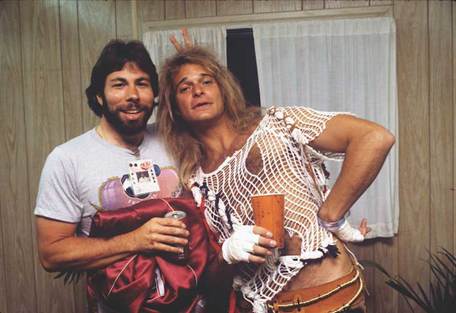
He meekly returned to Apple in 1983, applying for a job as an ordinary engineer, and worked on a sixteen-bit successor to the Apple II (though much of his time went to maintaining his symbolic role as an inspirational engineering hero, or even a mascot). Then he left again, for good, in 1985. The sudden fame and fortune granted to him in 1980 came as a bolt from the blue, not an expression of an inborn telos. His subsequent ventures, including a stint teaching computer skills to students in the Los Gatos School District, were marked by amiability and good nature, not a will to technological power.[1]
Steve Jobs, on the other hand, driven by an ambition to one-up himself and “make a dent in the universe” (a favorite phrase of his), went in urgent search of a second stroke of lightning. At first, he focused his attention on the design of the Apple III, the anointed successor of the II. Jobs, as Vice President for Research and Development, was involved in high-level product design decisions, but Wendell Sander, recruited from Fairchild Semiconductor as Apple’s first staff scientist, led the engineering team (the project was code-named after Wendell’s daughter, Sara). A fully-powered business machine, the III would lean into the success of VisiCalc by offering serious users everything they might ever want: more memory, a built-in floppy disk drive, upper- and lower-case text, an eighty-character-wide display, a clock chip, and backwards-compatibility with Apple II software. It was rushed to market in late 1980, to cover an expected drop in sales from the aging Apple II, and make a splash just before the IPO.
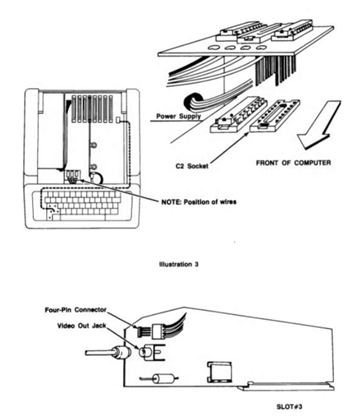
It bombed. Many explanations have been offered for this failure, but most come down to inadequate development time. Jobs’ decision to design the case before the hardware that would go in it was fully defined also contributed. The rush to cram everything needed into the case led to a circuit board with wires spaced too closely together, causing shorts from solder that bridged these small gaps; much of the initial production run didn’t work at all. The promised clock chip was not ready in time and would not ship with new computers until late 1981. These technical failures in engineering and production were expensive and embarrassing.[2]
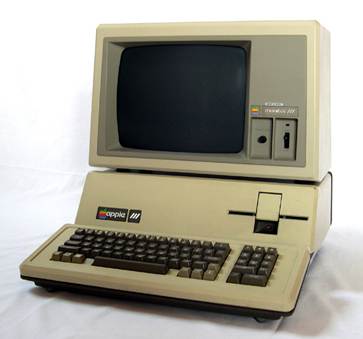
But Apple could have overcome them if not for the serious flaws in the Apple III as a product: hardly any software was ready for the launch (VisiCalc was the only major application) and its backwards compatibility strategy was deeply compromised. Many users already had third-party 80-column display cards for their Apple IIs, and software designed to use them. The Apple III could emulate a II, but none of the advanced Apple III features (such as 80-column display) worked in emulation mode; the very users most eager for a better business machine would have to throw away their software to migrate. Jobs expected sales of 50,000 units in the first year, but it would take almost three years to reach that figure.[3]
Jobs had little interest in the incremental Apple III after the initial product direction was set; this was not the revolutionary computer he was looking for. And so, he moved on before the whiff of incipient failure became a stench. His next stop was the Lisa computer, then, after Apple’s CEO forced him off of that project, Macintosh. The history of these computers more properly belongs to another volume of this story, but suffice it to say that the Lisa, released in 1983, was another commercial failure and the Macintosh, released in 1984, did not really take off until it was upgraded in 1986.[4]
Looking California
Despite its failure to launch any successful new computer line, Apple Computer continued to rake in revenues and profits. The Apple II series, believed by Apple execs to be on fumes circa 1981, somehow carried the company for half a decade more. The original 1977 model had already been supplanted by the expanded-memory Apple II Plus in 1979. Then, in 1983, Apple released the IIe, which had an improved keyboard and display circuitry capable of supporting lower-case characters (the original Apple II was upper-case only), among other features. But its most valuable advance from Apple’s point-of-view was invisible to users: reflecting the lessons of the home computer wars, the Apple IIe had custom-built chips to control the input, memory, and output. At scale, these were far cheaper to manufacture than the off-the-shelf circuits in Woz’s original design, allowing Apple to continue to rake in profits even while slashing prices: by 1984 a complete IIe system with monochrome monitor, disk drive, and expansion card with eighty-column support, sold for $1300, about the same price as a barebones Apple II Plus at release, despite the intervening years of high inflation. That same year Apple released the luggable Apple IIc, with a built-in floppy disk and printer controller card.[5]
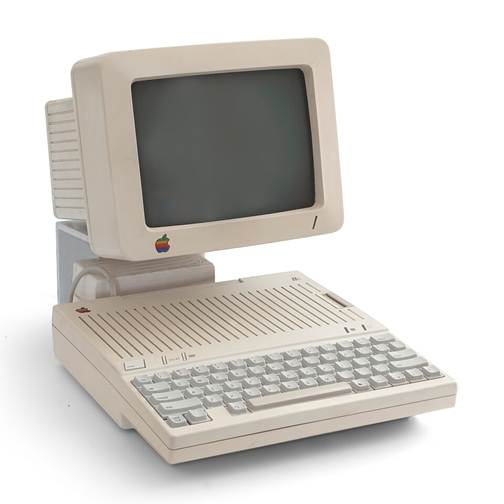
These models sold. The Apple II accounted for one quarter of the six-hundred-million-dollar American microcomputer market in 1982. In volume terms, it hovered between ten and fifteen percent of all American computers sold throughout the first half of the 1980s. The IIe alone sold 110,000 units over Christmas 1983. While Jobs pursued projects that offered more glory and glamor, unsung figures like engineers Walt Broedner and Peter Quinn and Apple II division director Del Yocam were bringing home the bacon.[6]
Apple had set in motion a flywheel in the late 1970s whose momentum carried the company through most of the subsequent decade. The initial impetus for the flywheel came partly from Wozniak’s insistence on making the Apple II expandable like a mini-computer, but also partly on the fact that the company’s early leaders understood that the external communities that feed and sustain a computer are at least as important to its success as the hardware itself.
We have already said something about how the Apple II became especially attractive to software developers in the context of the success of VisiCalc. With high-resolution color graphics, an inexpensive floppy disk drive, and a maximum of 48 kilobytes of memory, the Apple was technically superior in several ways to its late-1970s competition. But Apple also directly encouraged outside software developers in ways that many of those competitors did not. While some computer vendors tried to protect their technical secrets in order to give as much advantage as possible to in-house software products, or even (in the case of Radio Shack) excluded outside software from their sales channels, Apple made the details of their hardware freely available.[7]
The story with third-party hardware was similar – the Apple II’s open hardware specs and eight expansion slots encouraged the proliferation of hardware vendors making boards to do everything from supporting external peripherals like modems, printers, or drawing tablets to expanding the capabilities of the Apple II itself with more memory, better graphics, or even the ability to emulate other computers.[8]
Without a ready-made retail network like Radio Shack, Apple had to work hard to build relationships with retailers, and had a close relationship with the largest chain, Bill Millard’s ComputerLand. The robust software and hardware ecosystems attracted the most important community of all to those stores: buyers, many of whom came to the Apple II to get their hands on software or hardware available nowhere else. The most sophisticated computer role-playing games in existence in 1981, for example (Ultima and Wizardry), could be experienced onlyon the Apple II. More buyers, in turn, made Apple all the more attractive for new software and hardware makers, and the flywheel spun faster still. By the early 1980s, while other companies were selling higher volumes of computers, Apple was able to hold to a higher price point and pull in greater profits. People were willing to pay a premium to get access to what Apple had to offer.[9]
The Apple II sat within (and could not succeed without) this nurturing matrix of relationships with third-party hardware and software makers, retailers, and computer users. But it took one more community to sustain the incredible longevity of the Apple II: America’s educators. In 1984, Apple held about half of the market for computers in primary and secondary schools. As late as 1995, a survey found that 37.5% of the computers installed in public schools came from the nearly two-decade-old Apple II line (another 20% were Apple Macintoshes). As Steve Jobs reflected that same year, “[o]ne of the things that built Apple II’s was schools buying Apple II’s”. It began in 1978, with one more kick of the flywheel.[10]
Feeling Minnesota
By the 1970s, computers were inexpensive enough that terminals began to show up outside the university, in high schools and middle schools across the United States—especially in Minnesota. Educational computing took off in Minnesota like no other state due to a high concentration of computer businesses in the Minneapolis-Saint Paul area (Sperry Univac, Honeywell, and Control Data as well as a major IBM facility in Rochester), the presence of a major university in that same double-metropolis, and a progressive political culture that encouraged educational innovation.[11]
In 1965, University High, the University of Minnesota’s laboratory school, contracted to connect long-distance to the Dartmouth Time-Sharing System for upper-grade math lessons, using a grant from the General Electric Foundation to pay for the telephone fees. But reaching across to the East Coast was not a tenable long-term solution for getting students computer access. A couple of years later, a consortium of Twin Cities school districts banded together as Total Information for Educational Systems (TIES) to secure a federal educational grant and assistance from the university to buy and operate their own time-sharing system.
In 1973, the Minnesota legislature authorized the expansion the TIES cooperative model to the entire state, under the auspices of the Minnesota Educational Computer Consortium (MECC). MECC marshalled all of the collegiate and K-12 time-sharing resources in the state with the goal of serving every student, especially those “outstate”: that is, far from the density of population, wealth, and resources in Minneapolis-Saint Paul. To that end, it leased dedicated telecommunications lines to connect computers to distant school systems, set up low-cost programs for schools to buy and maintain computer terminals, and assembled a library of educational software (building on what TIES had already started). In the 1974-1975 school year, MECC’s network was used by 84% of public-school students in some capacity.[12]
By the end of the 1970s, however, more and more schools wanted microcomputers, not time-sharing terminals. The up-front cost was similar and the ongoing cost lower (since they accrued no telephone charges or computer rental fees), microcomputers offered graphical displays while most terminals were text-only, and access to a microcomputer didn’t have to be shared and coordinated with other schools. MECC’s primary time-sharing system in the late 1970s and early 1980s, for example, supported about 150,000 unique users (mostly students) but could handle only about 400 at one time. So, assuming they weren’t coming in on nights and weekends, each student could only claim about thirty minutes of computer time each month. After a microcomputer study in 1978, MECC decided to sign on with Apple in October of 1978 as the primary supplier for instructional microcomputers in Minnesota.[13]
The exact reasons for Apple’s triumph are unstated in any source I have found. They certainly did not win on price alone, as their two main competitors (Radio Shack and Commodore) would easily have undercut them. It may have been down to Apple’s commitment to the education market: according to a later interview by Dale LaFrenz (a long-time MECC administrator), Atari, Radio Shack, and Commodore were all inattentive the details of the contracting process, while Apple had a dedicated educational liaison (Roger Cutler, a former college professor, who became the point person for the MECC relationship).[14]
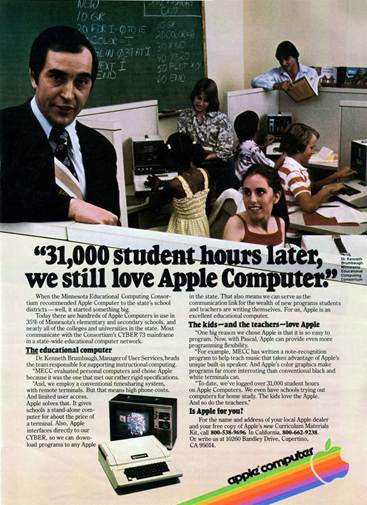
The Minnesota educators would certainly have noted that the Apple II, unlike the TRS-80 or PET, had built-in color graphics, a particular boon for drawing the attention of elementary-age students. It may (speculatively) also have been yet another victory for the Apple II Disk—in 1978 Apple was still the only major computer maker with a reliable, reasonably priced disk drive. Disk software was far superior to cassette software, especially in a classroom setting, where waiting minutes for a program to load would eat into precious instruction time.[15]
MECC sold a substantial number of Apples directly to Minnesota schools: about 2,000 by early 1981 and 10,000 by the end of 1984. But more importantly, they offered a catalog of predominantly Apple-based educational software, some ported from time-sharing systems and others original to the Apple II. In early 1981 this consisted of nineteen disks, roughly one-third elementary education, one-third secondary education, and one-third “other” (such as administrative tools, special education, or drivers ed).[16]
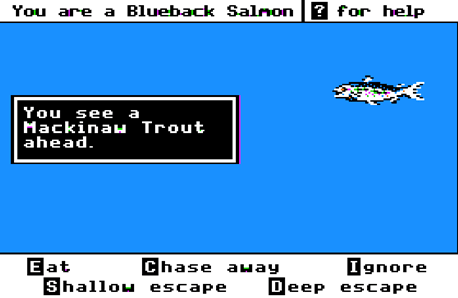
This material, drawing on a decade of institutional experience, was of exceptional quality for its time. A program in MECC’s sampler package called Odell Lake, for example,let students simulate the behavior of various species of fish, and was accompanied with twelves pages of documentation including clear instructional objectives. (More typical of the market was dross like Radio Shack’s $29.95 elementary school drill program Show and Spell—boring, frustrating, and of doubtful educational value).At first MECC gave their “courseware” away free of charge, later they offered a site license that allowed schools to use as many copies of a disk as they liked for a single flat fee. Schools wanting to take advantage of MECC’s exceptional resources had no choice but to buy Apple IIs.[17]
But beyond direct sales even indirect software leverage, MECC also exerted a penumbra of influence on other states and their school districts, who looked to Minnesota as a leader. Some states (like Colorado and Wyoming) partnered with MECC while others (like Iowa and Illinois) formed their own state computing consortia. And so, Apple’s advantage in the market continued to grow, state by state and school system by school system, from Houston (which by October 1981 had acquired 200 microcomputers, mostly Apple IIs), to Alaska (whose Individualized Study by Technology program comprised six courses of Apple II software).[18]
Kids Can’t Wait
Steve Jobs, however, didn’t want to wait for the gradual accumulation of Apples in schools across the country. As he recalled years later:
When I was ten or eleven I saw my first computer. It was down at NASA Ames (Research Center). I didn’t see the computer, I saw a terminal and it was theoretically a computer on the other end of the wire. I fell in love with it. …I thought if there was just one computer in every school, some of the kids would find it. It will change their life. We saw the rate at which this was happening and the rate at which the school bureaucracies were deciding to buy a computer for the school and it was real slow. We realized that a whole generation of kids was going to go through the school before they even got their first computer so we thought the kids can’t wait.
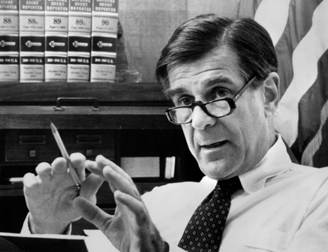
During a flight around late 1981 or early 1982, Jobs ended up next to Pete Stark, a California congressman with an MIT engineering degree, and began talking up his vision of a computer in every school. Stark did not represent Silicon Valley, his district consisted of the blue-collar towns of East San Francisco Bay (including Fremont, where Apple would open a factory to make Macintoshes in 1983). Nonetheless, he was convinced of the urgency of getting computers into schools. Shortly thereafter, he introduced the Computer Equipment Contribution Act in the House of Representatives. It would offer a limited-time tax deduction for computer equipment donated to schools, which could be valued at up to double their cost basis (that is to say, a company could deduct up to $1000—the exact maximum depended on the fair market value—for donating a computer that cost $500 to make). Jobs himself came to Washington to lobby for the bill: “[a]ll we want to do,” he told the House Ways and Means Committee, “is simply help the other States [sic] duplicate the success of Minnesota.” Though the exemption of course applied to any computer maker, Jobs’ pet project was commonly and justly known as the “Apple bill.” The only other computer industry representative to testify in its favor was Emery Rogers, chairman of Hewlett-Packard’s philanthropic arm.[19]
However, after passing the House easily, Stark’s bill became caught in the gears of larger education policy debates and never made it to the floor of the Senate. The Reagan administration, initially opposed, turned in favor of the bill as a potential weapon in its war to replace federal funding for education with private aid. Those in favor of a more expansive federal role in education, on the other hand, tried to make it just one piece of wider education policy bill. Impatient, Jobs moved on. The kids couldn’t wait, after all. So, he pressed his own state government to give computer-makers a similar deal.[20]
California came through in September 1982, with a bill closely modeled on the earlier federal bill. Apple donated about 9,000 computers under their “Kids Can’t Wait” program, one to almost every school in the state, at a net cost after tax deductions of about $1 million. This gave Apple a head start in every California school system that hadn’t already bought heavily into microcomputers, and provided a great marketing moment for Apple: the computer company that cares about education.[21]
Teacher’s Pet
In sheer volume, the Apple II was never the best-selling computer in the United States: it was outsold first by the TRS-80, then the Atari 400/800 then the Commodore 64, before all were drowned under the rising tide of IBM-compatibles (and yes, we will get there soon, patient reader) Nor did it have a complete lock on the educational market. Among Apple’s competitors, Radio Shack made the strongest effort to compete for the attention of schools, pushing the Color Computer as a lower-cost Apple alternative. In 1984, Radio Shack managed to secure about 20% of the market (compared to Apple’s 50%), followed by Commodore with 15%.[22]
Nonetheless, the Apple II’s ubiquity in schools probably made it the single most familiar model of computer in the United States. In 1984, just 8% of American households had their own computer, but 82% of elementary schools and 93% of high schools had at least one. Statistically speaking therefore, most students’ first and most formative experiences with computers would come at school, where Apple ruled. To half a generation of young people, the Apple II was personal computing.[23]
By the mid-1980s, MECC’s educational influence had waned. The microcomputer had disintegrated its original purpose of state-wide coordination of services, and it gradually mutated from a state-backed cooperative into a fully-private software company. In 1995, it was acquired by SoftKey, whose founder, Kevin O’Leary, later became Shark Tank’s Mr. Wonderful. Color graphics and a disk drive no longer made the Apple II special. The Kids Can’t Wait program had come and gone. But the flywheel had been set in motion: in 1982, 20% of Apple’s sales came from schools, and two years later half of the computers bought for schools in the United States were Apples.[24]

By this time, Apple’s primary competitors in 1979, the PET and TRS-80, were has-beens; few administrators would bet their school’s future on these dated monochrome machines. Commodore had brough out the Commodore 64 and Radio Shack the Color Computer 2, but the Apple II by this time had accumulated a years-deep back catalog of educational software. For administrators of school systems full of teachers familiar with Apples, staff trained to repair Apples, and piles of existing software that ran only on Apples, it only made sense to continue to buy more Apples. MECC itself remained predominantly an Apple II shop for over a decade, such was its gravitational force: “MECC simply stayed on Apple II because Apple II computers were the school market.” Not until the 1990s did they pivot to software for newer computers, with the help of venture capital from an IPO.[25]
In 1984, thirteen computer magazine editors unreservedly recommended the Apple IIe as the best computer for schools, because of the “tremendous body of interesting and innovative educational material available for the Apple ranging from real-time science experiments to special keyboards for preschoolers.” Up to now I have largely avoided this key point: what was the “educational material” that students were using? What were computers doing in classrooms in the first place? Who (other than Steve Jobs) thought they would be useful there, and for what? That will be the subject of our next installment.[26]
[1] Michael S. Malone, Infinite Loop: How Apple, the World’s Most Insanely Great Computer Company, Went Insane (New York: Doubleday, 1999), 199-202, 322-324; Frank Rose, West of Eden: The End of Innocence at Apple Computer (New York: Viking, 1989), 105; Jeanne Duprau and Molly Tyson, “The Making of the Apple IIGS,” A+ (November 1986), 57-63.
[2] Some accounts attribute the Apple III’s hardware failures to Jobs’ mandate that it have no cooling fan, but the consensus of well-informed opinion is that this was not true, opinion which is bolstered by the fact that the re-designed Apple III, released in late 1981, still without a fan, worked fine. Computer History Museum, “An Evening with Former Apple Industrial Designers Robert Brunner and Jerry Manock” (June 4, 2007) [https://www.computerhistory.org/collections/catalog/102695056, 25:30-27:15].
[3] Moritz, Return to the Little Kingdom, 301-305; Malone, Infinite Loop, 181-198; Gregg Williams and Rob Moore, “The Apple Story, Part 2,” BYTE (January 1985), 177; David Ottalini, “An Interview with Wendell Sander, Ph.D.,” The /// Magazine (November 1986), 8-11 [https://digibarn.com/collections/systems/appleIII/sandersinterview.html].
[4] Moritz, Return to the Little Kingdom, 305, Walter Isaacson, Steve Jobs (New York: Simon and Schuster, 2011), 93-94.
[5] Apple, “It’s the Same Old Apple II,” Interface Age, 10-11; Scott Mace, “Apple IIe Sales Surge as IIc is Readied,” InfoWorld (April 9, 1984), 54-55. Apple released more II sub-models in subsequent years. The IIGS, produced from 1986 to 1992, was really an entirely new 16-bit computer, with special emulation hardware to allow it to run Apple II software. Two years later came the IIc Plus, a “true” Apple II with a higher-speed 6502 processor than its predecessor and a 3.5-inch floppy drive, the new standard. It lasted until 1990. The IIe lasted longest of all; Apple continued to ship IIe computers until 1993, a full ten years after its debut.
[6] Rose, West of Eden, 11, 14, 110, 168-172; Gregg Williams, “C is for Crunch,” BYTE (December 1984), A75-A76; Jeremy Reimer, “Total Share: Personal Computer Market Share 1975-2010,” Jeremy’s Blog (December 7, 2012) [https://web.archive.org/web/20190705092524/http:/jeremyreimer.com/rockets-item.lsp?p=137]. To give credit where it’s due, the IIC did owe its new “snow white” aesthetic to Jobs.
[7] Michael S. Tomczyk, Home Computer Wars (Greensboro, NC: Compute! Publications, 1984), 6, 22.
[8] Steven Weyhrich, “Peripherals,” Apple II History (ca. 2011)[https://www.apple2history.org/history/ah13/#04].
[9] Jonathan Littman, Once Upon a Time in ComputerLand (New York: Touchstone, 1990), 131. Apple tried to break ties with ComputerLand in 1982 over irritation that they were being used as a prop to sell IBM PCs, but it was not practical to stay away and the split didn’t last. Rose, West of Eden, 184-185.
[10] Richard Severo, “Computer Makers Find Rich Market in Schools,” New York Times (December 10, 1984); Laurie Flynn, “Apple Holds School Market, Despite Decline” New York Times (September 11, 1995); Daniel Morrow, “Excerpts from an Oral History Interview with Steve Jobs,” Smithsonian Institution Oral and Video Histories (April 20, 1995) [https://americanhistory.si.edu/comphist/sj1.html].
[11] “Interview with Ken Brumbaugh,” Creative Computing (March 1981), 116.
[12] Joy Lisi Rankin, A People’s History of Computing in the United States (Cambridge: Harvard University Press, 2018), 139-165.
[13] By this time, Minnesota’s own Control Data Corporation had commercialized the PLATO time-sharing system, and tried to convince MECC to augment their time-sharing services with PLATO terminals, which did have graphical displays. But they were extremely expensive, and the state invested its money in Apple computers instead. “Interview with Ken Brumbaugh,” 119; Christopher Felix McDonald, “Building the Information Society,” Doctoral Dissertation, Princeton University (2011), 173.
[14] Judy E. O’Neill, “An Interview with Dale LaFrenz,” (Charles Babbage Institute, April 13, 1995), 27-28; “Apple Names Education Marketing Specialist,” Intelligent Machines Journal (December 11, 1978), 9. According to a different account, it was Apple who neglected the procurement process, and barely got their application in on time, but also claims that Cutler was key to Apple’s bid: Kenneth Brumbaugh,“Reflections on Educational Computing,” Creative Computing (November 1984), 170.
[15] O’Neill, “An Interview with Dale LaFrenz,” 25.
[16] “The Minnesota Educational Computing Consortium,” Apple Education News (January 1981), 8-9 [https://archive.org/details/apple-education-news-n-5-jan-1981]; Brumbaugh, “Reflections on Educational Computing.”
[17] Isaac I. Bejar, “Show and Spell from Radio Shack,” Creative Computing (March 1981), 22-24; Walter Koetke, “Software Close-up,” Creative Computing (March 1981), 134-138.
[18] David G. Wilck, “Minnesota Pioneers the Use of Computers in Classrooms,” Christian Science Monitor (June 9, 1983); National Science Board Commission on Precollege Education in Mathematics, Science, and Technology, Educating Americans for the 21st Century: Source Materials (Washington, D.C.: National Science Foundation, 1983), 173-181; Office of Technology Assessment, Informational Technology and its Impact on American Education (Washington, D.C.: Office of Technology Assessment, 1982), 222, 231.
[19] Morrow, “Excerpts from an Oral History Interview with Steve Jobs”; Ken Uston, “9,250 Apples for the Teacher,” Creative Computing (October 1983), 178; “Hearings before the Subcommittee on Select Revenue Measures of the Committee on Ways and Means, House of Representatives, Ninety-seventh Congress, second session, on H.R. 4667, H.R. 4948, H.R. 5177 [etc.],” (Washington, D.C.: Government Printing Office, 1982), 26 [https://babel.hathitrust.org/cgi/pt?id=pur1.32754077525297]
[20] Richard Corrigan, “A Setback for a Computer Company—Congress Says No Apple for the Student,” in “Extensions of Remarks,” Congressional Record 128, 24 (December 18, 1982), 32395.
[21] Uston, “9,250 Apples for the Teacher.” Apple spun off similar initiatives in other countries; they donated 2,000 computers under a Kids Can’t Wait program in Australia: “What Did You Do With Your Computer?” Education News (Nov. 1983 – Jan. 1984), 9 [https://archive.org/details/en198311].
[22] Reimer, “Total Share”; Chion-Kenny, “Schools Bought Record Number of Computers in 1984”; Boisy G. Pitre and Bill Loguidice, CoCo: The Colorful History of Tandy’s Underdog Computer (Boca Raton: CRC Press, 2014), 96-99.
[23] Chion-Kenny, “Schools Bought Record Number of Computers in 1984”; Camille Ryan, “Computer and Internet Use in the United States: 2016” (United States Census Bureau: August 8, 2018) [https://www.census.gov/library/publications/2018/acs/acs-39.html].
[24] Rankin, A People’s History of Computing, 240-241; Corrigan, “A Setback for a Computer Company”; Linda Chion-Kenny, “Schools Bought Record Number of Computers in 1984,” Education Week (March 27, 1985) [https://www.edweek.org/technology/schools-bought-record-number-of-computers-in-1984/1985/03].
[25] O’Neill, “An Interview with Dale LaFrenz,” 35.
[26] David H. Ahl, “Top 12 Computers of 1984,” Creative Computing (December 1984), 10.