HQ Trivia is dead. Today the company laid off its full staff of 25 and will cease operation of its trivia, sports and word guessing games, a source close to the company confirmed. You can watch the insane, drunken final episode here
HQ Trivia had a deal in the works to be acquired, but the buyer pulled out yesterday and investors aren’t willing to fund it any longer, CEO and co-founder Rus Yusupov said in a statement attained by CNN Business’ Kerry Flynn:
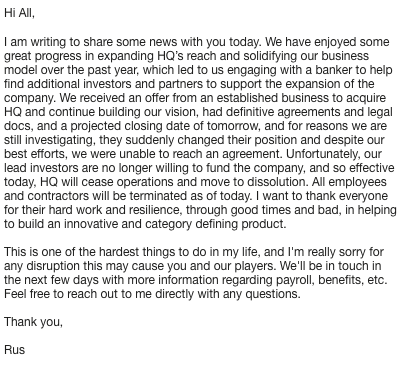
“We received an offer from an established business to acquire HQ and continue building our vision, had definitive agreements and legal docs, and a projected closing date of tomorrow, and for reasons we are still investigating, they suddenly changed their position and despite our best efforts, we were unable to reach an agreement,” Yusupov writes. “Unfortunately, our lead investors are no longer willing to fund the company, and so effective today, HQ will cease operations and move to dissolution. All employees and contractors will be terminated as of today.”
With HQ we showed the world the future of TV. We didn’t get to where we hoped but we did stretch the world’s imagination for what’s possible on our smartphones. Thanks to everyone who helped build this and thanks for playing.
— Rus (@rus) February 14, 2020
Techcrunch event
San Francisco | October 13-15, 2026
Launched in October 2017, TechCrunch wrote the first coverage of the 12-question live video trivia game started by two of the former Vine founders. Users could win real money by answering all the questions and not being eliminated in multiple daily games. HQ Trivia had raised more than $15 million, including a Series A led by Founders Fund. At one point it had more than 2.3 million concurrent players.
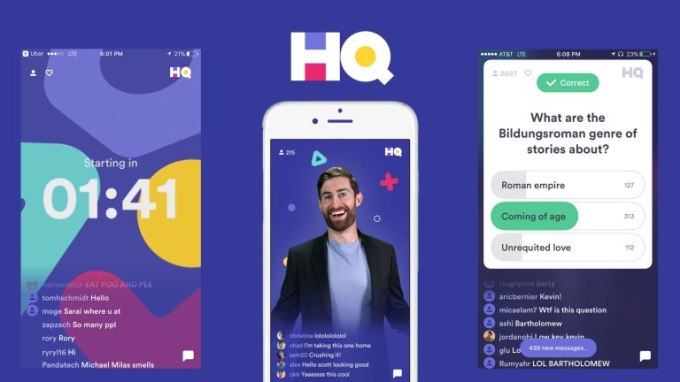
But eventually the novelty began to wear off. Cheaters came in, splitting the prize money down to just a few dollars or cents per winner. Copycats emerged internationally. Engineering issues led users to get kicked out of the game.
Then tragedy struck. Co-founder Colin Kroll passed away. That exacerbated internal problems at HQ Trivia. Product development was slow, leading users to grow tired of the game. New game types and viral features materialized too late.
A failed internal mutiny saw staffers prepare to petition the board to remove Yusupov from the CEO position. When he caught wind of the plot, organizers of the revolt were fired. Morale sunk. By July 2019, downloads were just 8% of their previous year’s, and 20% of the staff was laid off. HQ managed about 15 million all-time installs, peaking at 2 million in February 2018, while last month it had just 67,000, according to Sensor Tower.
The demise of HQ Trivia demonstrates the fickle nature of the gaming industry, and the startup scene as a whole. Momentary traction is no guarantee of future success. Products must continually evolve and adapt to their audience to stay relevant. And executives must forge ahead while communicating clearly with their teams, even amongst uncertainty, or find their companies withered by the rapid passing of time.
Josh Constine is a Venture Partner at ~$3 billion AUM early-stage VC fund SignalFire where he invests in pre-seed startups with a focus on consumer. He teaches startup pitch writing and fundraising strategy as a recurring lecturer at the Stanford Graduate School Of Business, and with accelerators like Z Fellows, Inception Studios, and Stanford ASES. Previously, Constine was Editor-At-Large for TechCrunch where he wrote 4000 articles and was ranked the #1 most cited tech journalist in the world from 2016-2020 by Techmeme. Constine has led 300+ on-stage interviews and keynotes in 18 countries with luminaries including Mark Zuckerberg and the CEOs of Shopify, DoorDash, Snapchat, Instagram, and more. Constine graduated from Stanford University with a Master’s degree he designed in Cybersociology, and wrote his thesis in 2008 on why remixable memes would be the future of marketing. He has been quoted in the NYT and WSJ, is regularly featured on CNN for his thoughts on AI and Silicon Valley, and advises startups on PR, fundraising, and organic growth.