“Is it wrong for a worker to stay at his job?”
— Wyndham Mortimer, vice president, United Auto Workers
In Sit-Down, published 1937, Joel Siedman describes a historic strike at a General Motors auto plant in Flint, Michigan. In one of a series of militant sit-downs that swept the industrial belt in the 1930s, workers recognized the need to strike for better conditions, but decided against walking out on a traditional picket line. Rather, they stayed at work, transforming the factory into a space of radical rest.
What fascinates me about the sit-downs is how relaxing they sound, knowing how much labor they actually require. Writing about Flint, Siedman paints a picture of a tightly organized system of volunteer strike supporters: people who work around the clock so that the strikers can turn hours of sitting into days and weeks.
I wrote a little about this previously when I made my tapestry about sleeping dragons: a form of direct action in which a protestor handcuffs themself to machinery or infrastructure, forcing the project to a halt. Both forms of radical rest need a committed solidarity network to keep the protestor fed and healthy.
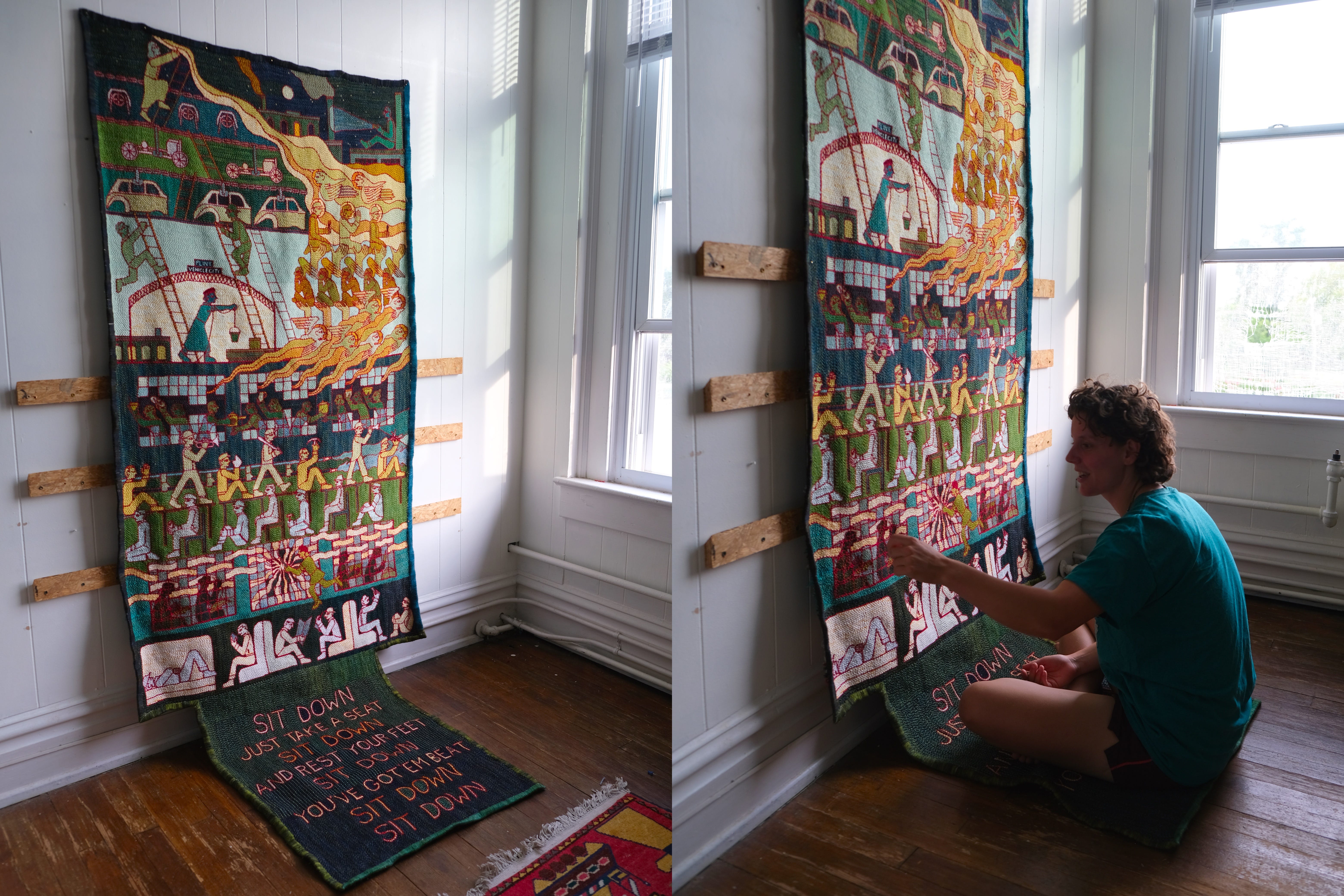
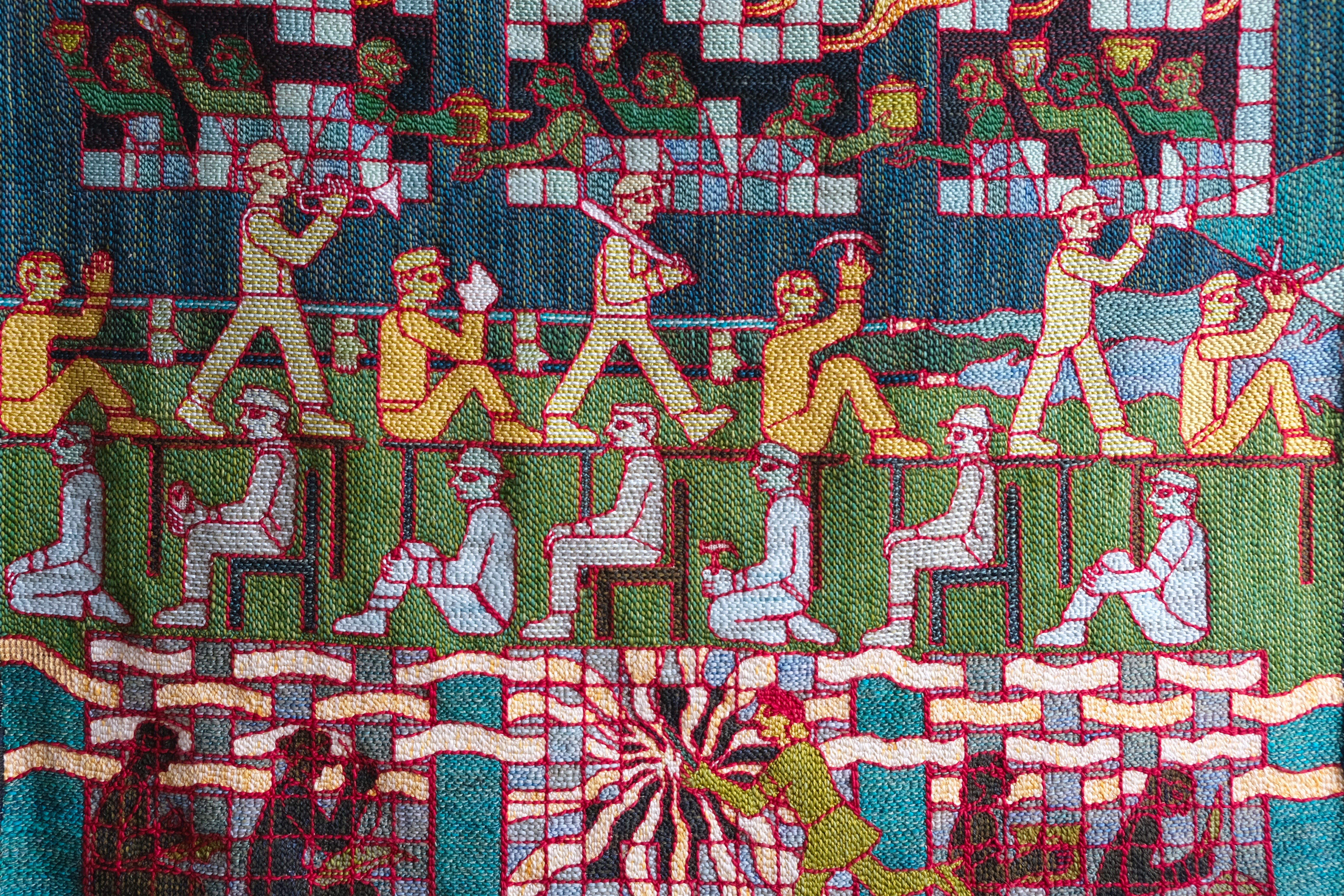
The Flint strikes were a massive success, thanks to militant organizing both inside and out of the occupied factories. In the sit-down zone, strikers formed an ad-hoc government that held nightly meetings to make collective decisions. They formed committees for security, communication, food, and entertainment. Strikers created a list of community rules which, if broken, called for extra dish duty or mopping floors. The workers held church services, musical performances, and political education classes. They kept machinery scrupulously clean and held daily sleeping area checks. In male-dominated factories, workers with barbering experience trimmed hair and beards. In one plant that mostly employed women, strikers with backgrounds in cosmetic work set up a in-house beauty parlor.
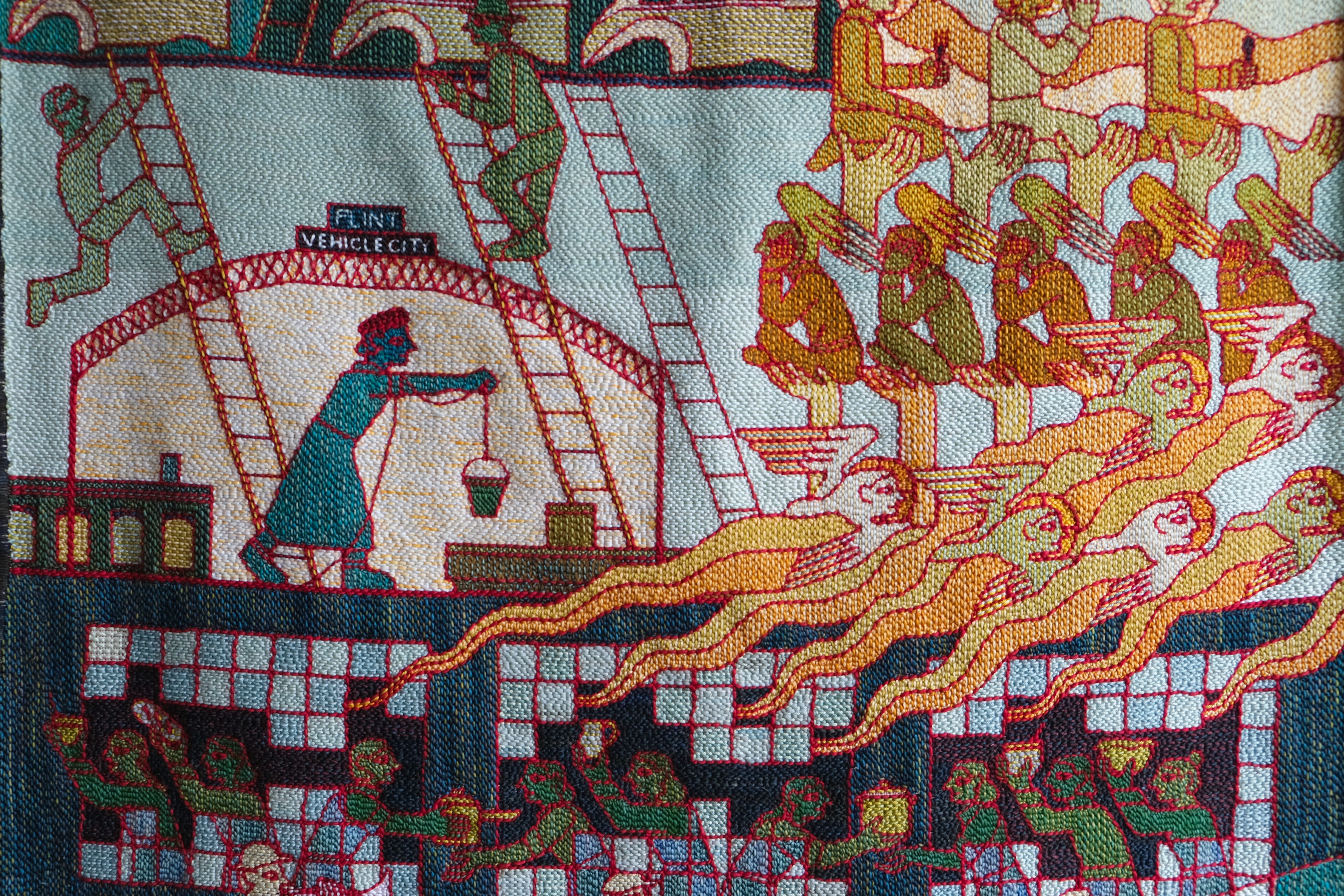
Outside the factory, companies took up war tactics to break the strike. Auto manufacturers in Flint attempted a food siege on the plant, where they blocked entrances for the community to deliver meals. The strike supporters fought back: women decorated in red berets, known as the Women’s Emergency Brigade, hauled food kettles with a rope from the rooftop of an adjacent bakery. When company men attempted to suffocate the strikers with tear gas, these women heroically smashed the factory’s windows.
I made the sit-down tapestry especially for Dom Museum Wien: a Catholic museum in Vienna, Austria, where it will be part of the upcoming exhibition Work in Progress. While I don’t practice Catholicism myself, it’s in my blood: my maternal ancestors, immigrants from Portugal and Poland, were all Catholic.
My grandparents left the Azores for Rhode Island at the turn of the century, likely escaping the dwindling whaling industry back home, and found factory jobs in the industrial new world. Part of a wave of working-class immigrants from across Western Europe, they came from a culture that prioritized leisure. The Catholic calendar organizes its parishioners around a series of feast days, during which work is forbidden. In Portugal, even the work day is disrupted by the siesta: a 2-hour rest after lunch.
One of my organizer friends in Chattanooga was radicalized by the Catholic worker movement as a young person in Wheeling, West Virginia. When he reflects on growing up in a hyper-exploited rust belt community, Corey remembers nearby House of Hagar as an organization that stepped in to provide free food to his neighbors. He never joined the church as a religious practice, but he became an active volunteer in these “mass cooks,” bringing feasts to people who need it. He still draws on his experience in the Catholic Worker movement to organize Bake The Rich: a monthly cook and food distribution project supported by Chattanooga DSA.
These mass cooks came to mind when I read about the sit-down strikes in Flint. Often, it was the workers’ wives and family members running the kitchen; but in at least one case, a local union chef was called out to an auto plant to manage what would be his 4th “strike kitchen.” Food distribution was a massive logistical challenge to keep the strike going, and just as many volunteers showed up to fundraise and gather ingredients as they did for the labor of cooking.
The whole community worked so that the workers could sit for as long as possible. I thought about this constantly during my own hundreds of hours spent sitting in front of the tapestry.
In Only the Lover Sings, Josef Pieper recalls hanging out in a sculptor friend’s studio. He saw the act of making sculptures as an expression of vita contemplativa - the contemplative life, per Aristotle. Pieper argues that an artist practices contemplation through their creative work, even though this process can seem as physically strenuous as productive labor. The act of contemplation is more than thinking: it demands seeing. And so for the artist—a visual observer—contemplation is the root of all of the work that follows.
I would go a step further than Pieper, who spent much of his life developing a theory of leisure. In my mind, the physical labor of executing an artwork is not a secondary act that simply follows contemplation. Those hours of gestures and strenuous movements are just as much a part of contemplation as the act of seeing. When the body moves, it creates the meditation. Like a good Catholic, who ritually moves from sitting to standing to kneeling over and over through the course of a liturgy, the labor-intensive artist opens a space in the mind through the engagement of the body.
I think any craft artist might agree with me. For those of us working in mediums that rely heavily on technique, and demand a long time for the execution of an object, the artist is compelled to return to the project again and again by the contemplative nature of the process. We choose these labor-intensive mediums because they are meaningful rituals, and every hour and movement is essential to the final artwork.
There are many ways to speed up the creation of a tapestry. I could invest in a tufting gun that shoots yarn, rather than hand-punching every stitch with a wooden needle. I could upload an image and print it instantly; even make mass-produced copies, using a mechanical jacquard loom. But the speed itself would destroy the work. My tapestries demand the tedious hours, because the images they contain only come to me in that contemplative space. I couldn’t just sit down for an hour and draw the pictures I’m planning to embroider on a tapestry, because they don’t exist in my mind. The conceptual image is born out of labor.
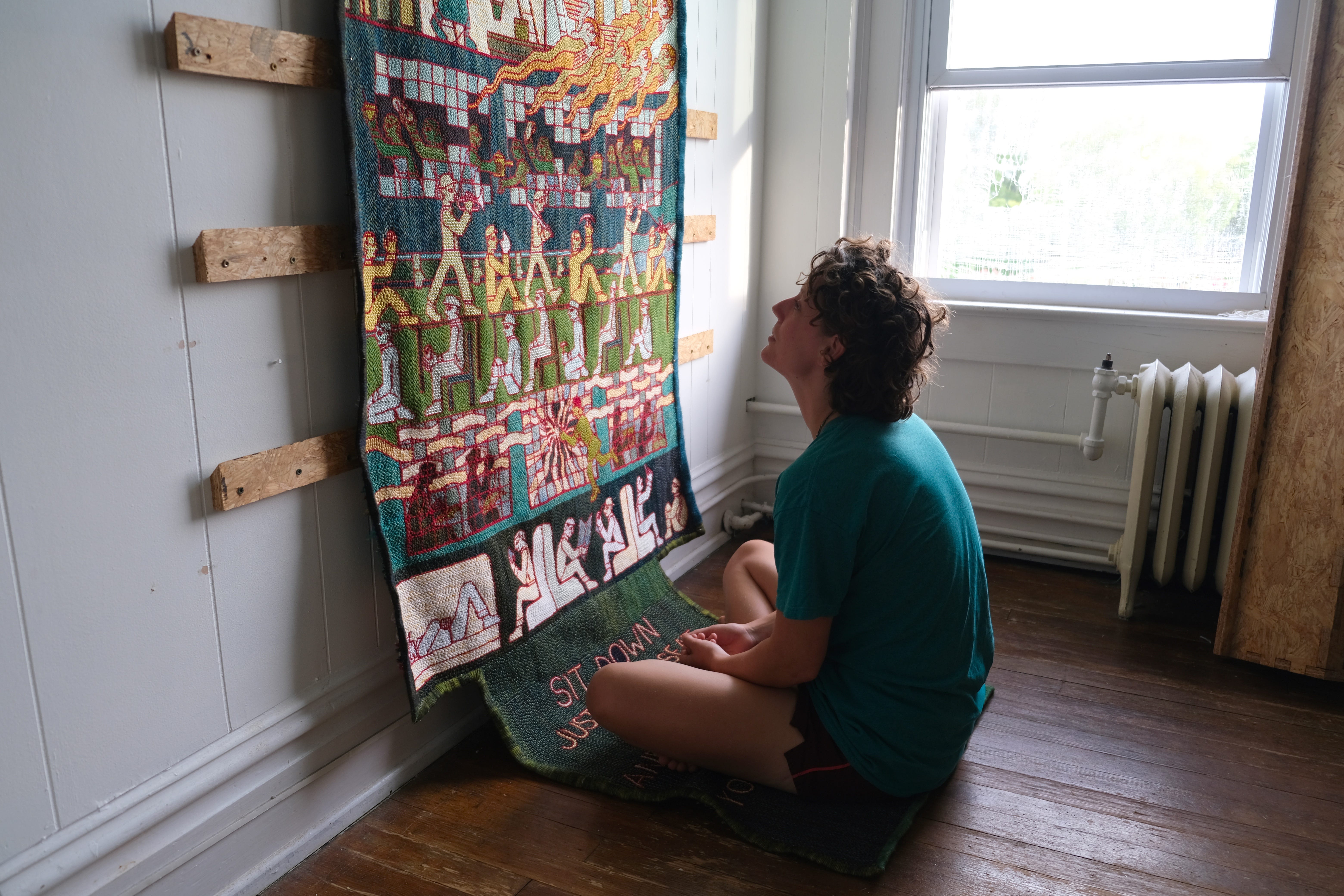
Where, in the space between work, rest, and leisure, might Aristotle or Pieper imagine the sit-down strike? Physically, the body is at ease. The worker is no longer creating value for the employer. They might sleep, read, lounge, pray, sing, or socialize. But all of this goes on within a radical space. It’s an occupation of time (the work day) and place (the work site) but also an occupation of the body. In the act of sitting down, the worker has reclaimed himself from capital. He hasn’t moved an inch, or taken off his factory uniform, but he has transformed his working body into a mode of radical leisure.
Luther believed “idle hands are the devil’s workshop.” But it’s not the devil who comes to occupy the resting striker; it’s the spirit of solidarity. The striker sits as an expression of love and justice, lifting the humanity of her brothers and sisters over any personal risk to her body and livelihood. Perhaps that’s another example of the Protestants getting labor all wrong.
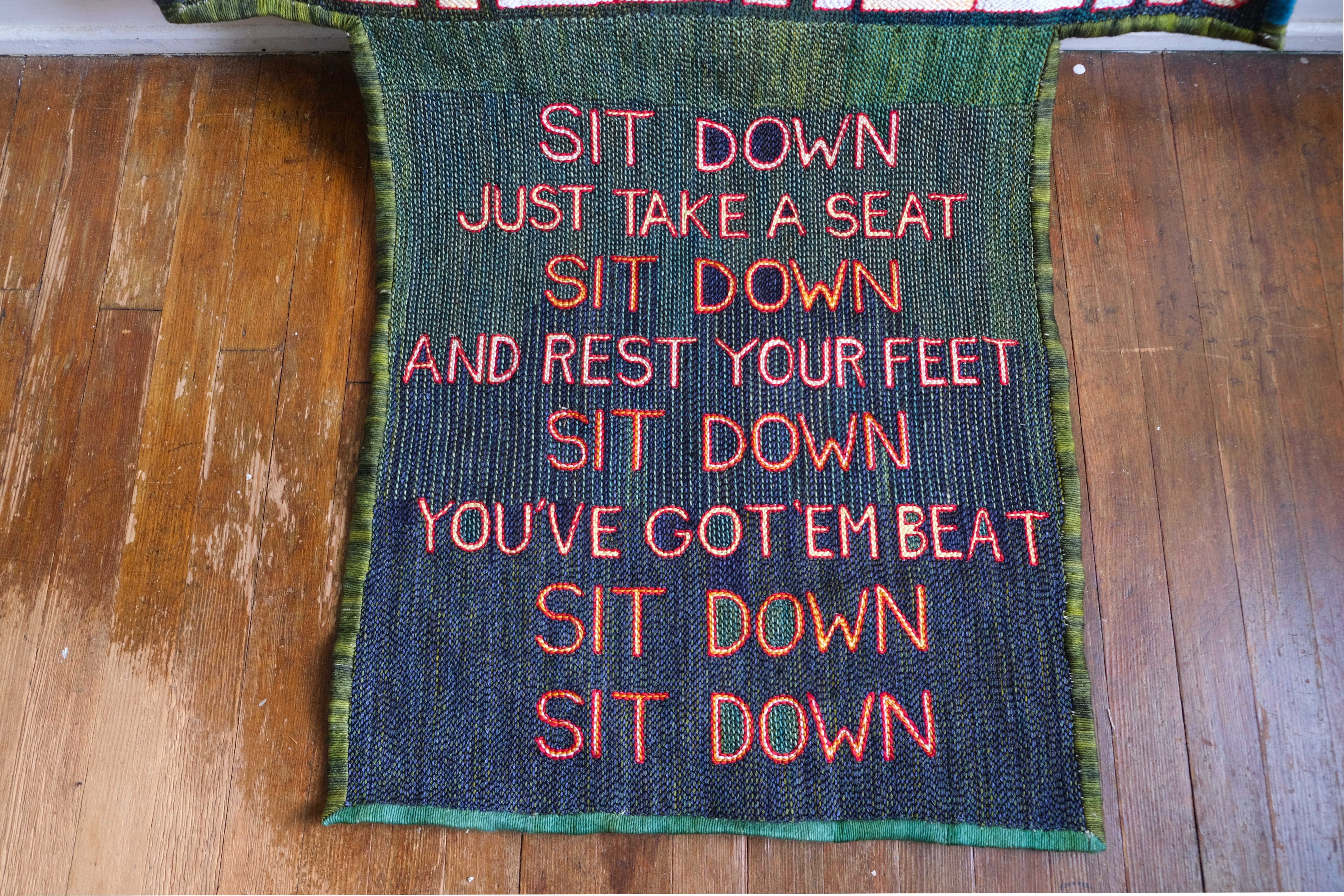
My tapestry invites the viewer to not just contemplate by seeing, but to rest while they do it, as a part of the piece itself. On the foot, which crawls out on the ground before the wall-mounted work, I’ve embroidered lines from Maurice Sugar, general counsel of the UAW and folk protest songwriter. Sit down, sit down — I hope some of you take up the invitation.