
Imagine a sheet of paper. It has two sides.
With me so far?
It’s not surprising that it has two sides, in fact you couldn’t call it a sheet of paper if it didn’t have two sides. Having two sides is in the nature of a sheet of paper.
Now say the paper is opaque. The writing on one side can’t be seen on the other side. Whatever you do on one side can never be “influenced” by what’s on the other side, because you can’t see it.
Suppose the paper is slightly transparent. You could, for instance, move a pen around on one side, leaving a mark, and the pen on the other side could follow that mark.
Believe it or not, we’ve just described the following seemingly wacky and famously difficult concepts:
Quantum superposition
Entanglement
“Many Worlds”
Orthogonality
Coherence & decoherence
Interference
The goddamn double slit experiment
One at a time:
The sheet of paper can certainly be said to have two sides, but you don’t have to say “a thing with two sides glued to each other,” because you can just say “a sheet of paper.”
Similarly, when you view the universe as one single thing, you can say it has lots of states, and sometimes those states can interact easily, and sometimes it’s very hard for them to interact.
When you say a coin flip can result in heads or tails, you don’t say “a heads-tails object,” you just say a coin. The coin is the actual underlying thing, not the results of flipping it. Furthermore, it’s not strange that there’s a 50% probability of heads or tails, it’s simply a fact of the thing having two sides.
This is the big bad boy, the one that every motherfucking journalist apparently ever calls “spooky action at a distance,” and I 100% guarantee you Einstein would go back in time and shoot himself before he ever said that just to prevent anyone else from ever repeating it.
Anyway, entanglement is when you’re able to follow the pen on the other side of the paper. Entanglement says “the marks on both sides of the paper constitute the whole paper.” That’s it. Yes, really. If you introduced another, separate sheet of paper, it’s possible their marks don’t have anything to do with each other, and you’d say they are not entangled with each other.
Another way of saying this: in order to describe the whole piece of paper, you must describe what’s on both sides of it. That means the two sides are entangled with each other.
If you take away only one thing from this unhinged, oversimplified rant, make it that entanglement is not a weird, unexpected connection between things. Entanglement is ordinary. Things NOT being connected is actually the much weirder, hard-to-imagine phenomenon.
Like many, I bet, Sean Carroll got me into Everettian quantum mechanics, often referred to as “Many Worlds,” because it’s what you get when you “take the math at face value,” so to speak.
So say you start off with a slightly translucent sheet of paper. Your marks on one side can be informed or affected by marks on the other side.
Then the sheet of paper becomes opaque, or least opaque enough where you can no longer see anything on the other side.
This is what is commonly thought of as “branching universes.” But you didn’t branch anything, you just can’t see the other side of the paper any more. That doesn’t mean your side is the only side that exists, or ever existed. The sheet of paper has always been there and its other side will go on doing whatever it does.
Those two independent sides are “orthogonal” to each other.
Look at a simple x-y chart. The reason we say the x-axis is “orthogonal” to the y-axis is because you only need one axis to describe a point on that axis.
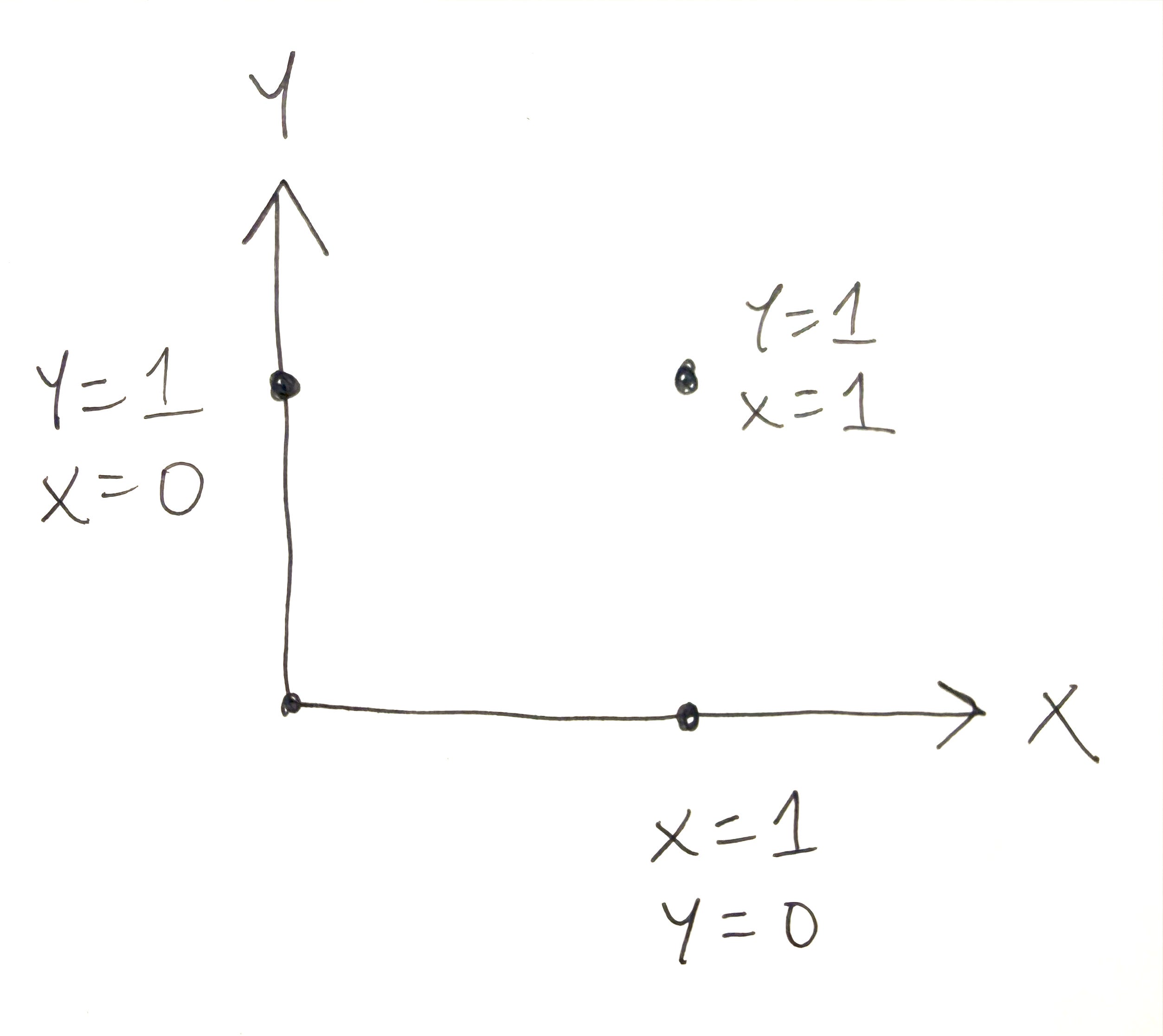
If you want to describe a point on the plane, you need at least two axes.
These axes are also called:
Dimensions
Degrees of Freedom
So when a “world” or “universe” or “branch” is orthogonal to another one, it means they are independently describable, and further, that you cannot provide any information about one world with another orthoganal world.
Following from the previous example, the translucent sheet of paper is in a “coherent” state, and “decoherence” is the process of the other side of the paper becoming unable to affect your side.
Let’s take this a bit further. When you make a mark on your side of the paper, the other side can see it and react to it. But the paper fibers move slightly, which themselves affect other nearby marks on both sides of the paper. Tiny wrinkles and cracks start to appear in the paper. The ink bleeds nearly imperceptibly.
The information in your mark is no longer just in the mark you made: it has spread out in ways you aren’t thinking about or aware of. And in order to describe the whole mark, now, you have to describe the entire sheet of paper. As we said above, that is entanglement. Your mark is now entangled with the whole sheet of paper.
Now let’s get to the really crazy interesting bit: Imagine that all these changes to the paper from the marks on your side start to make the paper itself opaque, so you can’t see the other side anymore.
THAT is decoherence!
We said above that two paper-sides that can’t influence each other are orthogonal. The decohered, now-orthogonal sides are effectively different, separate sheets of paper! This is what is meant by ‘branching’ ‘worlds.’ There’s no actual branching, and there’s still only one world, but the other side of the paper you started on is no longer ‘recoverable.’
(And if that sounds a little bit like thermodynamics to you—you’re not alone, and you’re poking at one of the biggest ideas in modern fundamental physics.)
OK, now this one will admittedly be slightly tortured.
Hold the sheet of paper horizontally, only by its edges, so it can freely vibrate, and sprinkle some sand on it. Play a sound in the room.
Some sand will settle in the parts of the paper that don’t move (these are called nodes).
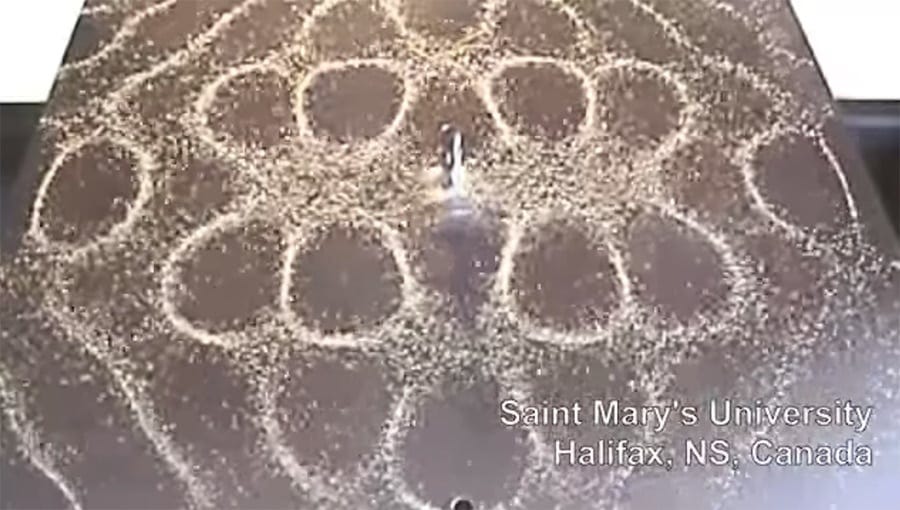
The motion of the paper causes the sand to be distributed in a certain way.
If you only ever lived on one side of the paper, you’d think, holy fuck, we’re spraying sand at the paper one grain at a time and yet they’re falling in place in this specific pattern! WHAT THE FUCK!
You have to imagine that both sides of the horizontal sheet of paper have the same gravity pulling on them and so on, so that a person living on the ‘under’ side is seeing a similar-but-different result. The underside world is “entangled” with our world because the vibration of the paper is affecting the sand on both sides, even though we can’t see the sand on the other side.
The point is that everything—the sand, and the pattern the sand is in, are elements of one system: the vibrating paper and the sound. In fact, the sand is all one continuous substance: the “sand field.”
This sand analogy has another very interesting angle.
First, stipulate that the sheet of paper is never not vibrating. It’s never still. Because of this, you can never place a grain of sand in an arbitrary place (state) and expect it to stay there. It will always settle into the nodes of the paper, given whatever pattern of vibration the paper is in.
This is what is meant when physicists say the classical world “emerges” from the quantum one. The stable result—the sand pattern—is describable with classical physics. But not every quantum state is equally robust: some “survive” and some “die out,” and we simply never find ourselves in unstable universes.
In this picture, there is no “wavefunction collapse.” There is no “observation.” There doesn’t need to be.
“Wavefunction collapse” and the “Copenhagen Interpretation” only seem sensible if you’re only ever seeing one side of the paper. You’re saying, “it’s as though there’s a vibration, but since only one side of the paper exists, the vibration must just magically go away because otherwise we have no explanation for it.”
We could say a grain of sand being jiggled into its resting place is an “interaction.” But you’d never called it an “observation.” Why would you? It doesn’t need to be observed, and it doesn’t need an observer. It’s just a thing that happens as a result of the movement of the paper.
Okay, you may have noticed that I’ve been saying “grains of sand” without saying “particles.” Well, stay with me here while I torture the paper & sand analogy even more. (TL;DR: there are no grains, only sand!)
Although the paper can vibrate in countless complex ways, all of them can be decomposed into simpler patterns called modes. If you’ve ever worked with sound and the Fourier transform, same thing.
The fact that there are irreducible underlying modes isn’t an ‘externally imposed’ rule, but rather that if something is vibrating at all, it can only do it in specific patterns.
And in order for the sheet to be vibrating, there must be some energy. When you hear “energy is quantized,” it means: there’s not no energy, and there’s not infinite energy, and there are only certain modes available to start with, so the sheet has to be in at least one basic one. This basic mode is the ‘quantum.’
If you’re reading this, you’ve probably heard of string theory. String theory isn’t about little pieces of string. It’s about the fact that a circle can only vibrate continuously in certain ways.
This next section is more speculative, and I’m not claiming that it’s a solved problem, or that I solved it.
Take an individual grain of sand and drop it on a vibrating sheet. Take a snapshot. The grain of sand is somewhere, right? But not anywhere. It is extremely likely to end up at the nodes, and extremely unlikely to end up at an antinode (the ‘peaks’ of the wave).
Why there’s a grain, and why a grain ends up here and not there is called the measurement problem, and it’s been pissing people off for as long as QM has existed.
Now, I said grains don’t exist, only the sand exists. When you take a snapshot of a single quantum of the sand field, it has to appear somewhere, and that somewhere is constrained by the wavefunction (the vibration). The apparent grain is the result of the sand field “interacting” with the paper. The remainder of the field is in all the other orthogonal universes you can no longer see.
Cool, right?
Let’s try this one another way. Take a handful of sand and spread it across an unmoving sheet. All that sand is the sand field. Start the vibration. Imagine that all the sand flies off your sheet except for one grain: in our big-picture analogy, the other sand grains have ‘decohered’ into inaccessible universes, but since we have to see at least some sand, a grain winds up somewhere on the sheet.
So why does the grain appear in this spot and not this spot?
In the case of a real physical sheet of paper and grain of sand, it’s because it had a starting location and was bounced around over time.
In the “universal wavefunction” analogy, there isn’t a reason, because there isn’t a cause. It’s like asking “Why am I Ted instead of someone else?” or “Why am I experiencing Tuesday instead of Wednesday?” The only answer is “that’s the universe I ended up in.”
But when you zoom back out and look at the whole picture of all the sheets of paper and all the sand as one big continuous thing, you realize that an apparent ‘grain’ of sand is just one ‘snapshot’ of the sand field spread across the universal wavefunction’s absurdly massive state space, and we are also spread across that space, and the you that is reading this right now is one of many in mutually-inaccessible subspaces.
…ok, so yeah, this is all still weird as hell.
But if you ask me, the source of most of the confusion around quantum mechanics is that most people are only looking at one side of the sheet of paper and doggedly insisting that it is the only side there is. (Well, that and copycat science writers.) As Prof. Carroll has been saying for many years now, Everettian QM or “many worlds” makes a lot of problems disappear because those problems rested on false premises to begin with.
So next time you draw on a piece of paper with your kid, you can tell them, “You know, all this stuff is really just an apparent artifact of the cosmos decohering constantly all around us.”