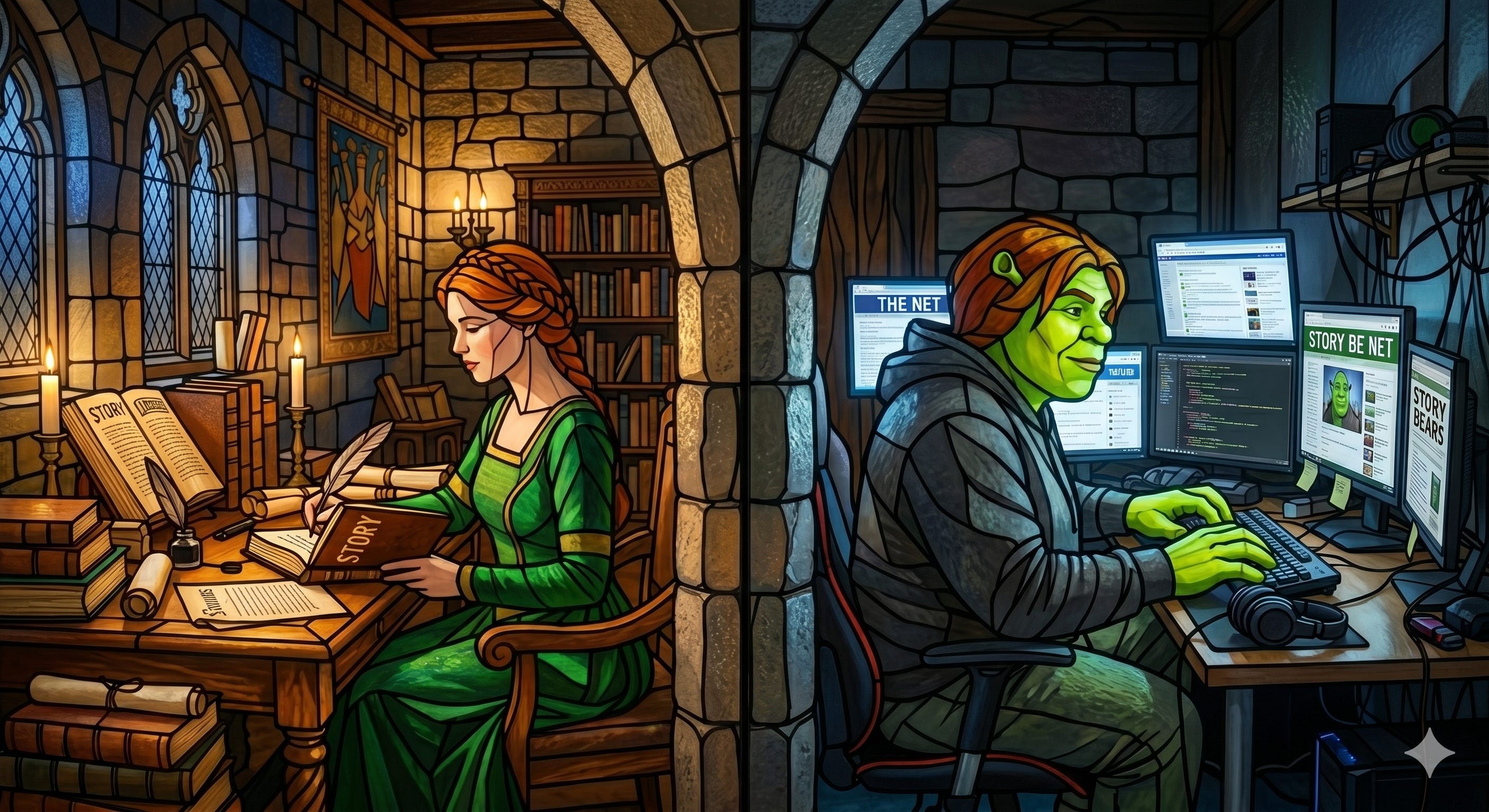
Before the late 1800s, short fiction was largely an exercise in mechanics. It relied heavily on fables, heavy-handed moralizing, or twist endings.
The mutation was sparked by Edgar Allan Poe and Guy de Maupassant, but it was Anton Chekhov who perfected it. Chekhov revolutionized short fiction by shifting the climax of the narrative from the external to the internal. He proved that a story did not require a neat, action-driven resolution to be effective. Instead, he pioneered the slice-of-life narrative, focusing on mood, psychological realism, and the internal realization—the epiphany.
By demanding that the reader look for meaning in the unresolved and the unsaid, Chekhov transformed the short story from a campfire tale into an engine for psychological depth.
If Chekhov gave the short story its soul, the mid-20th century (roughly the 1920s through the 1950s) gave it a kingdom. This era stands as the high-water mark of the form, a historical anomaly where the short story enjoyed mass-market dominance, high artistic prestige, and economic viability.
Publications like The New Yorker, The Saturday Evening Post, and Esquire boasted massive circulations. Writers like F. Scott Fitzgerald, Shirley Jackson, John Cheever, and J.D. Salinger could make lucrative, highly visible livings writing short fiction. This era also cemented the top-down nature of the form. The editors at these magazines acted as a court of kingmakers. A centralized, highly curated ecosystem where gatekeepers determined what constituted literary merit.
It was within this environment that Ernest Hemingway codified Iceberg Theory—a narrative should only show the tip, while the weight of the truth lurked unspoken beneath the surface. This mastery of the unsaid became the gold standard for modern short fiction. To be literary was to be parsimonious. The author’s power lay in what they withheld from the reader.
By the 1970s and 1980s, the magazine ecosystem was beginning to fracture, but the form itself experienced a resurgence. Writers stripped the short story down to its barest essentials.
On one end of the spectrum was Raymond Carver. Guided by the editing of Gordon Lish, Carver pioneered a brand of intense minimalism that focused on blue-collar struggles, domestic quietude, and suffocating tension. On the other end was Alice Munro, who achieved the opposite—perfecting the expansive short story that packed the weight and chronological breadth of a sprawling novel into thirty pages.
By the end of this era, as television and new media began to erode the mass-market circulation of the mid-century magazines, the short story needed a new patron. It found one in the academy.
Today, the literary short story no longer commands the mass-market cultural relevance it once did. Instead, it persists as an academic and prestige pursuit. Master of Fine Arts (MFA) programs pump out thousands of newly minted short story writers a year, and hundreds of small, grant-funded literary journals exist to publish them.
It is an entirely insular ecosystem where the writers are the primary consumers of the product. The short story has transitioned from a popular medium into a luxury good—a mechanism for cultural signaling rather than something consumed and respected in its own right.
When an art form loses its mass-market appeal and retreats into academia or high-society patronage, it stops breathing. Once it becomes a tool of status, structural change becomes problematic. Some might argue that art does not die simply because its niche shrinks. They would point toward Painting, which, as a response to the invention of photography, abandoned photorealism and fractured into movements like Cubism or Abstract Expressionism.
While historically true, this defense misses the crux of the critique. What actually suffocated the literary short story isn’t that its mass-market niche shrank. It is that a single institution made it a mission to preserve the format, filling whatever space was left with epoxy. Epoxy is a remarkable substance; it is crystal clear and seals the object in absolute rigidity. It preserves the exact shape of the mid-century short story, but it guarantees the suffocation of any further organic growth.
The prevailing literary defense for this ecosystem is that MFA programs act as a sanctuary from the degrading demands of capitalism. This is a hollow, commodified version of the Marxist Critique. The university system is, itself, a capitalist apparatus. It simply produces a different type of commodity: Prestige. Academia didn’t rescue the short story from the market; it just shifted it from the mass market to a luxury market.
Money is a made-up exchangeable concept of value. Prestige is just as made up, and academia runs on the Prestige Economy.
The fatal flaw of the Prestige Economy is its need for observable, measurable virtue. In the mass market, a reader can simply like a story. They can experience it, feel it, and move on. In academia, one cannot simply like a piece of art; they must justify it, grade it, and critique it. This creates a persistent, systemic bias toward art that is created to be analyzed rather than experienced.
To justify this academic enclosure, the literary establishment relies on a pervasive myth: that the mass market is inherently conservative and hostile to formal experimentation.
This has never been true—the public’s tastes have always mutated in unpredictable ways—but it has never been less true than it is right now. Technology has fragmented the market. The rise of self-publishing and algorithm-driven discovery means that incredibly weird, deeply niche, or previously ignored genres can suddenly explode into massive commercial success. Was it predictable to the academic elite that LitRPG or Romantasy would become the juggernauts they are now? Can they say what will come next?
There are still strong financial incentives to write to market, but there are equally strong incentives to invent the next big, bizarre thing. The mass market didn’t die; it abandoned the epoxy-filled museum.
Media theorists often look at the decentralized sprawl of internet culture and classify it as a return to Oral Folklore. They see memes as the modern equivalent of villagers telling stories around a campfire. But this theory leaves a large gap in the timeline. Oral folklore was eradicated by the printing press; it cannot be the direct ancestor of the internet meme. The parallels between Memes and Folklore are due to convergence from similar environmental pressures.
Instead, we suggest a different ancestry. The DNA of the literary short story escaped the academic laboratory and infected a new, highly volatile medium.
The Internet Meme.
We elaborate this claim by defining the Literary Short Story as a confluence of the following attributes: Parsimony, Formal Experimentation, Ambiguity and Psychological Depth.
Parsimony. The literary establishment has long worshipped at the altar of extreme brevity. Consider the famous (albeit apocryphal) six-word story attributed to Hemingway: “For sale: baby shoes, never worn.” This is considered a masterpiece of the unsaid. It makes the reader construct a tragic narrative in the blank space between two clauses. A meme operates on the same principles. It communicates complex narratives, devastating irony, and sharp cultural commentary through a single image and a handful of heavily coded words. When the foundational ideas of the short story are taken to their logical conclusion, the word count is irrelevant. A meme is just “baby shoes” rendered in Microsoft Paint.
Similarly, the internet is a theater of radical formal experimentation. Literary fiction plays with syntax and unreliable narrators; internet narratives play with visual juxtaposition, deep-fried noise, meta-irony, and platform architecture. A sprawling greentext on an anonymous imageboard, or a collaborative horror thread on a forum uses the medium as a structural device.
They are also defined by their ambiguity. In fact, they achieve a level of ambiguity that the traditional short story can only dream of, primarily because internet narratives are functionally authorless. While an identifiable user might post a meme, their identity is irrelevant to the text. The format immediately mutates as it is shared, copied, and remixed. The narrative is collaboratively shaped, resulting in stories where the meaning is completely destabilized.
So that is three out of the four. But, how can memes that rely entirely on shorthand carry psychological depth? How can an image macro of a depressed cartoon frog possibly map the interiority of the human condition the way a Salinger story does?
It can’t. Not on its own anyway.
But the internet does not produce isolated texts; it engages in semantic pointillism.
A single meme is a dot on the canvas. It has a dense cloud of closely related memes that surround it. The psychological depth of the internet is not found in a single image, but in the lineage of its mutations. When a user creates a meme about modern alienation or existential dread, they are contributing to a crowdsourced topography of the contemporary psyche.
The traditional literary short story is defined by a singular, curated consciousness—an author imposing their unique linguistic and philosophical worldview onto the page. You are reading Chekhov, or you are reading Carver. The internet operates on the exact opposite premise. It relies not just on mass collaboration, but on the complete obsolescence of the Author.
A critical pushback against meme culture is that while high art, like the literary short story, invites multiple, equally valid interpretations, a meme demands singular, culturally synchronized recognition. Critics argue that if a reader doesn’t immediately get the reference, the meme fails, therefore it lacks ambiguity.
This is a misunderstanding of the ecosystem. While the internet audience has little patience for interpretation, often resulting in memes that are incredibly obvious, you are looking for ambiguity in the wrong places.
The ambiguity isn’t in the text; it is in the lineage.
A meme relies on co-option, modification, and mirroring. By the time a format reaches its fourth or fifth layer of post-irony, the original meaning has been completely subverted or destroyed. Consider the bizarre phenomenon of 6-7. Can anyone cleanly articulate exactly what that was about? When an inexplicable, deep-fried, or hyper-niche meme format degrades into pure surrealism—where no one can actually explain what it means anymore—it proves that the internet audience actively craves ambiguity. They just don’t want to spend time interpreting to access that ambiguity.
These memes achieves the same aesthetic goal as absurdist literature, but it was generated by a hivemind rather than a lone genius.
When you remove the author and the restrictions of copyright, the boundaries between works become completely permeable. Consider mass collaborative projects like the SCP Foundation wiki or TVTropes.
Most would shake their heads at interpreting TVTropes as a narrative. Narratologist will even have a name for what it is, an encyclopedia, that makes it not a narrative. They argue that claiming such would conflate the anatomy of a story with a story.
Skip this part if you have no patience for jokes that no one will get.
I have a perfect metaphor to show why the abstraction of a story can be in itself a story. You have a category, objects and morphism. You move to higher level of abstraction, creating morphism of categories, functors. This combination of categories and functors is also a category.
(Commentary : This is an example of an absurd meme)
Jokes aside, the critics’ argument hit a pothole when looking at Ergodic Literature. In ergodic literature, the reader must put in non-trivial effort to navigate the text. Video games are a familiar example. Falling down a TVTropes rabbit hole, or piecing together the fragmented lore of an internet mystery from scattered wiki pages, is a profoundly ergodic reading experience. The traditional boundaries of author and reader dissolve.
This may be a devastating theoretical critique to the Narratologist, but to a layman, it sounds all a bit in the clouds. It is fair then I should produce an example to really show that taking other works, imposing rigid structures upon them, and explaining why is a narrative.
Jorge Luis Borges and Italo Calvino built literary careers on this premise. Calvino’s Invisible Cities is an encyclopedia of fake worlds. TVTropes operates in the exact same tradition. It is an emergent meta-narrative about how human beings process reality through storytelling. The act of a million anonymous users obsessively categorizing every piece of media into boxes like “The Hero’s Journey” or “Chekhov’s Gun” is a collaborative story about humanity’s desperate need for patterns.
Does this framework conflate “memes” with “internet narratives”? Yes. For the purpose of this analysis, I deliberately draw no distinction between the two, because a tight boundary cannot actually be drawn.
The internet doesn’t have distinct short stories and encyclopedias. It only has memes at various scales of aggregation. Again, TVTropes is an obvious case study: the accuracy of its rigid categorizations is highly questionable. As reference for analysis, it is not very useful. Many entries twist the definition to get the work to fit.
But that doesn’t matter. Each entry, rather than being understood as objective encyclopedic fact, is better understood as its own evolved meme.
If we accept the premise of semantic pointillism—that the internet builds narrative through massive aggregation—we must address a glaring bias in the ecosystem.
The internet is good at creating Lore: sprawling histories, intricate rules, and cosmic-scale world-building. But it is notoriously hostile to traditional Interiority—the deeply felt, intimate, and earnest reality of a human mind. If the Meme Era is a literary epoch, how does it handle genuine emotion?
With outright hostility. Often displays of vulnerability are immediately dismissed as being “fake and gay.”
Critics view this hostility as a fatal lack of psychological depth. But this is not a new literary phenomenon; it is a stylistic rebellion. Just as Hemingway and the Modernists rejected the flowery, moralizing sentimentality of the Victorians by adopting a sparse, emotionally detached prose, the internet has rejected the meticulously crafted emotional epiphany. In its place, it installed a shield of hyper-irony, shitposting, and cynical detachment. The deep reality of the human mind is still being expressed, but it is now filtered through layers of protective post-irony rather than earnest confession. The Ogre refuses to wear the Princess’s clothes.
But what about pacing? A single meme might deliver a momentary realization—a sharp exhalation of breath out the nose—but it cannot map the slow, agonizing change of a character over twenty pages.
This argument, again, relies on the boundaries of the printed page. Because internet formats are permeable and authorless, the slow, agonizing change of a character does happen; it just happens over six months of a viral format mutating, being referenced, deconstructed, and eventually decaying.
To make this extended timeline legible, the internet has grown its own equivalent of literary editors: the Curators. A cottage industry of YouTube video essayists, algorithmic archivists, and KnowYourMeme historians exists solely to chart the lifecycle and psychological evolution of these formats. They map the exact trajectory of a joke degrading into a cry for help.
Because these formats rely on immediate collective understanding to survive the viral cliff—the mandate that a meme must transmit its entire emotional payload in the three seconds or thereabouts before a user scrolls past—their characters inevitably flatten into Archetypes. You do not get the nuanced, highly specific protagonist of a Salinger story; you get The Doomer, The Tradwife, The Chad, and the Wojak.
It is easy to look at the peak of the viral distribution curve—the Archetype—and declare the internet shallow. But the Archetype is a feature of speed, not a bug of creativity. It acts as a universal shorthand, allowing the reader to immediately access the specific flavor of pain or absurdity being presented.
In The Lonely Voice, Frank O’Connor argued that the short story is the natural home of the “submerged population”—the outcasts, the lonely, the misunderstood, and the alienated.
The internet is entirely populated by this submerged population. The dread, the alienation, and the search for connection have not disappeared. The internet simply took the lonely, broken protagonist of a Raymond Carver story and hid him behind a crudely drawn, post-ironic cartoon frog.
To fully solidify the internet’s claim to the Short Story, we address the more traditional pretender to the title. Genre magazines are one of the few places where short-form fiction still enjoys a dedicated, paying readership outside the MFA ecosystem.
By a purely formal measure, this claim is undeniable. They are, after all, both short stories. However, if we define the Literary Short Story as the confluence of the four attributes established earlier, traditional genre fiction is actually further from the core tenets of the form than a deep-fried meme.
The primary divergence lies in their relationship with ambiguity and formal experimentation.
The fundamental goal of traditional genre fiction is to deliver ideas. Think of the men that defined Golden Age Sci-Fi like Isaac Asimov or Arthur C. Clarke, or modern High Fantasy architects. In these forms, the prose is rarely treated as a musical instrument or a canvas for structural rebellion; rather, it is a pane of glass. The words are meant to be a transparent window through which the reader can clearly view the spaceship, the alien society, or the magic system.
Because the mechanics of the world are the primary draw, ambiguity becomes a failure of world-building. If the reader does not clearly understand the rules of the universe by the end of the text, the author has failed.
Furthermore, bound by the commercial demands of traditional publishing, mainstream genre fiction almost always requires an avatar. The author is forced to invent a relatable, often blank-slate protagonist whose primary narrative function is to walk the reader through the world-building, asking questions so the universe can be explained to them. Very often, these mainstream narratives are simply disguised encyclopedias, and their content would have been much more efficiently delivered as a well-organized wiki.
The internet, as established in our defense of TVTropes, is simply honest about this. It skips the avatar and just writes the wiki.
When the internet does engage in world-building, it does so using the exact literary tools that genre fiction rejects: formal experimentation and aggressive ambiguity.
Consider internet ecosystems like The Backrooms, the lore of Five Nights at Freddy’s, or the found-footage aesthetic of Analog Horror on YouTube. These narratives do not offer a transparent window, nor do they clearly explain their rules. Instead, they build worlds entirely through omission.
An analog horror video might present a distorted local news broadcast from 1991 warning residents about a “meteorological anomaly,” accompanied by glitched audio and unexplained subliminal text. The medium is the message. The formatting is the fiction. The internet provides the edges of the map but refuses to fill in the middle, forcing the audience to guess at the mechanics of the horror. That is Hemingway’s Iceberg Theory applied to world-building.
A defender of genre fiction will push back. They will point to the New Weird or the Slipstream movements—writers like Kelly Link, China Miéville, or Jeff VanderMeer—who merge high-literary ambiguity with genre tropes.
They are correct. These writers are producing vital, formally brave fiction. But that’s the point isn’t it? It only survives in the sub-genre of the sub-genre. In the printed world, literary ambiguity has been marginalized into a niche; on the internet, it is the mainstream, driving millions of views and spawning global, crowd-sourced mythologies.
So what?
At this point, a skeptic might reasonably ask what the point of this entire exercise is. Haven’t we just redefined narrative and story to include whatever we want, sacrificing specificity just to sound provocative?
By aligning internet culture as the successor to the literary short story, and defining its attributes—parsimony, formal experimentation, ambiguity and psychological depth—we gain the vocabulary to diagnose the internet.
We can say, definitively, that political polarization is killing meme culture.
To use kill in an absolute sense is, perhaps, a slight exaggeration. One might argue that all art is political propaganda, and that times of extreme polarization forge some of the most vital art. But in the context of our ecosystem metaphor, what we are witnessing is not a renaissance; it is a mass extinction event. It is an ecological shift.
There is currently a two-front war on the ecosystem.
On the first front, political polarization demands rigid clarity. It enforces an us vs. them binary. This demand for ideological purity turns the meme back into a purely utilitarian, zero-irony shorthand. When memes become nothing more than political ammunition—think of the heavily labeled, hyper-sincere political formats that choke mainstream social media feeds—they are stripped of their ambiguity and their formal experimentation. The art is suffocated by the rigid messaging. It is the equivalent of agricultural fertilizer running off into a lake; it causes a massive, toxic algal bloom that sucks all the oxygen out of the water, leaving no room for nuanced life to breathe.
On the second front, the destruction looks entirely different. Here, factions routinely use surrealism, esoteric lore, and hyper-irony as a shield. If a political meme is overtly hateful or strictly partisan, it is swiftly banned by platform moderators or universally condemned by the public. But if that exact same political dog-whistle is buried under three layers of absurdity, the creator maintains plausible deniability. If confronted, they can simply retreat behind the shield of the format: “It’s just a joke,” or “You just don’t get the lore.”
This is the distinction between organic ambiguity and weaponized obfuscation. The ambiguity is no longer useful to explore the human condition or provoke a realization.
Often, there isn’t even a political message to decipher. Factions use deliberately confusing, hyper-experimental formats simply to exhaust and alienate their opponents. The formatting becomes an act of hostility.
The ecosystem of the internet narrative is being aggressively paved over. A living genre is being driven to extinction.
There is one final matter to discuss, and it is a matter of aesthetics: the prose itself.
In literary fiction, the prose is often the point. The rhythm of the sentence, the exactitude of the vocabulary, and the flow of the syntax are treated as finely tuned instruments. By contrast, internet narratives rely on language that is aggressively utilitarian, entirely lacking a thesaurus sense.
But while the vocabulary might be simple, its semiotics—the slang, the deliberate misspellings, the formatting, the layered irony—are complex. They are heavily coded to repel outsiders, acting as a tool to establish borders in a digital space that naturally has none.
That is a reasonable explanation, an efficient cause if you will, but I suggest a philosophical reason for this utilitarian prose. On the internet, Roland Barthes’s Death of the Author is not an academic theory; it is a physical reality.
When a text is completely divorced from an author, a copyright, and a definitive original version, the writing becomes something that lives in its own right. The prose is the vehicle for the Meme. Naturally, there are good vehicles and bad vehicles, beautiful vehicles and ugly vehicles. But they are all vehicles. The underlying Idea survives regardless of the carriage it rode in on.
In the ancient philosophical debate, this is the victory of the Platonists over the Aristotelians.
For the Aristotelian, the form and the matter are fundamentally inseparable. You cannot extract the soul of a John Updike story from Updike’s specific arrangement of commas and adjectives. The physical words are the story.
But the internet is fundamentally Platonist. Plato argued that the Form—the perfect, ethereal Idea—exists independently of its physical representation. A specific image macro, a specific horror thread, or a specific wiki entry is just a shadow dancing on the wall of the cave. The true art is the Meme itself, hovering in the cultural ether, immortal and infinitely transmutable.
The internet stripped the short story of its prestige, its editors, and its beautiful prose, and in doing so, proved that the underlying Form could survive without any of them.
But like any philosophical or ecological victory, this triumph is only temporary.
The wild ecosystem of the Ogre will not remain untamed forever. The mass extinction event of political polarization is paving over the wilderness. The internet has begun to rely on Curators. These curators will eventually become gatekeepers. The algorithms will solidify into institutions. Eventually, someone will decide that these chaotic, feral formats need to be studied, graded, and preserved.
They will bring out the epoxy. They will pour it over the Wojaks, the creepypastas, and the lore, trapping them in crystal-clear resin for academic study.
The cycle will begin all over again. The only question is how long it takes for the Ogre to become the Princess.