The Hierarchy of Work Is Inescapable (Even at Buurtzorg)
Part 1 of 2, How a so-called “flat” organisation handles complexity better than most hierarchies
There’s a blog I wrote in 2014 that has been haunting me ever since: “Bye-bye Elliott Jaques.” It was a polite way of saying that I had perhaps outgrown hierarchy, that surely we had progressed beyond all that. My working assumption back then was overly simplistic: remove the hierarchy, and the complexity it handles must magically disappear. Human liberation via org chart.
It took me another decade to realise I had confused organisational aesthetics with organisational physics, mistaking visible structures for the deeper mechanisms that make them viable.
What I understand now is almost too obvious to state: you cannot remove complexity; you can only choose where it lives and how to absorb it. And if you don’t make that choice consciously, it will find its own habitat anyway, usually somewhere dysfunctional and with a high cost.
Which brings me to Buurtzorg. It is one of the organisations most often held up as the counterexample when I bring up Jaques and work complexity (or task complexity as Jaques called it) as the “proof” that hierarchy is obsolete, that self-management transcends levels of work, that we can finally have flat organisations without sacrificing coherence or performance. And on the surface, it really does look like that. No managers. Thousands of nurses running their own teams. Astounding outcomes. Lean overhead. High satisfaction. International fame.
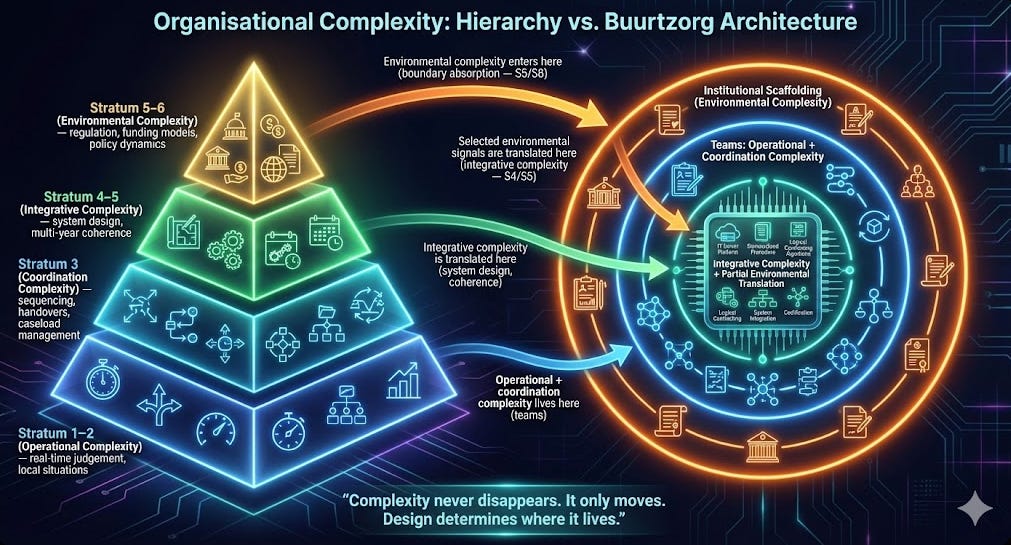
What I think however, it that what Buurtzorg demonstrates is far more interesting and far more challenging than the war cry that “hierarchy is dead.” The truth is that Buurtzorg doesn’t eliminate complexity at all. It simply relocates it into different structures: architecture, software, contracts, professional norms, and the macro-institutional environment of Dutch healthcare. And once you see where the complexity has moved, the whole model becomes not just plausible but elegant.
I want to walk through this carefully: slow enough to see the structural moves, direct enough not to pretend this is magic, and honest enough to acknowledge that theories I once nearly dismissed might have been pointing to something real all along.
I should also acknowledge that I have no direct experience of Buurtzorg myself so I’m relying on publicly available sources for this so it’s very possible that I have misunderstood or misrepresented certain aspects so I welcome anyone closer to it to correct me where this might be the case.
Here’s how I’ll approach this: first, what Jaques meant but most readers miss; second, the four unavoidable loads of complexity; third, how Buurtzorg redistributes them; and finally, why this matters for anyone designing modern organisations.
NB: When I talk about “organisational physics,” I mean the non-negotiable structural constraints created by real work; time-span, interdependence, variance, regulatory load, and the cognitive bandwidth required to hold them together. You can design around these forces, but you cannot abolish them. Changing the structure changes where they live, not whether they exist.
Two theoretical lenses matter here and apologies for getting straight into org theory here before you’re even warmed up, but it’s still just a shallow dip into two deep areas so please bear with me. If you know these well skip ahead.
Design Principle 1 = redundancy of parts: supervisors, layers, rules
Design Principle 2 = redundancy of functions: whole tasks, multi-skilled groups, self-regulation, variance handled at source
Before we get too deep into Levels of Work, it’s worth clarifying what Emery and Trist were proposing with DP1 and DP2, because most people who invoke DP2 today have hardly read OST and have turned it into a generic synonym for self-management.
DP2 is not the elimination of hierarchy. It replaces hierarchy-of-people with hierarchy-in-the-system or the structural logic that constrains work without requiring a managerial layer. Nor is it “empowerment”.
DP2 is fundamentally a variance absorption design, a way of structuring work so that the people closest to the situation can deal with variability at its source.
DP2 systems require specific structural conditions:
· whole tasks,
· self-contained work groups,
· multi-skilling,
· tight internal feedback loops,
· clean boundary control,
· and minimal external dependencies.
This matters for Buurtzorg because without DP2’s variance-absorption conditions, the entire model collapses into either chaos (if under-specified) or disguised DP1 (if over-specified).
DP2 only works when variance can genuinely be absorbed at the point of action. That requires two OST design constraints that most modern interpretations ignore:
1. a minimally critical specification of what must be achieved, not how, and
2. a clean boundary around the work group so it can regulate its own throughput without external interference.
Without those, what people call “self-management” is simply DP1 with slogans.
DP1 and DP2 are not cultural moods. They are design choices for how a system handles complexity.
DP1 is the default in most organisations. It tries to cope with variability by creating redundancy of parts: layers, supervisors, controllers, checkers, and specialised roles for every possible exception. The more variability, the more layers or functions you end up with.
DP2 flips the logic. Instead of supervisors absorbing the variability, the work system itself is designed so the team can absorb most variance without escalation. It uses a redundancy of functions: multi-skilled teams, whole tasks, feedback loops, boundary conditions, and a socio-technical design that pushes discretion to the point of action.
A classic DP2 example is a production cell in manufacturing or a multidisciplinary clinical team in healthcare: the work is structured so that 95% of variability can be handled inside the group, with no escalations and no bottlenecks.
And this is where some Agile/Teal proponents mistake autonomy for the product of mindset, when in fact it’s the product of deliberate socio-technical design.
If DP2 explains how local variance gets absorbed, Jaques explains why some variance cannot be locally absorbed at all, because it is discontinuous in time-span and integration.
One thing OST and most flat-organisation advocates consistently avoid is defining what “the work” actually is.
They talk about pushing decisions to “the people doing the work,” but never specify what counts as work, how to distinguish different kinds of work, or how to reason about the structural consequences of those differences.
In most of these debates, “the work” implicitly means customer-facing execution — the operational edge of the system.
But organisations do far more than operational execution. They integrate across time, absorb uncertainty, shape environments, codify standards, and architect coherence. None of this fits the vague category of “the work” as flat-org discourse uses it.
This is exactly the gap Jaques was trying to close.
He wasn’t defending hierarchy for its own sake.
He was defining work in a way that could be reasoned about, including its different levels of complexity, uncertainty, and time-span.
Without that definition, most modern debates collapse into moral arguments rather than structural ones.
If OST explains how local variance gets absorbed, Jaques explains why some variance cannot be absorbed locally at all, because the underlying work is discontinuous in complexity and time-span.
Being one of the few that actually had a definition of work and given how critical this is to organisational design decisions, let’s explore what he meant.
He defined work as:
“The individual exercise of judgement in making decisions and acting on them, with prescribed limits, in order to achieve a productive purpose within a given timeframe.”
This definition matters because it cleanly separates:
· Task difficulty (how technically hard something is)
from
· Work complexity (the time-span and integrative load your judgement must handle)
Most organisational debates collapse these two into one. That’s why the discourse gets confused so fast.
Before we get to the actual levels, it’s worth being precise about why Jaques used the word strata. He wasn’t describing rungs on a ladder or bureaucratic grades. He meant distinct layers of work, each defined by a different type of cognitive processing.
A higher stratum isn’t “a bit more of the same work.” It requires a qualitatively different way of handling uncertainty, interdependence and time.
This is why Jaques insisted the layers were discontinuous.
You cannot scale a Stratum-2 problem into Stratum-4 territory by adding more tasks or more people. The underlying mental processing required is different in kind, not in volume.
This is why Jaques treated strata as structural categories of work, not personal ranks, they describe the complexity of the judgement required, not the status of the person doing it.
Here is the part people misunderstand most.
Time-span does not mean how far into the future your plan looks or how long a project is.
You can produce a “2035 strategy” and still be doing short time-span work if:
· your judgement does not bind the organisation
· someone else approves everything
· the deliverable is a template exercise
· the consequences of your decisions evaporate within weeks
Time-span = the length of time over which your judgement has real, irreversible consequences, without further approval.
That’s it.
If your decisions shape only the next few days or weeks → short time-span.
If your decisions shape organisational commitments years ahead → long time-span.
If nothing you decide today constrains what the organisation must live with years from now, you are not doing long time-span work, no matter how futuristic your slide deck looks.
Jaques observed that real work clusters into discontinuous layers:
· Some work spans hours.
· Some spans months.
· Some spans years.
· Some spans decades and whole ecosystems.
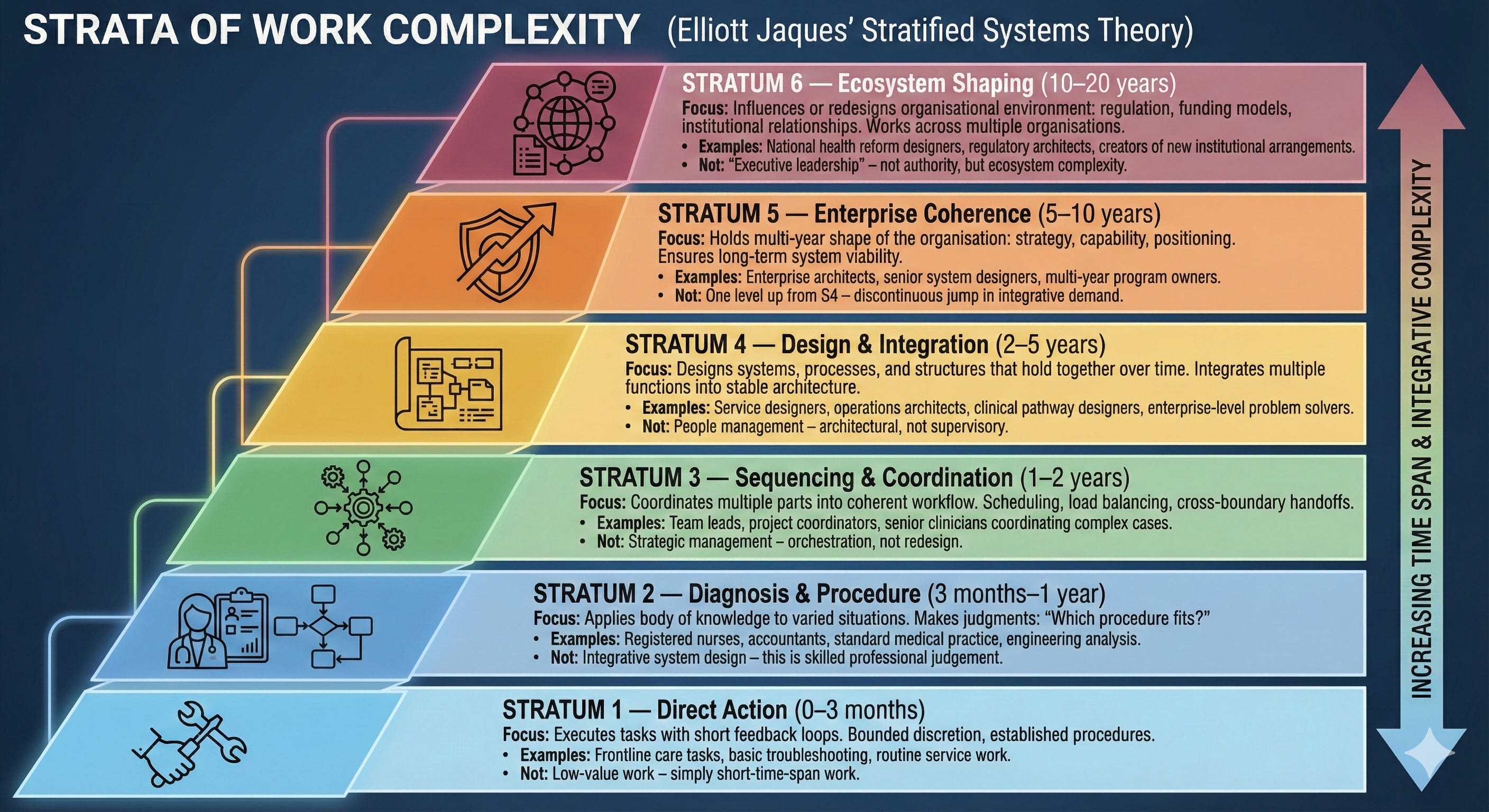
Figure 1. The first six strata of work complexity (based on Elliott Jaques’ Stratified Systems Theory). Each stratum represents a discontinuous jump in integrative demand and time-span of discretion. This is the “organisational physics” behind why different kinds of work require different mechanisms for coherence.
There’s a conceptual trap that derails this entire topic if it isn’t dealt with upfront: most people fundamentally misunderstand what “work complexity” means in Jaques’ framework.
They hear Stratum 1–2 and assume it means low-skilled, junior, or administrative work.
This is wrong and it’s the reason many highly educated professionals dismiss Jaques before understanding him.
Let me put it plainly:
Stratum 1–2 work is not “beneath” anyone.
It is diagnostic, analytical, professional judgement applied to concrete situations within a defined time horizon.
Most engineers, accountants, nurses, lawyers, and yes most doctors and surgeons spend their entire careers doing Stratum-2 work. Not because they are unsophisticated, but because the work has:
· a bounded time-span
· rapid feedback cycles
· a codified body of knowledge
· local, not system-level, consequences
This is where people confuse technical difficulty with work complexity.
A surgeon performing a standard procedure is not doing high-stratum work.
It is technically demanding, but short-cycle:
Diagnose → Decide → Act → Immediate consequences → Adjust.
That is Stratum-2.
Meanwhile, redesigning the surgical pathway, reshaping professional protocols, altering incentives, or architecting an entire theatre workflow is Stratum 4–5 not because it is “harder,” but because it:
· spans multiple systems
· unfolds across multiple years
· has irreversible downstream consequences
· changes the constraints for hundreds of clinicians
Skilled ≠ Complex.
They live on different dimensions.
This matters for Buurtzorg because people assume that if the nurses are highly skilled, they must therefore be working at a “higher level.”
This distinction is not theoretical nitpicking, it is essential for understanding why Buurtzorg works: the nurses’ professional skill sits in Stratum-2/3, while the system architecture absorbs Stratum-4/5 load. Without keeping those domains separate, the whole model collapses.
And yes, some clinicians do higher-stratum work.
This must be said explicitly:
· A surgeon redesigning a clinical pathway is doing Stratum-4.
· A surgeon pioneering a new operative technique or writing new professional protocols is doing Stratum-4/5.
· A tiny minority, the ones who reshape the field itself ,operate in Stratum-5 territory.
But these are exceptions, not the daily rhythm of clinical practice.
And this is Jaques’ point, frequently misread as elitist:
Different kinds of work sit on different inherent time-spans and interdependencies and systems fail when leaders pretend otherwise.
If you treat Stratum-2 work as menial, you miss the structural elegance of Buurtzorg.
If you treat Stratum-5 work as “boss work” rather than integrative architectural work, you miss why Buurtzorg still requires high-capability system designers even without managers.
This distinction matters because Buurtzorg allocates complexity to the right carriers, but through very different mechanisms than the managerial hierarchy Jaques assumed.
To see how this plays out structurally, we need to look not at people but at the four complexity loads that every organisation must distribute somewhere.
DP2 and Jaques are often treated as incompatible because Jaques focuses on hierarchy and OST emphasises autonomous work groups. But if you strip away the ideological coatings, they are both responding to the same underlying fact of organisational life:
· someone or something must absorb the complexity,
· and the only two questions are what that is and where you put it.
Jaques says: complexity lives in human capability and time-span → align structure accordingly.
OST says: complexity lives in the variance of the task environment → design socio-technical systems that minimise supervisory load.
Both are right. Both, I think, are incomplete on their own.
Buurtzorg is what it looks like when you combine the DP2 way of absorbing operational and coordination complexity with a small Stratum-5/6 architectural centre handling integrative and environmental complexity.
It’s a hybrid design solution that neither Jaques nor Emery & Trist articulated explicitly but both would recognise instantly.
It’s worth saying explicitly: Jaques was doing organisational architecture too.
His unit of design wasn’t software or socio-technical teams, it was roles, strata, and accountability relationships.
What he called a Managerial Accountability Hierarchy is simply one architectural mechanism for matching complexity with capability.
Clear role boundaries, lateral accountabilities, cross-functional authorities, and time-span of discretion are not “people issues.”
They are design features that shape how information flows, how decisions get made, and where integrative load sits.
In that sense, Jaques and Buurtzorg are not opposites.
They are different answers to the same architectural question:
Where does the complexity live, and what carries it?
What becomes obvious once you stop treating their work as competing ideologies is that both were describing different parts of the same elephant.
This is the frame we need before diving into Buurtzorg’s architecture.
Let’s start with a blunt reality: work complexity doesn’t give a damn about your org chart.
Every organisation, from a hospital to a bakery to a national intelligence agency, must handle, at minimum, four categories of complexity. These aren’t abstract categories; they are the four unavoidable loads that every organisation must assign to someone or something.
Once you understand that complexity must be carried somewhere, the next question is where it sits in the organisation.
A simple way to see how Buurtzorg allocates complexity is to map the four complexity categories to the strata they typically require.
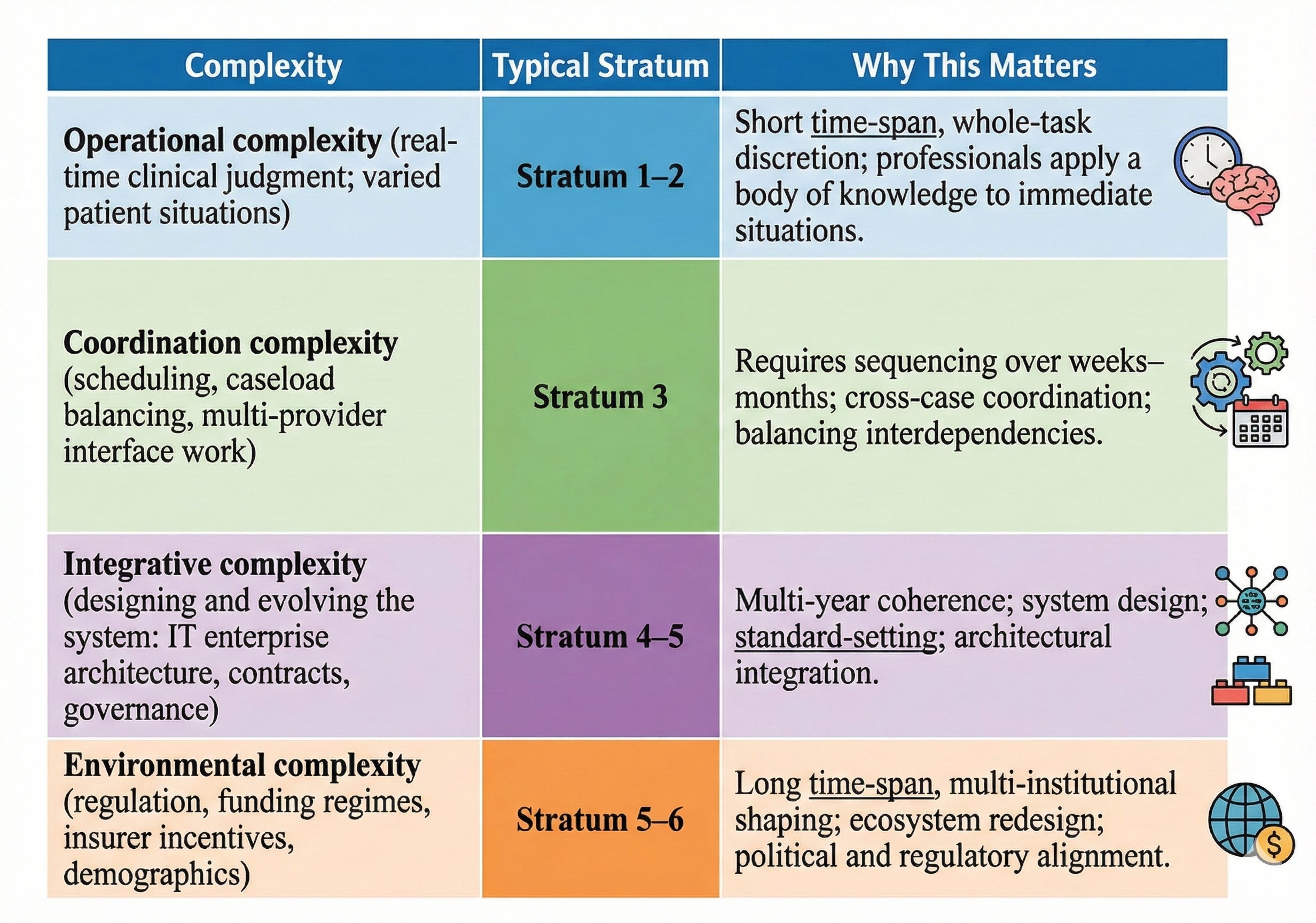
Figure 2. Work complexity based on Buurtzorg work
This mapping isn’t a dogma; it’s a diagnostic lens.
This is where the Jaques lens and the OST lens finally meet: both describe the same reality from different angles, one through the nature of work, the other through the design of systems.
It simply makes visible that all four loads must be carried somewhere in the organisation. Buurtzorg’s achievement is not that it removed these loads, but that it redistributed them: operational and coordination complexity live inside the teams, while integrative and environmental complexity live in the architecture and the institutional environment. That’s the real design innovation.
These are organisational physics, not management preferences. Then of course there is the social complexity that, as humans, we have to work with in all interactions with other humans, which Jaques addressed through social process skills and temperament, among other things - but that’s for another time.
In a Jaques organisation, people carry these loads through nested managerial roles.
In Buurtzorg, the organisational systems carry them.
Both agree the loads are real, the disagreement is purely about mechanism.
Same organisational physics; different design choices.
They don’t go away because the CEO hugs a teal circle.
And that brings us to the most persistent misunderstanding about self-management.
The most persistent myth in modern organisational thinking is that self-management somehow reduces the inherent complexity of the work. This is wishful thinking dressed up as philosophy or some mantra “self-management good, hierarchy bad”.
Buurtzorg works not because its work is simple, but because the organisational systems are designed to absorb the complexity without pushing it into a managerial accountability hierarchy.
This was where I think Jaques made a category error:
· He correctly identified the phenomenon (stratified work).
· He assumed that a managerial accountability hierarchy (MAH) was the stable solution, which was empirically true in the contexts he studied, but not universally necessary
When Buurtzorg nurses make decisions about a patient, they’re not just doing clinical tasks. They’re integrating the entire case: clinical, social, logistical, relational, environmental. In Jaques’ terms, they are doing Stratum-2/3 work. Not because it’s written on a job description, but because reality demands it. And Buurtzorg’s architecture gives them the whole situation, not a fragment of it. That’s the key. The work itself is not chopped into roles that then need to be stitched back together by a supervisor or cross functional teams. The team owns the whole thing.
This alone eliminates a huge amount of coordination complexity. It’s also why Studies show Buurtzorg nurses often deliver the same or better outcomes using 30–50% fewer hours than traditional Dutch providers, depending on patient mix and region.
They’re not faster; they’re not working harder; they’re simply handling the whole problem in one place rather than passing it through five different hands with five different incentives and five different prioritisations objectives.
If you’ve ever seen a conventional home-care provider in operation, (or quite frankly looked at any large traditional organisation) you know exactly what I mean. Fragmentation manufactures rework. Buurtzorg removes the fragmentation.
Before diving further into Buurtzorg’s internal logic, we have to acknowledge something that people tend to skip because it complicates the narrative: Buurtzorg operates inside an unusually well-aligned institutional environment.
Strong professional nursing norms and standards, bounded neighbourhood caseloads, a reimbursement system that trusts holistic judgement. Lower administrative friction than the UK or Germany. A regulatory logic that doesn’t demand hourly billing or KPI-driven documentation. Dutch long-term care reimburses for outcomes and professional judgement, not billable tasks, an institutional anomaly that makes whole-task nursing feasible
In other words: the external system does not undermine the internal model.
This is Stratum-6 complexity; the design of the ecosystem itself. You cannot self-manage your way out of hostile regulation. When Buurtzorg is transplanted into systems with rigid billing requirements or heavy documentation burdens, it often fails, not because the teams lack capability, but because the institutional environment suffocates the model before it can breathe. And every serious study of international Buurtzorg pilots shows the same thing: success correlates almost perfectly with environmental alignment, not enthusiasm or culture.
This is not a side note. It is the structural foundation.
This dependency on institutional scaffolding becomes starkly visible when you look at what happens abroad. The very structural conditions that enable Buurtzorg in the Netherlands are the ones that collapse in misaligned ecosystems. And once that scaffolding drops away, you see with X-ray clarity which parts of the model are genuine design features and which parts were environmental privileges all along.
And this is where the cracks show: when the institutional environment shifts, the Buurtzorg model reveals just how dependent it is on Stratum-6 alignment.
If we look at countries where Buurtzorg-style models have stalled or failed, the pattern is painfully consistent:
The environment kills it.
· Denmark: hourly billing suffocates whole-task nursing.
· UK (NHS): KPI-driven oversight and task-based contracting repeatedly prevented whole-case nursing from operating as designed.
· Germany: documentation demands make autonomy impossible.
· United States: fee-for-service fragmentation pulverises continuity.
Meanwhile:
· Sweden shows sustained multi-year adoption in municipalities with aligned funding.
· Japan has achieved stable integration under its national Long-Term Care Insurance model.
· US pilots in Kansas and Minnesota show 30% reductions in avoidable hospitalisations when Medicaid waivers are redesigned (still small in scale, but the pattern is real).
· China’s provincial pilots succeed when commissioning models are adjusted to replicate Dutch-like conditions through public–private hybrid arrangements.
These are Stratum-6 dynamics, the level at which ecosystems, not teams or leaders, determine viability.
And crucially: wherever Buurtzorg has succeeded abroad, it was never a pure plug-and-play import. Local institutional entrepreneurs always had to do the Stratum-6 translation work to make the model compatible with local funding, regulation, and professional pathways.
You cannot “empower” your way out of a broken institutional system.
What makes Buurtzorg compelling isn’t the absence of managers. It’s that integrative and environmental complexity are absorbed through architecture and ecosystem design rather than a managerial chain
The centre handles all the complexity the teams cannot or should not touch: insurer negotiations, contracting, compliance, workflow design, and the entire labyrinth of Dutch healthcare regulation. But it does so with a tiny footprint, roughly 50 staff supporting thousands of nurses. That alone should make leaders sit up. Because if you tried to run a conventional healthcare organisation with that ratio, you’d set something on fire within days.
The reason Buurtzorg can do it is because a huge amount of Stratum-4/5 complexity is embedded in its IT system. Ecare (built on the Omaha System taxonomy) takes the ugly, bureaucratic guts of healthcare and turns them into workflows that nurses can use in seconds. And to be clear, it is not just workflow, it is embedded policy logic, an architectural mechanism that shapes upstream behaviour.
Instead of needing a manager to interpret a policy, the system interprets it. Instead of having supervisors chase compliance, the workflow itself ensures it. Instead of requiring elaborate reporting structures, the data is captured passively as part of care.
This is what “moving complexity” actually looks like in practice: not ignoring it, but encoding it.
There’s a line often used when trying to explain Buurtzorg:
“If you want proof they don’t have managers, look at the math.”
A coach typically supports 40–50 teams, roughly 500 nurses. With that span, “managing” them is not physically possible. There aren’t enough hours in the week. All a coach can do is coach, support reflection, team dynamics, role clarity, conflict navigation.
This is governance without supervision.
Boundaries without authority.
Support without control.
DP2 in practice.
It’s also something that most organisations try to copy by simply renaming managers as “coaches,” which predictably fails. It fails because they keep the supervision, the authority, the escalation path, the performance management, all the DP1 artefacts.
You cannot sprinkle the word “coach” on a hierarchy and get DP2. Buurtzorg’s coaches work precisely because they cannot manage anyone.
The structure enforces the behaviour, and the Coaches inevitably hold a form of soft power, pattern recognition across dozens of teams, narrative framing, and gentle boundary-setting, but they cannot impose decisions or override team autonomy.
This might be my favourite part of the model. Buurtzorg doesn’t scale innovation by telling teams what to do. It scales by letting the best practices emerge.
1. A team does something new.
2. It works.
3. Another team copies it.
4. Eventually enough teams adopt it that the centre codifies it in the IT platform.
This is desire-path innovation.
It is evolution, not rollout.
In a DP1 system, innovation is a project.
In Buurtzorg, innovation is a pattern.
It’s also why Buurtzorg avoids the two traps that swallow most self-managing experiments:
local fiefdoms (because nothing spreads automatically)
chaotic divergence (because only useful ideas get imitated)
Slow, organic coherence is much more resilient than imposed uniformity.
Most organisations scale by aggregation: they get bigger, add more layers, expand spans, centralise decision rights, create more dependencies, and then wonder why they keep needing new layers of management.
Buurtzorg avoids this by keeping teams small and replicating them.
Not stretching them.
Not growing them.
Splitting them.
This simple structural rule prevents coordination complexity from ever reaching the threshold where a managerial layer becomes necessary. If you never allow a team to become large enough to require formal hierarchy, then formal hierarchy never emerges.
It is astonishing how many organisations refuse to see this. They grow teams to 40, 60, 100 people and then ask, “Why do we need so many managers?” Because they engineered the necessity through poor design choices and low understanding of work complexity.
Buurtzorg doesn’t eliminate managers; it eliminates the conditions that require them. Unit-size discipline is the structural keystone. By capping local complexity, it prevents the interdependency pile-up that forces most organisations to add layers just to survive.
Where others scale by aggregation and accidentally generate hierarchy, Buurtzorg scales by replication and sidesteps the whole mess entirely.
One of the most persistent misunderstandings about Buurtzorg is the idea that it somehow proves human capability doesn’t matter. That’s nonsense. Buurtzorg works because someone with extremely high integrative capability designed the system in the first place; Jos de Blok and a small group of collaborators.
They did the Stratum-5/6 work.
They encoded judgement into architecture.
They created the boundary conditions that make autonomy possible without inviting chaos.
Self-management did not emerge organically out of goodwill or culture. It was architected.
This is the Architect Paradox:
Even in post-managerial organisations, the need for high integrative capability does not disappear. It relocate, from managerial roles to organisational system design.
Most organisations miss this entirely.
They copy the self-managing teams and skip the architecture, then blame the teams when coordination collapses.
Buurtzorg is not what happens when you remove managers.
Buurtzorg is what happens when you replace managerial hierarchy with a designed system capable of carrying the integrative and environmental complexity.
All of this sets up the final and most important point: Buurtzorg is not an ideological rejection of hierarchy; it is a structural alternative for carrying the same stratified work complexity that Jaques correctly identified.
Once you remove the mythology, the lesson is stark:
· Complexity doesn’t go away, it moves.
· DP2 architectures can distribute complexity without hierarchy, in certain domains.
· Whole-task teams outperform fragmentation.
· Architecture can absorb integrative complexity better than managers.
· Scaling by replication is smarter than scaling by aggregation.
· High capability still matters—just not in supervisory roles.
· Environmental alignment is the make-or-break factor.
And there is a maybe a deeper insight hiding underneath all of this, one that speaks directly to the modern organisational environment: the tempo of environmental curvature has accelerated to the point where traditional hierarchy struggles to maintain coherence.
Requisite Organisation was built for environments where strategic meaning degraded slowly enough that a Stratum-5 or Stratum-6 manager could re-stabilise it. That assumption no longer holds. Today the environment bends faster than hierarchical meaning-making can keep up: regulation shifts, funding rules mutate, demand patterns fragment, and technology cycles compress. Organisations pay an “internal confusion tax” simply to preserve coherence.
Buurtzorg’s architecture is one response to this acceleration. It minimises internal complexity, caps unit size, and pushes most environmental curvature to the edges, where autonomous teams can respond immediately without waiting for a reclassification from above. The centre only intervenes architecturally—updating platforms, contracts, and boundary conditions—when clear patterns emerge.
In other words, Buurtzorg maintains coherence not by increasing managerial capability, but by reducing the amount of coherence that must be maintained.
This is why the model works so well in the Netherlands and collapses under the wrong institutional conditions abroad. It is not magically “self-managing”; it is architecturally tuned to a particular domain where environmental curvature is high but predictable, and where the institutional scaffolding absorbs much of the long-span complexity.
Buurtzorg is not post-hierarchical. It is post-managerial.
Buurtzorg does not prove that hierarchy is unnecessary.
It proves that judgement is unavoidable, and you must decide where it lives
Work complexity is still stratified, it simply has different carriers.
This matters because far too many organisations read Buurtzorg as a story about culture, empowerment, or mindset. It is actually a story about the mechanisms you choose, where you locate them, and how you architect the system so the unavoidable work complexity has someplace rational to live.
And that is the point that both Jaquesians and anti-hierarchists routinely overlook.
It is a story about the mechanisms you use to absorb complexity, which ones you choose, where you locate them, and how you architect the systems so the unavoidable work complexity has rational places to live.
Complexity must always be matched with complexity. If you don’t design deliberate mechanisms to absorb it, it will simply reappear somewhere else, usually in the form of overload, escalation, or accidental hierarchy.
That’s the lesson.
Part 2: Haier, same organisational physics at play, different design solution.
If Buurtzorg is what self-management looks like in a stable, professionalised domain,
Haier is what complexity redistribution looks like in a volatile, competitive, fast-moving ecosystem.
Where Buurtzorg uses boundary conditions, complexity “outsourcing” and replication,
Haier uses internal markets, dynamic contracts, and competitive bidding to allocate and absorb complexity.
Both models challenge Jaques.
Both models confirm him.
Just in different ways.
Part 2 will explore that.
Why I write analyses like this
I write pieces like this not to win theoretical arguments but to make the underlying organisational physics visible. Most debates about hierarchy, self-management and “new ways of working” get stuck at the level of slogans. Very few people examine the mechanisms that actually let an organisation function: the work itself (at all levels), the real time-span of discretion, the variety attenuators and amplifiers, the socio-technical architecture, the boundary conditions, the institutional scaffolding, and the viability constraints that either support or strangle a model.
That’s the gap I’m trying to close.
Synexia exists for that exact reason: to bring structural thinking, theoretical depth and design intelligence to organisations drowning in buzzwords but starving for clarity. These ideas aren’t academic indulgences; they’re the difference between an operating model that works in the real world and one that collapses as soon as the environment shifts.
If you read this and recognised your own organisation in the failure modes, then you already know a structural conversation is overdue.
Synexia works with leaders who are prepared to confront the real architectural choices rather than reshuffling roles or relabelling teams.
If that’s you, reach out. If it isn’t, this article will at least help you see the terrain more clearly.
References:
Books
Jaques, E. (1976). A general theory of bureaucracy. Heinemann.
Jaques, E. (1989). Requisite organization: Total system for effective managerial organization and managerial leadership for the 21st century (2nd ed.). Cason Hall & Co.
Jaques, E., & Clement, S. D. (1994). Executive leadership: A practical guide to managing complexity. Cason Hall & Co Publishers.
Laloux, F. (2014). Reinventing organizations: A guide to creating organizations inspired by the next stage of human consciousness. Nelson Parker.
Laloux, F. (2020). Reinventing organizations companion: Stories and practices from pioneers of the next stage of human consciousness. Nelson Parker.
Trist, E., & Murray, H. (Eds.). (1997). The social engagement of social science: A Tavistock anthology (Vol. 3). University of Pennsylvania Press.
Web Sources
Emery, F. E., & Trist, E. L. (1965). The causal texture of organisational environments. Human Relations, 18(1), 21–32. https://doi.org/10.1177/001872676501800103
https://www.buurtzorg.com/about-us/our-organisation/ “Our organisation”
https://www.buurtzorg.com/wp-content/uploads/2022/11/Buurtzorg-Case-Final.pdf “Buurtzorg-Case-Final.pdf”
https://centreforpublicimpact.org/public-impact-fundamentals/buurtzorg-revolutionising-home-care-in-the-netherlands/ “Buurtzorg: revolutionising home care in the Netherlands”
https://www.sciencedirect.com/science/article/pii/S2666142X22000017 “Implementing Buurtzorg-derived models in the home care ...”
https://pmc.ncbi.nlm.nih.gov/articles/PMC4311562/ “Buurtzorg Nederland: A Global Model of Social Innovation ...”
https://www.commonwealthfund.org/publications/case-study/2015/may/home-care-self-governing-nursing-teams-netherlands-buurtzorg-m... “Home Care by Self-Governing Nursing Teams”
https://www.buurtzorg.com/about-us/ “About Buurtzorg International”
https://insidestory.org.au/coffee-first-then-care/ “Coffee first, then care - Inside Story”
https://pmc.ncbi.nlm.nih.gov/articles/PMC6902511/ “Transforming community nursing services in the UK”
https://www.buurtzorg.com/update-grannvard-sweden/ “Update from Grannvård Sweden - Buurtzorg International”
https://pubmed.ncbi.nlm.nih.gov/37510584/ “Integrated Long-Term Care ‘Neighbourhoods’ to Support ...”
https://www.asiapacific.ca/sites/default/files/publication-pdf/china_senior_care_report_final_0.pdf “China’s Evolving Senior Care Sector”
https://www.buurtzorg.com/buurtzorg-neighborhood-care-asia/ “Buurtzorg Neighborhood Care Asia”