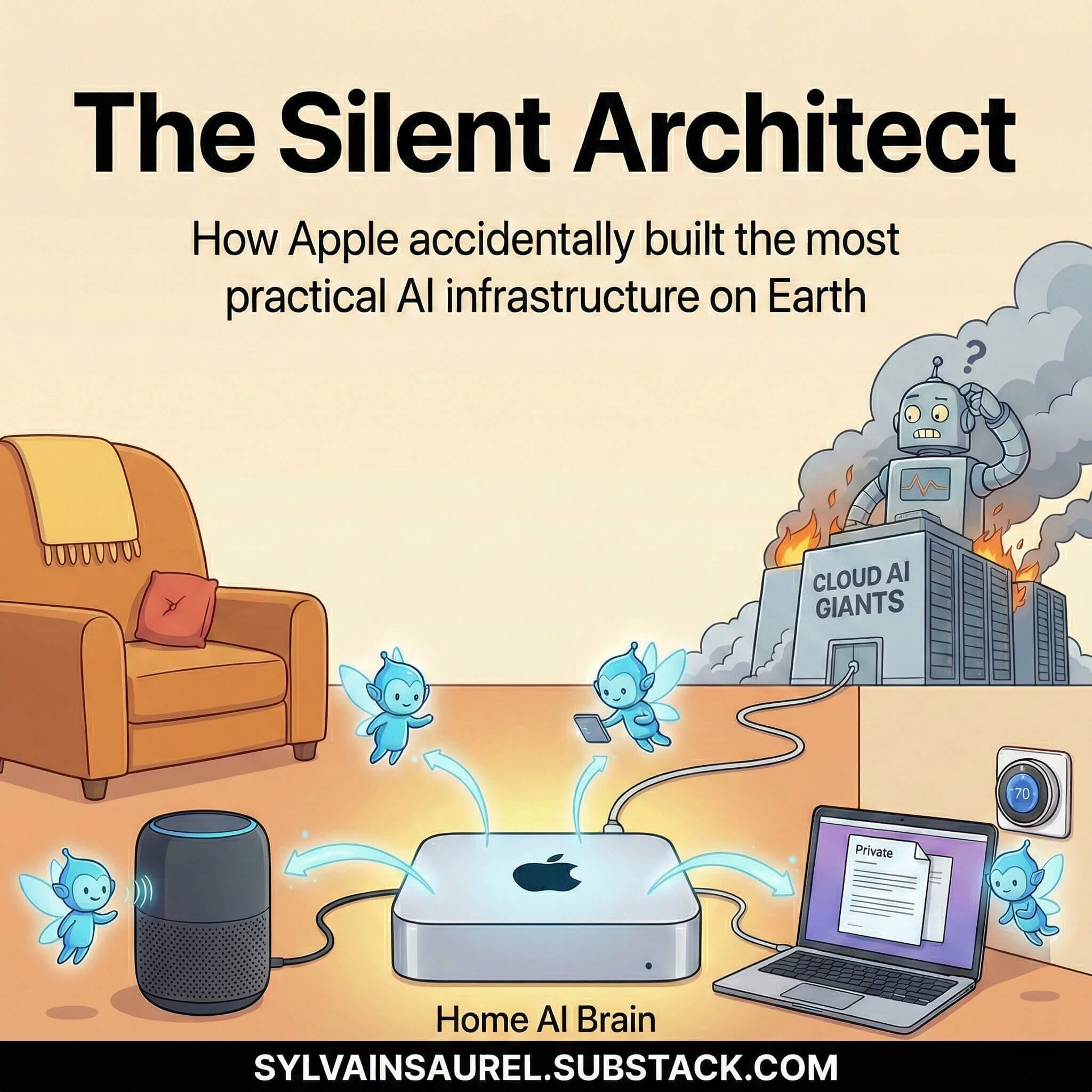
For the better part of three years, the tech world’s favorite pastime was mocking Apple’s “AI deficit.” While Sam Altman was becoming a household name and Jensen Huang was minting billionaires at NVIDIA, Apple seemed stuck in a bygone era.
The narrative was relentless:
No “Frontier” Model: Where was Apple’s GPT-4?
No AGI Race: Why wasn’t Tim Cook talking about the end of humanity?
No GPU Megaclusters: Why wasn’t Apple buying hundreds of thousands of H100s?
To the casual observer, Apple looked like a legacy giant caught flat-footed by the greatest technological shift since the internet. But tech loves irony. While the world was obsessed with the “Brute Force” era of AI—massive data centers, melting power grids, and eye-watering subscription fees—Apple was quietly perfecting a different game.
They weren’t building the cloud. They were building the Local Intelligence Infrastructure.
Today, the script is flipping. Developers are no longer just using Macs to write code; they are wiring Mac Minis into clusters to run workloads that previously required a server room. This isn’t just a hardware success story; it’s a fundamental shift in how AI is deployed, scaled, and owned.

Escaping the Fiat Debt Trap to Reclaim Your Time, Energy, and the Natural State of Market Abundance.
To understand why Apple is winning, we have to understand the technical lie we’ve been told for a decade. For years, the metric of power was FLOPS (Floating Point Operations Per Second). If you had more FLOPS, you had the better AI chip.
However, a strange thing happens when you try to run a Large Language Model (LLM). You realize that the processor isn’t the problem—the “road” to the processor is. This is known as being Memory Bound.
In modern AI inference, the bottleneck isn’t how fast the chip can calculate; it’s how fast the chip can move massive amounts of model data (weights) from the memory to the processor.