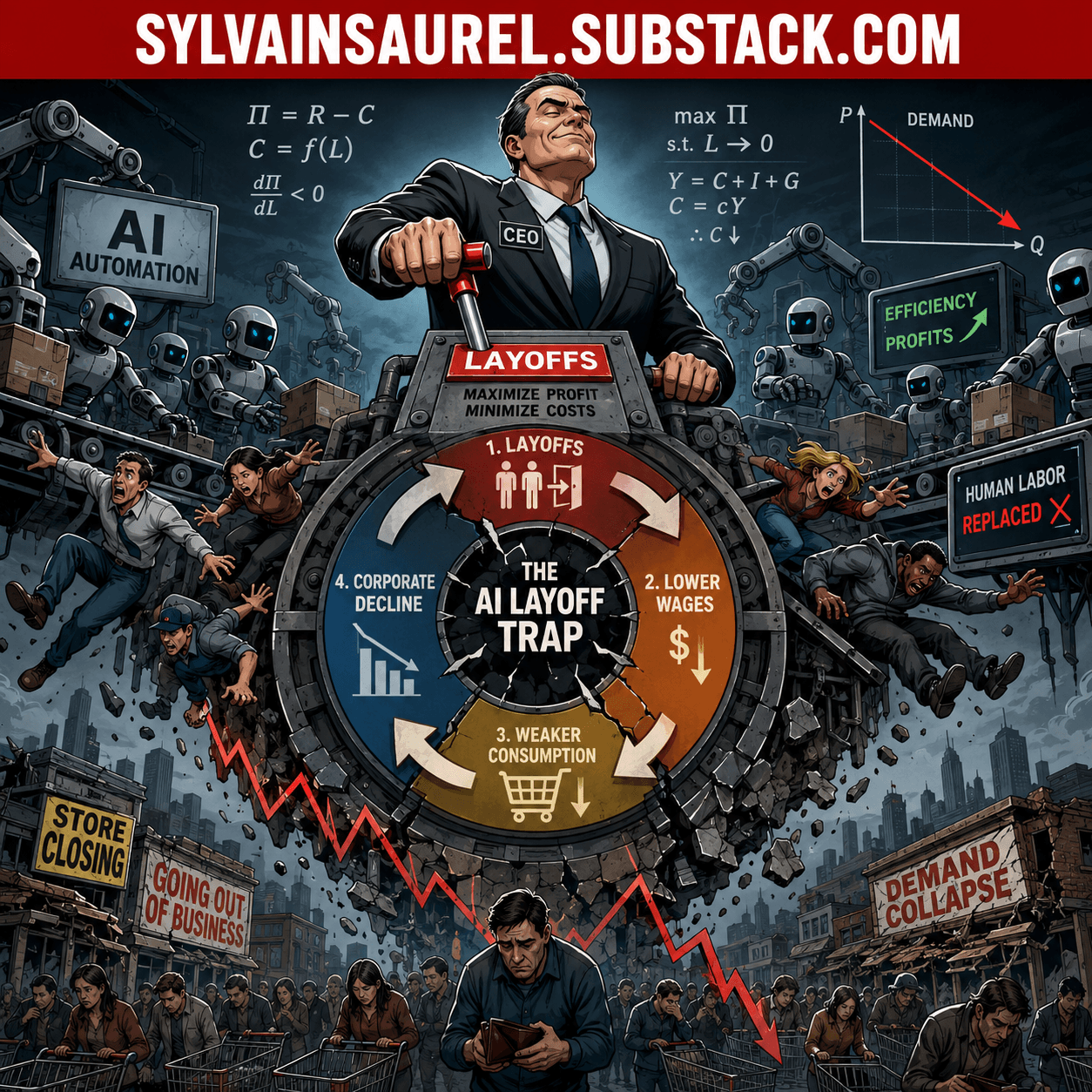
We are standing on the edge of a macroeconomic cliff, and the people driving the car can see the drop perfectly well. Yet, mathematically, they have absolutely no choice but to step on the gas.
For decades, the public discourse surrounding automation has been dominated by a debate between techno-optimists and labor advocates. The optimists argue that technology, while disruptive, always creates new, better-paying jobs in the long run. The advocates warn of mass unemployment and systemic poverty.
But a groundbreaking economic paper, “The AI Layoff Trap” (June 3, 2026) by researchers Brett Hemenway Falk and Gerry Tsoukalas, sidesteps the emotional and political debates entirely.
Instead, they reduce the AI transition to cold, hard mathematics.
What they found is terrifying. By mapping out the economic end-game of artificial intelligence, they have exposed a fatal, structural flaw in competitive capitalism. The paper proves that when AI displaces workers faster than they can be reabsorbed into the economy, it destroys the very consumer demand that businesses rely on to survive. More chillingly, the researchers prove that even with perfect foresight—even when CEOs know that mass layoffs will eventually hollow out their own revenue—they are mathematically forced to automate anyway.
This is not a story about greedy executives or rogue machines. It is a story about a structural market failure, a prisoner’s dilemma that traps rational actors in an arms race toward what the researchers call “boundless productivity and zero demand”.

When a hardware wallet’s failure can erase years of savings, Bitcoin’s hardest question is no longer who controls the keys — but who bears responsibility when the technology betrays the owner.
To understand why the economy is uniquely vulnerable to the current wave of Artificial Intelligence, we must understand the dual role of the human being in a capitalist system. A human is not just a unit of labor; a human is a unit of consumption.
Historically, technological displacement has largely been self-correcting. When the Industrial Revolution automated weaving, new jobs were created in factories. Economists Acemoglu and Restrepo call this the “reinstatement effect,” which has historically stabilized the labor market. But AI is different. Evidence suggests the current wave of AI is disproportionately affecting entry-level workers and middle management, and the creation of new work is not keeping pace.
The paper notes that in 2025, U.S. employers announced more than a million job cuts, with AI explicitly cited in roughly 55,000 of them. In early 2026, Block cut nearly half of its 10,000-person workforce, with CEO Jack Dorsey stating that AI made the roles unnecessary and that “the majority of companies will reach the same conclusion” within a year.
When these workers lose their jobs, a dangerous macroeconomic chain reaction begins:
The Marginal Propensity to Consume (MPC): Workers have a higher marginal propensity to consume than business owners.
The Spending Shift: When a worker is laid off, they spend a large fraction of their income (denoted as λ) on mass-market goods.
The Lost Income: A fraction of their income (denoted as η) might be replaced by unemployment benefits or eventual reemployment, but the remainder, (1 - η), is permanently lost to the sector.
When a firm replaces a human with AI, it captures 100% of the cost savings. However, the laid-off worker stops buying things. This is where the fatal flaw in competitive markets reveals itself: the loss of that worker’s consumer demand is not borne solely by the company that fired them. It is spread across the entire economy.
Imagine a market with 20 competing firms (N = 20). Firm A decides to replace 1,000 workers with AI agents.
Firm A captures 100% of the wage savings.
Those 1,000 workers stop buying goods across the whole market.
Because Firm A only possesses 1/20th of the market share, Firm A only suffers 1/20th of the economic damage caused by its own layoffs. The other 19 firms suffer the remaining 95% of the demand destruction.
Because competitive pricing allocates revenue across symmetric firms, each firm systematically underestimates the social cost of its automation. The researchers formalize this demand loss per automated task as the variable ℓ = λ(1 - η)w.
This fractional burden is the poison pill. Each firm’s profit-maximizing automation rate is a strictly dominant strategy that exceeds the cooperatively efficient level. Even if every CEO in the world gathered in a room and agreed that mass automation would destroy their consumer base, it would still be economically rational for each CEO to leave that room and automate as fast as possible. If they do not, their competitors will, and they will be crushed on price.
The Dollar's Biggest Threat Isn't China — It's the US Bond Market.

For years, geopolitical analysts and financial pundits have warned that the United States dollar is on the brink of being dethroned by external adversaries. The prevailing narratives point to the rise of China, the expansion of the BRICS alliance, the potential for a new gold-backed trade currency, and the slow unwinding of the petrodollar system. But while these external threats are real and accelerating, they are merely symptoms of a much deeper, more systemic vulnerability.
The researchers modeled this phenomenon using a task-based framework. Let us examine the chilling mathematical proofs that dictate this economic collapse.
The paper defines a critical automation threshold, N*, which dictates when the trap springs shut:
\(N^* = \frac{\ell}{s} = \frac{\lambda(1 - \eta)w}{w - c}\)
In this equation:
N is the number of competing firms.
ℓ is the demand lost per displaced worker.
s is the per-task cost saving from automation, defined as the human wage (w) minus the AI cost (c).
Proposition 1 of the paper proves that if the number of competitors (N) is less than or equal to N*, no firm automates. But if N > N* (meaning the market is fragmented enough that a firm’s share of the demand loss is smaller than its cost savings), every firm’s strictly dominant strategy is to automate.
As AI costs fall (c → 0), the threshold N* drops toward λ(1 - η), which is inherently less than 1. Because any competitive market has at least 2 firms (N ≥ 2), cheap AI guarantees that the over-automation region expands to cover virtually every market in existence.
In traditional economic theory, competition is the ultimate good. It disciplines firms to act in the interests of consumers. But in the AI Layoff Trap, competition is exactly what kills the economy.
The paper proves that the over-automation wedge (the gap between how much firms should automate to maximize total economic profit, and how much they actually automate) is strictly increasing in N.
A monopolist (N = 1) fully internalizes the externality. If a monopoly fires its workers, it directly loses its own customers, so it naturally restrains itself.
However, highly fragmented, competitive markets exhibit the widest gap. As N approaches infinity, the wedge reaches its absolute maximum.
Therefore, more competition dilutes each firm’s share of the demand loss, weakening the private incentive to restrain. The freer and more competitive the market, the faster it destroys itself via automation.
What happens when AI becomes incredibly easy to integrate? The researchers model the “frictionless limit” (where integration costs k = 0).
According to Corollary 1 of the paper, when adjustment frictions vanish and the number of firms exceeds the critical threshold, the game sharpens into a pure Prisoner’s Dilemma.
Full automation (αi = 1) becomes strictly dominant for every single firm.
If the cost savings are less than the demand loss (s < ℓ), the collectively optimal choice is zero automation.
Yet, the equilibrium yields full automation, resulting in total deadweight loss across the entire economy.
In this scenario, communication is mere cheap talk. Even if all firms acknowledge that collective restraint would raise profits for everyone, a firm that holds back unilaterally suffers the revenue decline from its rivals’ layoffs while missing out on the cost savings. Every firm is forced to defect. Every firm replaces its human workforce.
A common misconception in the AI debate is that automation represents a simple transfer of wealth from the working class to the capital-owning elite. If this were true, one might expect the billionaire class to simply walk away with the spoils.
However, Proposition 2 of the paper completely shatters this assumption. The researchers mathematically prove that the surplus loss generated by the AI Layoff Trap is a deadweight loss that harms both workers and firm owners.