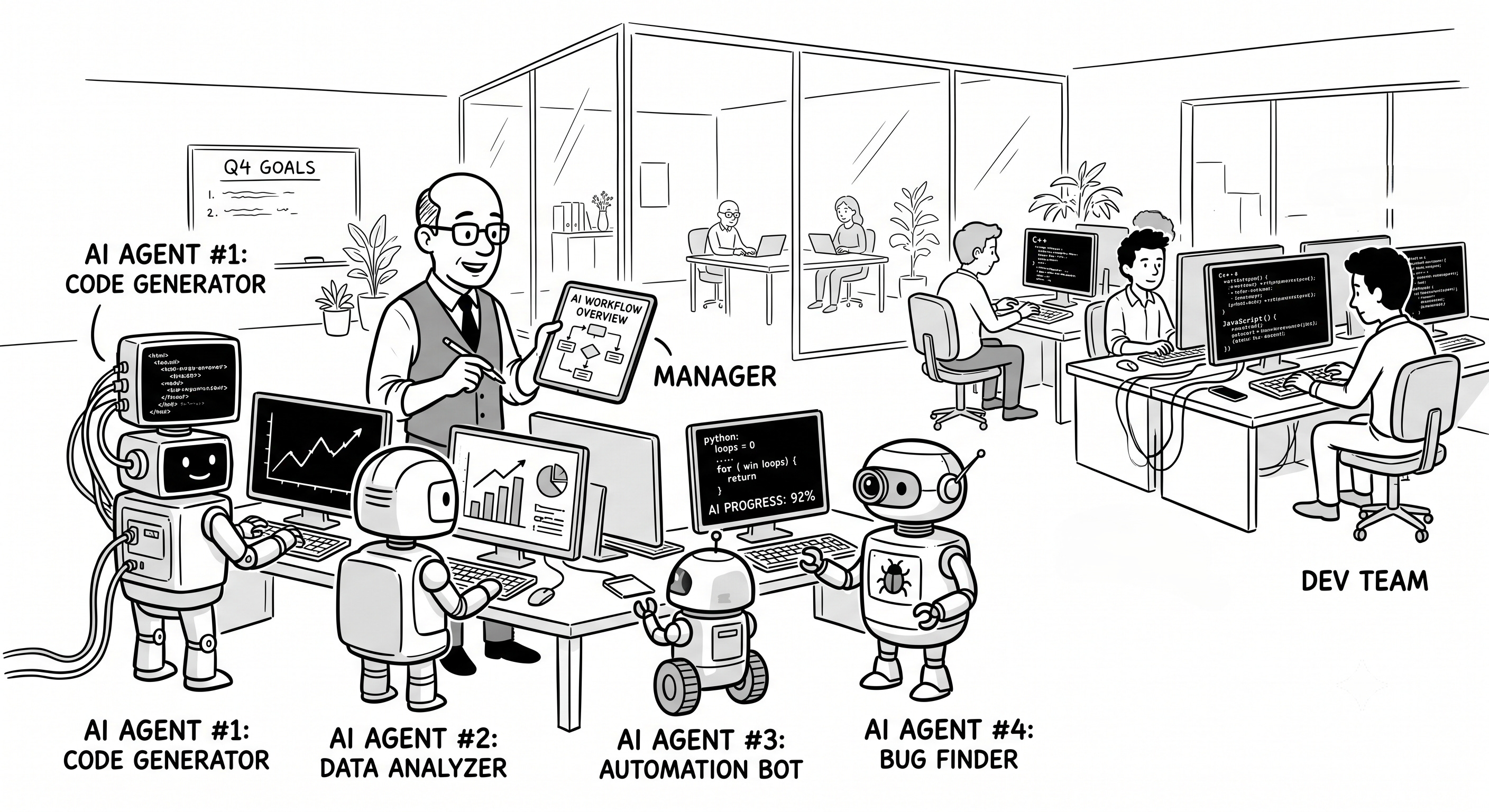
Lately, I keep seeing the same claim pop up in my feed:
“Managing AI agents is just like managing people. Managers are basically becoming better ICs now.”
My first reaction was scepticism. Are people really calling prompt-tuning and eval dashboards “people management” now? I get why people say this. The work feels more hands-on, more technical, more “builder-y” than the classic image of management. But in my experience, the story is backwards. Managers aren’t magically turning into super-ICs. What’s actually happening is that ICs are becoming much better system designers. I want to dive deeper into this.
There’s a very popular and exciting story going around that AI is turning everyone into managers.
Jack Clark, Anthropic’s co-founder, talked about an incoming “era of the manager nerds.” He says the ability to “manage fleets of AI agents and orchestrate them is going to make people incredibly powerful,” describing it as “the nerd turned manager who has their people, but their people are actually instances of AI agents doing large amounts of work for them.”
Guillermo Rauch, Vercel’s CEO, has gone even further: “We’re all kind of mini CEOs at this point.” He’s even declared, “No one is an IC anymore,” framing this as everyone now managing AI agents the way a manager oversees a team.
Philip Su, a former OpenAI/Microsoft/Meta engineer now running Superphonic, argues the IC role is “probably over” because engineers are now doing managerial-style work: setting priorities, giving feedback, resolving conflicts, just aimed at AI instead of people.
Emma Bostian, an engineering manager at Spotify, points out that AI is lowering the barrier for leaders to turn ideas into working software themselves, using natural language to generate and validate code faster.
When I read stuff like this, part of me is like: okay, this is exciting. It does feel like anyone with a good prompt and a clear goal can suddenly ship more. There’s a real sense of leverage in the air.
But another part of me keeps asking: if everyone’s a manager now, who’s actually designing the systems these “AI employees” live in?
In my experience, managing agents feels nothing like managing humans. It feels like designing and operating a slightly unhinged, extremely fast intern who never sleeps and occasionally invents new programming languages.
With people, you care about:
Motivation and morale, because a demotivated person’s work quality drops long before they say anything
Career growth and skill development, since that’s what keeps someone invested past the first six months
Psychological safety and trust, so people tell you about problems before those problems become expensive
That awkward 1:1 where someone says they’re burning out, and you actually have to do something about it
With agents, you care about:
What decisions they’re allowed to make without a human checking first
What tools they can touch, since a wrong API call can drain your company wallet
How you detect when they go off the rails, ideally before the output ships
Who owns the mess when they do go off rails
I’ve never had an agent ask for a promotion. But I have had many give me an incorrect incident RCA. Comparing an agent even to an intern doesn’t seem very accurate. If you gave your intern his personal email, you wouldn’t have to tell them - check it every 4 hours; if something says important or urgent, let me know asap. In that sense, managing an agent feels more like managing a very smart baby!
Paul Williams at Bloomberg pushes back on this whole trend, arguing that an EM’s core job (vision-setting, stakeholder management, team empowerment) hasn’t actually changed just because agents exist.
I think he’s right that the human side of management hasn’t magically disappeared. But I also think the “manager nerds” narrative is missing a key piece. In my opinion, the craft is changing more on the IC side than on the managers’ side.
So when managers dive into agent workflows, they’re not becoming “better ICs” in the classic sense. They’re just being pulled into system design whether they like it or not.
The ICs around me are becoming much better system designers. The best ICs aren’t just “using Copilot” more. They’re:
Designing agent harnesses and toolchains, the scaffolding that decides what an agent can and can’t do on its own
Building eval frameworks that catch weird agent behavior before it reaches a customer
Defining clear boundaries for what the agent decides versus what requires human review
Instrumenting everything so they can debug “why did the agent think this was a good idea?”
To me, this is the new “high-agency IC”: someone who can take an ambiguous objective, figure out what actually needs to happen, use AI to execute, evaluate the output, and turn the work into a repeatable system.
What makes this even more interesting is that some of the most senior engineering leaders are voting with their career moves. Over the last year or so, I’ve noticed a pattern where CTOs from big companies are moving into Member of Technical Staff (MTS) roles at Anthropic.
A few notable examples:
Peter Bailis, Workday CTO (a $9.5B revenue company), moved to an Anthropic MTS role
Bryan McCann, You.com co-founder and CTO ($1.5B valuation), moved to an Anthropic MTS role
Henry Shi, Super.com CTO ($200M revenue), moved to an Anthropic MTS role
Niki Parmar, Adept AI CTO, moved to an Anthropic MTS role
Mike Krieger, Instagram’s co-founder and original CTO, fits a related but different version of this story. He’d already moved to Anthropic as Chief Product Officer, and in January 2026 he stepped back from that executive seat into a hands-on MTS role in Anthropic’s internal incubator.
Just a couple of days back, Tanay Kothari, CEO of Wispr Flow, announced that Ganesh Ramnarayanan, Hex’s VP of Engineering, is joining Wispr Flow in an IC role.
These are all people who could have gone into pure executive or people-management roles. Instead, they chose an IC-style track at an AI lab. To me, that’s a signal that they see the highest-leverage work in the AI era as deeply technical and system-oriented, not just “managing fleets of agents” from a distance.
Jack Clark talks about “manager nerds” with AI agents as their “people”. But these CTOs seem to be saying: “If I’m going to work with AI at the frontier, I want to be hands-on in the system, not just orchestrating from above.”
If the IC role is “probably over”, as Philip Su says, it’s funny that so many CTOs are lining up to become ICs again.
When I frame this as “managers becoming better ICs”, I think it risks two things:
Undervaluing how much the IC skill set has actually changed (system design, agent ops, evals)
Confusing managers about what they should actually be optimizing for
In my view, managers aren’t turning into classic ICs. They’re becoming:
Agent system architects
Human-AI operating model designers
They are becoming the people who figure out:
What decisions agents can own without a human sign-off
Where humans must stay in the loop, and why that line moves depending on the stakes
How to structure accountability when the “doer” is non-human but someone still has to answer for the outcome
This is where Paul Williams’ point resonates with me. An EM’s core job (vision, stakeholders, empowerment) hasn’t fundamentally changed, and I agree with that. But I’d add that the craft of how that vision gets executed is changing fast. And the people closest to that craft are often ICs designing the agent systems that make the vision real.
If anything, managers are becoming part-product, part-engineering, part-governance. Which is… a lot. And not exactly “better IC” as we used to mean it.
Meanwhile, ICs are the ones deep in the weeds of designing the actual systems that make agents useful, safe, and scalable. That, to me, is the real change in the craft.
If you’re a manager reading this, here’s what I’d focus on:
Don’t worry so much about “Are agents replacing my team?”
Instead, a good problem to ponder on is “What decisions should agents own in my team?” List the decisions that can be delegated to agents, assign autonomy levels and define escalation paths.Treat agents as systems, not members reporting to you.
And you need good harnesses and guardrails for these systems to work well. So the biggest ROI for teams would come by investing in:
Observability (logs, traces, error categories)
Evals (regression tests for agent behavior)
Incident processes (what happens when an agent goes rogue?)
Redesign roles around “human + agent” units?
I’m actually not sure about this. Hence the question mark. But some teams and companies I know have started counting coding agents in their headcount. They are adjusting their hiring accordingly. This requires them to attach an exact productivity number per agent. I’m not sure how successful these experiments have been.Create a visible career track for agent ops / agent platform.
In my opinion, skills like orchestration, policy design, and eval infra are real engineering/ops skills, not just “manager stuff”. If you as a manager-cum-IC are taking it on, this is a serious chunk of work which can eat into your other managerial functions. If you’re assigning this to another IC team member, they should be made clear that this is not a side-project stuff.
If you’re an IC, here’s how I’d play this:
Your leverage is in designing better “agent harnesses”, not just using agents.
I’d rather see an IC build a solid eval suite and toolchain than brag about how many lines of AI-generated code they merged. Vibe coding is something any junior dev can do.Don’t treat agents like junior devs; treat them like powerful but brittle tools.
My rule of thumb is to assume the agent will do something clever and wrong, so it is important to build review checkpoints and automated checks around its output. In other words, they are more dangerous than a less skilled and less productive junior dev.Position yourself as the “human in the loop” expert.
As agents take over more execution, your value shifts to:
Problem framing, or turning a vague ask into a concrete, checkable objective
Constraint design, meaning deciding what the agent is and isn’t allowed to try
Judgment calls where context matters more than any rule you could write down
If you’re on a management track, don’t assume “agent management” = “people management”.
For agent management, you’ll need stronger systems thinking, more product/governance mindset, and less reliance on classic people-management heuristics alone. But almost none of the skills you’ll gain from agent management will help you with better people management. So choose your track wisely.
So, no, I don’t think managers are necessarily turning into super-ICs because they manage agents. There now seems to be a new operating model, similar to how PMs now are expected to design and vibe-code prototypes by themselves instead of just writing PRDs. Managers are adjusting to the new operating model, and although this doesn’t make them a better IC in the traditional sense, they are uniquely positioned to become high-agency contributors.
Jack Clark’s “manager nerds” and Guillermo Rauch’s “mini CEOs” are real. Philip Su’s “no one is an IC anymore” captures something true about how work feels now.
But when I see CTOs from Workday, You.com, Super.com, and Adept AI choosing MTS roles at Anthropic, alongside Mike Krieger’s own step back from CPO into a similar hands-on role, I can’t help but think: maybe the IC role isn’t over. Maybe it’s just being redefined, and it’s moving to people willing to design the systems, not just orchestrate them.
If you’re a manager feeling like you’ve suddenly become a part-time engineer, you’re not imagining it. What it means to be an “Engineering Leader” is getting redefined, and you are helping shape that definition in real time.