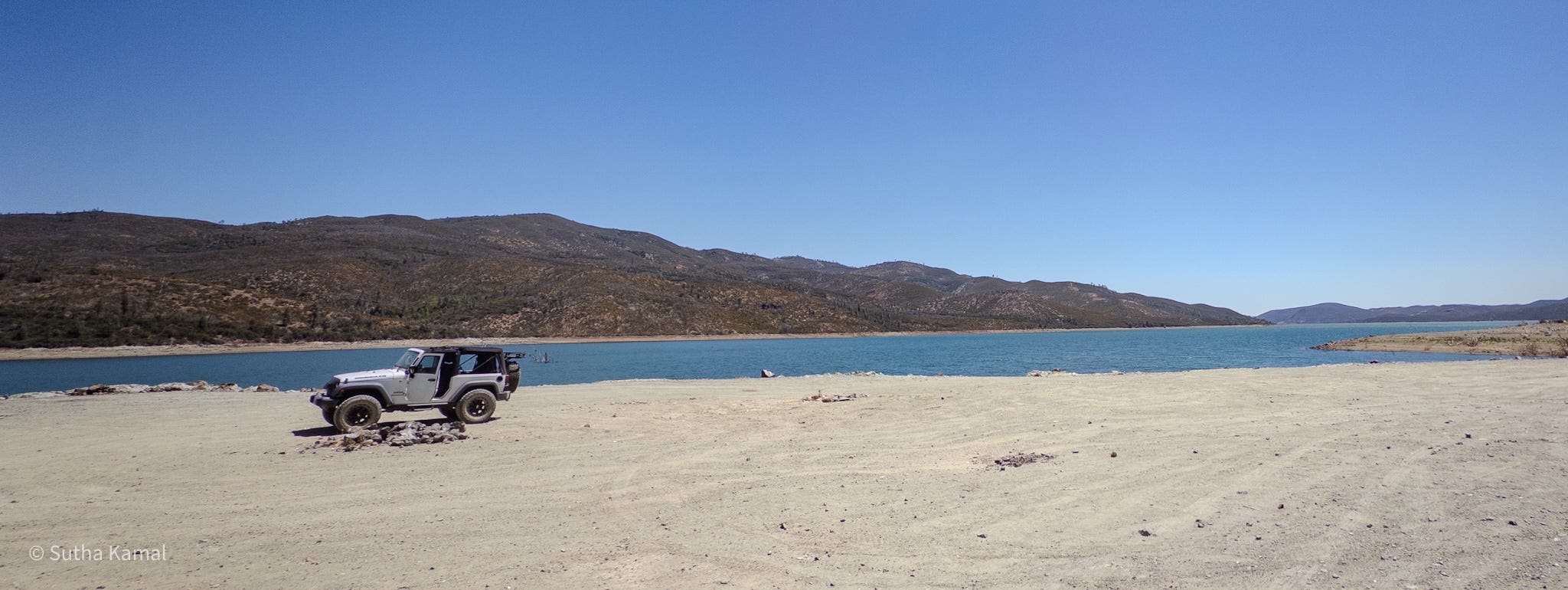
I’ve been getting acquainted with a buddy’s manual transmission Wrangler and having an absolute blast. Exploring California’s staggering natural beauty in this thing is practically like hiking in as much as it feels physically embodied and gives lots of slow languorous time to think and feel.
One of my discoveries is how long-form audio fits into this new agentic workflow - first I had Cortex write me a masterclass in learning the manual transmission and four-wheel drive system, written in a tongue-in-cheek Top Gear-inspired tone, and voiced by ElevenLabs (in the voice of Sir Laurence Olivier… it was a riot). I listened to it in the Cañada College parking lot, and again on some gravel fire roads, and slowly, slowly, my driving improved.
So on Saturday morning, while I was eating breakfast in Williams, California, about to point the Jeep at some of Northern California’s off-road trails, I wanted to make a last minute addition to Cortex. The T-Satellite link supports WhatsApp, including attachments, so I asked Cortex to build something that could rapidly generate audio, compress it into low bitrate WhatsApp-approved files of 1 to 4 MB, and integrate that capability into its satellite messaging spine.
Then I paid, got in the Jeep, and headed into the hills, not having hand-written a line of code. By the time I’d reached the trailhead, the capability existed: a tool that compresses an hour of speech to fit a satellite link, built, tested against transcription error, and already delivered to my phone as three tap-to-play voice notes at three sizes. I spent the morning driving ridgelines and listening to work that hadn’t existed at sunrise.
That loop (a wish at breakfast, a working system by the trailhead), is what this essay is about.
The first essay in this series was about the channel: how satellite text, the most hostile interface I could find, forces honest architecture. This one is about what happens when the thing at the other end of the channel stops being a switchboard and starts being a resident, and what that does to the pace and structure of thinking about hard things.
The system I described in the last essay answered satellite messages the way a vending machine answers coins. Each text woke up machinery, the machinery did a thing, a reply came back. Useful, stateless, transactional. A thinking partner it wasn’t.
So the week before this trip, Cortex grew what I call the conductor: one persistent agent session that lives on the server, next to the message spine from the last essay, and holds my WhatsApp thread the way a person holds a conversation. Every message I send from the backcountry lands in it as a turn in one long-running context. It answers questions directly, files notes-to-self without chatting at me, dispatches real work to other agents, and every few hours sends me a compact digest of everything that moved, sized for a screen I read standing on a rock. Its standing orders live in a written charter in git; if the session dies, a watchdog respawns a successor that re-reads the charter, the session plan, and the thread itself. The session can die without taking the charter, the plan, or the conversation with it.
The point of a resident at the far end is that I get to be more present in the real world where I am. I send intent and fragments; synthesis accumulates server-side; the satellite carries only what’s essential.
The wish I texted was underspecified in the ways that might annoy an engineer: “an hour of audio squeezed into about a megabyte, as a fast, repeatable capability.” The agents did the thing a good engineer does: they ran into physics, measured it, and changed the plan. An hour in one megabyte is 2.2 kilobits per second. MP3 cannot speak there; its floor is 8 kbps, which is 3.6 MB an hour, so a 1 MB MP3 can never hold more than about 17 minutes. Opus, the codec WhatsApp uses natively for voice notes, collapses into literal silence below about 2.5 kbps; measured output at 2.2 kbps was negative-94 dB of nothing, with a 100 percent transcription error rate. Its real floor is around 4.4 kbps.
So instead of pretending, the system sent me three honest options, each the same hour of speech, each scored by running a transcription model over the result and counting errors against the source: a 1 MB file holding the full hour at double speed (10.7 percent word error), a 1.9 MB file holding the hour at natural speed (1.4 percent error), and a 3.9 MB file that is effectively perfect. The build report’s verdict, verbatim: “2 MB is the sweet spot” and “1 MB honestly buys ~31 minutes at natural speed.”
And as it happens, we know (verified) 4 MB works, and I’ll try higher at some point, but the fact that I appear to have had a fast satellite link that quickly delivered that 4 MB file doesn’t mean I’ll always have such a good connection.
Anyway, the point of the above trivia is that the whole investigation, the research, the dead ends, the measurements, the working tool, happened while I ate breakfast. I supplied one sentence of intent and one number. I used to count deep work in hours at a desk; the expensive middle of it, the part that used to eat the morning, now happens between two of my messages.
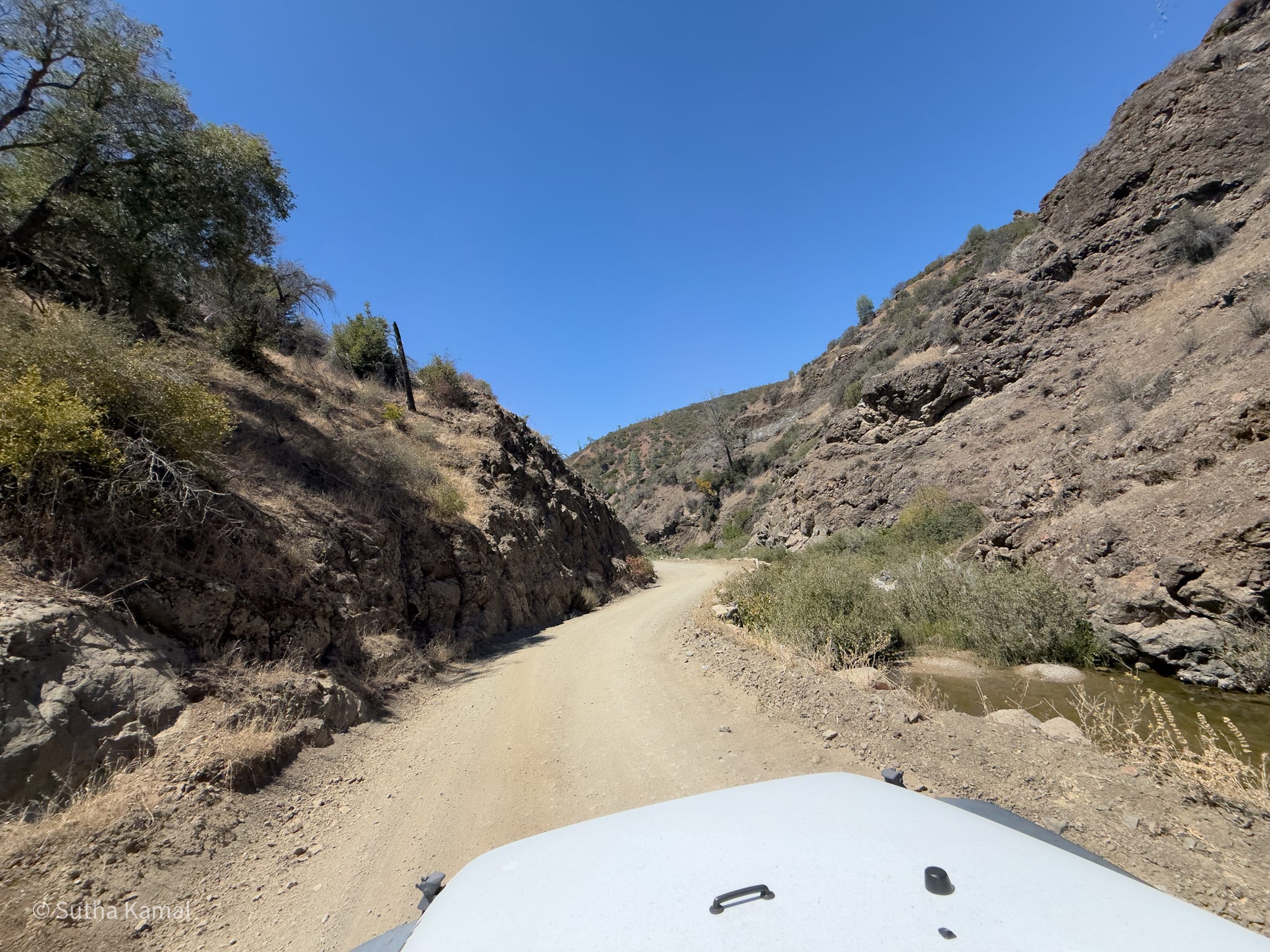
Why audio at all? Because out here my eyes and hands are fully employed. Picking lines through rock gardens, reading the light, boiling water. What’s free is my ears. And we are - I guess - verbal creatures.
Before the trip, the same text-to-speech pipeline built me a private audio syllabus against my actual gear list and trip plan: vehicle recovery, wilderness medicine, navigation when the GPS is wrong, and one essay about maintaining a machine you borrowed from a friend. Plus Matthew Crawford’s *Why We Drive*. Hours of chaptered audio, synced to the phone before I left pavement; the heavy bytes ride ordinary signal, and only text crosses the satellite.
Listening while driving a trail is a different cognitive mode than reading. I cannot read while picking a line through rocks; I can listen. Reading is foreground work; it wants a chair and your whole attention. Listening is background processing: the ideas go in while the body is busy, and they compost.
Asking Cortex to make and send me an hour-long essay on the current state of nuclear fusion, while on a ridge without cell coverage is pretty neat. I was never a big fan of voice-only assistants, because visual interfaces are better at a great many things - but this feels like a new interface/medium/pace-of-work-and-thinking that I’m far from having figured out, but am loving the exploration process of.
The other capability this weekend was boring on purpose: documents.
When I want to review something substantial out here, an essay draft, a plan, a reference, Cortex renders it to PDF and sends it over WhatsApp, because the satellite link reliably tolerates a ~1 MB attachment and a PDF reads fine on a phone in full sun. The text of the document also arrives as a plain message first, so even if the attachment loses the race with the sky, the content lands. Text first, attachment second.
The canonical editing copy lives in a Google Doc because Google Docs syncs offline beautifully and on both my phone and iPad (where I’m writing this). When I pass through a pocket of real signal, the doc quietly updates; back in the dead zone, I can edit it in the truck with no bars at all, and my edits flow home at the next pocket. The PDF on WhatsApp is a mirror of that doc, regenerated whenever it changes. Markdown in git stays the source of truth underneath both, so my edits can be diffed and harvested mechanically instead of retyped.
Ain’t none of this is clever… just match each artifact to what the channel and the tool are actually good at: WhatsApp for push and tiny payloads, PDF for reading, Google Docs for offline editing, git for truth. The satellite makes sloppy choices expensive enough to notice.
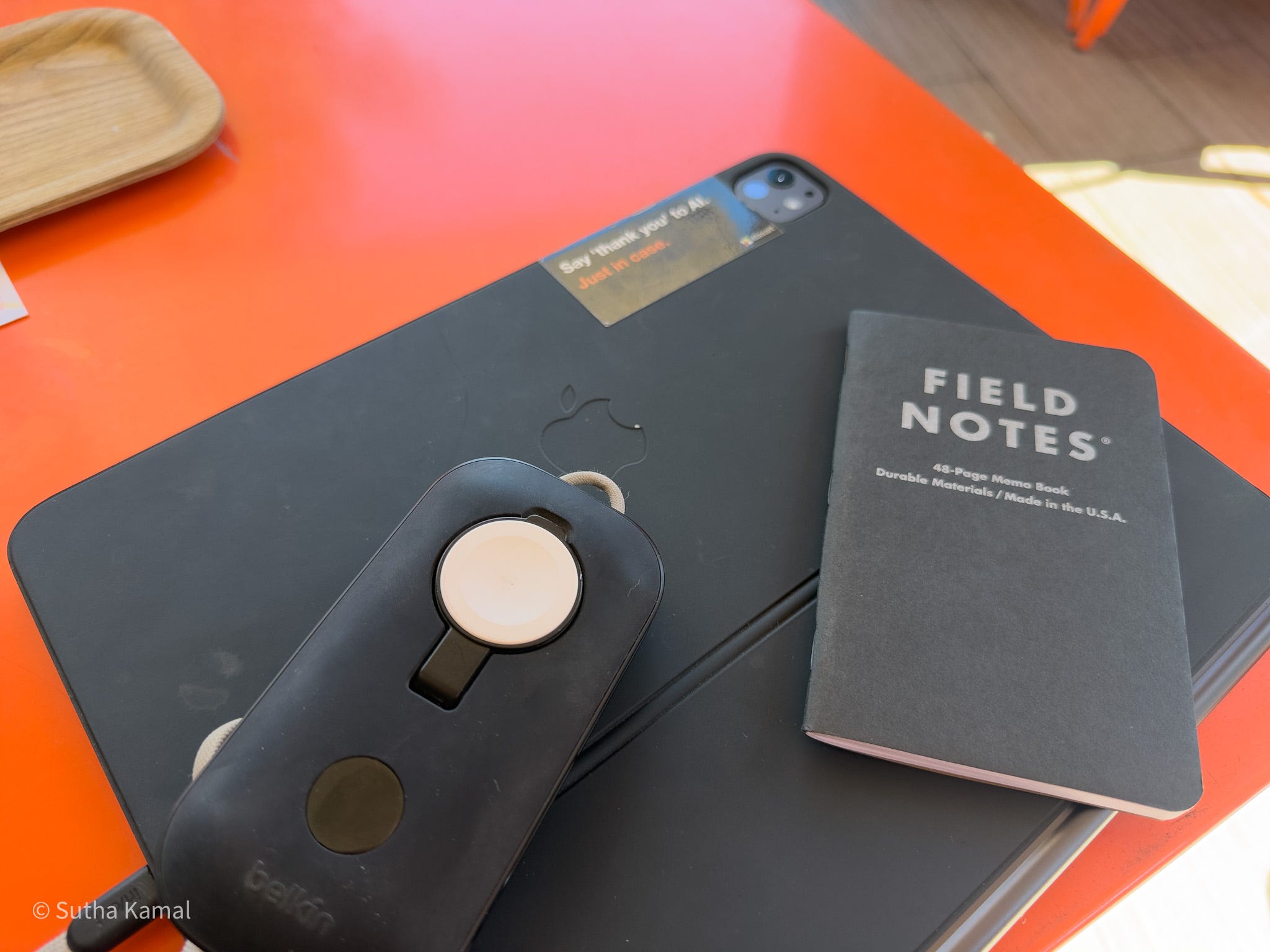
The paper notebook is still the best thinking tool ever shipped. No battery, latency, or doomscrolling. Its one flaw is that it’s a dead end: thoughts go in and nothing comes back.
This weekend that changed, and I tested it from a dirt road: I photographed a page-sized scene and sent it over the satellite link, and Cortex saw it, describing the gravel road, the fence lines, the hood of the Jeep in the frame. The chain behind that is unglamorous: the bridge saves every inbound photo at receipt, a vision pass writes a description into the message store, and the conductor can pull the actual pixels and read them with its own eyes when a description isn’t enough. Handwritten pages are the next test, and WhatsApp’s compression will have a vote; I’ll report honestly on how much of my handwriting survives.
One practical discovery worth stealing: WhatsApp strips all metadata from photo-sends, no GPS, no timestamp, and re-encodes the image around 1024 pixels. Send the same image as a document and the metadata survives intact. If you ever want coordinates to travel with a picture, send it as a file, not a photo. (And yes, Satellite Cortex has the ability to text, Telegram, and Signal my loved ones and emergency contacts with full context of where I am and what I’ve been up to. If that’s not a Machine of Loving Grace, I don’t know what is.)
The full loop I’m after: think on the trail, write at camp, photograph the pages, send them down the one thin pipe. The far end files the fragments into a running document per topic, keeps a synthesis current, and texts back a sip: two sharp questions, one disagreement. I think against it on tomorrow’s trail. Depth accumulates where the disks are; the satellite carries only intent and friction.
If you’re building anything that has to work over a hostile channel, or you just want your tools to think while you don’t, the transferable pieces from this weekend:
Budget the channel first. Know the link’s real byte tolerance and your codec’s real floor before designing the payload, and remember playback speed is a compression axis: double speed halves the effective bitrate cost of speech. Measure with a transcription-error score, not your ears.
Text first, attachment second. Send the content as plain text before the rich version, so the message survives even when the attachment doesn’t.
Put the editing copy where offline sync already works. I use Google Docs not out of loyalty but because it’s the best offline-sync editor that exists; git stays underneath as truth.
Photos strip metadata, documents keep it. On WhatsApp and most messengers. Choose accordingly.
Ears are the spare channel. If a person’s eyes and hands are busy, ship them audio. Generating speech server-side from your own material is cheap now.
Make the far end persistent. A stateless responder answers questions; a resident session with standing orders, durable state, and a digest cadence changes what you can start while you’re away.
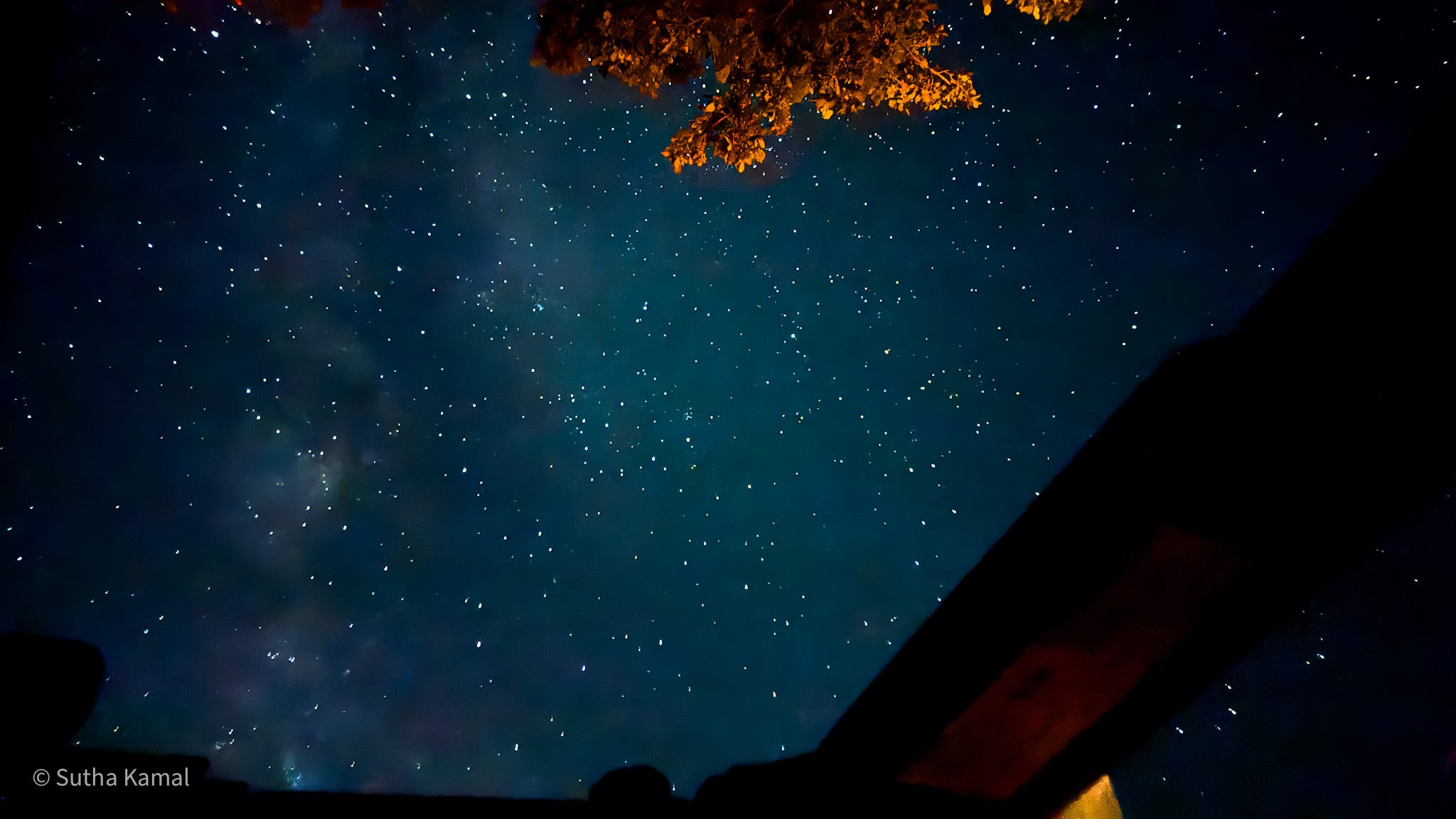
The last night, I lay in the Jeep with the top open and watched the Milky Way do its slow scroll, notebook closed, phone face-down. On a server in Oregon, a process I built was holding the day’s fragments, quietly keeping the thread, and ready to signal for help if I didn’t check in on time.
The expensive middle of hard thinking, the research, measurement, building, and formatting, has started happening in the gaps between my messages, while I do something embodied and slow. I described a tool at breakfast and used it on a mountain by mid-morning. The desk is no longer the unit or place of thought; the loop between the trail and the server is. The screen becomes the place where I drop off intent and pick up synthesis, not the place where the work happens.
There’s a longer story about the borrowed Jeep and what it’s doing to me to become a beginner again with skinned knuckles (or more accurately, a bruised ego 🤣).
That deserves its own essay or two, and I’m not ready to write ‘em. For now: the channel got a resident, the notebook is getting a receiving end, and the desk… there just ain’t no need for one.
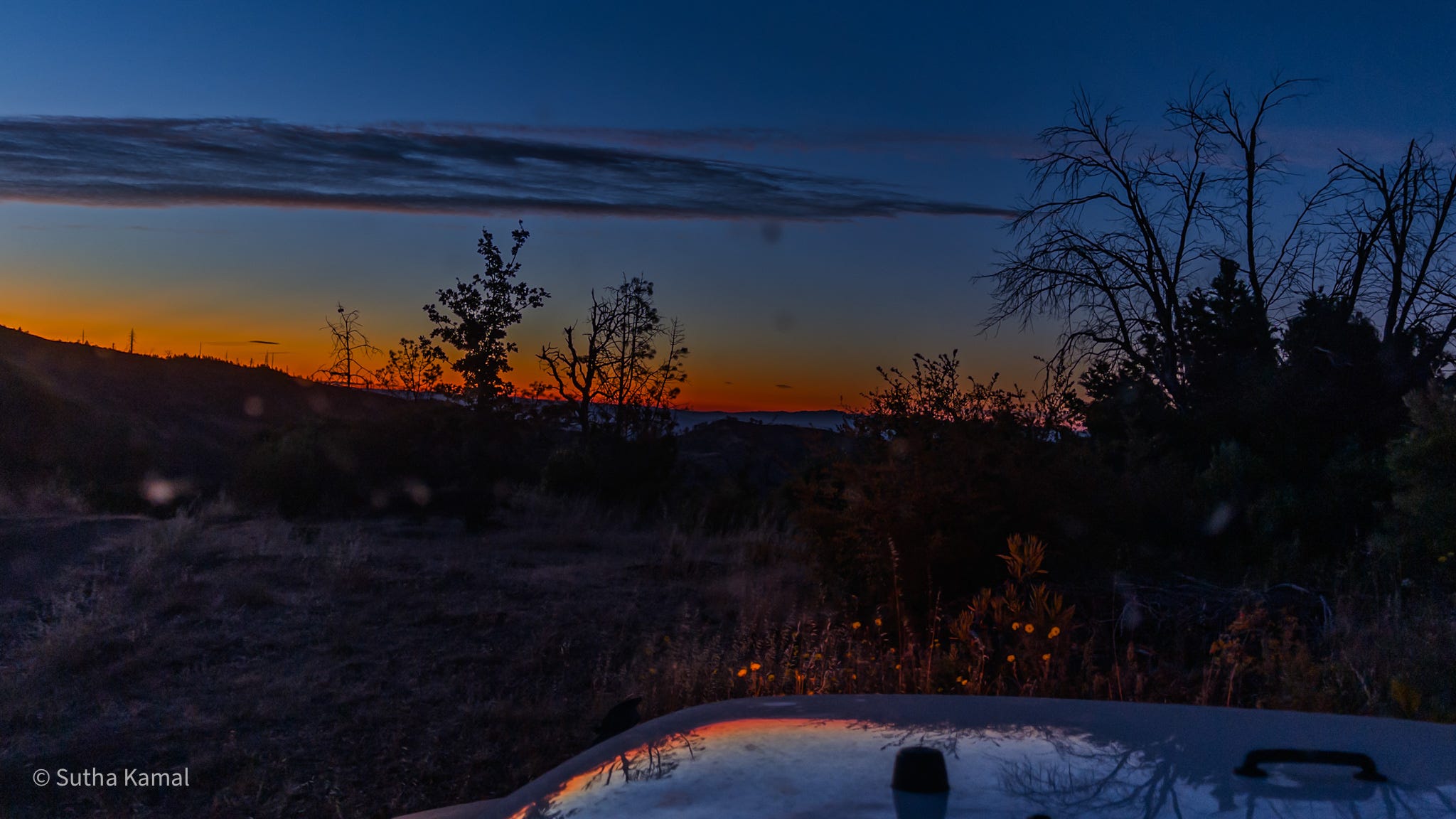
P.S. True story - the hardest part of writing this essay was attaching the pictures to it in the Substack web editor from Ukiah, CA. Satellite > cafe wifi at the moment. 🤷🏾♂️🤦🏾