SUMO community discussions
-
Hi, I am a locale leader of SUMO Japanese community. I have contributed to the Support over 20 years, before the beginning of support.mozilla.org.
Today, November 4, we decided to end our SUMO Japanese community.
In October 22, the sumobot was introduced to Japanese KB articles. I cannot accept its behavior and no words.
- It doesn't follow our translation guidelines.
- It doesn't respect current localization for Japanese users, so they were lost.
- It approves its direct English MT immediately for All archived KB articles.
- It approves only in 72 hours after its updates, so we lost our work to train new contributors.
- It has been working now without our acceptance, without controls, without communications.
- Over 300 Knowledge Base articles are overridden by sumobot.
They are all happened on the product server, not on staging server. I understand that this is mass destruction of our work and explicit violation to the Mozilla mission, allowed officially.
Therefore, I (marsf) declare:
- I quit to contribute to support.mozilla.org.
- I prohibit to use all my translation as learning data for SUMO bot and AIs.
- I request to remove all my translation from learned data of SUMO AIs.
However, individual Japanese contributors may want to work in their responsibility. It is their choice, we don't care nor support.
Bye.
Hi, I am a locale leader of SUMO Japanese community. I have contributed to the Support over 20 years, before the beginning of support.mozilla.org. Today, November 4, we decided to end our SUMO Japanese community. In October 22, the sumobot was introduced to Japanese KB articles. I cannot accept its behavior and no words. * It doesn't follow our translation guidelines. * It doesn't respect current localization for Japanese users, so they were lost. * It approves its direct English MT immediately for All archived KB articles. * It approves only in 72 hours after its updates, so we lost our work to train new contributors. * It has been working now without our acceptance, without controls, without communications. * Over 300 Knowledge Base articles are overridden by sumobot. They are all happened on the product server, not on staging server. I understand that this is mass destruction of our work and explicit violation to the Mozilla mission, allowed officially. Therefore, I (marsf) declare: * I quit to contribute to support.mozilla.org. * I prohibit to use all my translation as learning data for SUMO bot and AIs. * I request to remove all my translation from learned data of SUMO AIs. However, individual Japanese contributors may want to work in their responsibility. It is their choice, we don't care nor support. Bye.
-
"Gokurosama deshita" (ご苦労様でした)
"Gokurosama deshita" (ご苦労様でした)
-
Hi Marsf,
I'm sorry for how you and the Japanese community feel about the MT workflow that we just recently introduced. Would you be interested to hop on a call with us to talk about this further? We want to make sure we trully understand what you're struggling with.
My timezone is UTC+7, so it should be easier for us to set up time. Let me know how that sound!
Hi Marsf, I'm sorry for how you and the Japanese community feel about the MT workflow that we just recently introduced. Would you be interested to hop on a call with us to talk about this further? We want to make sure we trully understand what you're struggling with. My timezone is UTC+7, so it should be easier for us to set up time. Let me know how that sound!
-
Hi marsf, I'm so sorry to read your message. Even though we haven't seen each other for a while, I still have fond memories of you (we last met at All Hands in Orlando... in 2018). I completely understand your frustration after the introduction of SumoBot. We Italians, along with the Spanish, were the first to experiment with automatic translation/updates via SumoBot (https://support.mozilla.org/en-US/forums/contributors/717387?last=89505), and I've already expressed some concerns. I hope that, after talking with Kiki and the staff, you'll change your mind about ceasing your localization contributions.
marsf said
• It doesn't follow our translation guidelines.
Fortunately, for the Italian localization, our guidelines are being respected.
• It approves its direct English MT immediately for All archived KB articles. • It approves only in 72 hours after its updates, so we lost our work to train new contributors. • It has been working now without our acceptance, without controls, without communications.
These are also in my opinion the sore points, especially the fact that SumoBot updates or translates (when there's a new article) immediately, which hinders the training of new contributors because they end up doing "proofreading" since SumoBot immediately takes over... For me, as a locale leader, it's not easy to help a new contributor understand how the localization process works, the syntax of the Sumo wiki, if they have to view a "diff" that SumoBot has already automatically proposed (Often retranslating parts of the article that aren't subject to changes...).
I believe the various locales should be able to decide whether or not to use machine translations, especially if we want to involve new contributors. In the last few months, I've trained two new contributors, but since the introduction of machine translation and on-the-fly translation, they've lost interest, and I spend my time alone (As always) fixing SumoBot's intrusiveness.
Hugs, Michele
Hi marsf, I'm so sorry to read your message. Even though we haven't seen each other for a while, I still have fond memories of you (we last met at All Hands in Orlando... in 2018). I completely understand your frustration after the introduction of SumoBot. We Italians, along with the Spanish, were the first to experiment with automatic translation/updates via SumoBot (https://support.mozilla.org/en-US/forums/contributors/717387?last=89505), and I've already expressed some concerns. I hope that, after talking with Kiki and the staff, you'll change your mind about ceasing your localization contributions. ''marsf [[#post-89603|said]]''<blockquote>• It doesn't follow our translation guidelines.</blockquote> Fortunately, for the Italian localization, our guidelines are being respected.<blockquote>• It approves its direct English MT immediately for All archived KB articles. • It approves only in 72 hours after its updates, so we lost our work to train new contributors. • It has been working now without our acceptance, without controls, without communications.</blockquote> These are also in my opinion the sore points, especially the fact that SumoBot updates or translates (when there's a new article) immediately, which hinders the training of new contributors because they end up doing "proofreading" since SumoBot immediately takes over... For me, as a locale leader, it's not easy to help a new contributor understand how the localization process works, the syntax of the Sumo wiki, if they have to view a "diff" that SumoBot has already automatically proposed (Often retranslating parts of the article that aren't subject to changes...). I believe the various locales should be able to decide whether or not to use machine translations, especially if we want to involve new contributors. In the last few months, I've trained two new contributors, but since the introduction of machine translation and on-the-fly translation, they've lost interest, and I spend my time alone (As always) fixing SumoBot's intrusiveness. Hugs, Michele
-
Michele Rodaro said
Fortunately, for the Italian localization, our guidelines are being respected.
I wonder if what Marsf referring to was related to the the bug that we recently reported. I have a feeling the bug may have caused the impression that the MT doesn't respect prior translation and guidelines even though it's actually a bug.
These are also in my opinion the sore points, especially the fact that SumoBot updates or translates (when there's a new article) immediately, which hinders the training of new contributors because they end up doing "proofreading" since SumoBot immediately takes over... For me, as a locale leader, it's not easy to help a new contributor understand how the localization process works, the syntax of the Sumo wiki, if they have to view a "diff" that SumoBot has already automatically proposed (Often retranslating parts of the article that aren't subject to changes...).
Michele, you and I talked about the struggle of getting new contributors on board. We've been experimenting with training for the Forum Moderators and we've been getting great feedback from the participants so far. Do you think a training or video tutorials would help with this?
I believe the various locales should be able to decide whether or not to use machine translations, especially if we want to involve new contributors. In the last few months, I've trained two new contributors, but since the introduction of machine translation and on-the-fly translation, they've lost interest, and I spend my time alone (As always) fixing SumoBot's intrusiveness.
Can you tell me more about SUMObot intrusiveness that you've experienced?
''Michele Rodaro [[#post-89608|said]]'' <blockquote> Fortunately, for the Italian localization, our guidelines are being respected. </blockquote> I wonder if what Marsf referring to was related to the [https://github.com/mozilla/sumo/issues/2605 the bug] that we recently reported. I have a feeling the bug may have caused the impression that the MT doesn't respect prior translation and guidelines even though it's actually a bug. <blockquote> These are also in my opinion the sore points, especially the fact that SumoBot updates or translates (when there's a new article) immediately, which hinders the training of new contributors because they end up doing "proofreading" since SumoBot immediately takes over... For me, as a locale leader, it's not easy to help a new contributor understand how the localization process works, the syntax of the Sumo wiki, if they have to view a "diff" that SumoBot has already automatically proposed (Often retranslating parts of the article that aren't subject to changes...).</blockquote> Michele, you and I talked about the struggle of getting new contributors on board. We've been experimenting with training for the Forum Moderators and we've been getting great feedback from the participants so far. Do you think a training or video tutorials would help with this? <blockquote> I believe the various locales should be able to decide whether or not to use machine translations, especially if we want to involve new contributors. In the last few months, I've trained two new contributors, but since the introduction of machine translation and on-the-fly translation, they've lost interest, and I spend my time alone (As always) fixing SumoBot's intrusiveness. </blockquote>Can you tell me more about SUMObot intrusiveness that you've experienced?
-
Training for Forum moderators when elevating existing forum contributors is a different thing to onboarding new contributors to the forum or (in respect of the concerns raised here) L10n.
Training for Forum moderators when elevating existing forum contributors is a different thing to onboarding new contributors to the forum or (in respect of the concerns raised here) L10n.
-
Kiki said
Hi Marsf, I'm sorry for how you and the Japanese community feel about the MT workflow that we just recently introduced. Would you be interested to hop on a call with us to talk about this further? We want to make sure we trully understand what you're struggling with.
For clarification, are you involved with the bot rollout or not?
''Kiki [[#post-89607|said]]'' <blockquote> Hi Marsf, I'm sorry for how you and the Japanese community feel about the MT workflow that we just recently introduced. Would you be interested to hop on a call with us to talk about this further? We want to make sure we trully understand what you're struggling with. </blockquote> For clarification, are you involved with the bot rollout or not?
-
Kiki said
We want to make sure we trully understand what you're struggling with.
They just provided a list of their issues.
''Kiki [[#post-89607|said]]'' <blockquote> We want to make sure we trully understand what you're struggling with. </blockquote> They just provided a list of their issues.
-
I have a question related to this. Does this mean that, despite having an existing dedicated team, the deployment/activation/usage of a bot that not only oversee but take actual actions in place of that team was done without any discussion with anyone already involved in the matter?
That sounds like a big no-no regardless of the nature of the tool and, to an outside observer, really sounds like an horrible idea.
I have a question related to this. Does this mean that, despite having an existing dedicated team, the deployment/activation/usage of a bot that not only oversee but take actual actions in place of that team was done without any discussion with anyone already involved in the matter? That sounds like a big no-no regardless of the nature of the tool and, to an outside observer, really sounds like an horrible idea.
-
this is so sad. bots over people, eh?
this is so sad. bots over people, eh?
-
Kiki said
Michele Rodaro said
These are also in my opinion the sore points, especially the fact that SumoBot updates or translates (when there's a new article) immediately, which hinders the training of new contributors because they end up doing "proofreading" since SumoBot immediately takes over... For me, as a locale leader, it's not easy to help a new contributor understand how the localization process works, the syntax of the Sumo wiki, if they have to view a "diff" that SumoBot has already automatically proposed (Often retranslating parts of the article that aren't subject to changes...).
Michele, you and I talked about the struggle of getting new contributors on board. We've been experimenting with training for the Forum Moderators and we've been getting great feedback from the participants so far. Do you think a training or video tutorials would help with this?Honestly, I don't think so. I'll start by saying that I'm not trying to be argumentative, especially towards you, Kiki, who's easy to discuss because you're always kind and helpful. Providing forum support (I do it on Italian forums) is one thing, but localizing/translating Sumo Knowledge Base articles is another. Furthermore, the fact that SumoBot intervenes immediately doesn't help. As soon as a technical writer updates/translates the article into English and marks it "Ready for localization", SumoBot intervenes, and I receive a notification email informing me that the article has been updated/translated by SumoBot. This leaves me with no choice but to reject or edit what SumoBot has done. What should I do with a new contributor? Do I have them correct SumoBot's translation? What kind of enthusiasm can such an activity generate? A tutorial can only be useful if we locale leaders have the time to show a new contributor the article they need to update/edit before anyone else (including SumoBot and I) intervenes. The big problem is the immediacy of SumoBot's intervention.
Michele Rodaro said
I believe the various locales should be able to decide whether or not to use machine translations, especially if we want to involve new contributors. In the last few months, I've trained two new contributors, but since the introduction of machine translation and on-the-fly translation, they've lost interest, and I spend my time alone (As always) fixing SumoBot's intrusiveness.
Can you tell me more about SUMObot intrusiveness that you've experienced?Aside from the bug you mentioned, particularly the one related to interface entries ("MT revert translated UI elements back to English"), SumoBot often intervenes even where it's not needed. I tried to find SumoBot translations that highlighted this issue, but apparently I was so upset that I deleted/rejected them hahaha (I'll try to search more calmly).
Italian is a rather complex and nuanced language; it's not as direct and concise as American English. Unless we're describing a procedure, Italian translations of the more discursive parts of articles (such as an introduction) often require more complex sentences and the addition of words, phrases, or verbs that don't faithfully reflect the original En-US text. If a technical writer edits the original en-US article and replaces some words in a sentence, or just some words, SumoBot intervenes in the translation of that sentence and rearranges it to faithfully reflect the en-US text. So, if I added something to make a concept more understandable for an Italian user, those additions have been reverted in the new version of SumoBot. It would be easier to explain if English were my primary language and I could find a concrete, visible example of a change made by SumoBot (I'll try). Another similar example involves adding a link to Wikipedia or something else I decide to include in the Italian article to help less-savvy Italian users understand a technical term. If that link isn't included in the original en-US text, SumoBot does the job it was trained to do: it compares the en-US text with the Italian one, sees that the link isn't present in the en-US text, and removes the reference link I'd inserted in the Italian translation. That said, I hope this topic/discussion doesn't turn into a pointless media circus, that it stays on topic, that it doesn't become a source of gratuitous attacks that don't help anyone (especially us localizers), and that a way is found to solve the problem for the Japanese community, and not just for them, because the problem exists and is undeniable. Let's try to be constructive.
''Kiki [[#post-89609|said]]'' <blockquote> ''Michele Rodaro [[#post-89608|said]]'' <blockquote> These are also in my opinion the sore points, especially the fact that SumoBot updates or translates (when there's a new article) immediately, which hinders the training of new contributors because they end up doing "proofreading" since SumoBot immediately takes over... For me, as a locale leader, it's not easy to help a new contributor understand how the localization process works, the syntax of the Sumo wiki, if they have to view a "diff" that SumoBot has already automatically proposed (Often retranslating parts of the article that aren't subject to changes...).</blockquote> Michele, you and I talked about the struggle of getting new contributors on board. We've been experimenting with training for the Forum Moderators and we've been getting great feedback from the participants so far. Do you think a training or video tutorials would help with this? </blockquote>Honestly, I don't think so. I'll start by saying that I'm not trying to be argumentative, especially towards you, Kiki, who's easy to discuss because you're always kind and helpful. Providing forum support (I do it on Italian forums) is one thing, but localizing/translating Sumo Knowledge Base articles is another. Furthermore, the fact that SumoBot intervenes immediately doesn't help. As soon as a technical writer updates/translates the article into English and marks it "Ready for localization", SumoBot intervenes, and I receive a notification email informing me that the article has been updated/translated by SumoBot. This leaves me with no choice but to reject or edit what SumoBot has done. What should I do with a new contributor? Do I have them correct SumoBot's translation? What kind of enthusiasm can such an activity generate? A tutorial can only be useful if we locale leaders have the time to show a new contributor the article they need to update/edit before anyone else (including SumoBot and I) intervenes. The big problem is the immediacy of SumoBot's intervention. <blockquote> ''Michele Rodaro [[#post-89608|said]]'' <blockquote> I believe the various locales should be able to decide whether or not to use machine translations, especially if we want to involve new contributors. In the last few months, I've trained two new contributors, but since the introduction of machine translation and on-the-fly translation, they've lost interest, and I spend my time alone (As always) fixing SumoBot's intrusiveness. </blockquote>Can you tell me more about SUMObot intrusiveness that you've experienced? </blockquote>Aside from the bug you mentioned, particularly the one related to interface entries ("MT revert translated UI elements back to English"), SumoBot often intervenes even where it's not needed. I tried to find SumoBot translations that highlighted this issue, but apparently I was so upset that I deleted/rejected them hahaha (I'll try to search more calmly). Italian is a rather complex and nuanced language; it's not as direct and concise as American English. Unless we're describing a procedure, Italian translations of the more discursive parts of articles (such as an introduction) often require more complex sentences and the addition of words, phrases, or verbs that don't faithfully reflect the original En-US text. If a technical writer edits the original en-US article and replaces some words in a sentence, or just some words, SumoBot intervenes in the translation of that sentence and rearranges it to faithfully reflect the en-US text. So, if I added something to make a concept more understandable for an Italian user, those additions have been reverted in the new version of SumoBot. It would be easier to explain if English were my primary language and I could find a concrete, visible example of a change made by SumoBot (I'll try). Another similar example involves adding a link to Wikipedia or something else I decide to include in the Italian article to help less-savvy Italian users understand a technical term. If that link isn't included in the original en-US text, SumoBot does the job it was trained to do: it compares the en-US text with the Italian one, sees that the link isn't present in the en-US text, and removes the reference link I'd inserted in the Italian translation. That said, I hope this topic/discussion doesn't turn into a pointless media circus, that it stays on topic, that it doesn't become a source of gratuitous attacks that don't help anyone (especially us localizers), and that a way is found to solve the problem for the Japanese community, and not just for them, because the problem exists and is undeniable. Let's try to be constructive.
-
Hi,
New member here, this came across my feed elsewhere and it piqued my curiosity because I happen to work at the intersection of software and localization. I've seen this play out a few times before, and curiously, most often with Asian cultures (Japanese and Chinese localization in particular).
I wanted to chime in because I want to understand SumoBot and what it does better - right now, what I'm hearing is that SumoBot does translation, whereas what people like @Michele Rodaro and @marsf are doing are more akin to transcreation, which is an order of magnitude more complicated.
Am I hearing things correctly? I'd love to join the discussion even though I'm not a Mozilla Support member - I think I can contribute so that both speed and quality improve.
Hi, New member here, this came across my feed elsewhere and it piqued my curiosity because I happen to work at the intersection of software and localization. I've seen this play out a few times before, and curiously, most often with Asian cultures (Japanese and Chinese localization in particular). I wanted to chime in because I want to understand SumoBot and what it does better - right now, what I'm hearing is that SumoBot does ''translation'', whereas what people like @Michele Rodaro and @marsf are doing are more akin to ''transcreation'', which is an order of magnitude more complicated. Am I hearing things correctly? I'd love to join the discussion even though I'm not a Mozilla Support member - I think I can contribute so that both speed and ''quality'' improve.
-
Hey Mars! You left quite an impression on me all those years when we first met back at an All Hands. So I hate to hear this is happening to you & the Japanese SUMO community. I hate to see you go out this way.
My general thoughts on Machine Translation: I don't usually say too much about the KB area of things since there are many more longstanding KB localizers & contributors that take great care of it & could give a better opinion of what the KB needs. Like Alice, Michele & Underpass, Artist (+ Pollti, graba, milupo), Mars, dskmori, Wxie (+ YFdyh000), petercpg, Channy, TyDraniu, Pollti, Selim aka maxcoder, soucet, mstanke, Lan aka upwinxp, kkemenczy, Mozinet, Y.D., Jhonatas, marcelo.ghelman, markh2, Goudron, Tonnes, Goofy, Unghost and more. Some have single handily maintained localization efforts for their locale for years & some almost for a decade. Absolute legends! And I still am missing a few of their names, please forgive me.
So when I first heard about Machine Translation automatically localizing articles, I thought it was a cool idea and helpful. But.... ONLY for locales without any community members helping to localize it. Of which there are a ton. There's maybe 20+ locales that don't have any community or have small sporadic contributions.
So when I heard it was going to start testing MTs on very well maintained locales like Italian & Spanish, I became worried. But it did make sense to test machine translation in a highly watched locale so that the localizers there could report if it was doing a good or bad job. Or a mix of both.
What I didn't expect was for the machine translation to get enabled for all locales. Even the most popular and well maintained ones. As everyone knows certain languages have key nuances only a native speaker would understand. And that a bot/AI would never understand. So for example, a bot shouldn't mess with Italian, German, Dutch, Japanese, Korean, Chinese (zh-TW & zh-CN), French, Brazilian Portuguese and more. For the less popular locales, the automatic machine translation would be a huge help since no one is really writing new articles or translating them because the community either doesn't exist or has naturally moved on.
Main question: So I guess what I'm trying to get at is, why the rush to enable machine translation on locales that don't really need that extra assistance? It was already proven that machine translation can be enabled only on specific locales. So this feature already exists. It can simply be turned off.
So I propose that machine translation be immediately turned off in the Japanese locale and any other popular locale that requests this to avoid losing community members while the bugs or confusion gets worked out.
From Michele's detailed descriptions, it sounds like the MT is doing a lot of auto-corrections. I feel like it should only be doing translations for articles that never existed before (first creations) & for locales with the lowest contributor activity. To be more clear, it should only get one chance to edit/translate an article (first creation) then should not continue to modify the content of it going forward. With a possible exception for locales that never get any contributor updates to continue getting automated translations whenever a English article is updated.
Closing thoughts: I know I don't hold any pull here in the KB world since I mostly operate in the forums but I like to use simplicity & common sense when it comes to things. And turning on machine translation at full blast for very well maintained locales like Italian, German, Japanese, Brazilian Portuguese and Chinese (zh-TW/zh-CN) doesn't make much sense to me. I would want to ruffle as little feathers as possible with machine translation while still supporting the people that want to volunteer to manually translate articles so that they read & sound native to their locale. Since they are not paid for their work, I don't see any cost savings that machine translation is providing in those specific locales. It looks counter productive since they have to go back & undo/fix any mistakes the bot made.
Additional ideas:
- Create a hard limit of how many articles can be machine translated in a single day - Maybe 2 per day? This will lower the chances of a huge avalanche of reviews that a localizer would have to approve or reject
- Do not auto-approve MTs after 72 hrs. The timeframe feels too short. Especially if hundreds to thousands of MTs were completed. Possibly reserve this option for locales that are not active & are carefully earmarked beforehand by staff so everyone is aware which locales would be getting auto-approvals.
Also as Michele very, very well eloquently stated (also Hi! Great to see & hear from you my friend), I don't want to mudsling or insult machine translation or the decisions that led up to enabling it for every locale. I would rather that the SUMO admin take what the KB contributors are saying seriously. Pause course. Disable machine translation for the affected locales like Japanese, Italian and probably a few others. And let those locales continue to do their own manual translations. When the MT project first started, I honestly thought it was to help only with locales that had zero or very little translated content.
Sumobot can machine translate at the speed of light & that's awesome. But it also needs to accept it doesn't know or understand everything that humans do. So it would be good to keep it in check as much as possible for the good of the community. :)
Edit: I assumed MT had been turned on for all locales. It looks like Japanese was the 3rd locale recently activated for it. And no other locales have been added for machine translation. Sorry about that. I thought there was a plan to activate MT for all locales & that it finally happened. I think it's a good thing that did not happen judging from this case.
Hey Mars! You left quite an impression on me all those years when we first met back at an All Hands. So I hate to hear this is happening to you & the Japanese SUMO community. I hate to see you go out this way. My general thoughts on Machine Translation: I don't usually say too much about the KB area of things since there are many more longstanding KB localizers & contributors that take great care of it & could give a better opinion of what the KB needs. '''Like Alice, Michele & Underpass, Artist (+ Pollti, graba, milupo), Mars, dskmori, Wxie (+ YFdyh000), petercpg, Channy, TyDraniu, Pollti, Selim aka maxcoder, soucet, mstanke, Lan aka upwinxp, kkemenczy, Mozinet, Y.D., Jhonatas, marcelo.ghelman, markh2, Goudron, Tonnes, Goofy, Unghost and more.''' Some have single handily maintained localization efforts for their locale for years & some almost for a decade. Absolute legends! And I still am missing a few of their names, please forgive me. So when I first heard about Machine Translation automatically localizing articles, I thought it was a cool idea and helpful. But.... '''ONLY''' for locales without any community members helping to localize it. Of which there are a ton. There's maybe 20+ locales that don't have any community or have small sporadic contributions. So when I heard it was going to start testing MTs on very well maintained locales like Italian & Spanish, I became worried. But it did make sense to test machine translation in a highly watched locale so that the localizers there could report if it was doing a good or bad job. Or a mix of both. What I didn't expect was for the machine translation to get enabled for all locales. Even the most popular and well maintained ones. As everyone knows certain languages have key nuances only a native speaker would understand. And that a bot/AI would never understand. So for example, a bot shouldn't mess with Italian, German, Dutch, Japanese, Korean, Chinese (zh-TW & zh-CN), French, Brazilian Portuguese and more. For the less popular locales, the automatic machine translation would be a huge help since no one is really writing new articles or translating them because the community either doesn't exist or has naturally moved on. '''Main question:''' So I guess what I'm trying to get at is, why the rush to enable machine translation on locales that don't really need that extra assistance? It was already proven that machine translation can be enabled only on specific locales. So this feature already exists. It can simply be turned off. So I propose that machine translation be '''immediately''' turned off in the Japanese locale and any other popular locale that requests this to avoid losing community members while the bugs or confusion gets worked out. From Michele's detailed descriptions, it sounds like the MT is doing a lot of auto-corrections. I feel like it should only be doing translations for articles that never existed before (first creations) & for locales with the lowest contributor activity. To be more clear, it should only get one chance to edit/translate an article (first creation) then should not continue to modify the content of it going forward. With a possible exception for locales that never get any contributor updates to continue getting automated translations whenever a English article is updated. Closing thoughts: I know I don't hold any pull here in the KB world since I mostly operate in the forums but I like to use simplicity & common sense when it comes to things. And turning on machine translation at full blast for very well maintained locales like Italian, German, Japanese, Brazilian Portuguese and Chinese (zh-TW/zh-CN) doesn't make much sense to me. I would want to ruffle as little feathers as possible with machine translation while still supporting the people that want to volunteer to manually translate articles so that they read & sound native to their locale. Since they are not paid for their work, I don't see any cost savings that machine translation is providing in those specific locales. It looks counter productive since they have to go back & undo/fix any mistakes the bot made. Additional ideas: * Create a hard limit of how many articles can be machine translated in a single day - Maybe 2 per day? This will lower the chances of a huge avalanche of reviews that a localizer would have to approve or reject * Do not auto-approve MTs after 72 hrs. The timeframe feels too short. Especially if hundreds to thousands of MTs were completed. Possibly reserve this option for locales that are not active & are carefully earmarked beforehand by staff so everyone is aware which locales would be getting auto-approvals. Also as Michele very, very well eloquently stated (also Hi! Great to see & hear from you my friend), I don't want to mudsling or insult machine translation or the decisions that led up to enabling it for every locale. I would rather that the SUMO admin take what the KB contributors are saying seriously. Pause course. Disable machine translation for the affected locales like Japanese, Italian and probably a few others. And let those locales continue to do their own manual translations. When the MT project first started, I honestly thought it was to help only with locales that had zero or very little translated content. Sumobot can machine translate at the speed of light & that's awesome. But it also needs to accept it doesn't know or understand everything that humans do. So it would be good to keep it in check as much as possible for the good of the community. :) '''Edit:''' I assumed MT had been turned on for all locales. It looks like Japanese was the 3rd locale recently activated for it. And no other locales have been added for machine translation. Sorry about that. I thought there was a plan to activate MT for all locales & that it finally happened. I think it's a good thing that did not happen judging from this case.
Modified by NoahSUMO on
-
I agree with every word (…even the commas) of what my friend Noah wrote (Hi Noah! \o/ ). He's a passionate, knowledgeable, and sensitive person. I'll share my personal thoughts on this discussion in a future post, which, in my opinion, goes beyond the use or not of SumoBot, as it fully involves the concepts of translation, volunteering, love for Mozilla's mission, and involvement.
In the meantime, I'm posting a screenshot of how SumoBot works, taking the liberty of intervening forcefully in writing an introduction where only the icon change in the latest versions of Firefox for Android needed updating… It's not SumoBot's fault; as I've already written, it's programmed to do this kind of work.
The part of the text that needed updating is just "shield icon [[Image:shield]] that appears", but the SumoBot clearly wasn't comfortable with the Italian language. Too many words… let's cut some!
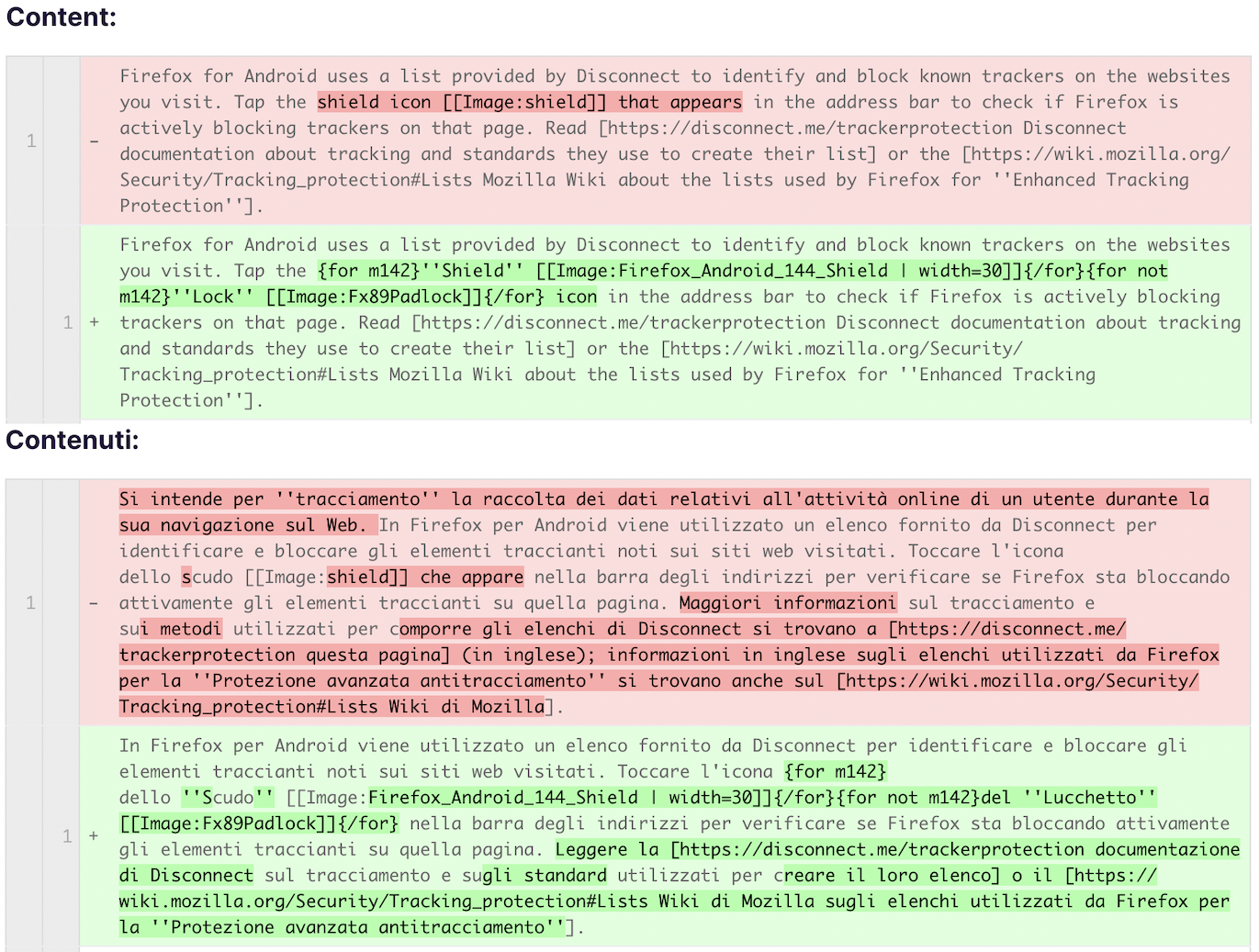
For now, just one question: Why should I waste my time correcting what the SumoBot writes when I could have simply updated what needed updating?
Hugs ;)
I agree with every word (…even the commas) of what my friend Noah wrote (Hi Noah! \o/ ). He's a passionate, knowledgeable, and sensitive person. I'll share my personal thoughts on this discussion in a future post, which, in my opinion, goes beyond the use or not of SumoBot, as it fully involves the concepts of translation, volunteering, love for Mozilla's mission, and involvement. In the meantime, I'm posting a screenshot of how SumoBot works, taking the liberty of intervening forcefully in writing an introduction where only the icon change in the latest versions of Firefox for Android needed updating… It's not SumoBot's fault; as I've already written, it's programmed to do this kind of work. The part of the text that needed updating is just "''shield icon <nowiki>[[Image:shield]]</nowiki> that appears''", but the SumoBot clearly wasn't comfortable with the Italian language. Too many words… let's cut some! [[Image:Diff_en-US_it]] For now, just one question: Why should I waste my time correcting what the SumoBot writes when I could have simply updated what needed updating? Hugs ;)
-
NoahSUMO said
Main question: So I guess what I'm trying to get at is, why the rush to enable machine translation on locales that don't really need that extra assistance? It was already proven that machine translation can be enabled only on specific locales. So this feature already exists. It can simply be turned off.
kiki said
Hi Marsf, I'm sorry for how you and the Japanese community feel about the MT workflow that we just recently introduced. Would you be interested to hop on a call with us to talk about this further? We want to make sure we trully understand what you're struggling with. My timezone is UTC+7, so it should be easier for us to set up time. Let me know how that sound!
It has been quite some time since the dissolution announcement was made. Regarding the response from Mozilla staff thus far and the active updates for translations in certain languages: Staff are attempting some form of persuasion secretly, via phone calls rather than forums, and without making it public.
Especially on the eve of layoffs occurring in the US, it is common for such phone calls to come in. Recently, however, there has been no contact at all, and everything shuts down suddenly.
Ultimately, it is fascinating how the AI staff's silence regarding their statements and the situation has thrust an icy blade toward future developments, effectively demanding the Japanese translation community accept the status quo and resign itself to defeat. Kiki or other AI-related staff could have offered explanations here. They could even have asked other supporters what should have been done.
For example, kiki could have at least started by saying: “No, no, I'm sorry, I accidentally turned the switch on. I just turned it off. This was a mistake. I've restored things to how they were, so please, everyone, come back.” This would have bought time to craft a better response, if not the best one. But to this day, that hasn't been done.
But the fact that they did not do so means that, as the stance of the AI-related team and its members, they succeeded in bringing down what they considered the iron fist of justice upon the Japanese community, ultimately achieving “regaining control.” In other words, by introducing new technology to the active translation community, they created the precedent that “it couldn't be helped,” inadvertently establishing the justification that “they've left. We must compensate using new technology.”
I hate to admit it, but if the staff's true purpose here was to quietly bury the activities and experiences of the global translation community members and ensure all control remains firmly in the hands of Mozilla staff and English speakers, then this outcome—pretending to mend fences while no actual mending occurs—is inevitable.
It remains to be seen how the staff will behave, explain themselves, and apologize going forward. Will it unfold like a Hollywood movie where members of other languages are similarly slaughtered, or will it have a sweet happy ending? However, at this very moment, it seems we've been shown the trailer for this movie without warning.
For now, let's observe this development.
Addendum: I made one mistake. It wasn't the trailer. In Japan, after watching the prologue depicting the Italian and Spanish language incidents, the main story—the massacre of the Japanese-speaking community—actually began, and most of it has already been played. Will the community's future lie in this problem, this spark of trouble, this pathogen-like issue, much like in the “Resident Evil” movies? Or will the next installment be released, where the next community is brutally slaughtered?
''NoahSUMO [[#post-89623|said]]'' <blockquote> '''Main question:''' So I guess what I'm trying to get at is, why the rush to enable machine translation on locales that don't really need that extra assistance? It was already proven that machine translation can be enabled only on specific locales. So this feature already exists. It can simply be turned off. </blockquote> ''kiki [[#post-89607|said]]'' <blockquote> Hi Marsf, I'm sorry for how you and the Japanese community feel about the MT workflow that we just recently introduced. Would you be interested to hop on a call with us to talk about this further? We want to make sure we trully understand what you're struggling with. My timezone is UTC+7, so it should be easier for us to set up time. Let me know how that sound! </blockquote> It has been quite some time since the dissolution announcement was made. Regarding the response from Mozilla staff thus far and the active updates for translations in certain languages: Staff are attempting some form of persuasion secretly, via phone calls rather than forums, and without making it public. Especially on the eve of layoffs occurring in the US, it is common for such phone calls to come in. Recently, however, there has been no contact at all, and everything shuts down suddenly. Ultimately, it is fascinating how the AI staff's silence regarding their statements and the situation has thrust an icy blade toward future developments, effectively demanding the Japanese translation community accept the status quo and resign itself to defeat. Kiki or other AI-related staff could have offered explanations here. They could even have asked other supporters what should have been done. For example, kiki could have at least started by saying: “No, no, I'm sorry, I accidentally turned the switch on. I just turned it off. This was a mistake. I've restored things to how they were, so please, everyone, come back.” This would have bought time to craft a better response, if not the best one. But to this day, that hasn't been done. But the fact that they did not do so means that, as the stance of the AI-related team and its members, they succeeded in bringing down what they considered the iron fist of justice upon the Japanese community, ultimately achieving “regaining control.” In other words, by introducing new technology to the active translation community, they created the precedent that “it couldn't be helped,” inadvertently establishing the justification that “they've left. We must compensate using new technology.” I hate to admit it, but if the staff's true purpose here was to quietly bury the activities and experiences of the global translation community members and ensure all control remains firmly in the hands of Mozilla staff and English speakers, then this outcome—pretending to mend fences while no actual mending occurs—is inevitable. It remains to be seen how the staff will behave, explain themselves, and apologize going forward. Will it unfold like a Hollywood movie where members of other languages are similarly slaughtered, or will it have a sweet happy ending? However, at this very moment, it seems we've been shown the trailer for this movie without warning. For now, let's observe this development. Addendum: I made one mistake. It wasn't the trailer. In Japan, after watching the prologue depicting the Italian and Spanish language incidents, the main story—the massacre of the Japanese-speaking community—actually began, and most of it has already been played. Will the community's future lie in this problem, this spark of trouble, this pathogen-like issue, much like in the “Resident Evil” movies? Or will the next installment be released, where the next community is brutally slaughtered?
Modified by pcb on
-
NoahSUMO said
Edit: I assumed MT had been turned on for all locales. It looks like Japanese was the 3rd locale recently activated for it. And no other locales have been added for machine translation. Sorry about that. I thought there was a plan to activate MT for all locales & that it finally happened. I think it's a good thing that did not happen judging from this case.
If I'm not mistaken, it's enabled for these locales (but there may be others as well): Bahasa Indonesia (id), Deutsch (de), Español (es), Français (fr), Italiano (it), 日本語 (ja), Português (Europeu) (pt-PT), Português (do Brasil) (pt-BR), Русский (ru), 中文 (简体) (zh-CN)
''NoahSUMO [[#post-89623|said]]'' <blockquote>'''Edit:''' I assumed MT had been turned on for all locales. It looks like Japanese was the 3rd locale recently activated for it. And no other locales have been added for machine translation. Sorry about that. I thought there was a plan to activate MT for all locales & that it finally happened. I think it's a good thing that did not happen judging from this case. </blockquote> If I'm not mistaken, it's enabled for these locales (but there may be others as well): ''Bahasa Indonesia'' (id), ''Deutsch'' (de), ''Español'' (es), ''Français'' (fr), ''Italiano'' (it), ''日本語'' (ja), ''Português (Europeu)'' (pt-PT), ''Português'' (do Brasil) (pt-BR), ''Русский'' (ru), ''中文 (简体)'' (zh-CN)
-
@pcb, please, let's try to stay calm and not create a false narrative. I think all this conspiracy talk is a bit overblown… ;) As an Italian locale leader, I too was involved in the suboptimal use of SumoBot, but I try to remain calm and seek constructive dialogue. What benefit would Mozilla gain from destroying translation communities, which work on a voluntary basis and for free? Incorrect or ungrammatical translations that would alienate users? If support articles are a product's calling card, what kind of impression would Mozilla make? I'm not a staff member, and it's not my job to defend anyone; I'm a volunteer who's been translating articles out of passion since 2008 (the year KB was launched).
I simply believe that, faced with the Japanese community's decision to discontinue collaboration (It would be a very serious loss!), more direct initial communication was the more logical option than exchanging posts, which could have led to confusion and dispersion, losing focus.
This isn't the first time disagreements have arisen between Mozilla and localizers of different languages over decisions that seemed to benefit localizers but actually turned out to be negative. Fortunately, through discussion, matters were ultimately resolved in favor of localizers and users, and, why not, even Mozilla.
@pcb, please, let's try to stay calm and not create a false narrative. I think all this conspiracy talk is a bit overblown… ;) As an Italian locale leader, I too was involved in the suboptimal use of SumoBot, but I try to remain calm and seek constructive dialogue. What benefit would Mozilla gain from destroying translation communities, which work on a voluntary basis and for free? Incorrect or ungrammatical translations that would alienate users? If support articles are a product's calling card, what kind of impression would Mozilla make? I'm not a staff member, and it's not my job to defend anyone; I'm a volunteer who's been translating articles out of passion since 2008 (the year KB was launched). I simply believe that, faced with the Japanese community's decision to discontinue collaboration (It would be a very serious loss!), more direct initial communication was the more logical option than exchanging posts, which could have led to confusion and dispersion, losing focus. This isn't the first time disagreements have arisen between Mozilla and localizers of different languages over decisions that seemed to benefit localizers but actually turned out to be negative. Fortunately, through discussion, matters were ultimately resolved in favor of localizers and users, and, why not, even Mozilla.
-
> Michele Rodaro said As there is no 'like' button here (and perhaps there shouldn't be), I'm replying with a ❤️ to express my appreciation for Michele's comments.
> ''Michele Rodaro [[#post-89633|said]]'' As there is no 'like' button here (and perhaps there shouldn't be), I'm replying with a ❤️ to express my appreciation for Michele's comments.
Modified by Irvin Chen on
-
Michele Rodaro said
@pcb, please, let's try to stay calm and not create a false narrative. I think all this conspiracy talk is a bit overblown… ;) As an Italian locale leader, I too was involved in the suboptimal use of SumoBot, but I try to remain calm and seek constructive dialogue.
Thanks Michele, I certainly recognize that the content of my post was not entirely appropriate.
This incident is clearly a tragedy equivalent to strangling the goose that lays golden eggs for the future. I must apologize for losing my composure regarding the staff's subsequent silence, the complete lack of progress in resolving this issue, and the current state where progress only occurs behind closed doors.
It's true that proving to the staff that they made no mistake is difficult for someone outside the community; it would surely become a “proof of the devil.”
However, regardless of me, the report everyone watching this thread least wants to hear is an empty conclusion from the staff saying, “Everything has been resolved between the parties involved, the decision won't change, so there's nothing more to discuss. Nothing will ever be posted here again. So everyone here can stop worrying about it now.”
In these harsh times, a rosy future with everything ending happily is rare. Still, it would be nice to at least hear of a happy resolution in this thread.
''Michele Rodaro [[#post-89633|said]]'' <blockquote> @pcb, please, let's try to stay calm and not create a false narrative. I think all this conspiracy talk is a bit overblown… ;) As an Italian locale leader, I too was involved in the suboptimal use of SumoBot, but I try to remain calm and seek constructive dialogue. </blockquote> Thanks Michele, I certainly recognize that the content of my post was not entirely appropriate. This incident is clearly a tragedy equivalent to strangling the goose that lays golden eggs for the future. I must apologize for losing my composure regarding the staff's subsequent silence, the complete lack of progress in resolving this issue, and the current state where progress only occurs behind closed doors. It's true that proving to the staff that they made no mistake is difficult for someone outside the community; it would surely become a “proof of the devil.” However, regardless of me, the report everyone watching this thread least wants to hear is an empty conclusion from the staff saying, “Everything has been resolved between the parties involved, the decision won't change, so there's nothing more to discuss. Nothing will ever be posted here again. So everyone here can stop worrying about it now.” In these harsh times, a rosy future with everything ending happily is rare. Still, it would be nice to at least hear of a happy resolution in this thread.
-
pcb, your continued sarcasm is unwarranted and repetitive, and therefore not helpful.
pcb, your continued sarcasm is unwarranted and repetitive, and therefore not helpful.