In LLMs Pre-commodify Ideas, I wrote about a strange effect of thinking with LLMs: people using the same models to work through similar problems can arrive at similar ideas at roughly the same time, often without knowing that anyone else has arrived there too. This produces simultaneous discovery without common knowledge.
The stranger part is that these ideas often seem unusually finished when they appear. Ideas normally spend some time in a rough social state: a small group develops them, misuses them, gives them local meanings, argues over what they should be called, and only later settles them into a standardized form that can circulate widely. LLMs can compress that intermediate stage. People arrive independently at ideas that already feel legible, named and portable.
Funnily enough I discovered that Mormonism has a surprisingly similar information structure, albeit without the actual technology. It is full of old information stored for use in the present: plates buried underground containing the history of ancient peoples, prophets writing explicitly for readers who will live centuries later, stones that reveal information unavailable by ordinary means.
This post was written with AI. I use AI to varying degrees across most Summer Lightning posts, but I explicitly disclose it when the level of AI involvement is significant.
The basic premise of the Book of Mormon is that an ancient religious record was communicated to Joseph Smith through magic stones. He claimed that an angel led him to a set of gold plates buried in a hill near his home, containing the history and religious record of ancient peoples of the Americas, written in what the text calls “reformed Egyptian.” Smith, who did not know the language, translated the plates through divine means.
Before this became revelation, however, it was divination. As a young man, Joseph Smith participated in the treasure-seeking culture of the early nineteenth-century Northeast, in which seers used stones to locate lost objects or buried treasure. Smith himself acquired a reputation for being able to “see” through a stone and was hired to assist in treasure searches. The continuity is striking: the basic information structure remains remarkably similar as treasure seeking becomes revelation. There is inaccessible information, a material interface for retrieval, and special people capable of reading it.
The information required to make sense of the present is already sitting in the past, finished and waiting to be retrieved. The plates are the archive; the seer stone is closer to an interface for querying it. An enormous body of old information exists, a problem appears in the present, and the interface produces information relevant to that problem.
The important difference is that LLMs are a strange-rules environment available to everyone with a $20 subscription while Mormon pre-commodification is only available to the special people. LLM pre-commodification is strange because access is widespread. Millions of people can query approximately the same archive through approximately the same interfaces, often without knowing what anyone else is asking. Mormon revelation has the opposite architecture. The information concerns everyone, but only a special person or set of people can retrieve it. Everyone inhabits the history revealed by the plates, but Joseph Smith and a few select people are the only people who can access it.
Mormonism therefore looks less like a universally available archive than a system of privileged access to an overdefined map. The prophet’s specialness consists partly in possessing information about the structure of reality that other people cannot independently obtain. This quickly creates an access-control problem. When Hiram Page began producing revelations through his own stone in 1830, the young church had to establish who was authorized to receive revelations that applied to everyone. The result was effectively a distinction between private revelation and canonical write access. A world in which revelation is possible still requires a protocol for deciding whose revelation becomes the map.
This is where Mormonism’s origins in treasure seeking become useful. The treasure seeker does not begin with a complete account of the world. He begins with rumors, dreams, stones, half-understood signs and the conviction that something valuable may be hidden nearby. The map is enough to justify the search but not detailed enough to determine in advance what will be found. Early Mormonism grows out of this environment, but its development can also be understood as a gradual increase in the resolution of the map: the buried treasure becomes a particular set of plates, the plates acquire a particular history, the stone becomes an instrument of translation, and the person capable of using it becomes a prophet.
Sarah Perry’s essay Treasure Hunting gives a useful vocabulary for this transition. She describes a class of activities that combine optimism, ignorance and a shitty map. Treasure hunting works because something valuable may exist in a domain that is poorly understood. The available theories are weak, the evidence is incomplete and the stories about enormous discoveries are probably exaggerated, but there is enough of a map to justify moving through the territory. Perry connects this to exploration, tinkering, invention and early science: activities in which the enthusiasm of the participants often exceeds what the available evidence can rationally support.
The shitty map matters because it guides the search without completely determining what will be found. A treasure hunter may be looking for gold and discover something else entirely. The territory retains the ability to revise the map.
There is a pessimistic version of the same activity. If treasure hunting begins with the feeling that something valuable is out there, monster hunting begins with the feeling that something dangerous is out there. Something is killing sheep, leaving tracks or making noises in the forest, but the available evidence does not yet tell you what sort of thing it is. Treasure hunters and monster hunters have opposite moods, but they share an epistemic structure: in both cases the evidence can precede the category.
This produces a simple two-by-two.
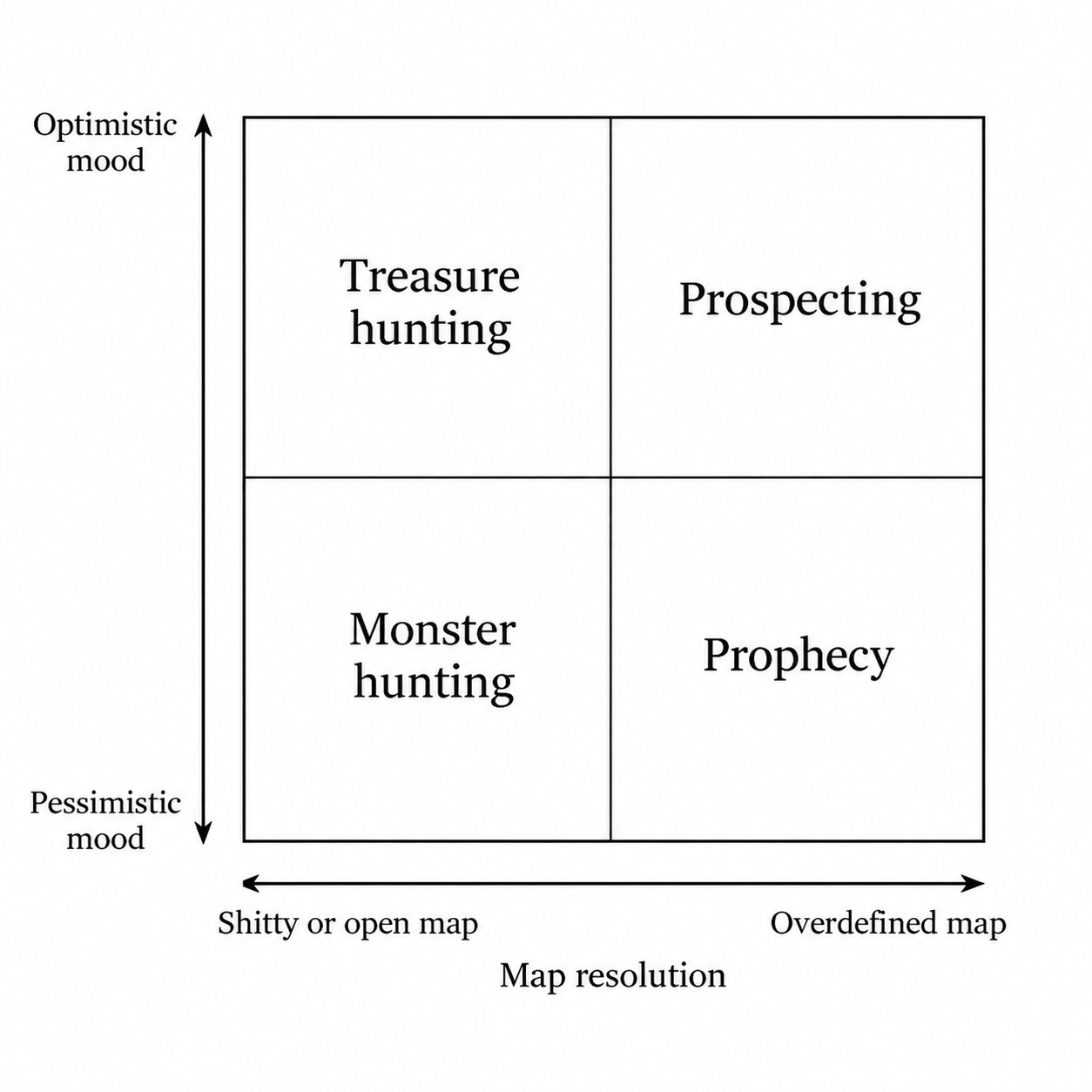
Prospecting differs from treasure hunting because the object of the search is already defined. We know what oil is, what geological formations tend to contain it and what instruments will detect it. There is still uncertainty, but primarily about location and quantity rather than ontology. The search is structured around finding more instances of something whose value and category are already understood.
The bottom-right quadrant is stranger. Here the mood is pessimistic, but the map is highly resolved. Something terrible is coming, and the person holding the map claims to know not only that it exists but what it will look like, how it will arrive and which events should be interpreted as evidence of its approach. The territory may still be unknown to everyone else, but from the perspective of the prophet the important uncertainty has already been resolved.
Mormonism can be read as a movement from something close to Perry’s treasure-hunting environment toward this prophetic one. Early nineteenth-century treasure culture contains bad maps, buried riches, dreams, stones and rumors. Smith’s later religious world becomes much more tightly specified. There is a particular treasure in a particular hill, deposited by ancient people for a historical purpose. An angel explains why it was preserved. Special instruments explain how to translate it. Ancient writers explain why they created multiple records.
The map eventually includes much more than the location of treasure. It contains a sacred history of the Americas, a theory of apostasy and restoration, rules governing revelation, a geography of Zion and instructions for building a community. The world remains strange, but it is no longer poorly mapped. Its strangeness arrives well documented.
This suggests a distinction between two kinds of ignorance. In one, nobody really knows what is out there. In the other, most people do not know what is out there, but somebody claims that they do. The latter condition naturally produces special people, because possessing the map becomes a source of authority.
This becomes especially important during an interregnum, or a Gramsci gap. Institutions are, among other things, places where societies store maps. Universities organize knowledge, newspapers establish common knowledge of events, governments maintain territorial and administrative categories, churches explain cosmology and morality, and professional disciplines provide clear paths of progress. None of these maps are complete, but when the institutions are functioning they provide enough shared orientation that most people do not need to construct a theory of the entire world for themselves.
During an interregnum, those maps become less convincing at precisely the moment when the demand for orientation increases. Old categories explain less, new institutions have not stabilized and people are forced to make decisions in an environment whose rules are changing. This produces treasure hunters and monster hunters: people willing to move through uncertain territory with incomplete maps. It also creates a powerful demand for people who claim that the map is actually complete, you just don’t know how to read it.
A lot of contemporary AGI discourse has this structure. Early AI research looks like genuine treasure hunting. Researchers build systems without knowing exactly what intelligence is, increase scale, try strange architectures and encounter capabilities they did not predict. The territory repeatedly revises the map. But some contemporary AGI scenarios are much more highly resolved. They describe sequences running from scaling to AGI, automated AI research, recursive improvement, superintelligence, geopolitical competition, loss of control or radical abundance. The future is divided into named stages populated by entities that do not yet exist.
The interesting point is not that these scenarios must be wrong. Experts sometimes possess better maps than everyone else, and detailed theories can correctly identify phenomena before they become visible. What matters is the relationship between the resolution of the map and the uncertainty of the territory. A future that has not happened can nevertheless acquire a surprisingly complete vocabulary: AGI, takeoff, scheming, instrumental convergence, alignment failure, recursive self-improvement, superintelligence, value lock-in. Events that have not occurred already have categories waiting for them.
This begins to resemble pre-commodification with the arrow of temporality flowing from the future to the present. The future arrives conceptually packaged before it arrives historically. Instead of strange events forcing new categories into existence, the categories are prepared in advance and the events are watched for as instances of them.
This is also what gives some AGI discourse a theological quality even when its participants are aggressively secular. The theological quality is not simply belief in a superhuman intelligence. It comes from the combination of an inaccessible domain, an overdefined map of that domain and a relatively small group of people who claim privileged ability to interpret the map. The map then reorganizes behavior in the present. If the scenario is correct, actions that appear excessive from outside it become ordinary forms of prudence. Large expenditures on compute, careers devoted to alignment, attempts to reorganize government policy around systems that do not yet exist, or arguments about civilizational extinction all become reasonable once the future described by the map is treated as real.
Mormon revelation has the same structural feature. If the plates do not exist, walking into the woods to meet an angel looks bizarre. If the plates exist and contain the true history of the world, ignoring them would be bizarre. The map determines which behaviors count as strange.
This is where special people and strange rules begin to reinforce one another. In an uncertain environment, the person who claims access to an overdefined map can justify unusual rules by appealing to information that other people cannot yet verify. The claim is no longer merely that there might be a monster somewhere in the forest. It is that the monster has already been theoretically described, its tracks have been identified and the institutions responsible for the forest do not yet understand what they are looking at.
There are many contemporary forms of this kind of scenario theology: technological singularity, demographic collapse, geopolitical catastrophe, climate catastrophe, the end of work, abundance. They differ enormously in evidence and plausibility, so putting them in the same structural category does not mean treating them as equally credible. What they share is the use of a highly specified representation of an inaccessible future to orient action in the present.
This is especially attractive when older institutions lose their ability to supply convincing maps. Modern societies were supposed to replace prophets with institutions that generated knowledge collectively and impersonally. During an interregnum, however, the individual interpreter returns. The new prophet does not need to say that God spoke to him. He can say that he has seen the model, understands the exponential, has access to capabilities unavailable to the public or has thought through a scenario more carefully than anyone else. The prophet becomes the person with privileged access to the map.
This also clarifies what is valuable about a shitty map. Its virtue is not that ignorance is intrinsically good or that expertise should be distrusted. A shitty map preserves the ability of the territory to surprise the person moving through it. It gets you far enough to search without specifying in advance everything you are capable of finding.
Pre-commodification poses a similar problem. The issue is not that the ideas LLMs produce are bad. It is that the interval in which an idea is alive but unsettled can shrink. Many people independently arrive at similar concepts and find them already legible, packaged and ready for circulation before a shared social process has made them common knowledge. The idea seems to have skipped the period in which nobody quite knows what it is.
Mormonism offers a much older and stranger version of this structure. The archive has already been written, the backup has already been prepared and the stones provide access to information whose relevance may only become apparent centuries later. The crucial difference is that the archive is not available to everyone. Its authority depends on a special person capable of reading it.
That combination—an uncertain world, an overdefined map and a privileged interpreter—may be one of the characteristic arrangements of an interregnum. When old maps stop working, people will naturally search for new ones. In search of the perfectly optimized map, people create new monsters.