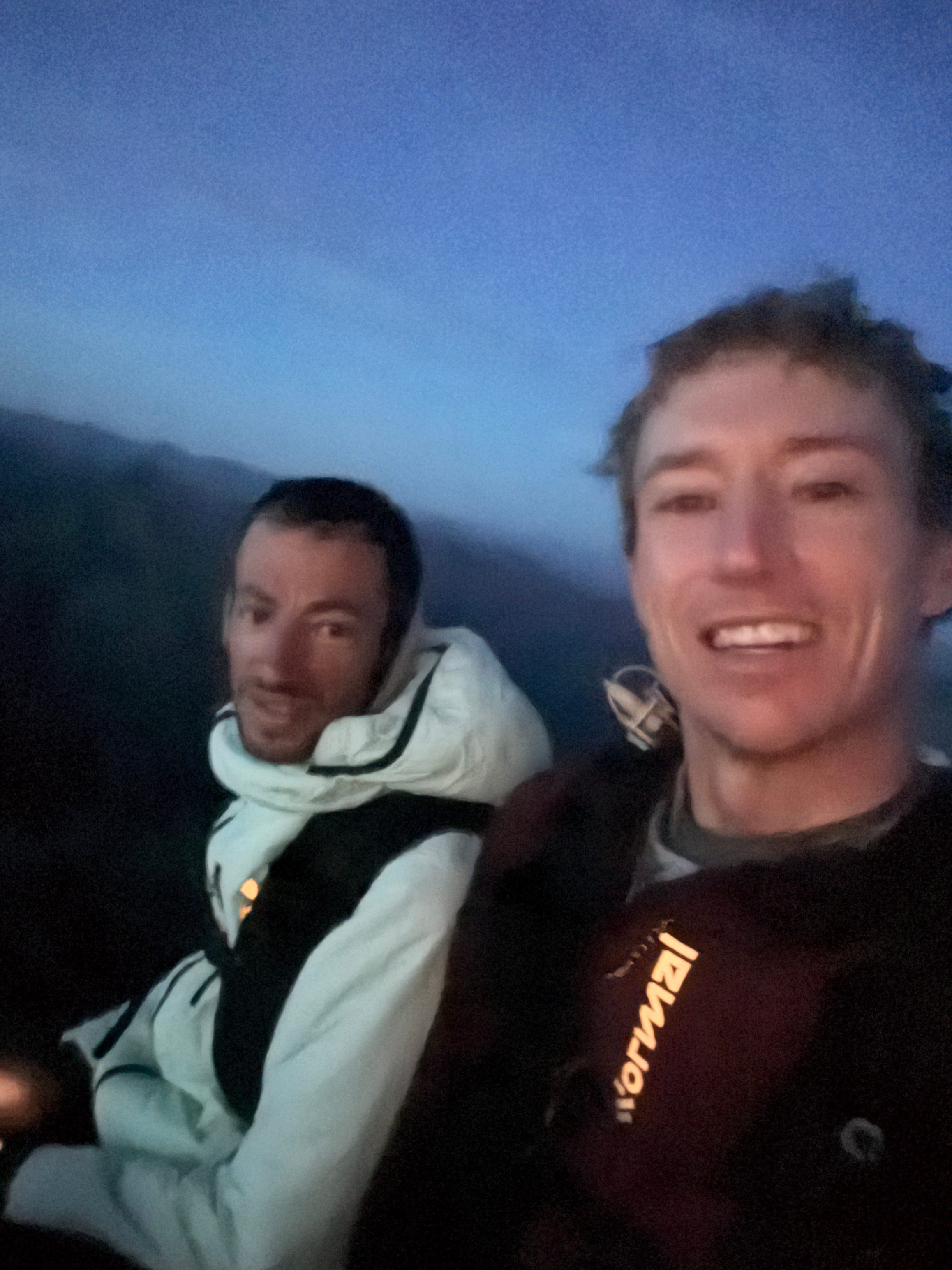
Last Wednesday evening I met Kilian Jornet at a trailhead near Telluride, Colorado. He’s doing a project to climb all the 14,000-foot peaks in the lower 48 states and connect them by bike, which is a characteristically massive undertaking that he is - also characteristically - dispatching with apparent ease. On 3-5 hours of sleep per night, he is spending 18 hours per day moving forward over mountain and valley. It is difficult to comprehend and harder to describe without overusing superlatives (the most incredible, hardest, biggest, toughest, strongest, etc). The first of the things I’m scared of is using too many superlatives. They dilute the power of words. So let’s just say Kilian is doing a thing that is very difficult indeed.
Last Wednesday, after being on his feet all day the previous day, climbing five peaks, and riding his bike a lot, he left Ouray, Colorado on his bike and rode up to the base of Mt. Sneffels. I joined him for that peak, having driven to the trailhead with photographer Nick Danielson. We did the loop and then Kilian followed the Hardrock 100 course over a nearby ridge and descended to Telluride. There his crew met him with food and bike, and he rode on up to where I met him at the base of the Wilson group. That’s where I started this story one paragraph ago. I’m scared of my readers losing the chronology of this story, so here’s where we’re at so far:
Wed morning: Kilian bikes to Sneffels, runs peak with me and Nick and another friend
Wed mid-day: Kilian jogs over to Telluride, bikes west to Wilson group
Wed late afternoon: Kilian and I start up toward the Wilsons
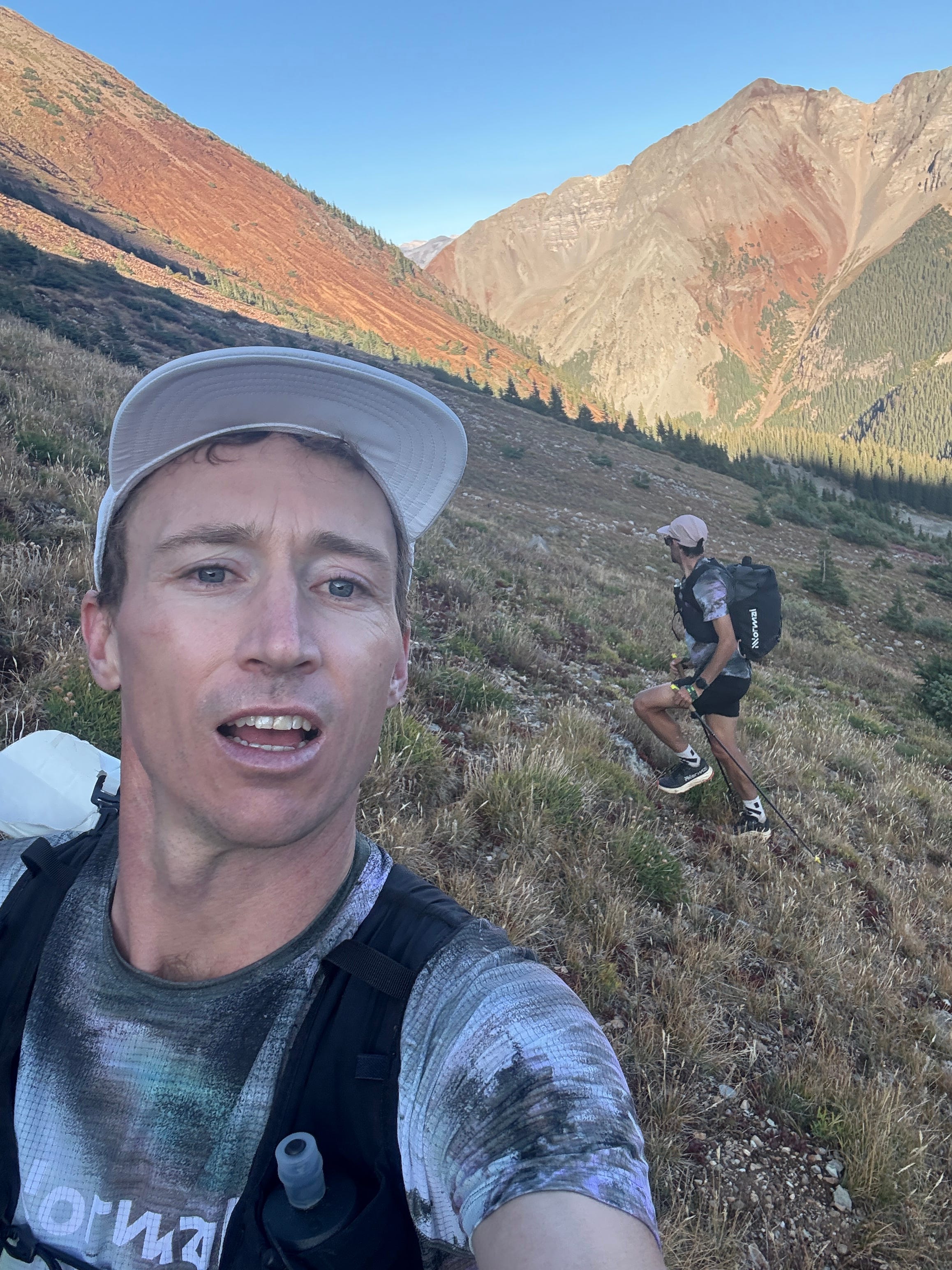
I grew up in the region and I know the San Juans well. Kilian’s crew was thrilled I’d be joining because they knew I was an expert on southwest Colorado’s mountains. In fact, I had never climbed any of the peaks before, so I had no more knowledge of the routes than he did. As we headed up Wilson peak in the final golden hours of sunset, I tried to scope out the route we would follow over Mt. Wilson and across the ridge to El Diente. That ridge is famously high and technical, and after some recent storms there was snow on the north-facing slopes.
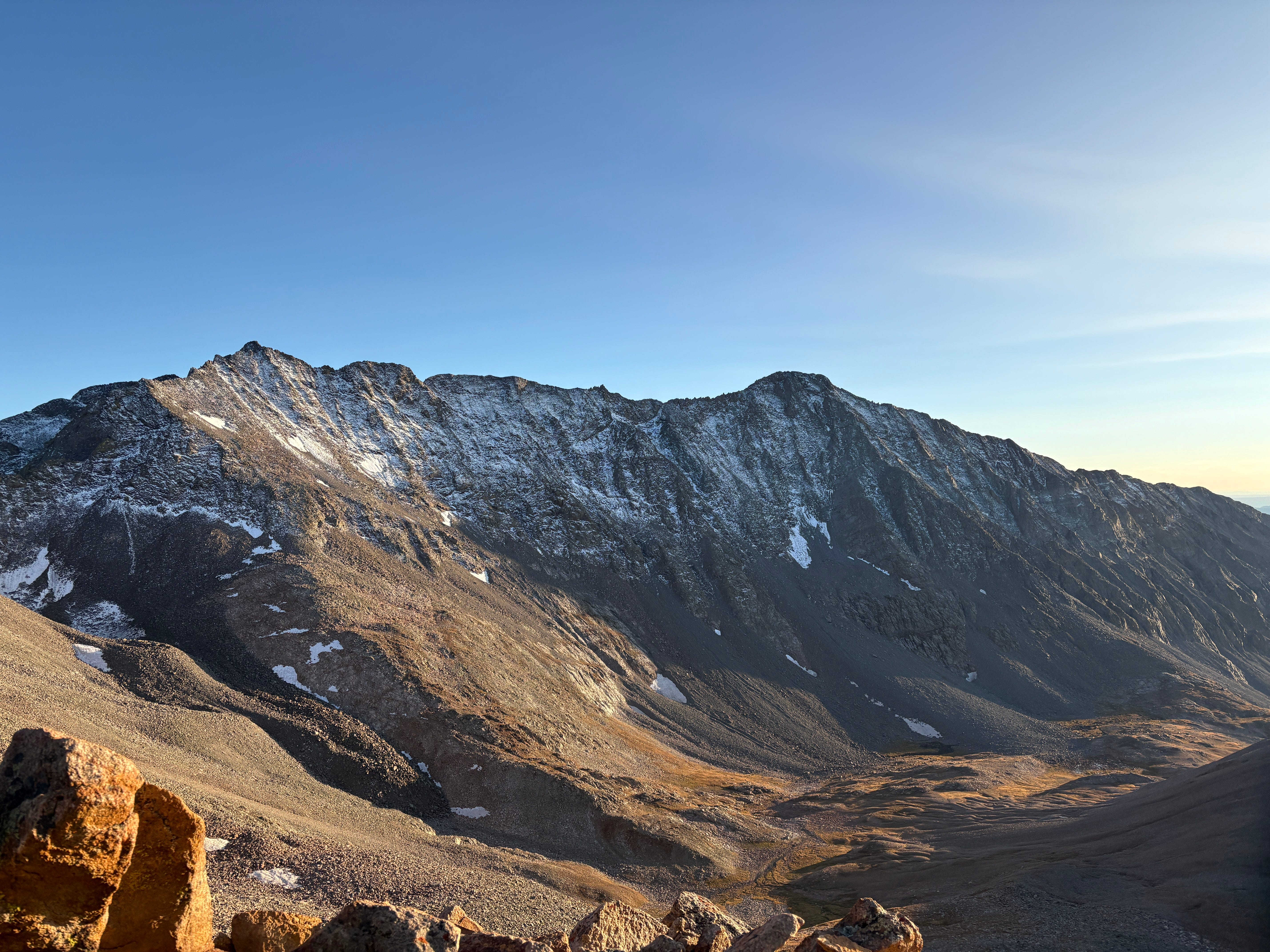
Late evening in the mountains is a melancholy time for me. It always makes me lonely. With the prospect of a scary mountain climb in the dark ahead I felt the solitude and sadness more than usual. Nick had joined us for the first part of the climb, but then he turned back to drive to the other side of the mountains. Kilian, after weeks of persistent huge effort, marched onward in his own silence. I looked across the land west to where the sun was setting over the LaSal mountains. My dad used to call the LaSals the center of the universe. The light and the memories gave the evening a kind of cosmic depth that’s easy to fall into but hard to climb out of. When this happens, I understand perfectly that I am nothing and nothing matters, and this scares me very badly. Something needs to matter for me to be able to keep going.
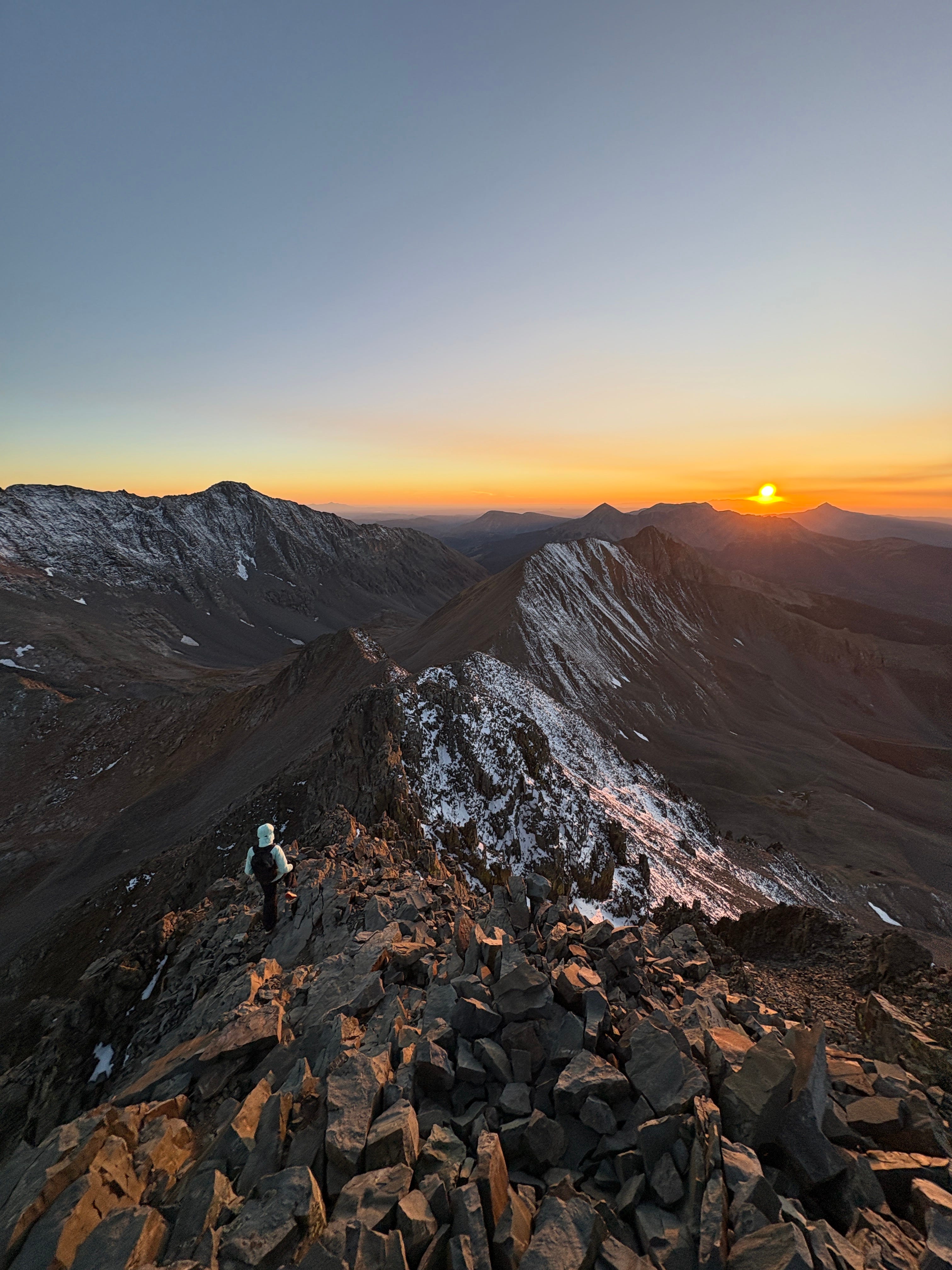
By the time we reached the top of the next ridge, it was full dark and we existed within two overlapping orbs of light. The route to the top of Mt. Wilson follows a narrow rock ridge. In the dark the empty space on both sides took on an abyssal quality. There was rock, and then there was nothing. I found that I was quite scared of the nothing, so I focused extremely hard on the rock within my grasp. Ahead of me Kilian scrambled with cool precision. I wanted to keep up but I was not willing to take unacceptable risks.
The thing with “unacceptable risks”, though, is that they are relative. My skill and comfort level present me with limits that are different from Kilian’s. I’ll try to avoid superlatives again here, so let’s just say that Kilian has climbed more mountains than I have, and they were often very technical, and he has developed considerable skill and comfort in places that other people might describe as unutterably horrifying. It’s frankly not a great idea to rely on his judgement if you want to have a safe and fun time in the mountains.
This has always been true. When I started running ultras, Kilian was already the best, and I was ambitious enough to try to imitate him. But doing so, both in training and racing, nearly always resulted in injury, exhaustion, or some other combination of symptoms that can be summed up with the word “explosion.” For a long time I was scared I would never be as good as him. But then I started to become kind of scared that I might hurt myself if I tried. Mostly that meant overtraining injuries, but last week it meant a little more. Trying to keep up with him on this traverse in Colorado might result in a serious fall.
These fears came to the fore as we descended Mt. Wilson. Our goal was to get onto the ridge that connects that peak with El Diente, but to do so you have to briefly get off the ridge proper to avoid some pinnacles. In the dark we descended the north face of the ridge. We picked our way down an extremely steep slope composed of loose rocks apparently jammed into dirt. The ground was frozen and the flat tops of the rocks held patches of snow. The uncertainty of the footing put me on edge. If I slipped, would anything that I grabbed actually arrest my fall?
The beams of our headlights shined across the face. “Look there,” Kilian said. “We can go across these ledges about 50 meters and then climb back up to the ridge. You see?”
I kind of grunted back at him, because in truth I did not see. All I saw was a sketchy conglomeration of angled snow-covered rocks extending from darkness to darkness, and hovering above a deeper darkness. In my mind I saw myself as from above, perched on this unstable slope high above the land my dad taught me to love. As Kilian started to move out onto the face, the blood pounding in my chest became a kind of warning for me. I was not comfortable here. I was not safe. But…it was Kilian Jornet. My idol. My boss, in a way (I run for his company.) He stepped through the snow and with him I knew was the person I had always dreamed of being. The alpinist. The runner. The true mountain athlete.
Years ago, when I lived in Bozeman, Montana, I had many opportunities to go ice climbing. I used to ice climb quite a bit and Bozeman has probably the best access for the sport in the lower 48. When I lived there I was invited many times to go ice climbing and I found myself making excuses more often than not. Eventually, I had to ask myself, do I actually like to ice climb? And the answer was simple: not really. I had always done the sport because it developed skills for the big mountains, which was what I pictured myself moving towards. When I realized I didn’t want to ice climb anymore, the real implication was that I no longer wanted to be a cutting-edge alpinist in the world’s biggest mountains. The dream of achieving that status had always existed as part of my identity. When I stopped ice climbing, I also had to let go of that part of myself. It was freeing. But it was painful.
A similar conflict played out in seconds during Kilian’s first steps across the face of Mt. Wilson. Kilian represents all the superlatives of our sport: he truly is the strongest, the fastest, the toughest, the greatest athlete ever to do it. Of course, trail running and mountain climbing are activities that have been undertaken by humans since before we were anatomically ourselves, and surely there were equally great phenoms in the distant unrecorded past. But to the extent that we have created a sport called “mountain running” or made mountain climbing competitive, Kilian is among the best ever. I have worked very hard for fifteen years to be an athlete, and much of that has been a process of following the greats, especially Kilian. If I couldn’t be ahead of him, maybe at least I could be with him while he accomplished his feats.
I stepped forward. The snow crunched under my feet. My hands were shaking as I reached for a handhold. And then it hit me like a missed step in the dark: this is not who I am. Not any longer. I am never going to be Kilian. I am myself and my limits are different. My goals are different. I am not less than him because I don’t want to do this scary traverse, I am just not as good or as brave as him at this specific moment. He has spent many years developing comfort in such situations, while I have spent many years developing comfort in other situations, in other fields that are just as valuable as climbing mountains. I can be worth it even if I am not the best.
The universe kind of receded from me then. It’s center became real while the cosmic depth retreated, leaving behind the land and the sky. I felt like someone. Everything mattered.
“Kilian,” I called out to him. My voice was clear in the windless night. “I’m really sorry, but I’m not comfortable with this.”
He paused. “No? You don’t feel safe?”
“No, I don’t,” I said. “I’m sorry. You can keep going forward, but I’m going to descend the mountain on the other side and then climb back up to the peak the long way.”
I envisioned him moving off across the ledges and myself descending the chossy trail on the far side of the mountain. I envisioned his disappointment in me. I envisioned nearly everything except what happened. “Ok!” he called back. “Then we go down the other side. No problem.”
“What?” I said. “You don’t have to do that. I just…”
“No,” he said. “If you’re not comfortable with this, then we turn back. There’s no problem. We will come up the peak from the other side. We do this together.”
I hemmed and hawed a little more, but he was adamant in this generosity. As we climbed back up toward the peak of Mt. Wilson, I realized that his experiences in the mountains had not simply taught him the skills necessary for moving through technical terrain. They had also taught him the value of a team, and how to take care of the people he goes into the mountains with. I needed to back off from that traverse, and he never hesitated to acquiesce. His silent confidence in the mountains can be easy to mistake for disinterest in the people around him. But his awareness and willingness to do what is needed for others proves that he cares deeply.
I felt a tremendous sense of relief as we climbed back up to the ridge. I knew we’d now have several thousand more feet of hiking uphill in order to climb El Diente, but at least it wouldn’t be so dangerous. As we passed over the ridge and started down a gully on the other side, we both noticed a ledge that jutted west. We paused. “Does that..?” I started to ask.
“Do you think we..?” he trailed off.
We left the trail and walked out on the ledge. We looked around the corner. Our headlamps illuminated a narrow rock ridge cut by ledges and cracks. It extended into the near distance and offered no serious obstacles. We looked at each other and went a little further. It still looked okay. Was it possible that by trying to bail we had found the correct route onto the ridge?
“Are you comfortable with this?” he asked me.
I looked out. The rock was solid. There was little snow. It looked a little scary, but it looked even more exciting. It looked interesting. It looked fun.
“Yeah,” I said. “I’m comfortable. Let’s do it.”
We moved onto the ridge proper. With blackness on both sides and a narrow ribbon of rock reaching ahead, I made one move after another, testing the rock and testing myself at the same time. I found myself capable. I remembered that I too have skills in the mountains. Giving up one dream doesn’t have to mean giving up them all.
In fact, letting go of one version of myself made another version that much more possible. And if I hadn’t been confident enough to admit my fear, I would never have found it.