When I decided to start this blog, my first instinct wasn’t to write. It was to shop. I went straight to Apple’s website (with ChatGPT as my sidekick) to figure out which MacBook would be the perfect tool. What should’ve been a quick choice turned into a rabbit hole of specs, reviews, and second-guessing — and it taught me a surprising amount about how we make decisions.
That’s what this post is really about: not laptops, but the process of choosing well. Over time, I’ve found three rules that almost every “decision expert” agrees on:
Rule #1: Avoid Decision Fatigue
Rule #2: Make Effective Decisions
Rule #3: Back It Up With Data
Before we dive in, pause for a moment:
Have you been stuck on a decision lately? Maybe researching something endlessly but unable to buy?
Harvard Business School Professor Theodore Levitt makes an observation on people buying quarter-inch drilling machines:
People don't want a quarter inch drill. They want a quarter-inch hole!
Levitt's example implies that the goal is really a hole, not the drill. But people spend so many decision cycles in focussing on the wrong goals.
Don Norman in his book The Design of Everyday Things takes the analysis deeper.
But why would anyone want a quarter-inch hole?
Implying that maybe all they wanted is to place a few books somewhere. So, they started with building a bookshelf. That led them to need of drilling holes. He suggests on asking questions: How many books are there to keep? Are they better off buying a kindle?
Clarifying the real goal can sometimes reduce the number of decisions one has to make.
Consider how Steve Jobs approached the importance of saying no. When Jobs returned to Apple in 1997, he killed over 70% of Apple’s product line. Why? Because too many options overwhelmed focus—for both users and teams.
“I’m as proud of the things we haven’t done as I am of the things we have done.”
- Steve Jobs
He famously wore the same clothes for all his launches and didn't own any furniture. Nothing fit his taste and he wanted to solve more important problems in the world.

Testing this Rule #1 on myself: I realized I didn’t really need to buy a MacBook right away. To write a blog? My phone was enough. Postponing the purchase gave me more time to focus on the writing instead of obsessing over the setup.
If you don't need it, don't buy it. Focus on what really matters.
The second rule focusses on time spent on making a decision. Being effective doesn't mean taking quick decisions. It means being intentional about the time spent.
If you are stuck on what clothes to buy and have been thinking about for days. Is that really worth your time? Just try them out and return them if you don't like them.
Try to fit your decision in the spectrum of irreversibility. The more it sits on the right, the more time can be justifiably spent on it.
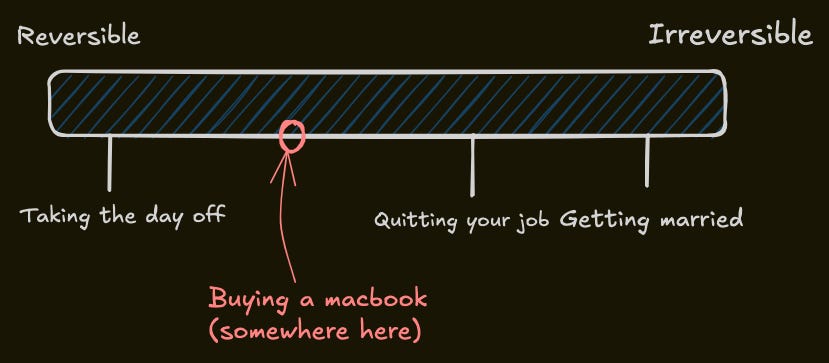
Testing rule #2 on myself: It's somewhat an irreversible decision. The cost of making the suboptimal choice here can cost me a lot of time and money.
A reversible decision is not worth spending time on.
An irreversible decision deserves time and careful thought.
A decision that has made this far isn’t an easy one. It’s probably a choice with long-term consequences — the kind that can leave you confused, frustrated, or even stuck. Now, imagine how corporate leaders or politicians handle these moments. They face high-stakes decisions every day. The difference? They have teams to gather and analyze all the relevant data. The final call is still theirs, but it’s backed by lots of data.
Of course, not every decision comes with neat data attached. Some things are simply immeasurable. In those cases, you aim for the best effort, not perfection. Data can tell you how long to boil rice — but sushi? For that, you don’t need data, you need Jiro.

Is there such a decision impending in your life? Some examples are: buying a car or a house, switching jobs, making a new investment, traveling abroad, etc
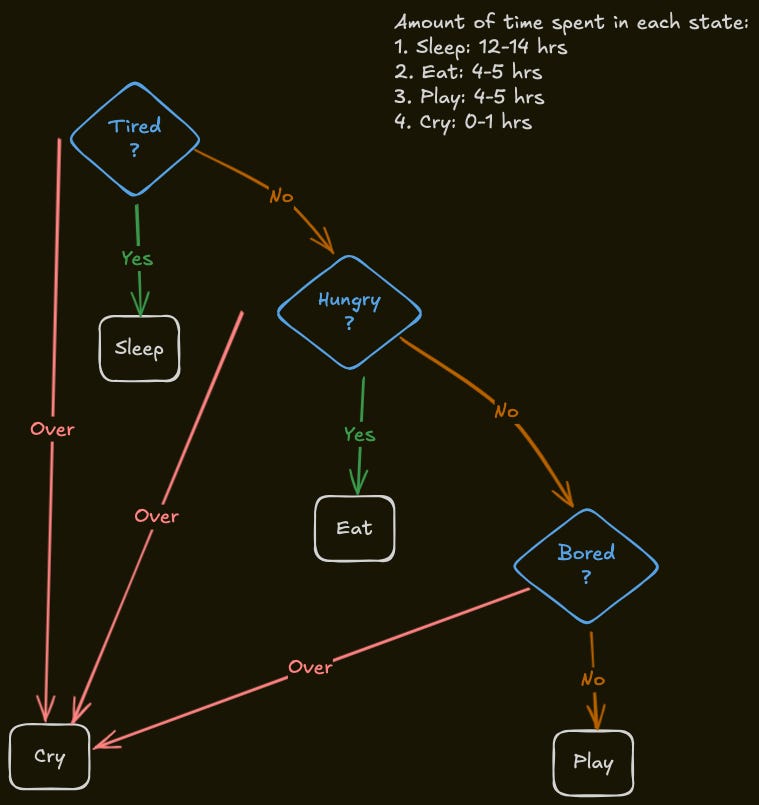
Decision trees are powerful tools, used heavily in machine learning to find patterns and make choices. In fact, when you combine many of them, you get the famous random forest.
Almost any pattern can be mapped to a big enough decision tree. To show you how intuitive this can be, let me borrow from my eighteen-month-old toddler’s world of emotions. Diamonds (non-leaf nodes) represent the in-between feelings, while squares (leaf nodes) represent the outcomes. Believe it or not, an entire toddler’s day can neatly fit into a decision tree.
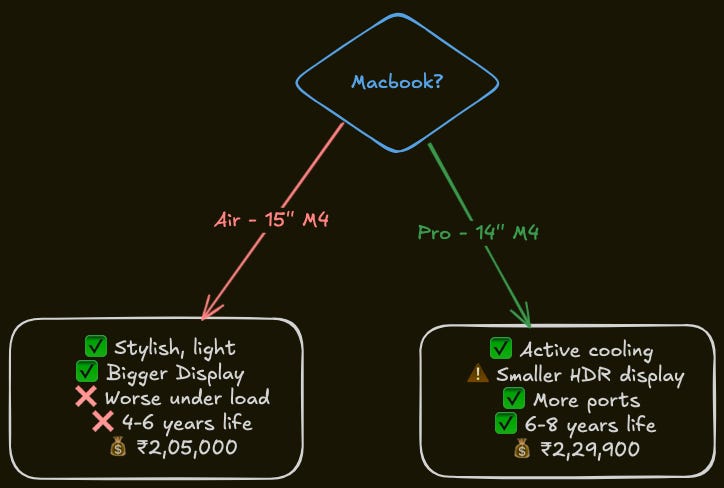
But life is more complicated. And coming back to my reality: I started mapping my macbook buying decision into a tree. And there came the first surprise: Even though macbook air starts very cheap, once I updated the RAM and SSD to a reasonable size, the prices were not all that different:
But hang on, I am upgrading my tech after a long time. I have so many other unbaked ideas that are not satisfied. I need an ipad pro as well. Do I really need a macbook then? I can buy a cheaper mac mini with the same spec as a macbook pro along with the ipad. How much will this cost though? How does it compare to the macbooks?
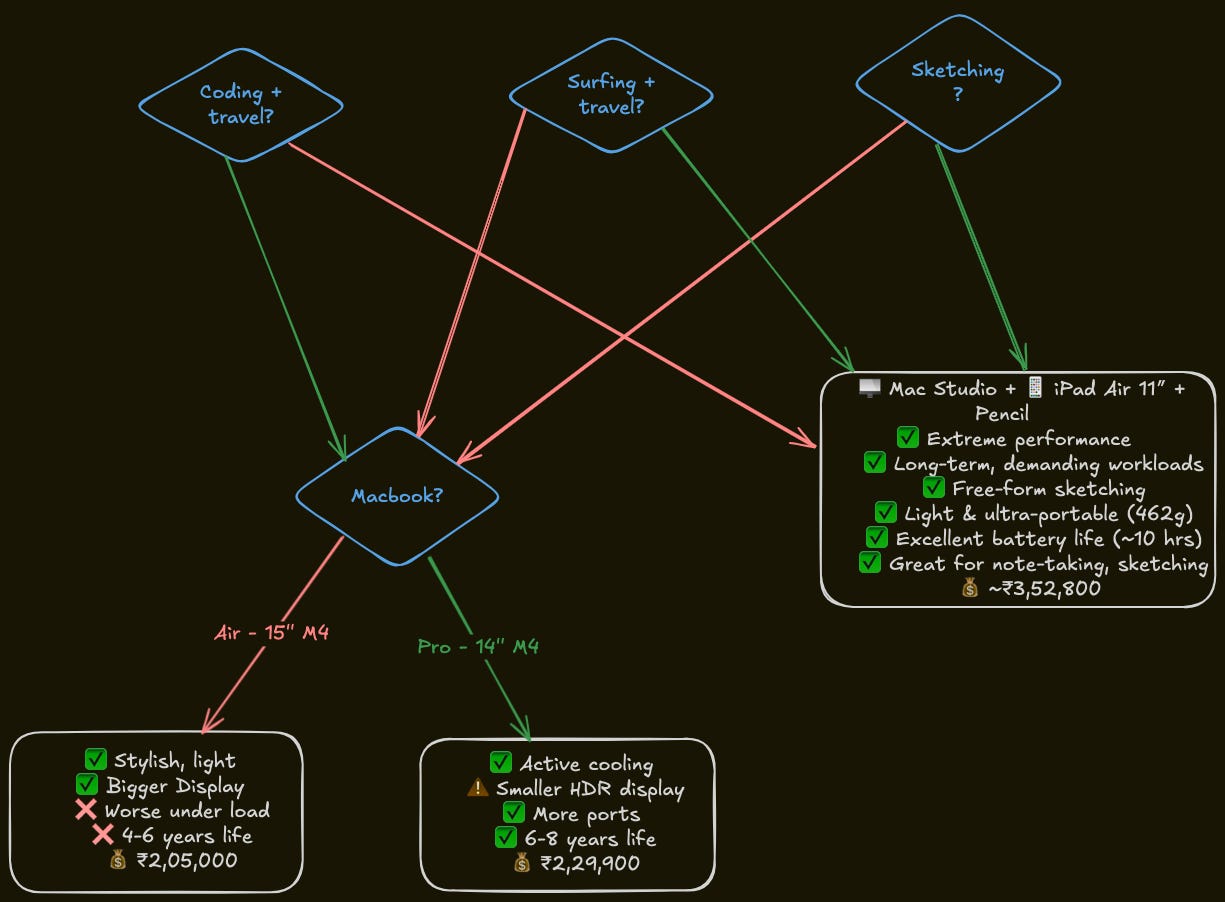
Soon, I was browsing reddit forums on how to build a custom hackintosh (Linux worksystem with mac software) - now, I am the guy buying that drill machine to build that bookshelf. This was for my use-case to support custom LLM model training on NVIDIA GPUs. My cost had ballooned to more than Rs 5,50,000. And I was still not happy with all the features that this configuration supported.
This is where I realized that this problem is getting out of hand. It left me frustrated, confused and annoyed. I found my data-scientist hat and wore it!
Before we go further, it's important to understand the primary dichotomy of data science. Some problems are straightforward — like the price of the Macbook I am looking to buy (until the next one arrives). These fall in the deterministic bucket. Others are unpredictable — like guessing the Apple Stock price tomorrow. These outcomes can only be predicted with some uncertainty. Hence they are termed as stochastic outcomes.
In this post, I will be focusing on deterministic outcomes. I will dive into the definition first and then how to apply this to any problem.
A general deterministic equation is as follows
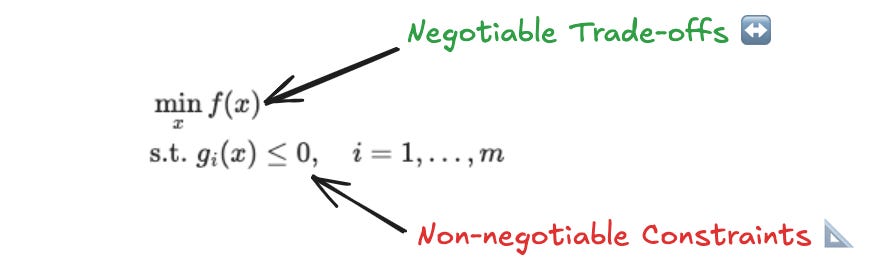
Whenever you are looking at a bounded problem (meaning limited outcomes), you can think about the negotiable (trade-offs) and non-negotiable (hard constraints) requirements. Start with the exercise of listing down these for your decision.
Mine are the following:
📐 Apple ecosystem
📐 Memory greater than 32GB
📐 SSD greater than 1TB
📐 Coding Compatibility
↔️ RAM
↔️ Price
↔️ Weight
Filter out the options that fall outside of the hard constraints. Use the trade-offs to build your decision tree:
Remove everything that falls outside of the hard constraints
Create a prioritized list of negotiable trade-offs:
Start from the most important one at the top
Keep branching off till you have exhausted all trade-offs and options
If the tree feels wrong, re-do the prioritization exercise
Print the final tree and store it in your safe
Since my decision tree had fairly large number of combinations (and I know how to code), I built a personal app to make this decision for me. But, if the options are fairly limited, which is true in most cases, you can do it by hand on a notebook (or on an ipad pro with Apple pencil pro).
The entire tree contains twenty-two options:
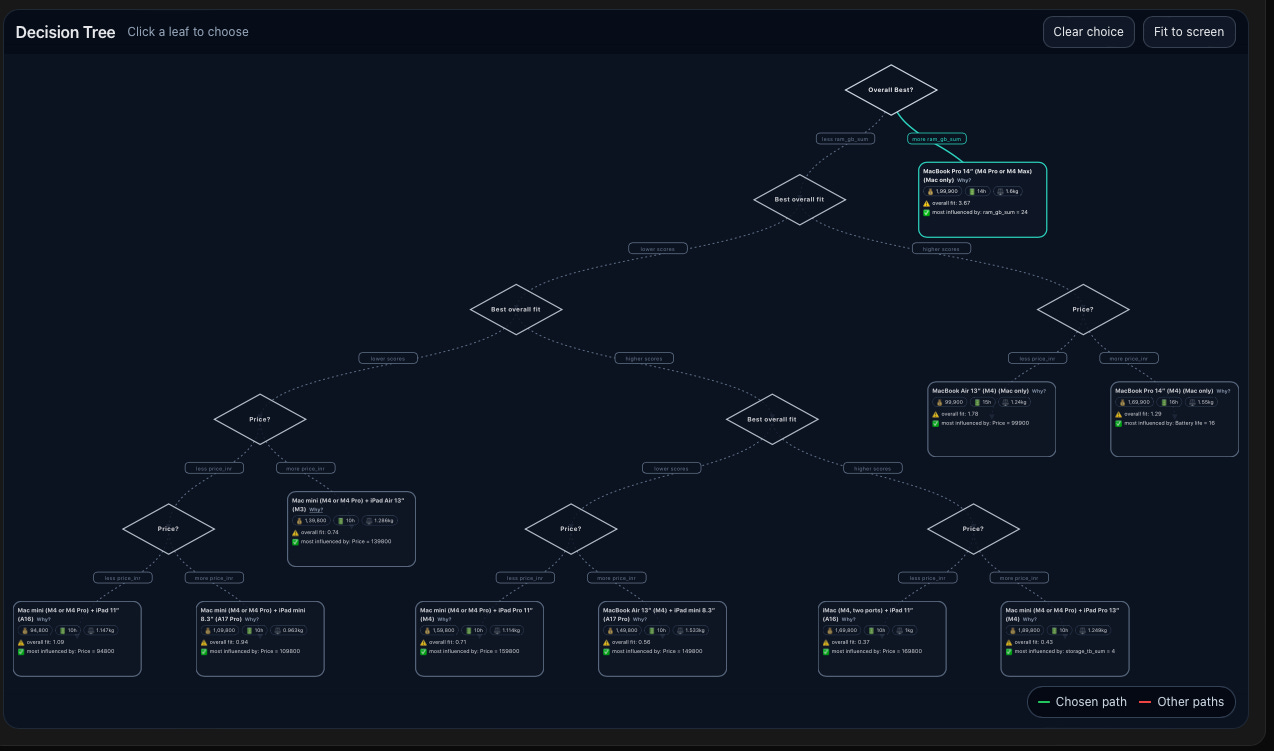
And the winner is (drumroll....): Macbook Pro 14'' Pro. Just where I started.
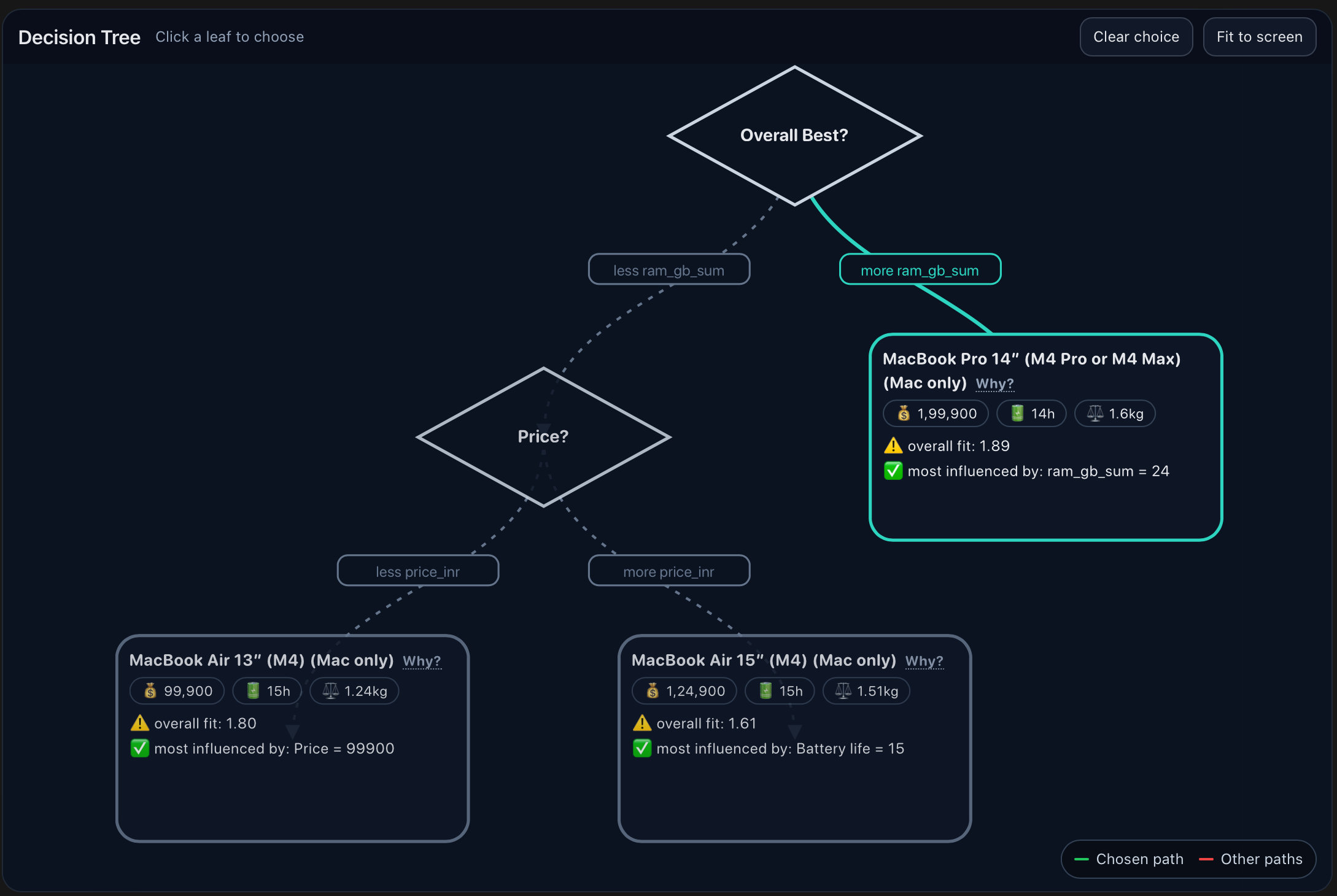
So here’s my takeaway after Rule #3: once you’ve put in the effort to make a structured, data-backed decision, you don’t need to beat yourself up over the outcome. If it goes wrong, you can trace it back, learn from the branch you chose, and move on wiser.
Outcomes don't really matter. It's the process of decision making that makes you grow.
What’s the last decision you spiraled into — comparing specs, reading reviews, chasing perfection? Did these three rules help you see it differently?