I like Sam Harris. I think he’s one of the most clear minded, rational, and well intentioned actors in our information landscape. I agree with him on most things. But in a recent subscriber Q&A on his podcast Making Sense, he was asked what advice he would give kids heading to college - as it seems to be a recurrent question for influential figures and thinkers of the day, a reflection of the anxiety AI has introduced in the parenting and educational landscape.
His answer was maybe too quick and clear-sided: “I’m very bullish on the humanities. Literally no one is saying ‘learn to code’ now, for good reason.” He went further: “If I was suddenly 18 again and going back to school, computer science would not be high on that list. Things have flipped there. I do think it’s going to be the revenge of the humanities.”
Sam’s instinct is not wrong. As a matter of fact, while my own secondary education was very much STEM-centered, I have long credited my earlier formative years for many of my analytical and creative skills (which entrepreneurship AND engineering require alike) for a strong backbone in literature, philosophy and the humanities. But Sam’s conclusion is built on a conflation that is worth pulling apart.
There are two things people mean when they say “computer science,” and they could not be more different. The first is the foundational discipline, which is - in fact - a science: algorithms, data flow, systems architecture, cause and effect, the logic of how complex systems interact and break and scale. Theorems and axioms. Formal proofs and verification methods. The second is the mechanical act of coding: writing syntax, managing packages, wiring up APIs, the implementation work that turns logic into running software. The engineering in Software Engineering. That’s more craft than science, and until now - it has been a foundational step required for real world production of working code.
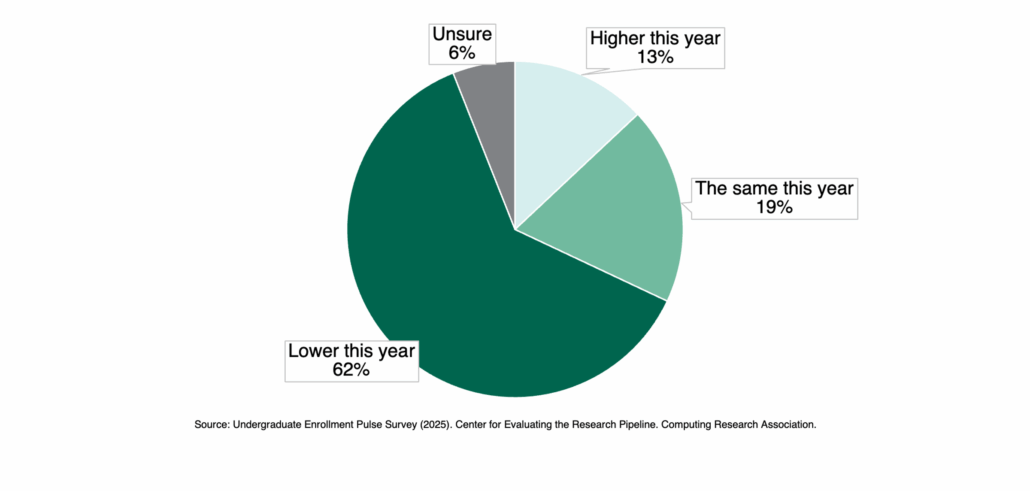
AI is absolutely devouring the latter. A Tufts University study projects that computer programmers face job losses exceeding 50 percent in the coming years. The Bureau of Labor Statistics confirms it: employment for computer programmers is projected to decline. CS enrollment has dropped for the first time since 2020, with 62 percent of computing programs reporting undergraduate declines last year. The unemployment rate for recent CS graduates now sits at 7 percent - tied, remarkably in my world perspective at least, with the performing arts.
The headlines have been predictably apocalyptic. “Goodbye, $165,000 Tech Jobs. Student Coders Seek Work at Chipotle,” declared The New York Times. And for a certain class of graduate - someone who learned Python syntax and React components without ever bothering to care too much about the why behind certain choices or system components - those headlines are probably accurate.
On the other hand, Computer science is not coding the same way creative writing is not spell-checking. One is the deep structure of thought and communication or story telling. The other is a mechanical task that has always been destined for automation. Telling a generation to abandon computer science because AI writes code is like telling them to stop studying foundational mathematics because calculators do arithmetic.
Ironically, though Harris, really agrees with me, as his words betray. In the same breath with which he dismisses computer science, he lists exactly what students should learn instead: “You should learn to think. You should learn to communicate. You should learn to write. You should learn to have good taste in ideas and in styles of thinking.” Add an understanding of data and systems and their interactions, and that is a near-perfect description of what foundational computer science actually teaches. Logic, rather than syntax. Systems, rather than packages and libraries. You might no longer need to know how to write a function call, but it will still be highly useful and adaptive to not long Software Engineering, but altogether value creation in a rapidly changing world, to know to how to reason about why complex systems behave the way they do, and how to steer them.

Yann LeCun@ylecun
Advice to students: study fundamental topics that have a long shelf life.

Moneycontrol @moneycontrolcom
@ylecun @chandrarsrikant @tsuvik #MCInterview | 🚨 "For a 20-year-old, the question is what specialty should I learn? You should study very basic things that have a long shelf life - mathematics, physics, basic computer science, applied mathematics. Those are things that would be necessary to understand and
3:52 PM · Oct 23, 2024 · 636K Views
98 Replies · 532 Reposts · 4K Likes
Yann LeCun put it well: “You should study very basic things that have a long shelf life - mathematics, physics, basic computer science, applied mathematics.” Zack Mabel at Georgetown’s Center on Education and the Workforce made the same point more directly: “You need to spend less time learning basic syntactic programming, but there are a lot of other skill sets that will be newly in demand.” The data supports them both. While programming jobs decline, data scientists and information security analysts are among the fastest-growing occupations in the country, both requiring deep CS foundations, not just the ability to push code.
I have a more eclectic background and set of interests than maybe most other software engineers by training. But over the years I have worked with, hired and built alongside other computer scientists for decades. The ones I have valued most were never the ones who could write the most amounts of code, in the most efficient way - although that was, at one time or another, highly valued by the market. They were the architects, the ones who could look at a system and see the dependencies, the failure modes, the places where complexity would compound. That is computer science. That is the science of logic and data, algorithms and systems. And it doesn’t look like it that will get less valuable when AI writes even all the code in the world. It gets more valuable, because now the bottleneck is not implementation, it is understanding, taste, ideation, and agent management.
The humanities argument is not wrong. I love the humanities, the arts and the I have written in these pages about oral exams returning to universities, about the liberal arts becoming the surprise winner of the AI age, about ambiguity tolerance and ethical reasoning as skills AI cannot replicate. About storytelling being the defining characteristic that gave humans the ability to super-power our intelligence. All of that is true. But the implication that technical education should disappear and yield to humanistic education misreads the moment, and the trend. We do not need fewer people who understand how systems work. But will need fewer coders per se.
Computer science is one of the sciences of logic. It is closer to philosophy than it is to pure code engineering. And in an age where AI handles the mechanical work, understanding the logic of systems - why they interact, how they fail, where the dependencies hide - is a superpower, not a relic.

Issam Laradji@ILaradji
COMPUTER SCIENCE IS NOT CODING COMPUTER SCIENCE IS NOT CODING COMPUTER SCIENCE IS NOT CODING

Anthony Bonato @Anthony_Bonato
"What happens if AI eliminates most coding jobs?"
11:44 PM · Jan 20, 2026 · 146 Views
1 Like
While we should probably stop telling students to “learn to code” (was it ever really a good idea, una tantum?) we should still tell them to “learn to think in systems.” Learn how to build, architect, ideate and see dependencies near and far. The former is quickly going the way of the Dodo. The latter is, as LeCun says, very BASIC - in the best sense of the word.