A lot of software engineers seem scared by the recent wave of LLM progress, especially around coding. Every new frontier model release accelerates that fear. But in the noise around “vibe coding” and agentic engineering, I think a few critical points are being overlooked - and one of them is the quiet cost of delegating not just the writing of code, but the ownership and understanding of the systems we build.
This article is about a new kind of debt that emerges when we lean too heavily on AI-generated code: what happens to software systems when human ownership and deep architectural understanding start to erode.
Let’s be clear: the landscape has fundamentally shifted. Coding today is not what it was three years ago. Tools like Claude Code and similar environments have moved well beyond autocomplete, they can build entire services, refactor across files, and translate specs into working syntax. For boilerplate, rapid prototyping, and well-defined tasks, AI is an undeniable force multiplier. It has lowered the barrier to entry for writing software more than any tool in the last two decades. More on this here:

The spawning of virtual developer teams through agentic frameworks like OpenClaw has changed the way we can create systems. But writing code was never the hardest part of software engineering. More about that here:

Every new model release comes with a fresh round of impressive numbers: SWE-bench Verified, Terminal-Bench, cyber evaluations, agentic task completion. The scores keep climbing, and the headlines keep amplifying.
But these numbers miss what actually matters in production.
Benchmarks measure short-horizon correctness in controlled environments. They test whether a model can solve isolated, well-defined problems within a limited context window. Production systems require something fundamentally different: long-horizon understanding of architecture, constraints, history, and trade-offs accumulated over years.
A model can generate correct code for a given task without understanding how that code fits into the broader system. It doesn’t maintain a persistent mental model. It doesn’t track architectural decisions over time. It doesn’t know why the team rejected a similar approach eighteen months ago. The result is locally correct solutions that quietly degrade the system as a whole.
The issue isn’t whether frontier models are powerful. They clearly are. The issue is what they optimize for, and how that differs from what real-world software systems actually require.
In the end these media narratives simply miss the point of modern software systems. To see where the “vibe coding” future leads, we don’t need to look at benchmarks and theory; we can look at human real-world organizational failures.
Consider a classic scenario: An experienced team designs a robust, well-architected core system. The company, trying to cut costs (move the seniors to other teams or even fire them), continues developing the product using only “cheap” (inexperienced or outsourced) engineers, assuming that because the “core works,” the rest is just adding features and maintenance.
Without architectural oversight, the system rapidly degrades. The engineers don’t fully grasp the underlying design patterns. They duct-tape new features onto the periphery, bypassing core abstractions. They optimize locally for their specific tickets, ignoring the global health of the application.
The main reasons the software becomes an unusable system are a lack of ownership and understanding. No one is responsible for the overall system anymore; they are only responsible for the newly added features.
I have seen this happen multiple times in practice. It is usually the result of short-term cost optimization, driven by misleading incentives and KPIs that prioritize immediate output over long-term system health. The consequences only become visible once the underlying ownership and understanding have already eroded.
Now with LLMs this is just amplified by orders of magnitude. LLMs can create code, but they completely lack persistent context. They cannot own a feature. They do not lose sleep when a production database locks up. They have no holistic understanding of the system’s history, the business domain constraints, or the subtle reasons why a specific architecture was chosen - they simply don't learn.
This brings us to the core issue. By over-relying on AI to write logic we do not deeply understand, we are no longer just accumulating Technical Debt; we are accumulating Cognitive Debt.
Cognitive Debt is the discrepancy between a system’s actual behavior and the maintainers’ mental model of that behavior.
Traditional technical debt is usually a conscious compromise: “We know this is a hack, but we need to ship by Friday. We will refactor it later.” The debt is known, and the path to repayment is understood. Cognitive debt, however, is far more insidious, for three distinct reasons:
With cognitive debt, no one actually knows how the system works anymore. Because the AI generated the implementation, the human developers only understand the surface-level inputs and outputs. When the system eventually breaks, the team is forced to treat their own codebase as a black box. Debugging a critical production issue in such a system becomes significantly harder.
Past technical debt looked ugly, massive files, nested loops, lack of comments, open TODOs and FIXMEs. It was easy to spot. AI-generated cognitive debt looks beautiful. The syntax is flawless, the variables are neatly named, and the functions are heavily commented. It is “Spaghetti Code wearing a Suit.” Because the code looks professional, it easily passes pull request reviews, masking the deep architectural rot and logical redundancies beneath the surface.
Software is read and maintained far more often than it is written. While AI drops the cost of writing code to near zero, cognitive debt makes the cost of maintaining it skyrocket. When a complex bug spans multiple AI-generated microservices, the lack of human ownership means there is no mental map of the system to rely on. The speed gained in the initial creation phase is violently paid back with interest during the maintenance phase
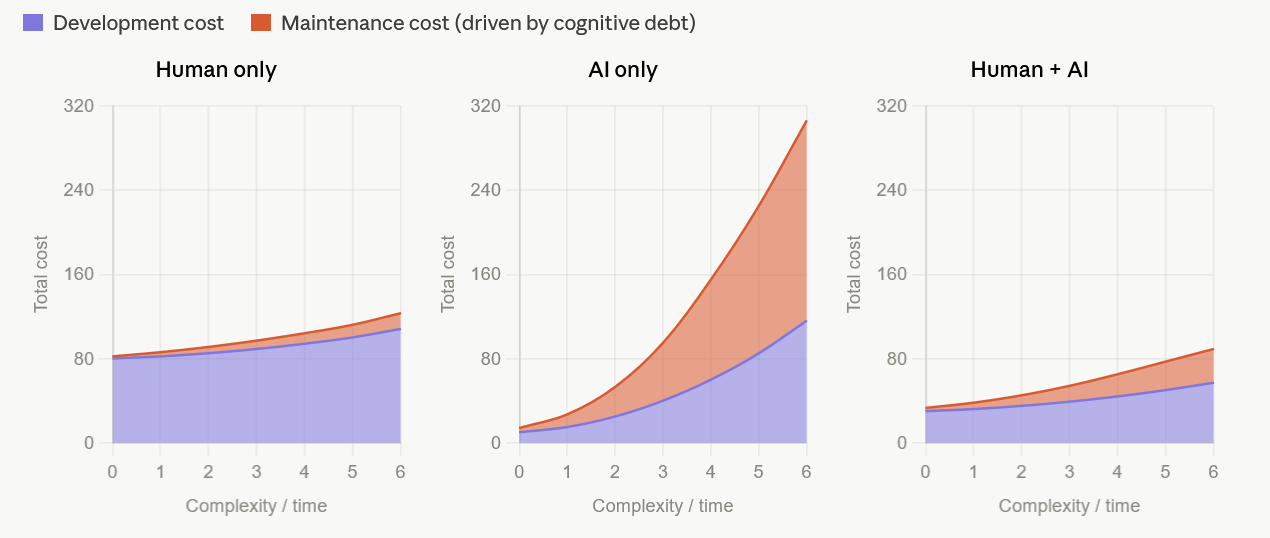
And this exposes a second-order problem: Junior engineers need guidance and need to make these experiences themselves. Seniority isn’t just a function of years: it’s built through code reviews, architectural debates, post-mortems, and the slow accumulation of scars from systems that broke.
If companies stop hiring juniors because “the AI can do it cheaper,” they are quietly breaking the pipeline that produces the senior engineers they still depend on. In five or ten years, when the current generation of seniors moves on, where do the replacements come from? Companies that skip this investment are digging their own grave, they’re optimizing for this quarter’s burn rate while eliminating their future architectural capacity.
I use AI-assisted coding every day especially in personal projects, but I sometimes realize that I am getting too lazy and just accept code that I did not fully understand. While this is fine for side projects that only I am using, it will become a problem if it’s a company asset.
We must stop confusing code generation with software engineering. Engineering is about managing complexity, making architectural trade-offs, and taking responsibility for the outcomes. Would you drive across a bridge that no one understands or takes responsibility for?
Avoiding cognitive debt requires discipline: never merge what you don’t understand, enforce ownership at the architectural level, treat AI as a junior contributor, and optimize for understanding—not output.