As the movement escalated, the Red Guards were no longer satisfied with ruining a person’s reputation through posters.
The real struggles began.
Targeting so-called “capitalist roaders in positions of power,” big-character posters, small posters, and leaflets flooded the city. From national leaders and military generals to local officials, police, judges, school administrators, and teachers—almost no one was safe. Their “crimes” were publicly displayed on the streets. Private lives, family relationships, and even unfounded rumors could be written up as evidence.
In Hanzhong, East Street, North Street, Chuanqian Street, Hanzhong Road, North Gate, and Dongmen Bridge became the densest sites of posters. New ones were pasted over those not yet dry. The entire city seemed plastered in paper and ink, the air permanently thick with the smell of moldy paste and fresh ink.
Soon, the names on the walls were dragged into real life.
Those who were singled out—men and women, young and old alike—were forced by rebel groups, often in public, to wear large wooden boards inscribed with their alleged crimes. On their heads they wore pointed hats made of newspaper, painted black. Some were made to carry black flags; others were forced to beat gongs. As they walked, they had to shout their own names aloud, followed by a list of crimes written for them in advance.
They were paraded through the streets on black ropes, or taken to squares, schoolyards, or auditoriums, where they stood with heads bowed before crowds of hundreds or thousands, enduring curses and abuse.
To amplify the spectacle and deepen the humiliation, members of the already-condemned “Five Black Categories” (a label applied to entire families deemed politically impure) were often dragged in to be struggled alongside them. Mockery, shouting, pushing, and beatings followed one another in endless rotation. Human dignity was stripped away bit by bit, in full public view.
Some people could not endure it. They jumped into wells or rivers, or ended their lives in other ways. More were slowly destroyed by prolonged humiliation and fear.
I saw it with my own eyes.
A female teacher surnamed Zeng at Hanzhong No. 3 Middle School, in her forties, was held down by her own students. Using a razor, they shaved off half her hair, leaving a grotesque “yin-yang head,” and then dragged her through the streets.
An elderly teacher surnamed Zheng, his hair completely white, wore a pointed hat made of newspaper with the words “Down with Zheng ××” written across it in brush and ink. The principal, Wu ××, was short in stature. Someone deliberately made an oversized wooden placard for him and fastened it around his neck with thin wire. The wire cut into his flesh, old wounds layered with new ones, blood seeping down his neck.
Scenes like this appeared again and again.
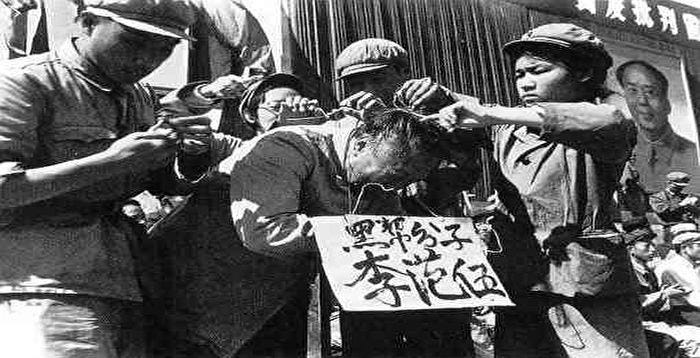
An archival photograph found online showing a public struggle session against individuals labeled as members of the “Five Black Categories” during the Cultural Revolution, 1966–1967.
They made me understand, for the first time, that this was no longer a “revolution” in any meaningful sense, but a form of persecution sanctioned by the collective. Standing in the crowd, I could only watch, powerless. That helplessness settled in my chest like a block of ice, and it took a very long time to melt.
At the time, none of us understood that this was still only a prelude, and that this violence was about to change its form.
By 1967, the movement had entered a new phase. Across the country, rebel factions began launching full-scale seizures of power. At the level of slogans, nearly everyone claimed the same ground: to be “the most loyal to Chairman Mao,” to be “the most thorough in carrying out the revolutionary line.” The slogans were written the same way, the chants sounded the same; listening to them again and again, at least to my ear, the difference seemed to lie only in how loudly they were shouted.
Yet this shared language did not produce unity.
In Hanzhong, the struggle quickly took on a clear geographic and social shape. North Street Intersection marked the center of the city. To its west lay the government offices, public security bureaus, courts, and other key institutions. Many cadres and their families lived in this area. The rebel faction dominant there tended to stress organization and restraint, repeatedly warning against disorder and loss of control. They called themselves the Lianxin faction, commonly referred to as the “Lian faction.”
The eastern part of the city was the old downtown, home to large numbers of ordinary residents. Hanzhong’s largest construction unit—Bureau Five, Company Four—was based there, employing many frontline workers. In these neighborhoods, the same slogans were heard differently. Revolution was understood as the complete smashing of old authority; the more thorough the destruction, the firmer one’s revolutionary stance appeared. This group became known as the Tong faction.
At the time, this divergence was not seen as a contradiction. Each side believed it was the one that had truly understood the words. Only later did it become clear that the difference lay not simply in interpretation, but in position—where people stood, and what stood behind them.
Both factions maintained close ties with rebel groups elsewhere in China and could call on outside support when needed. Well-known national organizations, such as the Erqi Commune in Henan and the Million Heroes in Wuhan, exerted wide influence, forming a vast and interconnected network.
As factional lines hardened, everyday life began to fracture. Neighbors who had lived side by side for years now quarreled bitterly over political positions, small grievances hardening into lasting hatred. Families were torn apart as well—husbands and wives divorced, fathers and sons severed ties. These were not isolated incidents, but common features of the time.
As tensions escalated, verbal attacks and poster campaigns gave way to physical confrontation. Retaliation and kidnapping became increasingly common, setting the stage for the armed clashes that followed.
Uncle Xie, who lived next door, was a factory worker in Hanzhong. In ordinary times he liked to show off a little. During the Cultural Revolution, he became a minor leader within the Lian faction. One day, after secretly slipping home to visit his elderly mother, he was discovered and reported to the Tong faction’s command.
One evening at dusk, more than twenty burly men suddenly flooded into the street, surrounding the Xie household from both front and back. Some rushed inside. They bound Uncle Xie’s hands behind his back, pulled his clothing up over his head, and covered his face. His mouth seemed to be blocked as well. He let out muffled cries for help. I was terrified.
The incident had happened so suddenly.
A classmate of mine, Xiang, had an older brother who was a core member of the Lian faction at Hanzhong No. 2 Middle School. After returning home, he too was discovered and reported. In broad daylight, Tong faction members surrounded his house, abducted him, and dragged him to their base, where he was brutally beaten. After his release, he fled the area altogether.
In the summer of 1967, two rival mass factions 1inside Hanzhong University began openly confronting each other. At first, the clashes consisted only of shouting, insults, and pushing. Very quickly, they escalated into organized group fights. Stones and wooden clubs were used as weapons. In just two confrontations, six people were killed and more than twenty were injured.
The situation spiraled out of control. Violence, once sporadic, became planned and coordinated. Both sides set objectives, assigned personnel, and eventually began using real firearms.
That year, a phrase circulated everywhere in the city: “wen gong wu wei.2” What it actually meant varied from person to person. What became clear, however, was that factional identity was no longer just a difference of position. It had turned into a line between life and death. People who had once lived on the same street quickly became those one had to guard against—or eliminate. Violence was no longer exceptional; it entered daily life.
At noon on August 28, 1967, the only newly built four-story brick-and-concrete building in Hanzhong was blown up. It stood near a small market outside the North Gate, at one of the busiest times of day. After the explosion, the street descended into chaos. Dozens of people were killed or wounded.
People said bodies had been blown apart, fragments scattered across the ground. Some victims were trapped beneath the rubble, calling for help, but were difficult to reach. Many people only glanced at the site from a distance and never went near it again.
After that, the atmosphere in the city changed.
Gunfire began to intrude into ordinary life. People grew acutely sensitive. At the slightest loud noise, or if someone suddenly shouted “Run,” the crowd would instantly lose control. Streets that were already overcrowded broke apart, spilling outward like an overturned pot of liquid. People shoved and fled, ducking into doorways, alleys, or anywhere that might offer cover. Vegetable stalls were trampled, baskets overturned, produce scattered. Shoes left behind were ignored.
Scenes like this happened almost every day. I gradually learned how to read the flow of a crowd, how to protect my body amid chaos. The ever-present question in my head was: If a shot is fired here, where should I run?
Dongmen Bridge was not the fiercest battleground, but it was a crucial passage controlled by the “Tong” faction. Stray bullets often passed overhead. When fighting intensified, shells were occasionally fired from opposing positions, destroying homes and injuring civilians. Over time, fewer people remained on the street. Families left quietly, locking their doors behind them, moving farther away or retreating to the countryside.
My aunt lived on Wangjia Alley off Dongguan Street, some distance from Dongmen Bridge. Shells rarely reached there, making it relatively safer. During the day, I sold chili powder from a street stall. At night, after closing, I tried to return home as early as possible.
On September 17, 1967, the two factions fought fiercely over control of the Lianhuachi Bathhouse on North Street, a strategic high point. The gun battle lasted from noon until nightfall. Several people were killed. A senior student I knew was wounded. Later, I heard he had been shot in the abdomen, his intestines spilling from the wound. He pressed a steel helmet against his injury and held his position until the opposing side withdrew. Only then was he carried away on a stretcher. Soon afterward, he was repeatedly praised and turned into a hero of factional propaganda.
On April 18, 1968, Gu Hantai—located at the center of East Street and one of the city’s highest points—once again became a target of contention. Intense fighting left five people dead. When the news spread, panic returned to the city, and more residents chose to flee. Both sides began constructing bunkers and defensive positions, erecting checkpoints and blocking roads. The city was cut into segments. Streets were closed, shops shut down. East Street, Zhongshan Street, and North Street became battle zones.
By then, few people were willing to stay. Gunfire could erupt at any moment, and the outskirts were no safer. Skirmishes occurred one after another. Routes in all directions were nearly severed. There were no functioning markets; to buy necessities, one had to travel to the outskirts. Daily supplies became increasingly difficult to obtain.
On May 8, 1968, houses in the North Street area began to be set on fire. Positions that could no longer be held were often burned before being abandoned. From outside the North Gate to North Street, entire blocks were consumed by flames. At night, standing upstairs in my home and looking west, I could see the sky glowing red. Explosions followed one another, and shockwaves rattled the buildings.
That night, I understood clearly for the first time: this place was no longer somewhere life could depend on.
May 31, 1968 was the Dragon Boat Festival3. It became a day I would never forget.
That afternoon, our family of seven—my grandfather, my mother, my second elder sister, my uncle, my aunt, and me—had just finished our meal when the gunfire outside suddenly intensified and drew closer. Then came a tremendous explosion. Not far away, the Santai Pavilion4 was completely destroyed. The Lian faction had advanced to Dongmen Bridge. Large numbers of armed fighters were now exchanging heavy fire with the Tong faction from a narrow alley just outside our wall.
The gunfire was relentless. The fighting lasted more than half an hour. As dusk fell, the shots gradually thinned. Through the wall, we heard voices in the alley, followed by hurried footsteps running past.
Then came a blast at close range.
Everything went black. The house collapsed with a deafening roar. Roof tiles and debris crashed down one after another. We could see nothing. We pressed ourselves beneath the bed, holding our breath. About five minutes later, the dust began to settle and a faint light returned. Only then did we crawl out.
The scene outside had been completely transformed.
Rubble covered the ground. The air was thick with dust. The two storefront rooms at the front of our house and our neighbor Granny Xie’s home had been completely destroyed. Walls that had once been solidly rammed earth were blown flat, forming a massive mound that blocked the public alley entirely. Roof beams lay slanted across the debris, with only a few pillars still standing, as if stunned by what had just happened. The shockwave had knocked down every wooden door along South Tuanjie Street. Inside our home, cabinets had toppled over, goods scattered everywhere. Broken tiles littered the street. My uncle’s family suffered the worst losses. None of their belongings could be retrieved; everything was buried beneath the rubble.
Yet at that moment, my strongest feeling was not grief over losing our home. It was something much simpler: all seven of us were still alive.
Word spread quickly that fighting had broken out near Dongmen Bridge and Santai Pavilion. People came to look. They expressed sympathy for our loss, and disbelief that an entire family could survive such destruction without injury. Many called it a miracle.
After the house was destroyed, we had nowhere left to live.
My mother took me to stay temporarily with my maternal uncle in the countryside. My father, along with my grandparents, crowded into my eldest aunt’s house. War scattered families. People stayed wherever they could; if a place would take you in, you stayed alive there.
After the house was destroyed, my mother often returned to the ruins to search for anything still usable. The area was not safe. Stray bullets could appear at any time, and gunfire might erupt without warning.
My father, however, never once dared to go back to the site. His fearfulness—his hesitation and retreat—filled me with contempt.
Later, during a period of temporary martial control,I witnessed one incident during a lockdown. At the entrance to Wangjia Alley, a man armed with a rifle was stopping pedestrians from crossing to the other side. A middle-aged man, perhaps in his thirties, approached. I did not hear what he said, nor whether he had even spoken at all. Suddenly, the armed man swung his rifle butt and struck him on the head.
Blood poured out immediately. The man screamed.
Without hesitation, the attacker slung the rifle behind his back, grabbed the injured man’s clothing, and pulled it up over his head, covering his face completely. He then bound him swiftly with a thin rope, tying him tightly, and dragged him away to an unknown place.
What shocked me most was not only the violence itself, but the identity of the attacker. Before the Cultural Revolution, he had worked at the Red Light Cinema near Dongmen Bridge, checking tickets at the entrance. I had seen him many times. I had never imagined that he could become like this.